
Howard Silverman
Hi Jean. As you know, I’ve been describing currencies as a missing discourse in cybernetics and systems circles. And I reached out to you because you’ve been involved in currency work and I’ve learned a lot from you over the years.
That’s my framing for this conversation. How about you? Any particular framings?
Jean M. Russell
Well, I’m following my curiosity. I want to learn about levers for change. And I’m always looking for points of convergence, where the work that I’m doing meets the work of others, as we try to cultivate a more thriving world. So if there are opportunities in this cybernetic space, that’s awesome.
HS
Let me begin by asking: How did you first start thinking about currencies?
JR
Back in 2003 or 2004, I was working with somebody doing transformational philanthropy, and I was also trying to understand what it means to do that. How might we change systems themselves? So rather than just feeding a homeless person for the day, how do we change the ways in which that person ends up becoming homeless? Somebody sent me to the online community Omidyar.net, which was doing some innovations in philanthropy. And I was fascinated by a lot of the social-impact metrics work that was emerging with certifications like fair trade and organic. And that’s where I bumped into people who were doing alternative currency work, first Arthur Brock (https://www.artbrock.com/) and then Eric Harris-Braun (https://eric.harris-braun.com/blog/), and through them others, like Michael Linton, whom you know. And I just kept weaving in and out of that space since then.
HS
So why the term currency? Why group together various forms of money, along with metrics, quotas, votes, and so on?
JR
Yeah, that’s an interesting question, and it takes me back again to my early conversations with Arthur and Eric. They had evolved a diagram that I believe Eric had gotten from Jean-Francois Noubel (https://noubel.com/about/). It showed types of wealth, with tradeable wealth as part of a spectrum with measurable, acknowledgeable, and other types of wealth (Figure 1). That diagram gave me a way of thinking and talking about money as the wrong “currency” for environmental and social outcomes. And when Arthur would talk about currencies as something that’s shaping the system and incentivizing behavior, that became, in my language, a lever, the kind of leverage I was looking for.

Figure 1
Arthur Brock’s version of the “spectrum of wealth” framework, reprinted with permission (https://www.artbrock.com/metacurrency).
HS
Let’s talk about definitions (Figure 2). Could you introduce the different ways that currency is defined and point out distinctions among them?
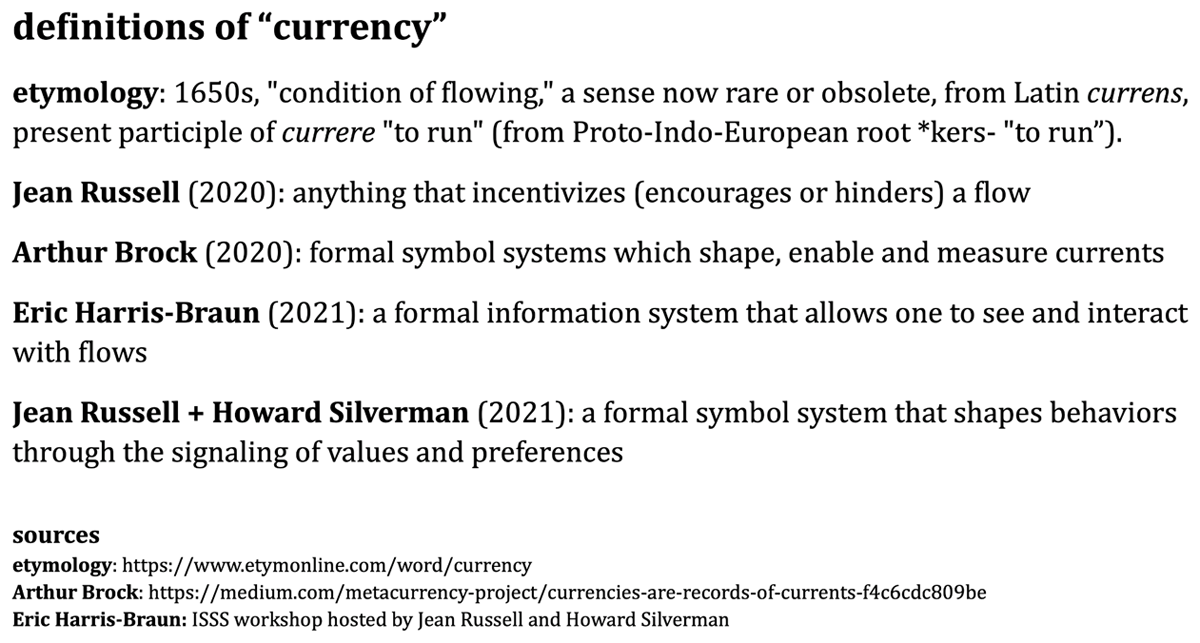
Figure 2
Definitions of currency.
JR
Sure. Etymologically, a current is a flow, like an electric current. The definition that I’ve been using, from early conversations with Arthur, emphasizes incentives, the way that a currency encourages or discourages a particular behavior or flow. Arthur has since added formal symbol systems to his definition. And Eric’s thinking is grounded in grammars, with currencies as grammars.
HS
That was a real light-bulb moment for me, when we talked last year about currencies encouraging or hindering flows. That’s when I started to play with the phrase “currencies as cybernetic objects” — using this phrase to describe circularities between the objects we shape and that shape us in turn. That’s true for the proverbial hammer, with which everything looks like a nail, and it’s true in very different ways for currencies, which drive self-organizing patterns of human behavior.
JR
Totally. Here’s something that I’ve been playing with more recently. Life is about choice and the ability to make a choice that’s better for the aliveness of the chooser. A currency encourages a particular choice over some other choice. That feels really abstract, right? And so it depends on how big of a definition you want. For what purpose? So I also think it was useful of Arthur to narrow the definition down to symbol systems. Because that’s something we can control. We design symbol systems, seeking to shape, enable, and measure flows or behaviors.
HS
And that narrows the definition to the human realm. Humans create symbol systems. Other species don’t, or not in ways that we humans recognize. On the other hand, when Eric uses the term “grammar,” he’s talking about human and non-human systems. That’s what I understand from his and Arthur’s writing on grammatic capacities (Brock & Harris-Braun, n.d.). This approach might be called a study in biosemiotics, focusing on meaning-making across living systems.
JR
So why do you feel this is a missing discourse? And what might be enabled by including it as a discourse?
HS
Yeah, those are great questions. I think of it as a missing discourse partly because, despite all the buzz around crypto, I don’t see a lot of people in the academic circles of cybernetics and systems engaging with currency ideas. There are exceptions of course — like John Waters, who participates at Metaphorum (https://metaphorum.org/) and works on open money (https://openmoney.github.io/specification/). I’m also partly thinking about the human tendency to repeat what’s familiar. One example is the familiar reference to the water clock of ancient Alexandria as the earliest known feedback control device or regulatory feedback design. Well, if we think about human designs and don’t limit ourselves to control mechanisms, then we might consider the design of currencies, like Sumerian tablets or Lydian coins, as feedback designs — designs that stimulated economic activity (Figure 3).
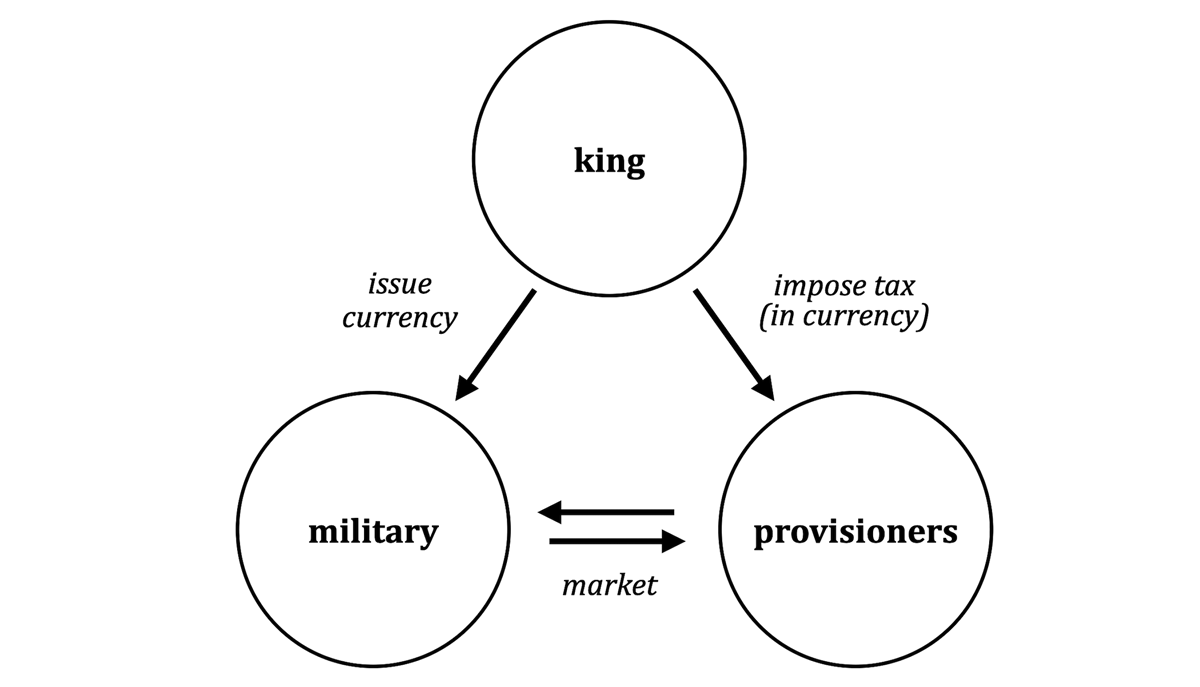
Figure 3
A diagram of the first millennium B.C.E. “military-coinage complex” described by Geoffrey Ingham (2004, pp. 99–100) and elaborated by David Graeber (2014, pp. 229–230) as a “military-coinage-slavery complex.”
JR
As we’re revisiting it, I notice that it’s so easy to look at the clock and see it — to see that they had an intentional design, right? Whereas the coin, and the market that it engenders, require some capacity for abstraction.
HS
Absolutely. The clock can be designed, whereas the market may be designed for. That “for” points to the dynamic interplay between organized plans and self-organizing patterns. I wrote about this interplay in a chapter on design (Silverman, 2015), and it’s the subject of Cynthia Kurtz’s (2021) recent book Confluence.
JR
Cool. I look forward to reading that! Part of what I’m trying to do is to imagine engaging with that interplay through a mixing board where I might be able to adjust the knobs and dials. So if you’re working with a small group, what kind of group process are you going to use? How does changing the number of people affect the dynamics? If there’s a currency involved, how does that change the group behavior?
HS
This mixing board metaphor reminds me of currency use in game design, which is one of the topics that we engaged with in the workshop that we hosted at the ISSS conference.
JR
Yeah. There are different layers to that one. Metaphorically, there’s James Carse’s distinction between finite and infinite games, where infinite games are about bending the boundaries to expand how much we can play. That’s one piece. Another piece is about behavioral economics and group dynamics. How do humans operate as social beings with each other? How do people respond to rewards? That is the stuff that corporations have been trying for a while: the game of incentivizing performance in your employees, and the game of selling merchandise or whatever. We are learning about how behaviors are influenced and how currencies can be used to do so. Nicole Lazzaro, who joined our workshop panel, is a game developer of virtual reality games, online games, and computer games (http://www.xeodesign.com/founder/). And her specific interest, I believe, is about how people feel when they’re playing. So if you’re watching the emotions of a player, and then use that to adjust how the game is structured, you can create emotionally informed games. So her model that she discussed at the workshop is called four keys to fun (AIGAdesign, 2016). And she developed it through watching people’s facial expressions, and tracking them during gameplay. I have to think that this is not just about computer games. What would happen if we watched people’s facial expressions while they’re voting? We would learn a whole bunch about how that game leaves people feeling. And so I think that’s going to be an influence in the future on how we do currency design.
HS
I imagine that my facial expressions when I’m voting from home are a lot less frantic and pressured than if I were standing in line for the voting booth.
JR
Yes, exactly. And it might be that your face has a lot of consternation on it as you struggle with a task, but struggling with the task is part of the fun. We like to become masterful. Now we’re getting into Mihaly Csikszentmihalyi’s work on flow states. As a game designer, you want some challenge there. And as a player, the fact that your face might not be lit up in a big grin is not necessarily a problem.
HS
Let’s move to another panelist that we invited to the workshop, Siddharth Sthalekar, who works on reputation currencies (https://www.sacred.capital/).
JR
Basically, I’d say that Sid wants culture to be the driver for behaviors, rather than financial drivers. When I say culture, I mean the small things that bond groups together. It might be that me and my buddies have decided to all wear red socks. We’re insiders in the Red Socks Club. And the aim of Sid’s work on neighborhoods is that we’re able to manage these cultures with each other, instead of through massive platforms like Facebook or Twitter or whatever (https://neighbourhoods.network/). So if we want a culture of sharing memes or sharing rides, then what matters to us about that? And how do we acknowledge it? And then how are those acknowledgements transportable across contexts? Or are they?
Reputation does work in this weird way. If you’re a consistent person in one spot, you might be a consistent person in another. But your humor might be appreciated in one spot and not in another. And so finding ways to create porous systems, managed by insiders, is a really powerful opportunity.
HS
These two concepts, these two goals — contextuality and transportability — present a fascinating dialectic. We live amidst historical contexts that isolate us in unhealthy ways, in ways that are no longer fit-for-purpose, if they ever were: an educational system that is distinct from the food system that is distinct from the health care system. At the same time we use national currencies that are nearly context-free — fungible, transportable monetary currencies. And the convenience of that monetary system, for people who have access to it, comes at the expense of currencies that might be better matched to contextual variety or complexity.
JR
Yes, exactly. And, I’m much more into targeted currencies. A currency should be targeted towards the thing that it’s designed to stimulate, regulate, coordinate, or whatever.
HS
This mixing board of targeted currencies reminds me of when my students and I were trying to sort out the ecosystem of currency innovation. We went through an inductive process of examining a lot of different currencies and trying to cluster them. One of the first ways we clustered them was by promises. What is the nature of the promise that’s being made by this currency? For me, that approach was informed by Mark Burgess’s writings on promise theory (http://markburgess.org/promises.html). Then, we shifted to a functional approach, with an ecosystem divided into four groupings: currencies that stimulate, regulate, coordinate, and facilitate care (Figure 4). For me, that approach was informed by conversations with you, as well as with Michèle Friend, who has written about what she calls a policy compass, according to which policies are analyzed and rated by three qualities: passion, suppression, and harmony (Friend, 2019).
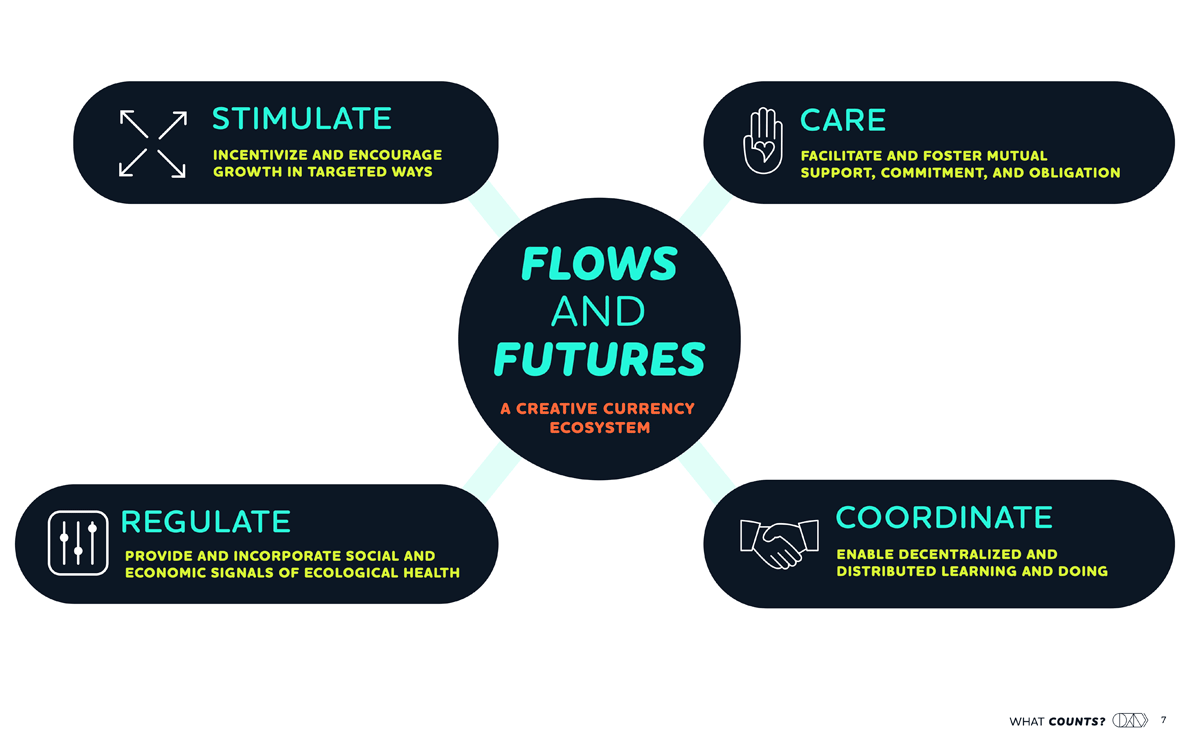
Figure 4
Ecosystem map from the publication, “What Counts?” (Tasneem et al., 2021). Reprinted with permission of Humaira Tasneem, Jono Melamed, Betsy Lance, Jake Crahan, Samantha Caruthers-Knight, and SJ Bowden, Pacific Northwest College of Art, Willamette University.
In cybersystemics we often use the language of positive and negative feedbacks, whether we call them reinforcing and regulating, or stimulating and inhibiting, passion and suppression, or whatever. So I’m particularly curious about currencies that instead serve to coordinate activity or facilitate care — in Michèle’s terms, to harmonize. And I wonder how a currency mixing board might be used in targeted ways that get beyond some of the broad generalizations about a steady-state or degrowth economy.
JR
Likewise, I’m thinking about questions of collective intelligence, and how humans might operate at the scale that we’re at. I’m also thinking of existing examples like Fureai kippu, the Japanese care currency, which smooths the coordination of elder care as an informal economy among caregivers. I’m also thinking of Curitiba, Brazil and the tokens that were used there to coordinate trash collections in exchange for bus rides. Currency designs have been used to coordinate fishery access, and they can be used to coordinate who gets to speak when. There are lots of possibilities in an expanded mixing board of currency design.
HS
I’m also interested in the distinctions we might make among types of social technologies. How does a currency function differently from a policy? In what situations would you use which? And in what ways are currencies, which Eric classifies as grammars, similar to or different from linguistic grammars? Questions like that. Here, I’m using the phrase “social technology,” but there are a lot of ways of talking about these things that we create that then have circular effects upon us.
JR
As you’re talking, I’m thinking again about the water clock versus the coin. It’s easy to point to the object that’s out there, like the water clock, rather than the system we’re participating in, like the market engendered by the coin. I am inside of it, and it is inside of me. It has some qualities of an external object, but it also has interior and inter-subjective realities.
HS
That sounds like a lead in to Shannon Wheeler’s illustration. As you know, I got in touch with him last spring because I was thinking about “currencies as cybernetic objects,” and I wanted to get his take. I described circularities between the coin and the people using the coin. A couple days later, he responded with this illustration of five people, each with particular emotions on display (Figure 5).
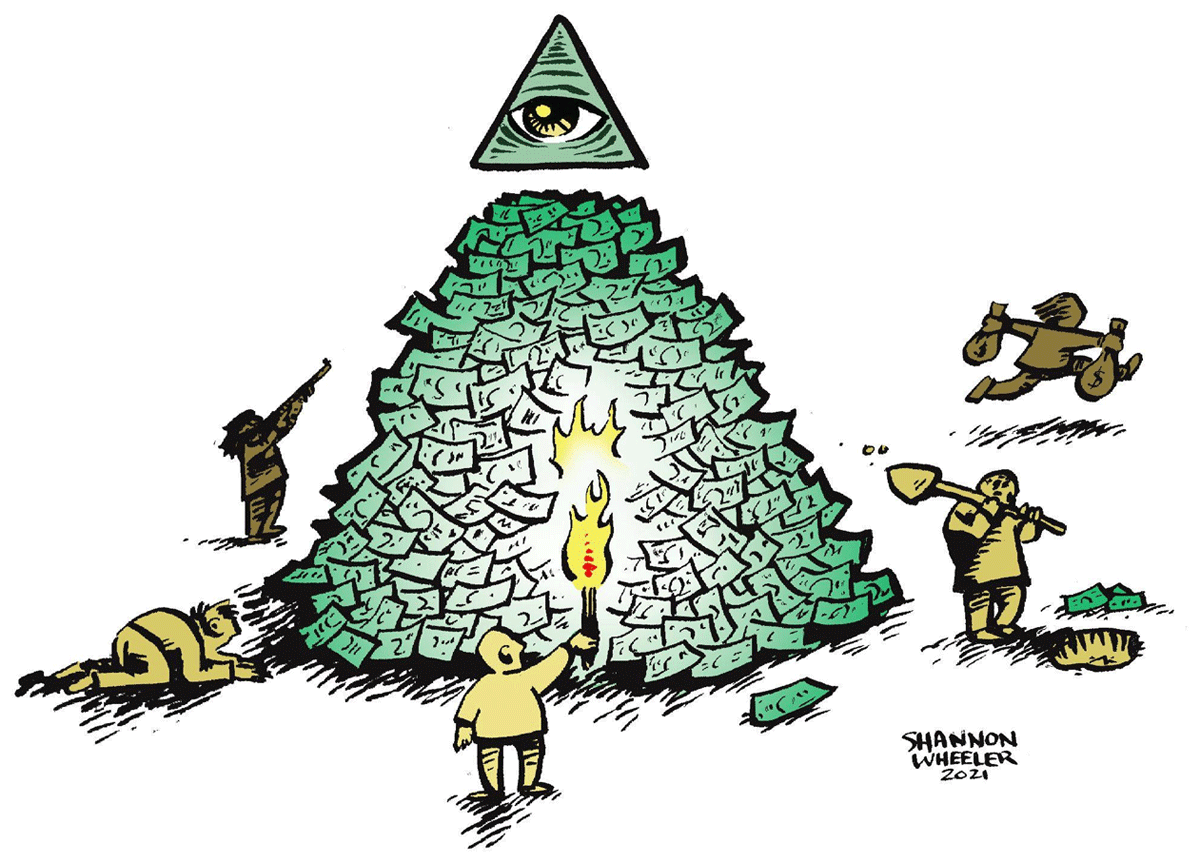
Figure 5
Reprinted with permission of Shannon Wheeler (https://www.shannonleowheeler.com/).
JR
I love how that image captures different ways we relate to money. There is another dimension we haven’t covered yet. We can also mention constellations of currencies, the ways in which currencies can be nested together. Like in an educational system, you have grades, credits, and degrees, and so on. And so you’ve got these nested structures that are interdependent.
HS
You’re reminding me of an exercise we did in one of my classes to map this ecosystem of currency flows in the US higher education system. Sticking with the narrower definition of currencies as formal symbol systems: the teacher gives grades to the students; the students give evaluations of teachers to the administrators, which hopefully then flow back to the teachers; the students give money to the to the school and the school gives money to the to the administrators and teachers; the accreditors give accreditation to the school, and the school gives degrees to the to the students. As we mapped all these out, the one flow we weren’t sure about was what’s flowing up to the accreditors. Is there a way that the students might give some rating to the accreditors to indicate something about the education they’ve received from the school?
JR
Oh, no, that may be a one-way thing! Explicitly anyway. But accreditors are informally managing their reputations, so that the accreditors need to give the right kinds of accreditation to the right kinds of institutions. And there will be feedback, if they’re too vastly out of line.
HS
Right.
JR
I feel like we’ve covered most of the things that we wanted to cover. Is there anything still missing?
HS
Well, I’m not sure I’ve adequately responded to your — or my own — questions about cybersystemic theory and currency practice. Still, our conversations have been clarifying for me personally. And perhaps readers will feel that we’ve pointed in some fruitful directions.
One last thought, though — we didn’t specifically mention Holo (https://holo.host/). Should I ask you about Holo?
JR
Sure.
HS
Well, when we started this conversation, you took us back to when you were beginning to think about currencies. Take us to the present and look forward. What are your hopes for currencies and currency platforms?
JR
Well, over the years of exploring, I’ve definitely become convinced that we need not have one currency to rule them all. Ideas about one thing seem to lose all that contextual information. Targeted currencies can be highly contextual, and nesting structures allow them to be built in constellations together, building up to coordination.
So various experiments have happened over the years, like a pattern language for currencies, or that interest in a mixing board of knobs and dials. And as that body of work was getting built up, Metacurrency was developed, and Arthur and Eric came up with a 50-year vision of the future they call Ceptr (http://ceptr.org/). I guess I’m not quite as visionary. I’m a bit more operations focused. In 2017, when they said: Okay, we’ve got a blockchain-like technology that we want to develop that would get us towards that vision of the future. That is when I joined Holo and Holochain because I’m very excited to see the emergence of currency systems in a distributed ledger technology that allows for this nested ability to coordinate between groups, not just within groups. Holochain is a distributed ledger technology that can deliver on the promises of blockchain, providing a secure peer-to-peer sharing version of cloud hosting. This means we can bridge from our current experience of the digital cloud into Web 3.0. Holo uses a mutual credit currency, HoloFuel, to pay for the miniscule transactions involved in hosting fees. Holo and Holochain are currently in alpha and launching beta soon, I believe.
I think that will lead to a more thrivable world because there’s a way in which currencies enable flow to happen with greater ease and fewer negative outcomes. Otherwise, you might have power grabs, you have friction, maybe you have lawsuits. When you create some ease, it’s kind of like good manners. Everyone just knows what to do and what you can rely on in that space. So I’m interested in that flourishing. I’m also particularly interested in the development of certifications and other performance indicators that let us speak to our values. That ties into your comments on our revised definition, which includes a focus on values, coordinating around values and preferences.
Does that answer it?
HS
Yeah, fantastic. It also sounds like a good way to wrap up.
Competing Interests
Jean M. Russell has worked with Holo and Sacred Capital/Neighbourhoods.