
1. Background
Amidst the flux of life, I perceive continuities. My family remains my family, regardless of its changes. I understand human identity as constituted through relational patterns that are durable amidst the flux, persisting over time, and I use recursively contextual identity to describe continuities of such patterns across recursive couplings. In this example, recursive couplings embed me within my family and entangle my family in the broader contexts of familial life in a particular time and place, such as the early 21st century United States of America.
In focusing on identity, my aim has been to better understand and engage with the dynamics of purposeful change. If identity is understood through continuity and durability in a system’s patterns of relations, then perhaps examinations of identity may conversely inform efforts to effect discontinuities or repatternings of relations. In developing and describing our understandings of purposeful change, Gregory Hill and I constructed and analyzed an identity-based model of individual-to-ecological dynamics in the resilience literature (Silverman & Hill, 2018). Based on this model, I then worked with collaborators to develop a design canvas, followed by the exercise below (Silverman & Rome, 2018).
In seeking to examine this exercise, I turned to cybernetics. Soon after, I realized that I had begun to explore a variant context- and identity-based account of first- and second-order. This was not my original aim, per se, but it has become the focus of this paper. Herein, I describe this enquiry.
2. Situating This Enquiry
To situate this enquiry, I begin with a brief and selective introduction to the cybernetics concept of first- and second-order. In 1967, at the inaugural symposium of the American Society for Cybernetics, Margaret Mead (1968, p. 10) wondered “what in thunder we are founding” and proposed that cybernetics be applied to the process of creating the new organization. Mead’s proposal, which Heinz von Foerster titled “Cybernetics of Cybernetics,” has been discussed as a second-order “reentry of cybernetics into its own domain of concepts” (Richards, 2022). Then, in the 1970s, Foerster began to emphasize a first-second distinction. Foerster diagnosed a blind spot in Western culture, impairing perceptions of social problems, and described this blindness as rooted in the explanatory paradigm of causation and deduction and the delusion of objectivity. Foerster’s (1979/2003, p. 286) response was to complement a first-order cybernetics of observed systems with a second-order cybernetics of observing systems, a “social cybernetics” of autonomy and responsibility. Years later, Foerster (1991/2003, p. 303) offered a “paraphrase” of first and second as a choice between two “fundamentally different epistemological, even ethical, positions,” seeing oneself as “apart from the universe” or as “part of the universe” (p. 293). Foerster’s apart-from and part-of were interpreted by Karl Müller and Alexander Riegler (2016) as modes: a first-order exo-mode (from without) and a second-order endo-mode (from within). Elsewhere, first and second have also been used as labels for historical phases, for example in Foerster’s (1989/2017) periodization of implicit (zeroth-order), explicit (first-order), and complicit (second-order) cybernetics, and in Gordon Pask’s (1992) analogous characterizations of old and new (i.e., first and second) cybernetics. Each of these approaches—second-order as reentry, along with first and second as cybernetic systems, as epistemic and ethical modes or stances, and as historical phases—will figure into my investigation.
In examining first- and second-order, I adopt Foerster’s (1979/2003) terminology of formulation and stipulation. I use formulation to describe a particular theorization of first- and second-order and stipulation to describe that which is attributed to or defined for a system of attention. Foerster used these terms in distinguishing an observed-and-observing formulation from Pask’s (1970) formulation and its stipulations of purpose, “the system’s purpose” and “his own purpose” (Foerster, 1979/2003, p. 286).
Seeking to analyze first- and second-order as a relational unity, I adopt Francisco Varela’s (1976a, 1979), notation for complementarities, in which pairs of mutually referencing, asymmetrical concepts are specified in a notational form that Varela called the star. Following this approach, I consider first-second dialectics in the complementary format: first/second. This notation also supports a systematic investigation, development, and comparison of formulations.
Any consideration of variant formulations raises the question of criteria. By what factors might one formulation be compared with another? This question animates my investigation. In comparison with the textual formulations of Foerster and Pask, and with visual depictions by Gregory Bateson and Mead (Brand, 1976/1986) and by Ray Ison (2010), I examine ways in which a context- and identity-based account might afford analogously and distinctly variant understandings of the first/second complementarity.
3. Design Methods
General methods for this enquiry are as follows.
State one’s aim or purpose
Frame an area of exploration
Appreciatively survey existing approaches
Develop (e.g., distinguish, analogize, diffract, bricoler) a variant approach
Examine and compare analogies and distinctions across approaches
Consider implications for research and practice, given one’s aim or purpose
Picture this situation. You have a task. Looking for tools to apply to this task, you find your current toolkit inadequate, so you select one that most closely matches your needs, make adjustments or variations to it, and try again. You take note of the ways in which these variations may have changed your applications of the tool. Perhaps it fits or fails better than before. Norbert Wiener described the practice of mathematics in similar terms, as discussed in Thomas Fischer and Christiane Herr’s introduction to Design Cybernetics (2019).
First-person styles of writing have been encouraged in cybernetics (Glanville, 2009), and I adopt one here, while also seeking to situate this variant formulation within the cybernetics literature. “I try to construct a description so that I involve the reader,” reflected Foerster in a 1997 series of interviews (2002/2014, p. 48), “so that together we form a living system in which we carry out the game of writing, reading, talking, understanding, answering.” In this spirit, I offer a performative exercise.
4. An Exercise
This exercise begins with a fill-in-the-blank script:
In [A CONTEXT] I am [A ROLE].
There are also variations, such as:
I [PARTICIPATE] in [A CONTEXT].
Instructional prompts are as follows. One presents oneself by slowly and verbally repeating this script, filling in the blanks. As one repeats these sentences, one may become aware of other participants in the context, or the boundaries that seem relevant to a context, or the ways in which contextual relations are themselves embedded and entangled in additional ones, or the function(s) or purpose(s) or effect(s) that one might attribute to these contextual relationships, or one’s own feelings about such relationships. In noticing these participants and boundaries, these recursive entanglements, these functions-purposes-effects, or these feelings, one might also talk about them. Or one might merely notice them and leave them unsaid.
This is an example of my performance:
— In my family, I have been a son, a sibling, a spouse, an uncle, and so on.
— I have been teaching in a design program, in an art college, within a university, all entangled in institutions of accreditation, regulations of finance, norms of pedagogy, and so on.
— I am, still, a consumer of fossil fuels, embedded in countless systems that rely on their use, on a planet that is being heated by their consumption.
— I participate in academic communities.
— On digital platforms, I am variously a user or contributor or persona or, as they say, the product.
— In the context of a land colonized by white people, I am a white person.
— In my country, state, and city, I am a citizen, a voter, a commoner, and so on.
— Among living organisms, I am of a particular species, a particular organism.
You get the picture. In a class or workshop, I would probably ask you to perform as well, with a process perhaps as follows. After demonstrating a performance, as above, we split up and perform for each other in pairs: one speaking, another in silent witness. After a few minutes, switch speaker and listener roles. After a few more minutes, rotate partners. Then, after a few rotations, gather to discuss observations.1
I use this exercise to elicit explorations of embeddedness and entanglement in contextual relations. My observations of participant engagement have varied. One might feel a kind of dissonance in the acknowledgement, spoken or not, of uncomfortable affiliations with particular relational contexts. This has been my personal experience. One might also find that one’s performance, describing one’s contextual embeddedness from within, leaves one feeling hesitant and vulnerable, whereas the group discussion of observations, in which everyone shifts to discussing the exercise from without, may be easier and more familiar. This has been my experience as well.
This exercise, simple though it is, engenders opportunities for a type of reentry. That is, it invites participants to conceptualize and narrate our experiences of being in context, so that we might recursively bring self-in-context distinctions, relationships, attributions, and feelings into ourselves for reflection and verbal performance. In Bruce Clarke’s (2008, p. 71) terms, “Through the form of reentry, the system constructs within itself as a virtual reality the real distinction between itself and its environment.” In Terry Marks-Tarlow and colleagues’ (2002) description of psychological processes, “Consciousness operates continually upon objects and aspects of both internal and external worlds. Reentry occurs through feedback processes whereby products of one state of consciousness become the content for the next state” (p. 39).2
In this paper, I use this exercise to function like a model. Conversationally, I describe a model as a tool for fixing a view on how things work, and I use this script to fix a particular view, centering my investigation on a human-in-context view of identity, rather than, say, the identity of a cell (Maturana & Varela, 1987) or that of an organizational enterprise (Beer, 1979/1994). This approach can also be said to outperform conventional models. Bernard Scott (2021) listed manipulability as an essential feature of models, and this exercise is designed for a particular kind of personal and experiential manipulability. At the same time, because this investigation is constrained by the exercise-as-model, it might also fail to capture one’s understanding of identity.
5. First/Second Complementarity
In developing this formulation and comparing it with others, I adopt the notation of Varelian complementarities, introduced in the 1976 paper “Not One, Not Two.” Varela used this notation in formulating a logic of self-reference, composing dialectical relations as asymmetrical pairs that “mutually specify each other” in an “imbrication” (or overlapping) “of levels” (1976a, p. 64). Varela called this notation the star: * = the it/the process leading to it. Varela’s (1976a, 1979) examples of such complementarities included: environment/system, ecosystem/species interaction, and conversational pattern/participants in a conversation.3
Following the form of the star (the it/the process leading to it), I describe first- and second-order as complementary in the format first/second. I use “first/second” as a general and conceptual pattern for comparing formulations, which can be understood as instances or interpretations of the general pattern. In these terms, following the general pattern first/second, Foerster’s first-order observed system and second-order observing system can be written: observed system/observing system. That is, an observed system is the it that is distinguished and indicated by the processes of observing. In Varela’s (1984, p. xiii) introduction to Foerster’s collected writings, Varela can be read as pointing to this general pattern when describing Foerster’s first-order systems (“those we study”) and second-order systems (“those we are”) as “two levels” in a “mutually specifying pair.”4 Turn now to the human-in-context narratives of the above exercise. Following the general pattern, and analogous to Varela’s (1979, p. 101) “conversational pattern/participants in a conversation,” one can describe a contextual pattern as the it that emerges from the words and actions of the participants: contextual pattern/participants in the context. In Humberto Maturana’s terms, these roles and this participation might be described as class identities (1988a) or manners of living (1988b). Reflecting contemporary vernacular, one might also write: contextual pattern/showing up, where the phrase “showing up” describes manners of participation.
Amusingly, when scholars of cybernetics discuss the historical periodization of first- and second-order cybernetics, they sometimes refer to what I think of as a star-like pattern (Richards, 2022). In these terms, the it of a historical first is distinguished and indicated only with the ongoing process of developing a second, a cybernetics of cybernetics. In Louis Kauffman’s (2016) terms, “Perhaps there never was a first-order cybernetics” (p. 492).
6. Recursively Contextual Identity
I interpret this exercise in terms of recursively contextual identity. That is, I describe each role-in-context and participate-in-context statement in my performance as an expression of an embedded identity relation, a pattern that is durable amidst the flux, persisting over time. Recursively, I also interpret each context described through my above performance—my family, my school, my country, my species, and so on—as systemically entangled in contextual relations that can also be stipulated in terms of identity.
This approach draws from across the cybernetics and broader cyber-systemics literatures. Varela (1991, p. 102) described a “double dialectics” of maintaining internal coherence amidst the perturbations of environmental couplings, with a “bricolage of various identities” from cellular to social (1995, p. 211). Stafford Beer (1979/1994), Beth Dempster (2000), and Niklas Luhmann (2002/2013) each examined social systems in terms of identity, as did Silverman and Hill (2018) for social-ecological systems. The concept of identity offers a flexible and coherent approach to analyzing “systems,” whether they are considered, for example, as unities (Maturana & Varela, 1987) or as regimes (Silverman & Hill, 2018).
I also interpret this exercise in terms of first- and second-order. Adapting Foerster’s (1991/2003) language, one might consider one’s universe of contextualities as apart-from oneself or one might recognize one’s part-in these contexts. Simply stated, one might reify role and context as separate from one’s participation (a first-order stance) or one might remain self-reflectively aware of one’s participation in constructing both role and context (a second-order stance).
7. Coupled, Transcontextual, Situated
To further develop this interpretation of recursively contextual identity and to explore the challenges of a second-order stance, I adopt and adapt from the cybernetics literature a three-part framework: coupled, transcontextual, situated.
Coupled, Coupling
I use coupled and coupling to describe the coevolutionary dynamics through which recursive continuities and discontinuities of identity are experienced and effected. I use the term embedded to describe one-within-another identity relations, and the terms affiliation and entanglement to describe the experiences and effects of coupling. Fundamental to such couplings is the “interactional asymmetry” described as human agency (Di Paolo et al., 2017, p. 117). Various accounts have been given for the constructivist experience of coupled relations (Riegler, 2005). Here I follow Varela (1991, 1997) in describing my coupled experience of any particular contextual environment as a world that I bring forth, an approach that has been described as bring forthist, rather than constructivist (Proulx, 2008). To illustrate, I belong to the same family as my siblings, the same context, but our experiences of this family are hardly identical. Within a particular contextual environment, such as the family, the people affiliated with this environment each experience differing worlds—to lesser or greater extents.
Transcontextual, Transcontextualities
In the above performance, each role or act of participation emerges in context, a sequence of dialectical interplays between myself and the systems of attention. In Varela’s (1995, p. 211) terms, these can be described as “various identities that manifest in different modes of interaction.” I adopt Gregory Bateson’s (1972) and Nora Bateson’s term transcontextual to describe this “interdependency” (N. Bateson, 2017, p. 86)—the constitution of identities, co-arising in and entangled across contexts.5 Relatedly, the dissonance that may arise in performing this exercise can be interpreted through the narrative of double bind (G. Bateson, 1972). Nora Bateson (2017) described a double bind as “a pattern of perceived impossibility produced by cross-contextual limitations” (p. 95). For example, I experience the dissonance of being a consumer of fossil fuels while also being a living organism, of a particular species, which I take to be endangered by such consumption.
Situated, Situatedness
By situated I mean that one brings one’s memories, experiences, emotions, interests, and values to the activity of perceiving and interpreting one’s contextual environments (Varela, 1991, 1997). From a situated position, a particular standpoint, I shape how I see what I see, feel what I feel, and know what I know (Glasersfeld, 1995). At the same time, how I see, feel, and know are also, metaphorically, shaped—constrained and afforded, regulated and reinforced—by the entangled transcontextualities of being, in my case, a white person, a man, of the born-in-the-1960s generation, an American, a teacher, and so on. Foerster (1974/2003) described such dynamics as follows: “the ‘environment,’ is a purely personal affair, whose constraints are anatomical or cultural factors” (p. 250). In Foerster’s words, I read Varela’s later world-environment distinction, with Foerster’s environment analogous to Varela’s world, and Foerster’s cultural factors descriptive of Varela’s environment. To summarize, sticking with Varela’s terminology and with an emphasis on contextualities: My situated world-constructing is constrained and afforded by the contextual environments with which I couple. Furthermore, many of these contextual distinctions—my gender, my country, my religion or creed—are ones that long precede me. The experience of situating oneself within pre-existing historical contexts can also be interpreted as a source of the dissonance described above.
8. Analogies and Distinctions: Textual
Having now sketched a variant formulation, I use Figure 1 to compare it with Pask’s and Foerster’s, that is, my exploratory interpretations thereof. I title this matrix “analogies and distinctions” to emphasize both that one person’s analogy may be another’s distinction and that one might discern analogies in distinction and distinctions in analogy (Silverman & Rome, 2018).
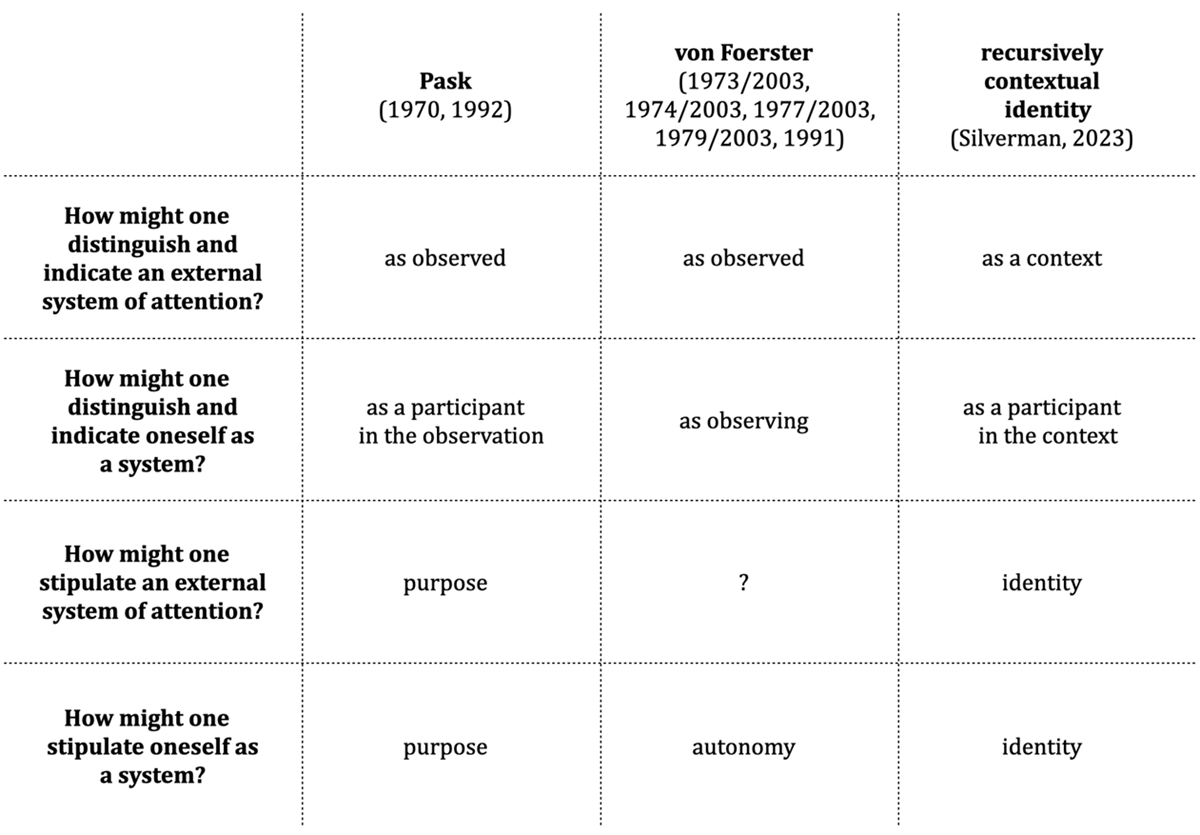
Figure 1
Analogies and distinctions: comparing textual formulations (i.e., my interpretations thereof) of first- and second-order.
At top, I raised the question of criteria: the factors by which one might judge analogies and distinctions among formulations. In this matrix I framed these criteria as questions in the leftmost column, asking how systems of attention are distinguished and indicated and how they are stipulated. As Figure 1 offers, Foerster’s (1979/2003) comparison of “observed systems” and “observing systems” with Pask’s “the system’s purpose” and “his own purpose” can be clarified by distinguishing questions of distinction and indication from those of stipulation.
In the next column, my interpretation of Pask’s formulation turns on Pask’s discussion of observation. Pask (1970) drew a distinction between taciturn and language-oriented systems, that is, systems for which a goal or purpose may be stipulated and systems that may state their own goal or purpose. At the same time, Pask also specified that this distinction be understood as observer dependent, writing (p. 25): “we mean, to be strict ‘observed as taciturn/observed as language oriented.’” Decades later, Pask (1992, p. 24) distinguished observational stances that are “essentially external” (in “old” Cybernetics) from those that are “essentially participant” (in “new” Cybernetics).
My interpretation of Foerster’s formulation turns on Foerster’s discussion of objects (1977/2003), of which observed systems might generally be taken as a subset. “The environment is experienced as the residence of objects, stationary, in motion, or changing” (1974/2003, p. 248). Foersterian objects are “perceptual regularities” (Varela, 1979, p. 171), of an “apparent solidity and stability” (Kauffman, 2005, p. 130), which “arise in the course of the orientating and adapting activities a subject performs when trying to come to terms with its experiences” (Füllsack & Riegler, 2017, p. 239). Stated another way, “objects are tokens for (eigen) behaviors – that is, for the recursive co-constructions of co-observing systems and their environments” (Clarke, 2012, p. 205). “Fixed points, Eigen-values, Eigen-behaviors, attractors, strange attractors, and so on…account for the stability of things observed or created, be they objects, concepts, languages, customs, rituals, cultures or whatever” (Foerster, 1991, p. 72). In these terms, “An organism is its own ultimate object” (Foerster, 1974/2003, p. 256).
In the rightmost column is this paper’s variant formulation. Here, analogous to Foerster’s observer-indicated objectual systems are participant-indicated contextual systems. Analogous to Pask’s stipulations of purpose are stipulations of identity.6
Pursuing comparisons, turn to the first question in Figure 1, distinguishing and indicating an external system of attention. To what extent is a context, as I have described it, analogous to that which is observed by Pask and Foerster? Stated another way, in what respects might a context be considered an analog to or perhaps a type of Foersterian object? Foerster (1991) pointed to this analogy-distinction when he listed “objects” alongside “concepts, languages, customs, rituals, cultures” as “things observed or created” that are stabilized through “dynamic equilibria.” Here, several analogies and distinctions might be drawn, including between that which is observed and that which is created, between the “apparent solidity” (Kauffman, 2005) of objects and the apparent immateriality of the other “things” listed by Foerster, among which one might include contexts, and between the various ways in which these things are dynamically stabilized. That said, a context for one person might also be an object of attention for another, as when my embedding contextual environment serves as an external focus of attention for the organizational consultant or anthropologist. Similarly, participants in the above exercise begin by describing their contextual embeddedness and then shift to taking the exercise, immaterial though it is, as an object of observational examination. Turn now to the second question in Figure 1, distinguishing and indicating oneself as a second-order system. With the second-order observer, cybernetics scholars appropriated the “ocular metaphors” (Krippendorff, 2009, p. 102), through which “objectivity … [has been] etched into the very act of scientific seeing” (Daston & Galison, 2007, p. 10). Foerster referenced this metaphorical history when he offered: “second-order cybernetics invites you to leave Helmholtz’s locus observandi” (Brier, 2004, p. 636). At the same time, these visual metaphors were often stretched beyond the visual experience, as in Maturana’s “Anything said is said by an observer” (Foerster 1979/2003, p. 283). Noting these ambiguities—what might be considered an objectual system, what might be considered observing—I move on.
9. Metaphors and Domains
The stretched metaphor of the observer has met with mixed reactions. As noted above, Pask (1992) described second-order observation as essentially participant. Likewise, Kauffman (2005, p. 149) emphasized the “recursive participation of the observer.” Klaus Krippendorff (2008), however, drew a sharper distinction, describing the shift in attention “from the limiting concept of an observer to that of a participant” as one of “cybernetics’s reflexive turns” (pp. 173–175). Loet Leydesdorff (2006) lamented that “the metaphor of a (meta-)biological observer has disturbed the translation of social systems theory into sociological discourse” (p. 531).
One person who emphasized an alternative metaphor is Stein Bråten (2000). Bråten described an amusing 1988 conference exchange with Maturana, Foerster, and Lynn Hoffman in which Bråten decried the notion of being able to observe the Lifeworld (Lebenswelt) in which we swim. Bråten’s protest highlights another point of distinction between objects and contexts, based on their metaphors. In these terms, the analogy-distinction that I am investigating might be described as between the domain of objects and the metaphor of observing, versus the domain of contexts and the metaphors of embeddedness or swimming.
Such domain distinctions have been described in various ways. In Varela’s (1979) discussion of “the nature of a unity and the domain in which it exists,” he distinguished between the “conceptual” distinction-making of the “observer” and the “physical” distinction-making of the “autonomous unity” (p. 30). Ranulph Glanville and Varela (1981, p. 638) distinguished “the external observer” from “the self.” Sebastjan Vörös (2017, p. 301) pointed to Jakob von Uexküll’s terminology of umgebung (“environment-for-the-observer”) and umwelt (“environment-for-the-organism”). I will emphasize this distinction in my analysis of visual materials.
10. Analogies and Distinctions: Visual
My visual analysis technique is to interpretively simplify selected source materials, so as to focus on the relationship between first- and second-order, labelled 1 and 2. I compare a series of these interpretive diagrams in Figure 2. From left to right, the first is derived from existing visual materials: the Bateson-Mead (1976/1986) diagram. Next are a pair redrawn from Varela (1976a, 1979) but which Varela did not indicate as presenting first- and second-order. Next is a simple diagram of contextual identity. In the rightmost column is a diagram inspired by an illustration in Ison (2010). As above, my interpretations are exploratory, and analogies and distinctions are open to readers’ interpretations.
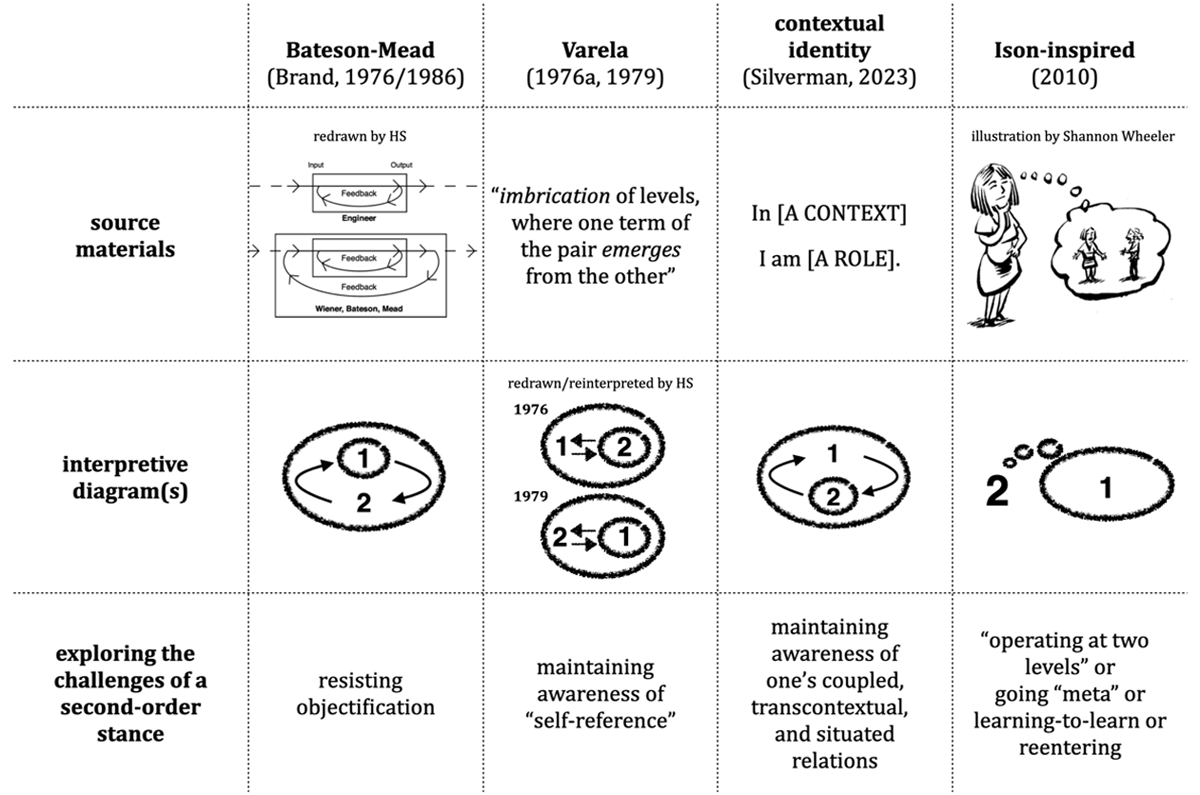
Figure 2
Analogies and distinctions: comparing visual depictions (i.e., my interpretations thereof) of first- and second-order.
Begin with the source materials of the Bateson-Mead diagram, which is itself a top-bottom pairing of diagrams. In Stewart Brand’s (1976/1986) interview with Bateson and Mead, Bateson described the diagrammatic first-order (top): “You’ve got a box, and you’ve got this line enclosing the box, and the science is the science of these boxes. … They are trying to keep themselves out of that which they’re studying” (p. 34). Switching to second-order (bottom): “Now, the essence of Wiener’s cybernetics was that the science is the science of the whole circuit. … The engineer is outside the box … and Wiener is inside the box” (p. 34). Below, in my interpretive simplification of the Bateson-Mead diagram, the 1 indicates the external box—i.e., the objectual system—that the scientist or practitioner distinguishes for investigation, and the 2 indicates the observing system, scientist or practitioner, who is self-including in a “single circuit” with the box or object of investigation.
In the next column are Varela’s diagrams from his 1976 and 1979 writings on complementarity, discussed above. Declaring a “departure from the classical way of understanding dialectics” as a symmetrical “clash of opposites,” Varela (1979, pp. 100–101) graphically depicted an “imbrication of levels, where one term of the pair emerges from the other. Varela’s two diagrams reflect this iterative overlapping or imbrication, 2-in-1 and 1-in-2. I have redrawn them as they originally appeared and interpreted them as presenting first- and second-order. The 1979 version is analogous to the Bateson-Mead diagram, with the 1 inside the 2.
In the third column, I have drawn a simple diagram of contextual identity. Here, the 1 indicates the system of attention, the context in which one is embedded, and the 2 indicates oneself as a system, coupled inside the system of attention. My drawing, with the 2 inside the 1, reverses the Bateson-Mead interpretive diagram, with the 1 inside the 2. This contextual identity diagram is analogous to Varela’s 1976 one.
These diagrams illustrate a distinction between domains of objects and contexts. First- and second-order systems in the domain of objects can be depicted with a 1-in-2 diagram. Conversely, first- and second-order systems in the domain of contexts can be depicted with a 2-in-1 diagram.
11. Modes and Stances
I describe the experience of these domains as modes: the mode of the observer of objects and the mode of the organism in contexts. Then, I describe as corresponding to each mode the enactment of stances that, in Foerster’s (1991/2003) terms, “paraphrase” first- and second-order. Recall that Müller and Riegler (2016) described Foerster’s apart-from or part-of as modes: a first-order exo-mode (from without) and a second-order endo-mode (from within). In contrast, I find myself describing two stances for each mode. That is, the observer-of-objects mode is from without, and the organism-in-contexts mode is from within. As an observer of objects, one experiences apart-from and part-of objectual dynamics, and as an organism in contexts, one experiences analogous contextual dynamics. I refer to these as first- and second-order stances.
Returning to Figure 2, I now describe first- and second-order not as systems but as stances. In the bottom row of Figure 2, I explore second-order stances as challenges, using quotation marks to indicate authorial sourcing. These challenges are described in general terms, and relative vulnerabilities to these challenges are best posited as individually, situationally, and culturally specific.
Begin again with the Bateson-Mead diagram. One might, like the depicted engineer, adopt a first-order stance, emphasizing the external object of observation as separate from oneself. Or one might, like the depicted Norbert Wiener, adopt a second-order stance, seeking to maintain awareness of one’s own distinctions and circularities. Here, the challenge is about including oneself in the circuit with the object of attention. This might be described as the challenge of resisting objectification, a challenge one might hear in Gregory Bateson’s words at the end of Nora Bateson’s (2011) film, “There are times when I catch myself believing that there is such a thing as something, which is separate from something else.”
In the next column, adopting a term used by Varela and others, I interpret the challenge depicted in Varela’s diagrams as maintaining an awareness of self-reference. As Varela (1976b) described in a contemporaneous interview, “the properties we discover in systems will depend upon our own properties” (p. 29) and “what we do is a reflection of what we are” (p. 31). Pursuing my analogy to the Bateson-Mead diagram, in terms of self-reference, the scientist or practitioner faces the challenge that the object is distinguished and observed, to a greater or lesser extent, in self-reference to one’s own assumptions and experiences of how such an object is to be distinguished and observed. Moreover, such assumptions and experiences are not one’s alone but are reinforced and regulated by one’s affiliations of class identities.
In the next column is my organism-in-context diagram. With a first-order stance one reifies the contextual system, emphasizing its pattern of identity as distinct from one’s own and limiting one’s involvement according to one’s perceived role. As Varela (1976a) noted, “there is a dispersive tendency for the participants in these conversational patterns to chop themselves out, to detach from the wholes and become isolated, rigid participants” (p. 66). With a second-order stance one seeks to develop and maintain awareness of one’s coupled, transcontextual, and situated relations. Restated as a challenge of self-reference, the individual depicted in the contextual identity diagram experiences the self-referential challenge of being shaped by, while also shaping in turn, to a lesser or greater extent, one’s contexts of coupled interaction, such that one’s identities are constitutionally entangled.
Turn now to the rightmost column. An illustration presented by Ison (2010, p. 48) showed a person “operating at two levels” (p. 50), as a practitioner inside a situational context and also outside of the context, seeing oneself in such a context and role. Ison described this scene as “taking a meta or second order perspective” (p. 50) and described this awareness as arising out of a “reflective responsibility” (p. 51). Inspired by this illustration in Ison (2010) but omitting its terminology, the illustration in Figure 2 similarly shows a person reflecting on the situation that includes oneself. As simplified in the interpretive diagram, with a first-order stance, one operates in situational context; with a second-order stance, one reflects on the self-included situation, taking responsibility for one’s co-constructions of the situation and the role one enacts within it. Following Ison, this might be described as the challenge of operating at two levels or going meta. It might also be described in terms of circularities such as learning-to-learn or reentering. In addition, seeing these stances and challenges as related to those described for the Figure 2 organism in context might offer additional insights. In this interpretation, an awareness of one’s contextual entanglements—one’s coupled, transcontextual, and situated relations—is related to the capacity to question how, and perhaps why, one participates in these contexts (contextual pattern/showing up).
12. Conjectures
Krippendorff (2007) maintained, “A design is always a proposal, a conjecture” (p. 79). In conjecturing about the dynamics of purposeful change, we developed a model of recursively contextual identity. The conceptual language of identity has long been a way of theorizing and investigating continuous and discontinuous change, whether conceived in terms of durable relations, as herein, or in terms of distinctions, as for example by Allenna Leonard (2004).
With its use of design methods, this paper reflects the learning journey that I experienced. While I regarded a context- and identity-based account of first- and second-order as missing, I found in cybernetics a robust suite of gestures for developing variants: distinction-making, analogizing, complementing, stipulating, recursing, and so on. Enabled and constrained by exercise and performance, I stepped through the methods along conjectural pathways, interwoven amongst which were ways of accounting for first- and second-order as reentry, as systems, as modes or stances, and as historical phases. With regard to distinctions, I composed a pairing of pathways, emphasizing an object-context distinction while also using Varela’s notation for complementarities to imbricate the distinction of first from second. In this way, both modes—observers of objects and organisms in contexts—are discussed in terms of self-reference.
Given the focus of this paper on first- and second-order, adjacent questions went unexplored. The concept of identity offers a coherent approach to analyzing socially contextual embeddedness and entanglement without necessarily venturing into discussions of social systems as, say, autopoietic or sympoietic. In other writings, my coauthors and I analyzed social dynamics in terms of social attractors. Naturally, as I worked on this paper and sought to situate it within the cybernetics literature, my other affiliations of identity were also diffracting my attention.
I came to cybernetics thinking about the entanglements of recursively and contextually embedded identities, in particular the implications of such a model for purposeful change. With this paper, I shifted to thinking about these entanglements in terms of first- and second-order, in particular the challenges of maintaining a second-order stance. Going forward, these will be among the learnings that I take from this enquiry.
Notes
[1] This exercise has been hosted, online and in person, in professional settings (International Society for the Systems Sciences 2019 Conference, Liberating Structures Global Gathering, H3Uni Colloquium) and classroom settings (by myself and by Todd Umhoefer at Pacific Northwest College of Art, by Marina Zurkow and Sarah Rothberg at New York University). A variant hosting approach would be to invite each participant to write out a series of fill-in-the blank sentences, perhaps then sharing them aloud, perhaps not. I invite you to incorporate this exercise, or your own version of it, into your research and practice.
[2] See also Tom Scholte’s (2016) analysis of reentry among performers of naturalistic theatre.
[3] Constructions and interpretations of Varelian stars may vary, and I have selected these three examples from Varela (1976a, 1979) as fitting my interpretation in this paper. For more on “Not One, Not Two,” see Evan Thompson’s (2021) explication.
[4] Varela’s earlier 1976 and 1979 writings discussed “observer/observed” as one of several “Hegelian pairs” (1979, p. 101), that is, as a duality to be recomposed in complementary form.
[5] Both Varela’s (1995, p. 211) “various identities” (which include cellular, immune, cognitive, and social identities) and Nora Bateson’s (2017, p. 86) “interdependency” (which includes “living and non-living systems”) highlight the constraints of this paper’s human-in-context exercise, which are in practice also its affordances.
[6] Foerster (1973/2003, p. 225) stipulated autonomy for “every living organism”.
Acknowledgements
I have enjoyed many opportunities to learn about the topics presented this paper, including conversations with collaborators; classes and workshops where my collaborators and I hosted the exercise; the 2019 and 2020 American Society for Cybernetics conferences, where I presented these ideas; responses to earlier versions of this paper by Ben Sweeting, Bruce Clarke, and Louis Kauffman; and then conversations convened by Larry Richards with Tom Scholte, Claudia Westermann, and Mark Johnson about moving beyond the distinction between first- and second-order cybernetics. Thanks to Shannon Wheeler for the illustration embedded in Figure 2. I also thank three anonymous reviewers for their comments.
Competing Interests
The author has no competing interests to declare.