Have a personal or library account? Click to login
Using the Initial Systolic Time Interval to assess cardiac autonomic nervous function in Parkinson’s disease Cover

Using the Initial Systolic Time Interval to assess cardiac autonomic nervous function in Parkinson’s disease

Open Access
|Dec 2011

Figures & Tables

Fig.1

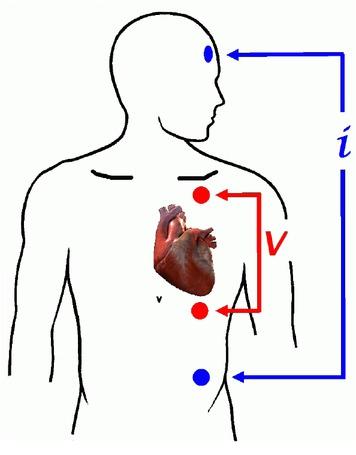
Electrode configuration for the measurement of ISTI: A small electrical current i was applied to the upper part of the body by means of the two outer electrodes. The two inner electrodes measured the subsequent electrical voltage difference V over the heart from which the impedance Z was computed.

Fig.2

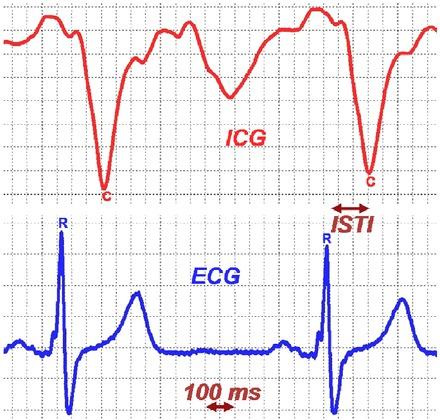
Simultaneous registration of an Impedance CardioGram (ICG) and an ElectroCardioGram (ECG) (arbitrary units). ISTI is defined as the time interval between the R-point in the ECG and the C-point in the ICG.

Fig.3

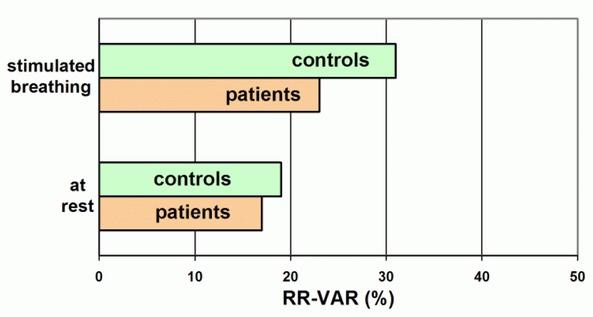
Variability in RR-interval (RR-VAR) in the group of patients suffering from Parkinson’s disease and in the control group, during normal breathing at rest and during stimulated, deep breathing. At rest there is no significant difference between the two groups. During stimulated deep breathing RR-VAR increased significantly within both groups. However, this increase was significantly less in the patient group.

Fig.4

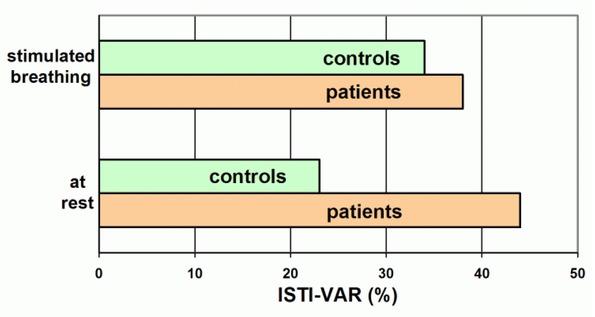
Variability in ISTI (ISTI-VAR) in the group of patients suffering from Parkinson’s disease and in the control group, during normal breathing at rest and during stimulated, deep breathing. At rest there is a significant difference between the two groups. During stimulated deep breathing ISTI-VAR increased significantly in the control group. However, ISTI-VAR did not change significantly in the patient group as it was already substantially elevated.

ISTI-interval ± S_D_ [ms] in the group of patients with Parkinson’s disease and in the group of control subjects while breathing at rest and during stimulated, deep breathing at 0_1 Hz_

subjectsISTI [ms] at restISTI [ms] stimulated
controls (24)145 ± 14147 ± 10
patients (18)143 ± 17147 ± 19

Variability in ISTI (ISTI-VAR) ± S_D_ [%] in the group of patients with Parkinson’s disease and in the group of control subjects while breathing at rest and during stimulated, deep breathing at 0_1 Hz_

subjectsISTI-VAR [%] at restISTI-VAR [%] stimulated
controls (24)23 ± 1534 ± 17
patients (18)44 ± 4038 ± 20

Variability in RR-interval (RR-VAR) ± S_D_ [%] in the group of patients with Parkinson’s disease and in the group of control subjects while breathing at rest and during stimulated, deep breathing at 0_1 Hz_

subjectsRR-VAR [%] at restRR-VAR [%] stimulated
controls (24)19 ± 1031 ± 12
patients (19)17 ± 723 ± 10

RR-interval ± S_D_ [ms] in the group of patients with Parkinson’s disease and in the group of control subjects while breathing at rest and during stimulated, deep breathing at 0_1 Hz_

subjectsRR [ms] at restRR [ms] stimulated
controls (24)990 ± 180990 ± 170
patients (19)940 ± 170940 ± 170
DOI: https://doi.org/10.5617/jeb.216 | Journal eISSN: 1891-5469
Language: English
Page range: 98 - 101
Submitted on: Nov 30, 2011
Published on: Dec 19, 2011
Published by: University of Oslo
In partnership with: Paradigm Publishing Services
Publication frequency: 1 issue per year

© 2011 Jan H. Meijer, Eskeline Elbertse, Sanne Boesveldt, Henk W. Berendse, Rudolph M. Verdaasdonk, published by University of Oslo
This work is licensed under the Creative Commons Attribution-NonCommercial-NoDerivatives 3.0 License.