Have a personal or library account? Click to login
Isolation and Characteristics of Biotechnologically Important Antagonistic Thermophilic Bacteria from Rhizosphere of Haloxylon salicornicum Cover

Isolation and Characteristics of Biotechnologically Important Antagonistic Thermophilic Bacteria from Rhizosphere of Haloxylon salicornicum

Open Access
|Feb 2022

Figures & Tables

Fig. 1.

Neighbour-joining phylogenetic tree of the selected bacterial isolates.The tree was rooted with Escherichia spp. as an out-group. The scale bar represents the sequence divergence. Bootstrap values (100 replicates) are shown at the nodes. The optimal tree with the sum of branch length = 0.65614117 is shown. The percentage of replicate trees in which the associated taxa clustered together in the bootstrap test (100 replicates) is shown next to the branches (Felsenstein, 1985). The tree is drawn to scale, with branch lengths in the same units as those of the evolutionary distances used to infer the phylogenetic tree.

Fig. 2.

RFLP analysis of the selected bacterial isolates using 5 different restriction endonucleases.

Fig. 3.

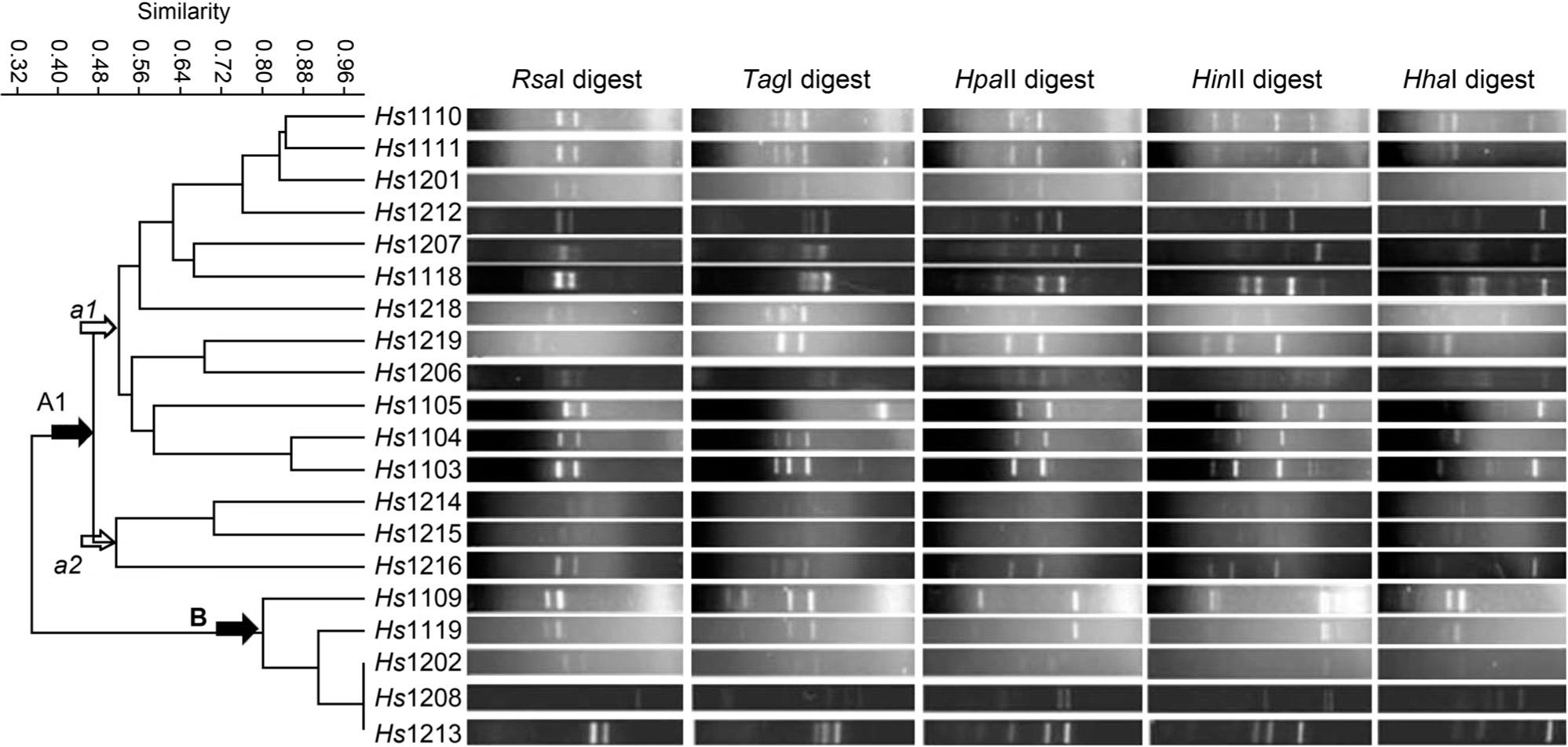
Dendrogram constructed based on RFLP analysis of 16S rRNA gene of bacteria isolated from rhizosphere of H. salicornicum.
DOI: https://doi.org/10.5604/01.3001.0011.6142 | Journal eISSN: 2544-4646 | Journal ISSN: 1733-1331
Language: English
Page range: 49 - 58
Submitted on: May 14, 2017
Accepted on: Aug 31, 2017
Published on: Feb 21, 2022
Published by: Polish Society of Microbiologists
In partnership with: Paradigm Publishing Services
Publication frequency: 4 issues per year

© 2022 Muhammad Aslam, Faiz-Ul-Hassan Nasim, Rana Ruhi, Hassan Murad, Samina Ejaz, Muhammad Shafiq Choudhary, Ghulam Mustafa, Muhammad Ashraf, Jameel Rehman, published by Polish Society of Microbiologists
This work is licensed under the Creative Commons Attribution-NonCommercial-NoDerivatives 4.0 License.