
Introduction
Openness in education and its practices have impacted the educational landscape and emerged as a major paradigm across the globe (Stracke et al., 2023a). Likewise, in recent years, there has been a growing movement towards open-access publishing in the scholarly landscape. This movement seeks to make scholarly research more accessible and widely available to the public, without the barrier of expensive subscription fees. Open-access journals have become an important part of the educational landscape, as they provide a platform for researchers to disseminate their work and for readers to access the latest research findings.
Published by the International Council for Open and Distance Education (ICDE), the journal of Open Praxis is a peer-reviewed open-access scholarly journal focusing on research and innovation in open, distance, and flexible education. Before, Open Praxis was a printed journal published twice a year that replaced the ICDE Bulletin from 1993 until 2003, and it became an electronic journal for ICDE members from 2006 to 2010, hosted by Lillehammer University College, Norway. In 2011, ICDE announced its intention for Open Praxis to be relaunched as a peer-reviewed open access journal. The Universidad Nacional de Educación a Distancia (UNED) was selected as host for the period 2011–2022, followed by Anadolu University from 2023 onwards.
The first issue in this new stage was launched in January 2013, and it was purposely focused on “openness in higher education” as a way to remark the open access approach, on the one hand, and the need to critically reflect on the idea of “openness”, on the other hand (Gil-Jaurena, 2013). Other special issues during these years have published, on three occasions, the ICDE Prizes for Innovation and Best Practice in the field of open and distance education and, in six issues, selected papers from the Open Education Global Conference. Open Praxis, through its open access character, has reached a global audience, and has an increasing impact in terms of citations in academic publications, which have grown substantially in the last few years (Gil-Jaurena, 2022).
Bozkurt et al. (2022) contend that comprehending the past, learning from experiences, and devising strategic roadmaps based on that knowledge is crucial for understanding the future and positioning oneself effectively in the academic landscape. Consistent with this assertion, the aim of this editorial is to investigate the patterns and trends evident in previous Open Praxis publications to gain further insights that will enable us to better shape the journal’s future.
Methods
In order to gain a deeper understanding of the evolution of Open Praxis journal over time, we employed a systematic review approach (Gough et al., 2012), as well as bibliometric analysis (Donthu et al., 2021), data mining, and analytical methods (Fayyad et al., 2002), such as text mining (Feldman & Sanger, 2007) and social network analysis (SNA; Hansen et al., 2010). We utilized the Web of Science (WoS) database to compile our research corpus, excluding editorials since they are routinely published in every issue and their inclusion could potentially affect the findings of our analysis. Given that our focus was solely on the Open Praxis journal, we did not utilize a predefined protocol and examined all the publications available on WoS.
Findings and Discussion
Bibliometric Trends and Patterns
Our data corpus comprised 350 documents that were published in the Open Praxis journal between 2006 and 2022, thus, covering all the papers available on the Open Praxis website, since it became an electronic journal, with contributions from a total of 667 authors (including 123 single-authored articles). After its establishment, and with the ICDE goal of relaunching Open Praxis as a peer-reviewed open-access journal, regular issues began to be published by 2013, with approximately 30–35 articles per year (see Figure 1).
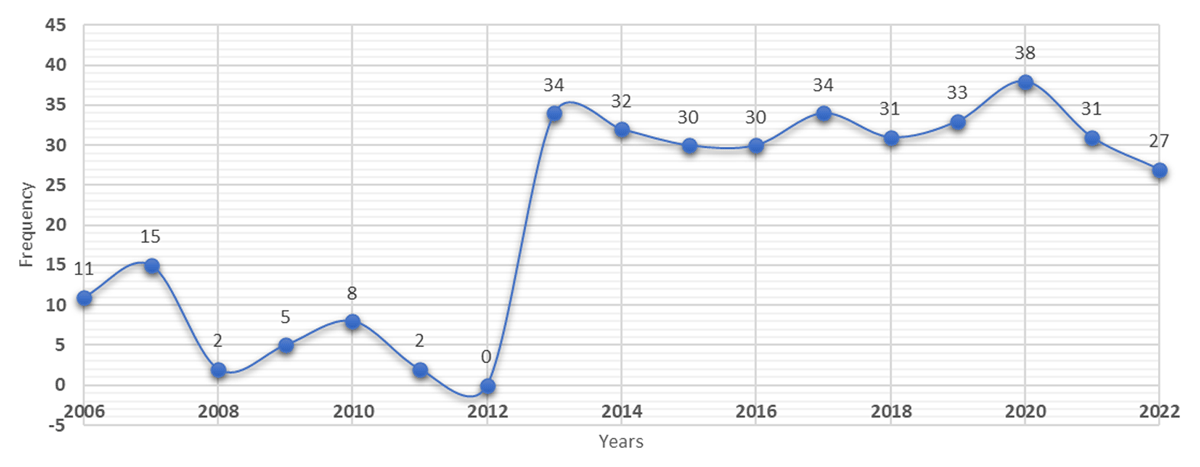
Figure 1
Number of publications by years.
When we examine the country base contribution (see Figure 2), we see that a total of 53 countries contributed to scientific production. Among these, the US (n = 158), UK (n = 86), Turkey (n = 66), Canada (n = 56), Australia (n = 43), India (n = 42), South Africa (n = 40), Spain (n = 36), and Pakistan (n = 26) are the leading countries that contribute to the scientific production.
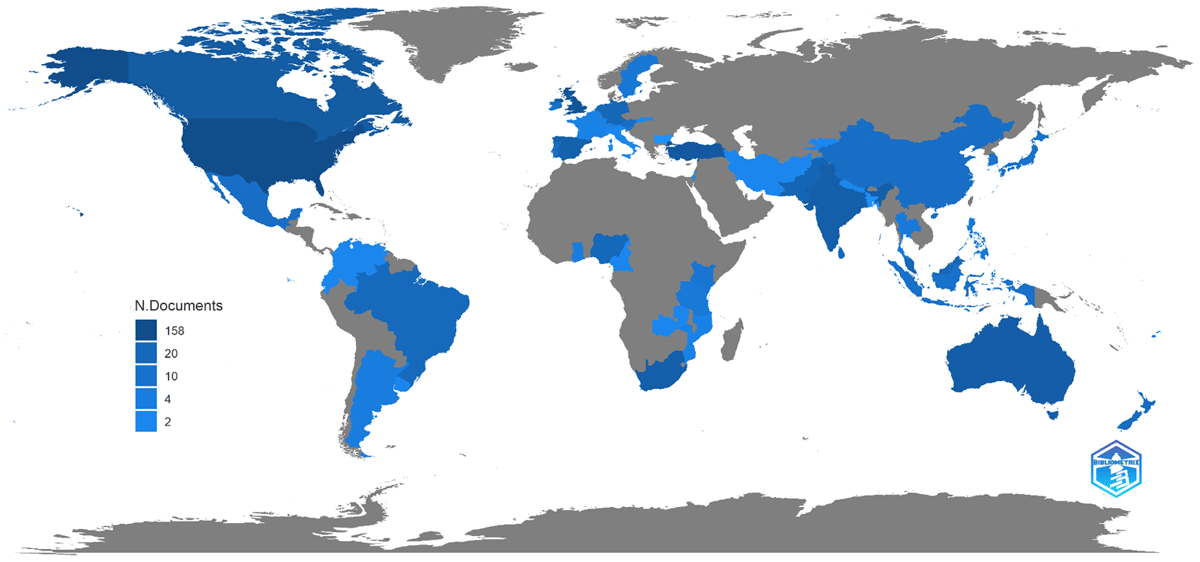
Figure 2
Country base contribution trends.
Our analysis of country-based collaboration (see Figure 3) revealed that although there is a pattern of collaboration among many countries, there is a strong tendency for collaboration between the UK and Canada, as well as between Australia and New Zealand. These patterns suggest a need to encourage authors from continents such as Africa, East Europe, and North Asia to collaborate more actively.
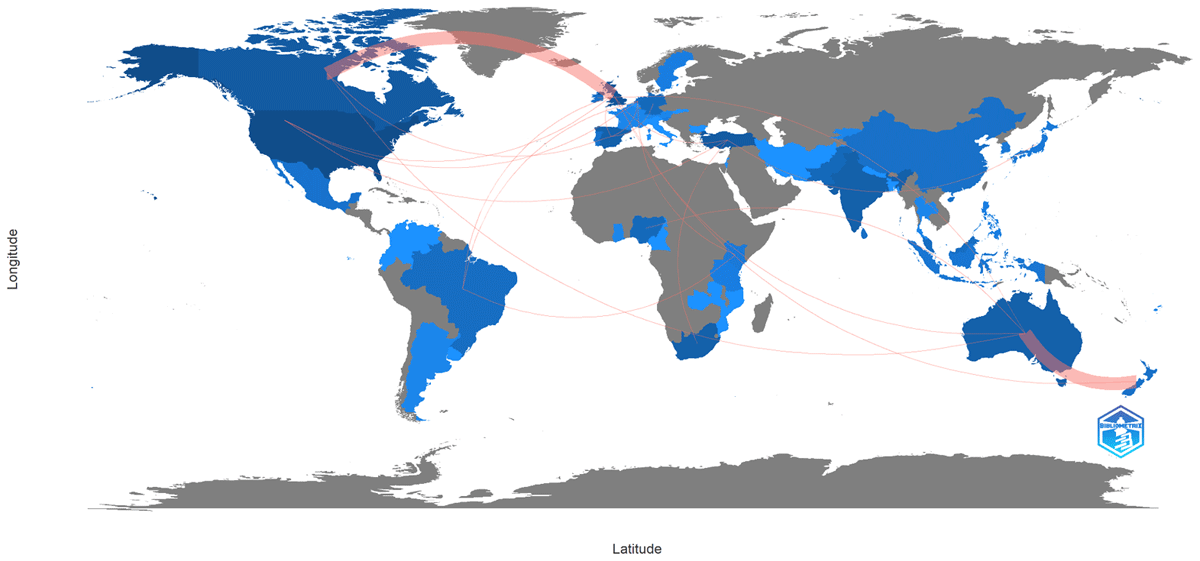
Figure 3
Country base collaboration patterns.
Research Trends and Patterns
The thematic evaluation of research trends (see Figure 4) highlighted some key patterns. One of the most notable trends is the significant growth of research on open educational resources (OER), online learning, and open and distance learning practices. These trends suggest that traditional distance education has become an integral part of mainstream education in the form of online learning, and that online technologies have revolutionized collaboration, and delivery of education. These initial findings are consistent with previous research that highlights the multifaceted nature of openness. For instance, Zawacki-Richter et al. (2020) argue that “throughout history, openness has been given many meanings: access, flexibility, equity, collaboration, agency, democratization, social justice, transparency, and removing barriers.” (p. 321) and it widely benefits from flexible delivery modes such as open, online, and distance education. Moreover, the study supports the idea that open, online, and distance education are essential in advancing openness and its related concepts, such as OER, OEP, and MOOCs, which form a larger ecosystem of openness (Bozkurt et al., 2019; Stracke et al., 2023a; Zawacki-Richter et al., 2020; Weller et al., 2018). The study further suggests that these terms should not be treated as isolated entities but rather as interconnected components of a broader openness ecosystem (Bozkurt et al., 2019; Stracke et al., 2023b).
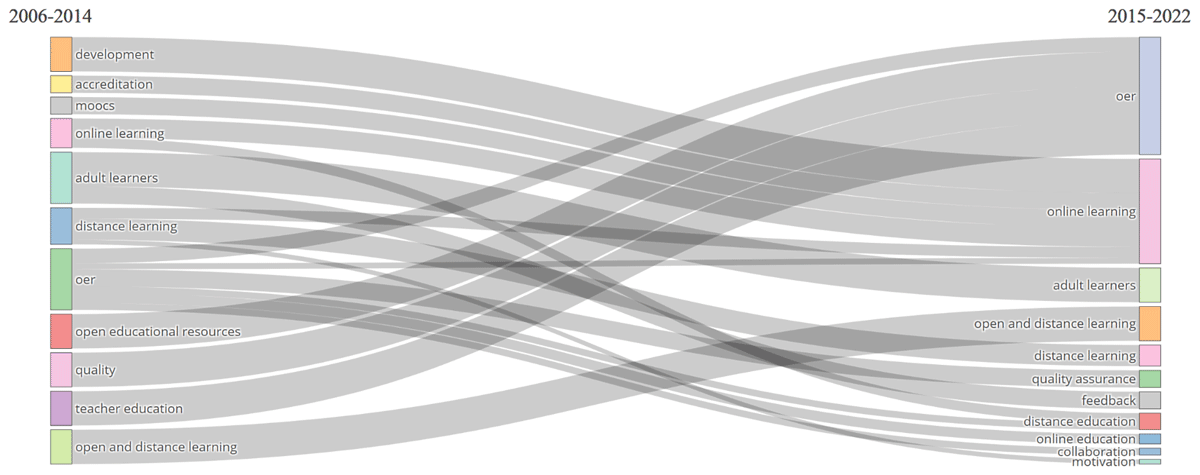
Figure 4
Thematic evolution of research published in Open Praxis.
This section provides text mining of the titles and abstracts (see Figure 5) and SNA of the keywords (see Figure 6). For text-mining, a lexical analysis was performed, and for SNA, the co-occurrences of the keywords were examined and visualized on a network graph. By combining both strands of analysis, the authors were able to trace the roots of broad main themes across the various layers of the scholarly papers.
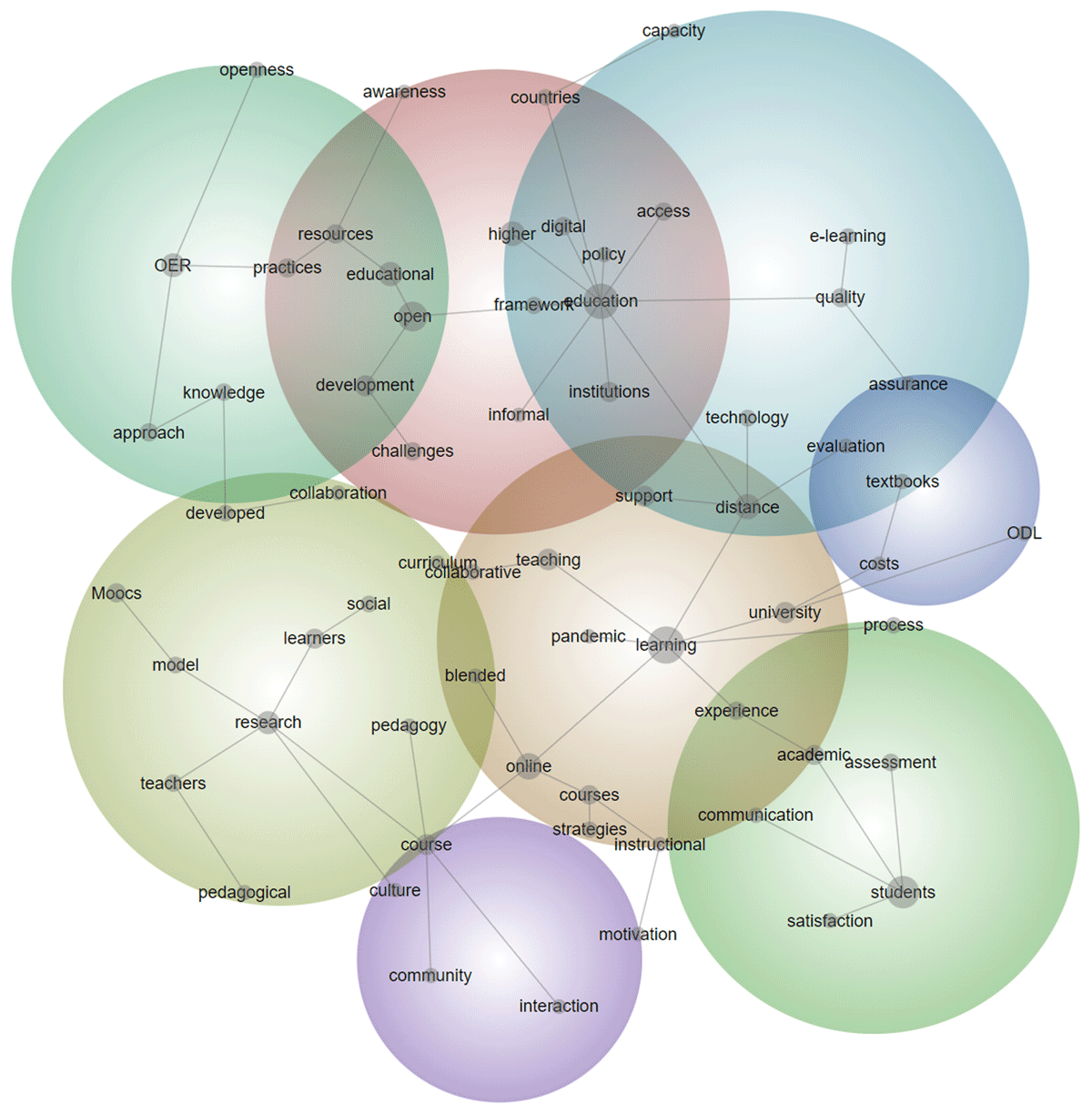
Figure 5
Text-mining analysis of the titles and abstracts of the articles published in Open Praxis.
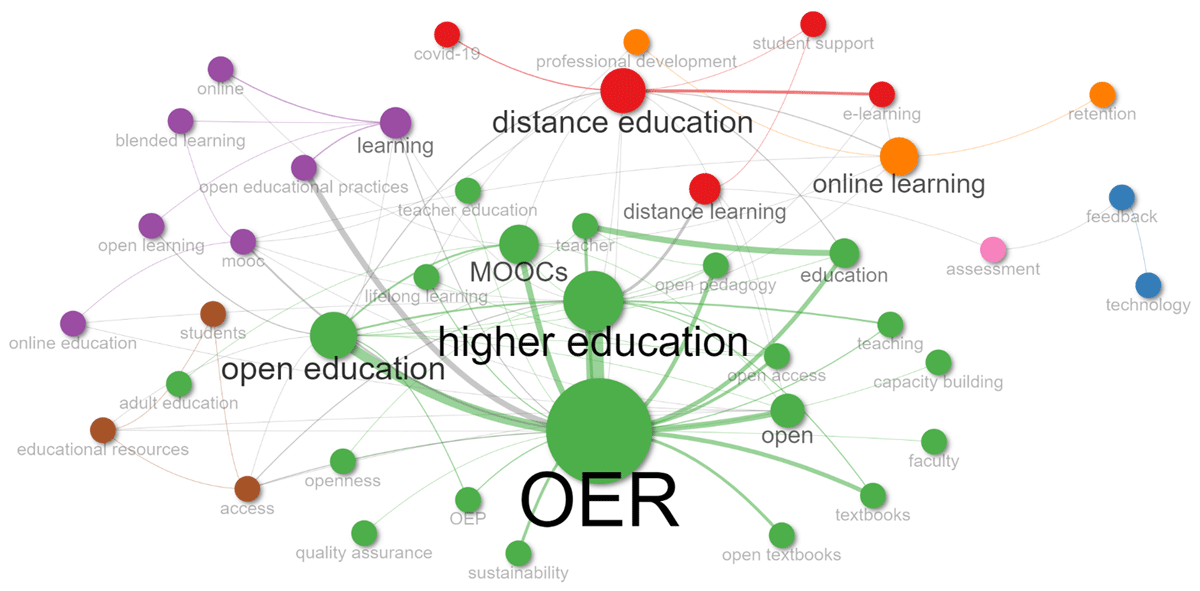
Figure 6
Social network analysis of the keywords of the articles published in Open Praxis.
Openness as a praxis
The first theme is identified using the text-mining and SNA patterns (see path in Figure 5: open, education, educational, resources, practices, OER, openness; see nodes in Figure 6: OER, OEP, open education, open learning, open textbooks, open access, open pedagogy, openness). The concept of openness in education encompasses a broad range of dimensions, levels, and layers, as evidenced by the works of various scholars (Cronin, 2017; Cronin & MacLaren, 2018; Marin et al., 2020, 2022a, 2022b; Paskevicius, & Irvine, 2021; Pomerantz and Peek, 2016; Smith & Seward, 2017). This complexity forms an ecosystem, as emphasized by Bozkurt and Stracke (2023), which requires a praxis-oriented perspective to address the theoretical, conceptual, and practical implications of openness in the education system. Cronin and MacLaren (2018) note that “open education often carries the weight of describing not just policy, practices, resources, curricula, and pedagogy, but also the values inherent within these, as well as relationships between teachers and learners” and they also critically question if openness and open education are “a slogan or a philosophy, a metaphor, model, or movement?”. As it is clear from our analysis, the journal Open Praxis provides a platform for empirical research and scholarly critical views that best address such questions.
Digital and online technologies as a catalyst for openness
The second theme is identified using the text-mining and SNA patterns (see paths in Figure 5: online, course, pedagogy, community, interaction, and digital, education, institutions, and learning, distance, technology, and elearning, quality, education; see nodes in Figure 6: Online education, online learning, distance education, elearning, higher education, lifelong learning). Digital and online technologies in education, that is educational technology, widely influenced educational theories and practices. Supporting this view, Zawacki-Richter and Jung (2023) argue that open, distance, and digital education (ODDE), and more specifically “online learning, has been seen as a main or alternative mode of delivery to widen access to education, provide flexibility and openness in school education, satisfy continuing educational needs of adults, expand the trained workforce, train teachers to improve the quality of schooling, and/or increase cross-border traffic in education” (p. 4). In a similar vein, Weller (2023) also noted that digital education has a direct relationship with open education and has grown exponentially by the new millennium and onward. Bozkurt and Zawacki-Richter (2021) highlighted the critical role of technology, and Zawacki-Richter and Bozkurt (2023) further argued that “ODDE is now practiced in its different forms across all disciplines and on all educational levels from pre-school to higher education” (p. 216). However, while digital and online technologies played a significant role as a catalyst for openness, the openness ecosystem is much broader and there still are other different elements (Zawacki-Richter et al., 2020) that should be examined empirically and critically (Peng & Xiao, 2022) by ensuring rigor in the design, development, and implementation of ODDE research (Naidu, 2022) and this is where journal of Open Praxis steps in.
Conclusion and Insights for Future Research Directions
Open Praxis has been playing a crucial role in producing and sharing empirical data and critical scholarly perspectives. As an academic journal, it holds significant responsibility in this regard and will continue to contribute to the academic landscape. Our bibliometric analysis has shown that we need to make additional efforts to be inclusive and to represent diverse critical and thought-provoking viewpoints worldwide, creating a more accessible and comprehensive academic community. We have already identified key themes covered in Open Praxis through text-mining and social network analysis, and we plan to explore neglected gray areas in the future.
Acknowledgements
The current Editor-in-Chief of Open Praxis journal, Dr. Aras Bozkurt, pays his respects to his predecessor, Dr. Inés Gil-Jaurena for her service on behalf of Open Praxis, ICDE, and the broad scholarly community.
Competing interests
The authors have no competing interests to declare.