
Table 1
SDG7 interactions with SDG3, SDG8 and SDG13 and the key knowledge gaps (as identified and adapted from the broader ICSU list of SDG7 interactions, 2017, 167–169.
| SDG7 INTERACTS I. A. WITH THE FOLLOWING SDGS | IDENTIFIED KEY KNOWLEDGE GAPS OF SDG7 WITH THREE OTHER SDGS |
|---|---|
| SDG3 – Good health and well-being |
|
| SDG8 – Decent work and economic growth |
|
| SDG13 – Climate action |
|
Table 2
Key competencies for sustainability (UNESCO, 2017, p. 10).
| A KEY COMPETENCY FOR SUSTAINABILITY | THIS COMPETENCY COMPRISES THE ABILITIES TO: |
|---|---|
| 1. Systems thinking | recognize and understand relationships, analyse complex systems and think of how they are embedded within different domains |
| 2. Anticipatory competency | understand and evaluate multiple futures (possible, probable, and desirable) and create one’s own visions for the future |
| 3. Normative competency | understand and reflect on the norms and values that underlie one’s actions and negotiate sustainability values |
| 4. Strategic competency | collectively develop and implement innovative actions that further sustainability |
| 5. Collaboration | learn from others, understand and respect the needs, perspectives and actions of others (empathy); facilitate collaborative and participatory problem solving |
| 6. Critical thinking | question norms, practices and opinions and reflect on one’s own values, perceptions and actions |
| 7. Self-awareness | reflect on one’s own role in society and continually evaluate and further motivate one’s actions |
| 8. Integrated problem-solving | apply different problem-solving frameworks to complex sustainability problems and develop viable, inclusive and equitable solutions |
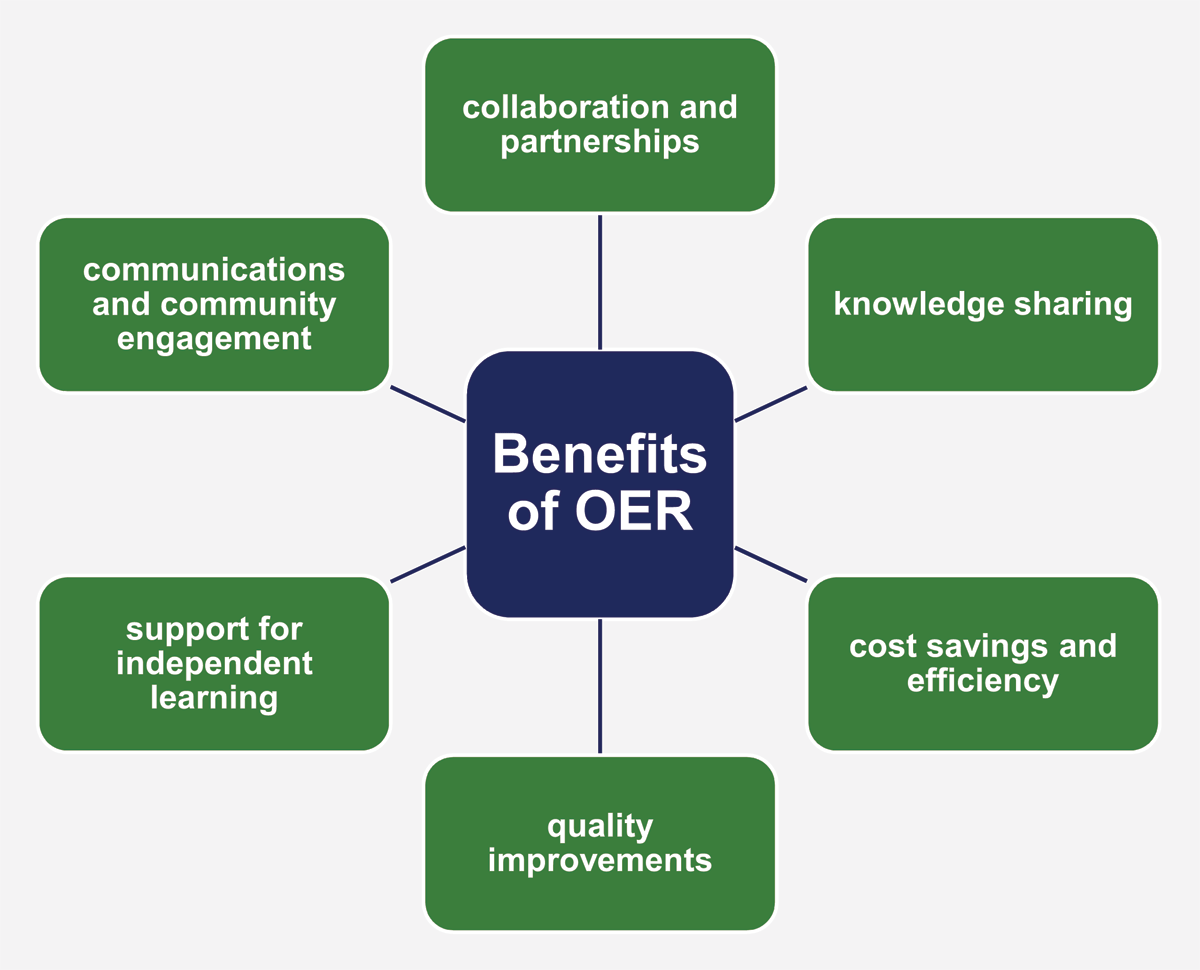
Figure 1
Six general benefits of OER (Bliss, Tonks & Patrick, 2013).
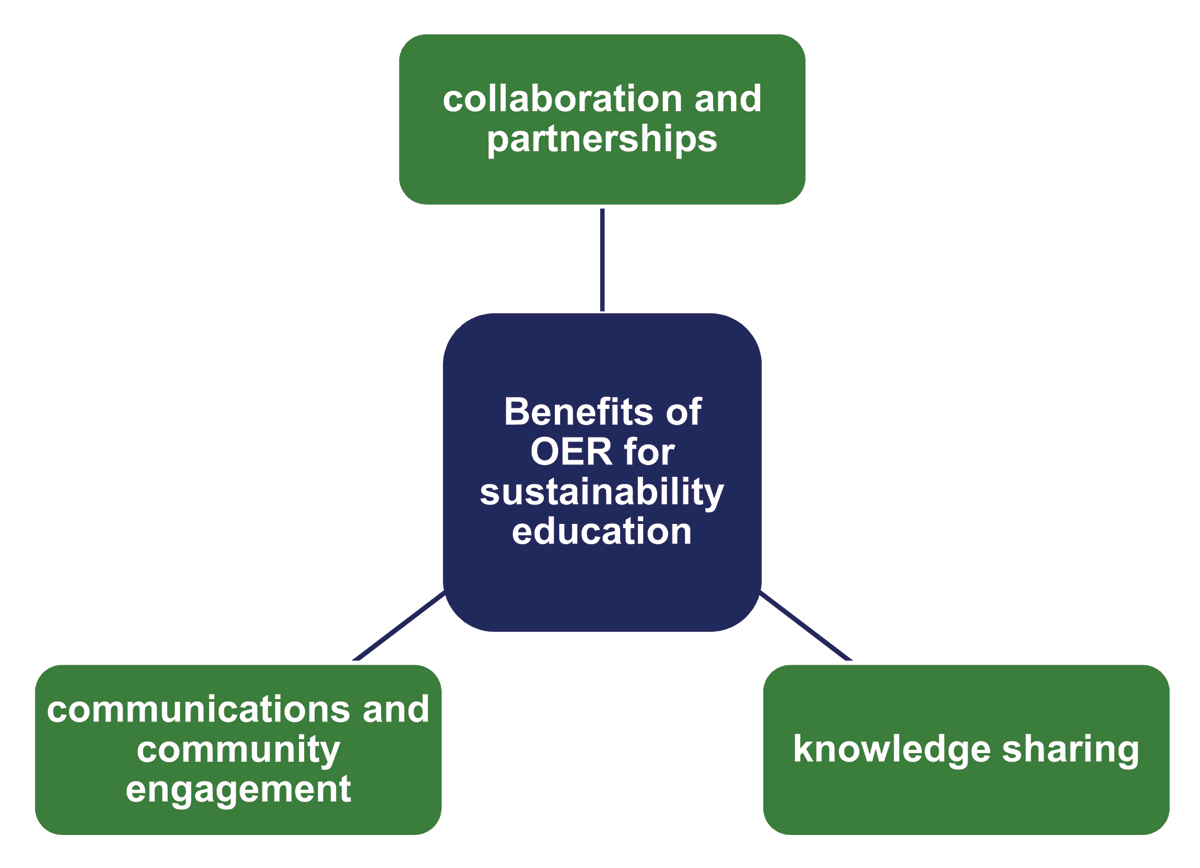
Figure 2
Three key benefits of OER, selected from general benefits of OER (Figure 1), which are of central importance from the perspective of key competencies for education for sustainability.
Table 3
Description of the key benefits of OER, relevant for the education for sustainability competencies and terminologically partly adapted from Bliss, Tonks and Patrick (2013).
| BENEFIT OF OER | BRIEF DESCRIPTION |
|---|---|
| Collaboration and partnerships | OER can create powerful partnering learning opportunities by enabling stakeholders to see, develop, share, and reuse quality OER to meet the learners’ unique requirements and needs. |
| Knowledge sharing | OER enables knowledge sharing for the benefit of all learners and educators by widening access to high-quality resources; they help bridge the gap between formal and informal learning by widening access to quality material outside the classroom and promoting lifelong learning. |
| Communications and community engagement | OER serve as a model for engaging learners in activities such as development and review and highlight the opportunities through open content. |
Table 4
OE4BW’s hub activities and their connection to the key competencies for education for sustainability and the benefits of OER.
| OE4BW’S SDG7 HUB & ENERGY, BIODIVERSITY AND SUSTAINABLE LIVING HUB TEAMWORK ACTIVITIES | RELATION TO THE KEY COMPETENCIES FOR EDUCATION FOR SUSTAINABILITY (UNESCO, 2017) | RELATION TO THE OER BENEFITS (BLISS, 2013) |
|---|---|---|
| Introductory hub meeting: Joint presentation of the SDG7 and related SDGs, their targets and interactions | Systems thinking competency, strategic competency, integrated problem-solving competency | Knowledge sharing |
| Regular hub meetings: The motivation of developers to define and present their OER projects from the SDG-interactions perspective, as well as to discuss potential connections to other OER projects in the hub | Strategic competency, critical thinking competency, self-awareness competency | Collaboration and partnerships |
| Presentation of implemented OER at the OE4BW final event and teamwork promotion: Presentation of OER projects in a topically oriented final event and upload of OER materials into the joint iEnergy Open Library; promotion of the hub’s teamwork (events, workshops etc.) | Collaboration competency, self-awareness competency, integrated problem-solving competency | Communications and community engagement |
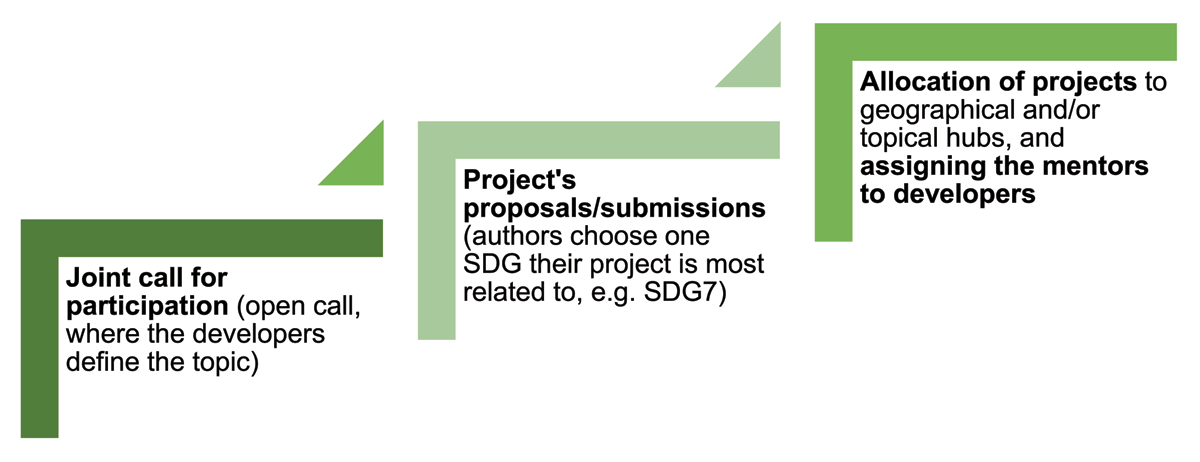
Figure 3
Existing procedure on the general OE4BW level (implemented by the OE4BW organising team).
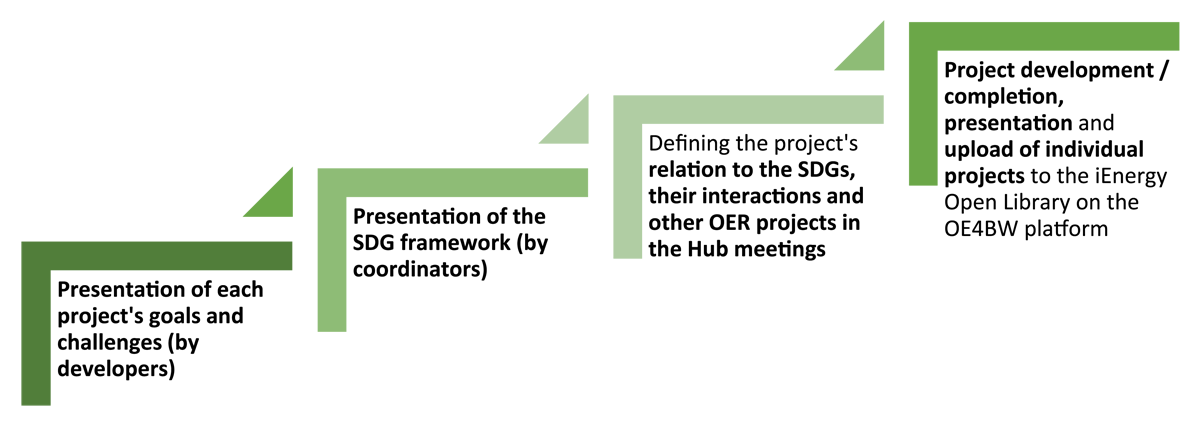
Figure 4
Existing procedure on the topical hub level (implemented by the topical hub coordinators).
Table 5
OE4BW program’s OER projects, involved in the SDG7 Hub (the year 2019/20) and the Energy, Biodiversity and Sustainable Living Hub (the year 2020/21), and their connections to the SDGs.
| PROJECT TITLE | DEVELOPER | COUNTRY | CONNECTION(S) TO THE SDG(S) |
|---|---|---|---|
| 2020 OE4BW projects (SDG7 Hub) | |||
| History of transport | Satwant Balse | India | SDG7, SDG9, SDG13 |
| Understanding sustainable energy | Basil Dmello | India | SDG7, SDG13 |
| Meet the World of energy | Melita Lenošek Kavcic | Slovenia | SDG7, SDG11, SDG13 |
| Inquiry and concept-based pedagogy in education for sustainable development | Sumit Nair | Sweden | SDG4, SDG7, SDG13 |
| Climate change education | Pradnya Wakpainjan | India | SDG13, SDG11, SDG7 |
| iEnergy Open Library | Mojca Drevensek | Slovenia | SDG7, SDG4, SDG11, SDG13 |
| 2021 OE4BW projects (Energy, Biodiversity and Sustainable Living Hub) | |||
| Towards clean energy | Satwant Balse | India | SDG3, SDG7, SDG8, SDG9, SDG11, SDG12 and SDG14 |
| NEWCOMERS project: OER for new clean energy communities | Mojca Drevensek | Slovenia | SDG7, SDG11, SDG13 |
| Make a dream to stay green | Dibyayoti Bhattacharyja | India | SDG15 |
| URBiNAT: Healthy corridors as drivers of social housing neighbourhoods | Saša Dobricic | Slovenia | SDG11 |
| GIS and spatial analysis for biodiversity conservation | Lucy Tallents | UK | SDG15 |
| Plant Tissue Culture | Didwana Vinodkumar | India | SDG8 |
| Basics of Angiosperm Taxonomy | Hensal Rodriges | India | SDG15 |
| Inclusive Growth & Sustainable Living | Singh Rohit | India | SDG8 |
| Energy @ Wikipedia | Iva Tajnšek | Slovenia | SDG7, SDG4 |
[i] Note: Please note that these connections were defined in hub meetings during the development of OER and are subject to change in the project’s finalisation phase or its future development.
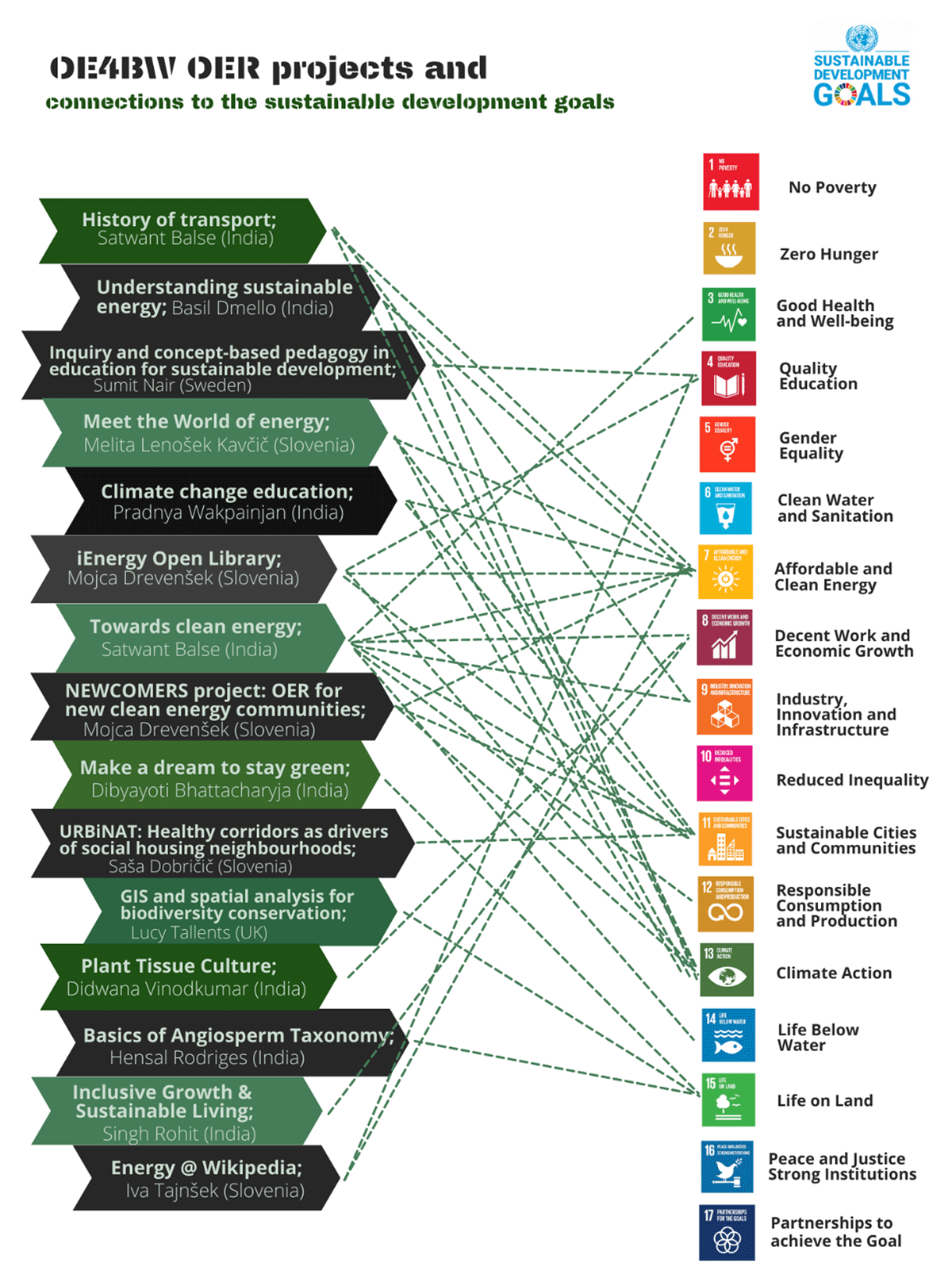
Figure 5
OE4BW projects, developed in the SDG7 Hub (the year 2019/20) and the Energy, Biodiversity and Sustainable Living Hub (the year 2020/21), and their connections to one or more SDGs.
Figure 6
The front page of the iEnergy Open Library.
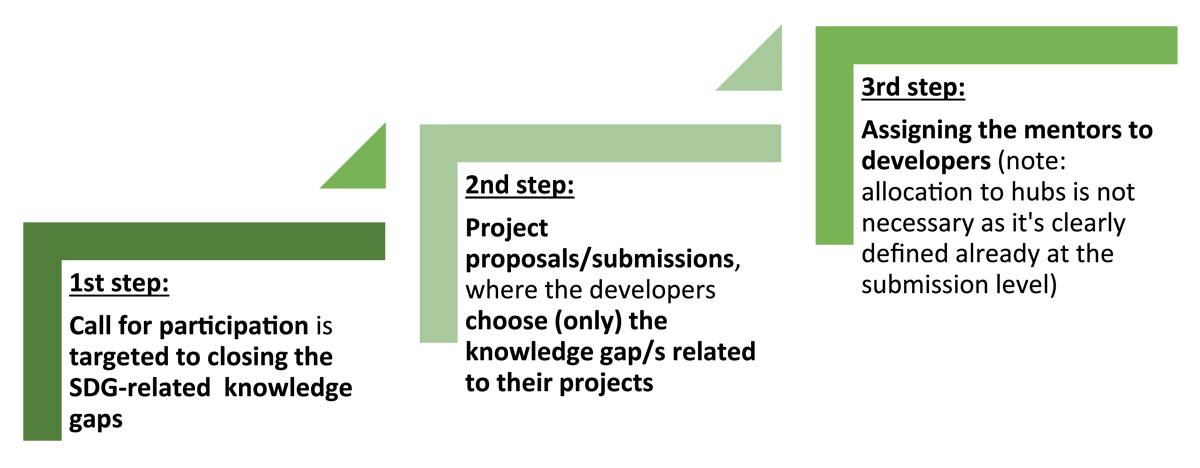
Figure 7
Suggested modified procedure on the general OE4BW level (implemented by the OE4BW organising team).
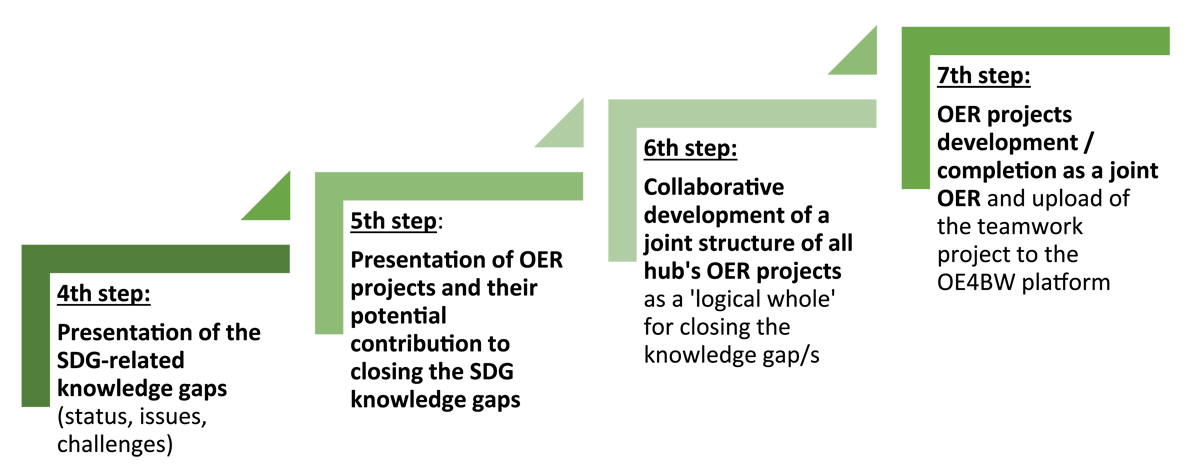
Figure 8
Suggested modified procedure on the topical hub level (implemented by the topical hub coordinators).
Table 6
An exemplary list of ten possible topics, derived from the knowledge gaps, as identified in interaction of the SDG7 with three other SDGs.
|