
Figure 1
Distribution of patients according to occupation
| Name | Patients |
|---|---|
| Govt. servant | 21 |
| Businessman | 18 |
| Shopkeeper | 9 |
| Teacher | 15 |
| Others | 37 |
| Total | 100 |
Pathological correlation of multiple sclerosis with musculoskeletal disability
| Symptoms | No. of patients |
|---|---|
| Musculoskeletal disease | 54 |
| Psychosomatic effect | 70 |
| Fatigue disease | 19 |
| Blurred vision | 48 |
| D. Pallor | 25 |
| Numbness | 69 |
| Slurring speech | 3 |
| Ataxic gait | 9 |
| incoordination | 7 |
| Spasticity | 10 |
| Weakness | 53 |
| Eye/vision problems | 57 |
Distribution of multiple sclerosis plaques in brain parenchyma
| No of lesions Mean | Standard deviation | |
|---|---|---|
| Temporal lobe (n = 9) | 0.2 | 0.63 |
| Juxtacortical (n = 62) | 13.1 | 9.20 |
| Periventricular (n = 96) | 0.1 | – |
| Corpus callosum (n = 2) | 13.7 | 9.33 |
| Infratentorial (n = 16) | 0.7 | 2.65 |
| Temporal (n = 8) | 1.5 | 2.28 |
| Paraventricular (n = 97) | 12.5 | 9.91 |
| Parahippocampus (n = 4) | 13.9 | 9.25 |
| Acute (n = 82) | 0.0 | – |
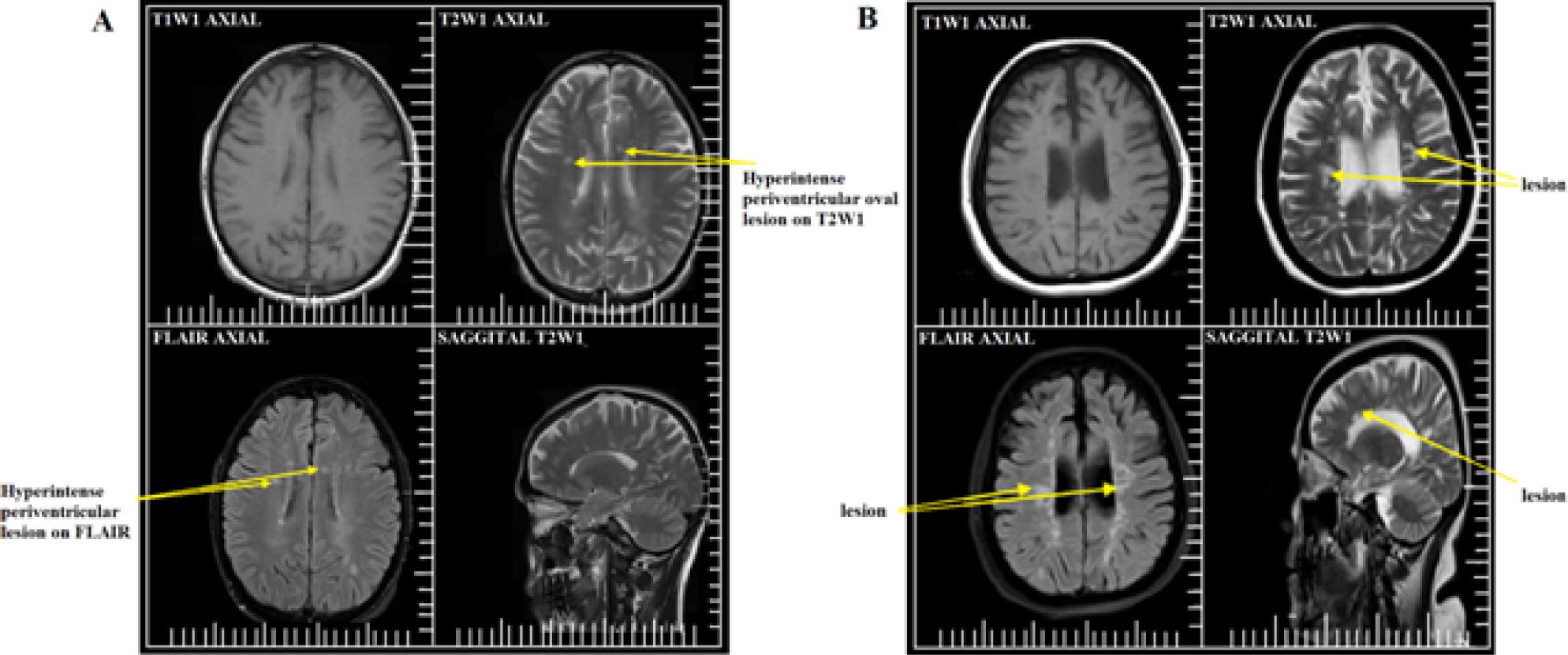
Detection of multiple sclerosis plaques by magnetic resonance imaging
| Sequences | Lesions detected |
|---|---|
| T1W1 | 47 |
| T2W1 | 99 |
| Flair | 100 |
Frequency of lesions in patients with multiple sclerosis
| Symptoms | No. of patients |
|---|---|
| Deep white matter disease | 95 |
| Temporal lobe lesions | 9 |
| Juxtacortical lesions | 62 |
| Periventricular lesions | 96 |
| Infratentorial lesions | 16 |
| Supratentorial lesions | 97 |