
Table 1
Phenotypic spectrum of genetically confirmed VPS13A disease.
| DOMAIN | FEATURE/PHENOMENOLOGY | TOPOGRAPHY/SUBTYPE | n (%) |
|---|---|---|---|
| Movement disorders | Chorea | Generalized | 18/18 (100.0%) |
| Upper face | 8/18 (44.4%) | ||
| Lower face | 12/18 (66.7%) | ||
| Lingual | 11/18 (61.1%) | ||
| Upper limb | 17/18 (94.4%) | ||
| Lower limb | 17/18 (94.4%) | ||
| Trunk/neck | 16/18 (88.9%) | ||
| Dystonia | Blepharospasm | 5/18 (27.8%) | |
| Jaw | 9/18 (50.0%) | ||
| Lower facial | 11/18 (61.1%) | ||
| Lingual | 16/18 (88.9%) | ||
| Laryngeal | 1/18 (5.6%) | ||
| Cervical | 4/18 (22.2%) | ||
| Truncal | 2/18 (11.1%) | ||
| Lower limb | 3/18 (16.7%) | ||
| Upper limb | 2/18 (11.1%) | ||
| Tics | 9/18 (50.0%) | ||
| Ataxia | 3/18 (16.7%) | ||
| Stereotypies | 3/18 (16.7%) | ||
| Other movement disorder | Parkinsonism | 2/18 (11.1%) | |
| Myoclonus | 2/18 (11.1%) | ||
| Akathisia | 2/18 (11.1%) | ||
| Tremor | 1/18 (5.6%) | ||
| Eye movement abnormalities | Delayed vertical saccade initiation | 6/18 (33.3%) | |
| Delayed horizontal saccade initiation | 6/18 (33.3%) | ||
| Slow/absent vertical saccades | 4/18 (22.2%) | ||
| Slow/absent horizontal saccades | 4/18 (22.2%) | ||
| Restricted vertical gaze | 0/18 (0.0%) | ||
| Restricted horizontal gaze | 1/18 (5.6%) | ||
| Ophthalmoparesis | 1/18 (5.6%) | ||
| Nystagmus | 0/18 (0.0%) | ||
| Orofacial/Bulbar | Feeding dystonia | 17/18 (94.4%) | |
| Dysarthria | 16/18 (88.9%) | ||
| Lingual dystonia | 16/18 (88.9%) | ||
| Oral Injuries | 12/18 (66.7%) | ||
| Dysphagia | 4/18 (22.2%) | ||
| Psychiatric | Anxiety | 9/15 (60.0%) | |
| Depression | 8/15 (53.3%) | ||
| Psychosis | 2/16 (12.5%) | ||
| Additional neurological features | Rubber-man/woman gait | 10/18 (55.6%) | |
| Peripheral neuropathy | 12/18 (66.7%) | ||
| Seizures | 7/18 (38.9%) | ||
| Myopathy | 3/18 (16.7%) | ||
| Pyramidal signs | 2/18 (11.1%) | ||
| Sleep abnormalities | 2/18 (11.1%) | ||
| Dysautonomia | 1/18 (5.6%) | ||
| Neuroimaging findings | Caudate atrophy | 14/15 (93.3%) | |
| Caudate signal change | 6/12 (50.0%) | ||
| Putamen signal change | 5/12 (41.7%) | ||
| Putamen atrophy | 6/13 (46.2%) | ||
| Cerebellar atrophy | 4/14 (28.6%) | ||
| Cortical atrophy | 4/14 (28.6%) | ||
| Striatal iron deposition | 1/11 (9.1%) | ||
[i] *Denominators vary across neuroimaging findings because magnetic resonance imaging availability, sequence coverage, and interpretability differed by patient and by imaging feature; percentages were calculated using the number of patients with assessable imaging for each finding.
Video 1
Representative movement phenomenology in genetically confirmed VPS13A disease.
Case 2: Broken horizontal and vertical smooth pursuits without ophthalmoparesis. Generalized chorea involving the bilateral upper and lower limbs, trunk, upper and lower face, with a jack-in-the-box tongue. During walking, choreiform movements were more prominent in the left upper limb, with additional lower-limb involvement. Parkinsonian gait with hypomimia was also evident.
Case 8: Lower facial chorea with jack-in-the-box tongue, characterized by inability to sustain tongue protrusion, along with lingual dystonia.
Case 9: Blepharospasm with a geste antagoniste, relieved by touching/bringing the hand toward the forehead. Generalized chorea involved the upper and lower face, bilateral upper and lower limbs, and trunk. Mild feeding dystonia was seen while bringing food into the mouth, without difficulty in chewing or swallowing. Hypomimia and a parkinsonian gait were present.
Case 11: Severe oromandibular–bulbar involvement with lingual dystonia, jack-in-the-box tongue, oral injuries, drooling, marked feeding dystonia, significant dysarthria, and orofacial dystonia. Chorea involved the upper limbs, more prominent on the right, with truncal involvement and gait instability showing a rubber-woman pattern. Hypomimia/parkinsonian facial expression was also evident.
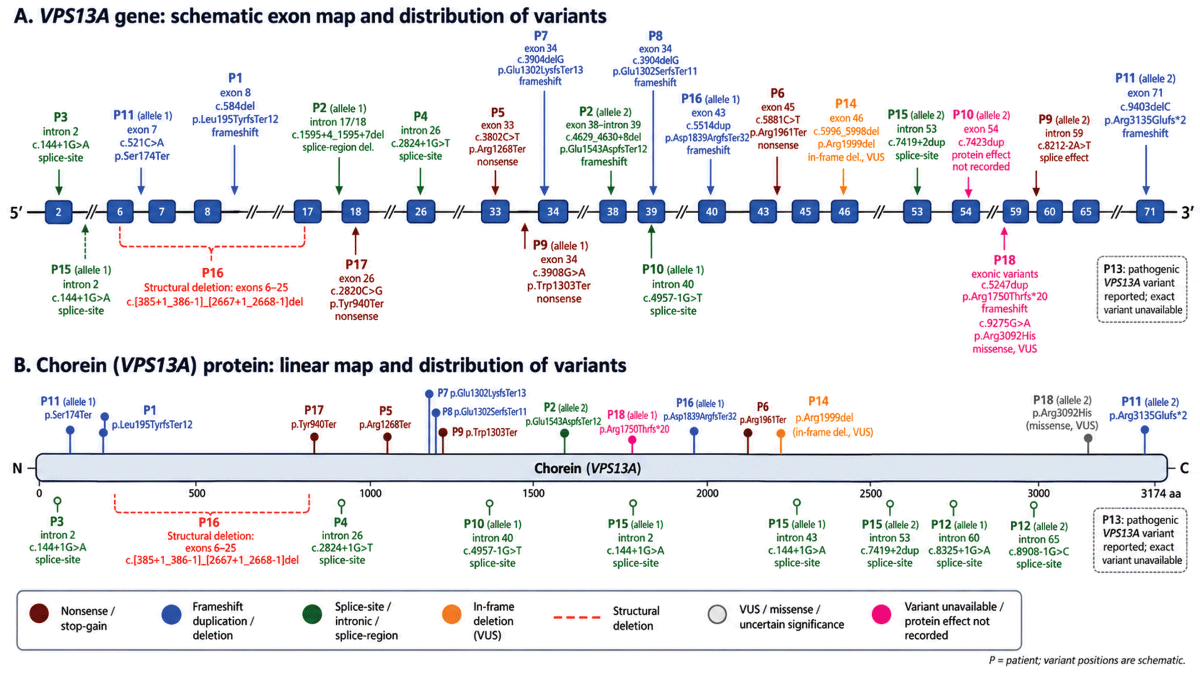
Figure 1
VPS13A gene and chorein protein variant map.
Schematic localization of recorded VPS13A variants across the gene and chorein protein. Positions are approximate. P, patient; VUS, variant of uncertain significance.
Table 2
VPS13A variant spectrum, testing method, zygosity, localization, and ACMG classification in genetically confirmed VPS13A disease.
| PATIENT ID | GENETIC TEST | ZYGOSITY | REFSEQ | VPS13A VARIANT(S) | PROTEIN CHANGE | VARIANT CLASS/LOCALIZATION | ACMG/SOURCE CLASSIFICATION | GNOMAD |
|---|---|---|---|---|---|---|---|---|
| Patient 1 | Whole-exome sequencing | Homozygous | NM_033305.3 | Exon 8 c.584del | p.Leu195TyrfsTer12 | Exonic/coding; frameshift | Likely pathogenic (PVS1, PM2) | Novel |
| Patient 2 | Whole-exome sequencing | Compound heterozygous | NM_033305.3 | c.1595 + 4_1595 + 7del/ c.4629_4630 + 8del | Not available/ p.Glu1543AspfsTer12 | Exon-Intron junction 17 deletion/ Exon 38-intron 39 splice junction deletion | VUS (Splice AI 0.99)/ Likely pathogenic (Splice AI score 1.00) | Novel |
| Patient 3 | Targeted gene panel | Homozygous | NM_033305.3 | Intron 2 c.144+1G>A | Not available | Intronic/splice-site | Likely pathogenic (Splice AI score 0.99) | Novel |
| Patient 4 | Whole-exome sequencing | Homozygous | NM_033305.3 | Intron 26 c.2824+1G>T | Not available | Intronic/splice-site | Likely pathogenic (Splice AI score: 1.00) | Novel |
| Patient 5 | Whole-exome sequencing | Homozygous | NM_033305.3 | Exon 33 c.3802C>T | p.Arg1268Ter | Exonic/coding; nonsense | Pathogenic (PVS1, PM2) | Minor allele frequency 0.004% (gnomAD) Not reported in SAS gnomAD Reported in ClinVar 2184590 |
| Patient 6 | Whole-exome sequencing | Homozygous | NM_033305.3 | Exon 45 c.5881C>T | p.Arg1961Ter | Exonic/coding; nonsense | Pathogenic (PVS1, PM2, PM3) | Minor allele frequency 0.006% (gnomAD) Minor allele frequency (MAF): 1.1 × 10⁻⁵ in SAS gnomAD Reported in ClinVar 1458994 |
| Patient 7 | Whole-exome sequencing | Homozygous | NM_033305.3 | Exon 34 c.3904delG | p.Glu1302 LysfsTer13 | Exonic/coding; frameshift | Pathogenic (PVS1, PM2, PP4) | Minor allele frequency 1.24e-6 (gnomAD) Not reported in SAS gnomAD Absent in ClinVar |
| Patient 8 | Targeted gene panel | Homozygous | NM_033305.3 | Exon 34 c.3904delG | p.Glu1302SerfsTer11 | Exonic/coding; frameshift | Pathogenic (PVS1, PM2, PP4) | Minor allele frequency 1.24e-6 (gnomAD) Not reported in SAS gnomAD Absent in ClinVar |
| Patient 9 | Whole-exome sequencing | Compound heterozygous | NM_033305.3 | Exon 34 c.3908G>A/Intron 59 c.8212-2A>T | p.Trp1303Ter/splice effect | Mixed exonic + intronic/splice-region | Pathogenic (PVS1, PM2,PM3)/Pathogenic (PVS1, PM2, PM3) | Novel ClinVar 2064491/Novel |
| Patient 10 | Whole-exome sequencing | Compound heterozygous | NM_033305.3 | Intron 40 c.4957-1G>T/exon 54 c.7423dup | Splice effect/not recorded | Mixed exonic + intronic/splice-region | Likely pathogenic (PVS1, PM2) (Splice AI score 0.98) | Novel |
| Patient 11 | Whole-exome sequencing | Compound heterozygous | NM_033305.3 | Exon 7 c.521C>A/exon 71 c.9403delC | p.Ser174Ter/p.Arg3135Glufs*2 | Exonic/coding; nonsense + frameshift | Likely pathogenic (PVS1, PM2) | Novel |
| Patient 12 | Clinical exome sequencing | Compound heterozygous | NM_033305.3 | Intron 60 c.8325+1G>A/intron 65 c.8908-1G>C | Not available | Intronic/splice-site | Likely pathogenic (PVS1, PM2, PP5) (Splice AI score 1.00)/Likely pathogenic (PVS1, PM2) (Splice AI score 0.84) | Minor allele frequency 5.77e-6 in gnomAD ClinVar 1347984 (classified variably as likely pathogenic and VUS)/Novel |
| Patient 13 | Targeted gene panel | Not available | NM_033305.3 | Not available | Not available | Not available | Pathogenic | – |
| Patient 14 | Clinical exome sequencing | Homozygous | NM_033305.3 | Exon 46 c.5996_5998del | p.Arg1999del | Exonic/coding; in-frame deletion | Pathogenic (PVS1, PM2, PP4) | Novel |
| Patient 15 | Whole-exome sequencing | Compound heterozygous | NM_033305.3 | Intron 2 c.144+1G>A/Intron 53 c.7419 + 2dup | Not available | Intronic/splice-site | Likely pathogenic (Splice AI score 0.99)/ Pathogenic (Splice AI score 0.88) | Novel |
| Patient 16 | Whole-exome sequencing | Compound heterozygous | NM_033305.3 | Exon 43 c.5514dup/exons 6–25 deletion c.[385 + 1_386-1]_[2667 + 1_2668-1]del | p.Asp1839ArgfsTer32/structural deletion | Exonic/coding + structural deletion | Pathogenic (PVS1, PM2, PM3)/Pathogenic (PVS1, PM2, PM3) | Novel |
| Patient 17 | Whole-exome sequencing | Homozygous | NM_033305.3 | Exon 26 c.2820C>G | p.Tyr940Ter | Exonic/coding; nonsense | Pathogenic (PVS1, PM2, PP4) | Novel |
| Patient 18 | Single-gene study | Compound heterozygous | NM_033305.3 | Exonic c.5247dup/c.9275G>A | p.Arg1750Thrfs*20/ p.Arg3092His | Exonic/coding | Pathogenic (PVS1, PM2, PM3)/VUS (PM2, PM3, PP3) | Novel/Minor allele frequency (0.0004%) in gnomAD Absent in SAS gnomAD Reported in ClinVar 3603267 |
[i] *ACMG = American College of Medical Genetics and Genomics; ClinVar = clinical variant archive; gnomAD = Genome Aggregation Database; RefSeq = Reference Sequence; SAS = South Asian; VUS = variant of uncertain significance. ACMG evidence codes are shown as reported in clinical genetic reports.
Table 3
Comparison of patients independent versus dependent in activities of daily living at last follow-up.
| FEATURE | INDEPENDENT (n = 12) | DEPENDENT (n = 5) |
|---|---|---|
| Median age at onset, years | 28.5 (18–49) | 28.0 (25–44) |
| Median symptom duration, years | 5 (2–20) | 6 (2–12) |
| Choreic onset (first symptom) | 5/12 (41.7%) | 4/5 (80.0%) |
| Seizures | 4/12 (33.3%) | 3/5 (60.0%) |
| Peripheral neuropathy | 7/12 (58.3%) | 4/5 (80.0%) |
| Dysphagia | 2/12 (16.7%) | 2/5 (40.0%) |
| Oral injuries | 7/12 (58.3%) | 4/5 (80.0%) |
| Rubber-man/woman gait | 8/12 (66.7%) | 3/5 (60.0%) |
| Comprehensible speech | 5/12 (41.7%) | 1/5 (20.0%) |
[i] Values are median (range) or n/N (%). Functional data were available for 17/18 patients (one patient had no follow-up). Continuous values were similar between groups; percentages were calculated within each group. Given the small dependent subgroup (n = 5), comparisons are descriptive and no statistical testing was performed.