
Video 1
Preoperative head tremor. Irregular no-no head tremor observed in the sitting position. The tremor could not be voluntarily suppressed but transiently ceased when the patient touched his face or head, suggesting a sensory trick. Marked postural instability is also evident. Speech was clear without apparent dysarthria.
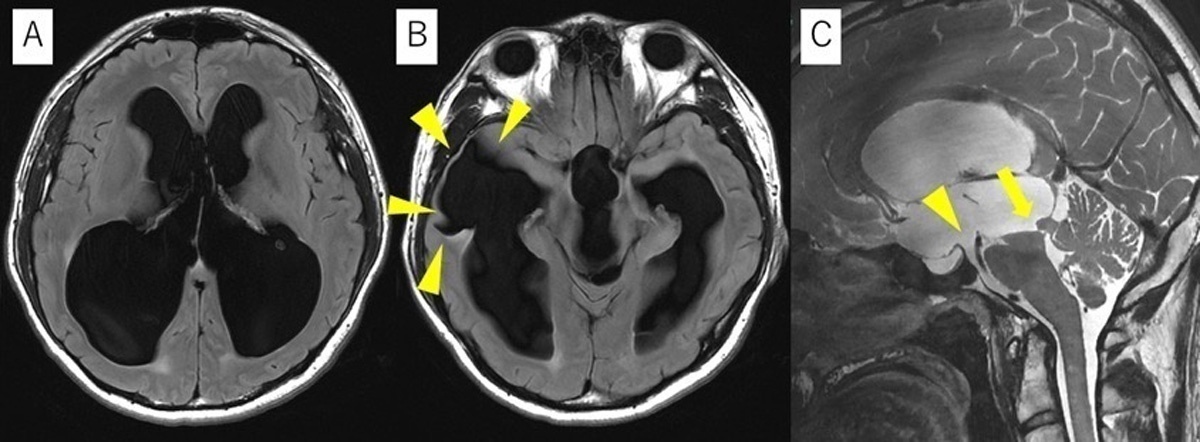
Figure 1
Preoperative magnetic resonance imaging. (A) Axial fluid-attenuated inversion recovery (FLAIR) image demonstrating marked enlargement of the lateral ventricles. (B) Axial FLAIR image showing an old lesion in the right temporal lobe adjacent to the inferior horn of the lateral ventricle (arrowheads). (C) Sagittal heavily T2-weighted image demonstrating an indistinct floor of the third ventricle with an unclear anatomical relationship between the third ventricular floor and the basilar artery (arrowheads). An aqueductal web is also identified at the entrance of the cerebral aqueduct (arrow).
Video 2
Postoperative outcome. Complete resolution of head tremor within one week after shunt placement. Cognitive and gait function gradually improved. At 16-months follow-up, improved gait is maintained with mild residual postural instability.
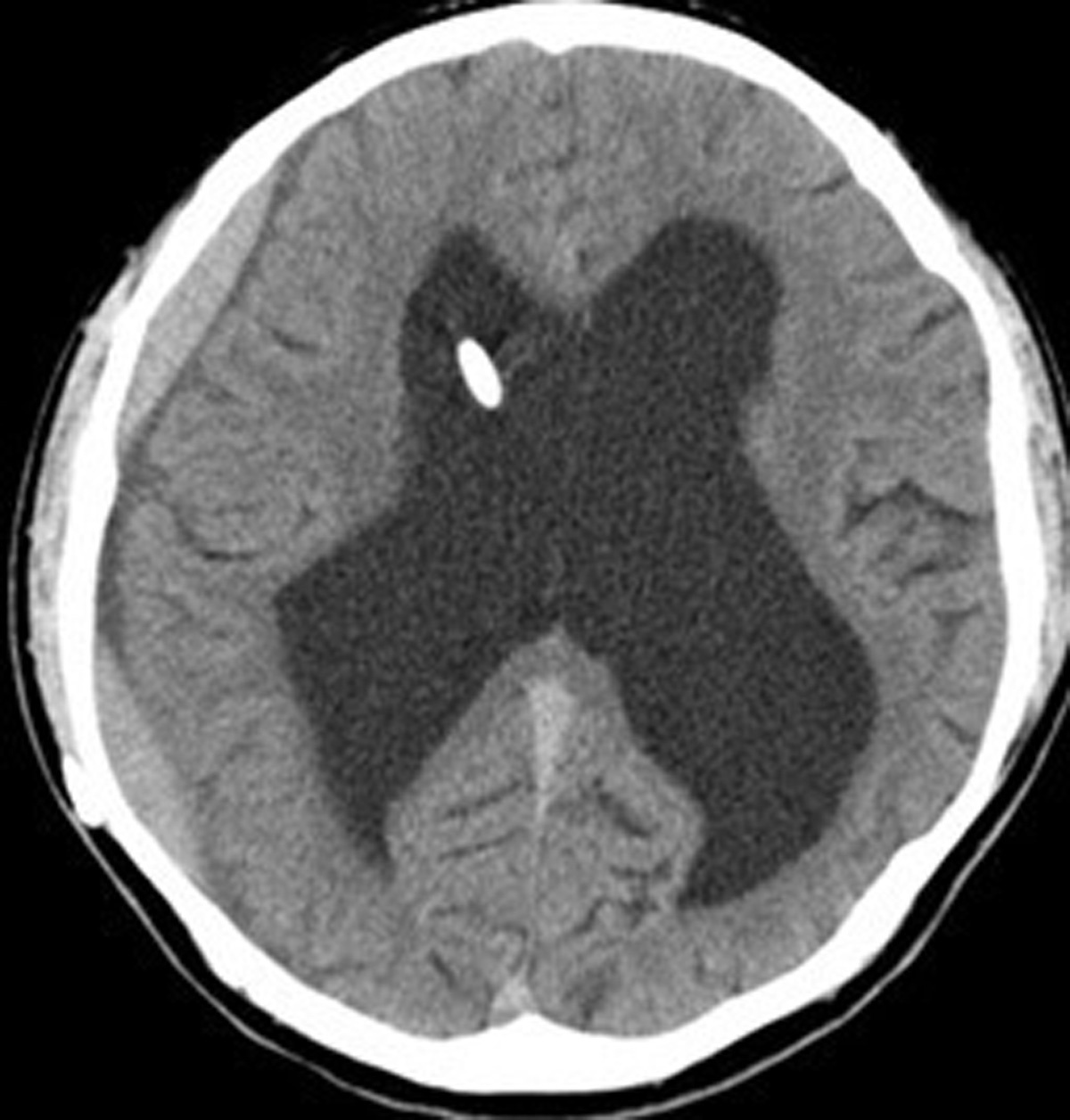
Figure 2
Postoperative computed tomography. Axial image demonstrating placement of the ventricular catheter in the right frontal horn. A subdural hematoma is observed beneath the inner table of the right cranial vault.
Table 1
Clinical characteristics, suppression factors, and surgical outcomes of 11 cases of bobble-head doll syndrome (BHDS) associated with aqueductal obstruction or stenosis.
| CASE (YEAR) | AGE | CAUSE | DIRECTION OF BOBBING | VOLUNTARILY SUPPRESS | SUPPRESSION FACTORS/SENSORY TRICK | ATAXIA/INTENTION TREMOR | TREATMENT | POSTOPERATIVE COURSE |
|---|---|---|---|---|---|---|---|---|
| 1. Nellhaus (1967) [6] | 10y | aqueductal stenosis | No–No | yes | sleep | yes/no | Pudenz valve shunt | Resolved within 8 months |
| 2. Russo (1974) [7] | 1y | aqueductal stenosis | Yes–Yes | yes | sleep | no/no | VA shunt | Resolved after 8 days |
| 3. Tomasovic (1) (1975) [8] | 10m | aqueductal stenosis | Yes–Yes | no | sleep | yes/no | VP shunt | Markedly decreased within 4 months |
| 4. Tomasovic (2) (1975) [8] | 5.5y | aqueductal stenosis | Yes–Yes | yes | sleep, recumbent position | yes/yes | VP shunt | Resolved within several days |
| 5. Deonna (1976) [9] | 1.5y | aqueductal stenosis | No–No | no | sleep, supine position | no/no | Torkildsen procedure | Resolved |
| 6. Jensen (Carrea) (1978) [10] | 11m | aqueductal stenosis | Yes–Yes | N/A | N/A | N/A | Shunt surgery | No change |
| 7. Coker (1986) [11] | 6m | Trapped 4V | Yes–Yes | yes | sleep, supine position, concentration | no/no | 4V shunt | Resolved, then returned after 2 mos, then resolved after revision |
| 8. Bhattacharyya (2003) [1] | 13y | aqueductal web | Yes–Yes | yes | sleep, concentration | yes/yes | VP shunt | Resolved |
| 9. Bhattacharyya (2014) [12] | 11y | Pineal mass | Mixed | yes | sleep, concentration | yes/no | VP shunt | Immediate resolution |
| 10. Renne (1) (2018) [3] | 14y | Tectal tumor | No–No | no | sleep, supine position | N/A/no | ETV | Immediate resolution in recovery room |
| 11. Our case | 24y | aqueductal web | No–No | no | sleep, concentration, touching the cheek | yes/no | VP shunt | Resolved after 7 days |
[i] This table summarizes the clinical profiles of 11 cases where BHDS was secondary to aqueductal lesions (obstruction, stenosis, or tumors). It details the primary direction of head movements, the presence of voluntary suppression, and specific suppression factors (sensory tricks) such as mental concentration or postural changes. Associated neurological signs, including truncal ataxia and intention tremor, are also recorded. The “Postoperative Course” column highlights the efficacy and immediacy of surgical interventions, including ventriculoperitoneal (VP) shunting and endoscopic third ventriculostomy (ETV).