
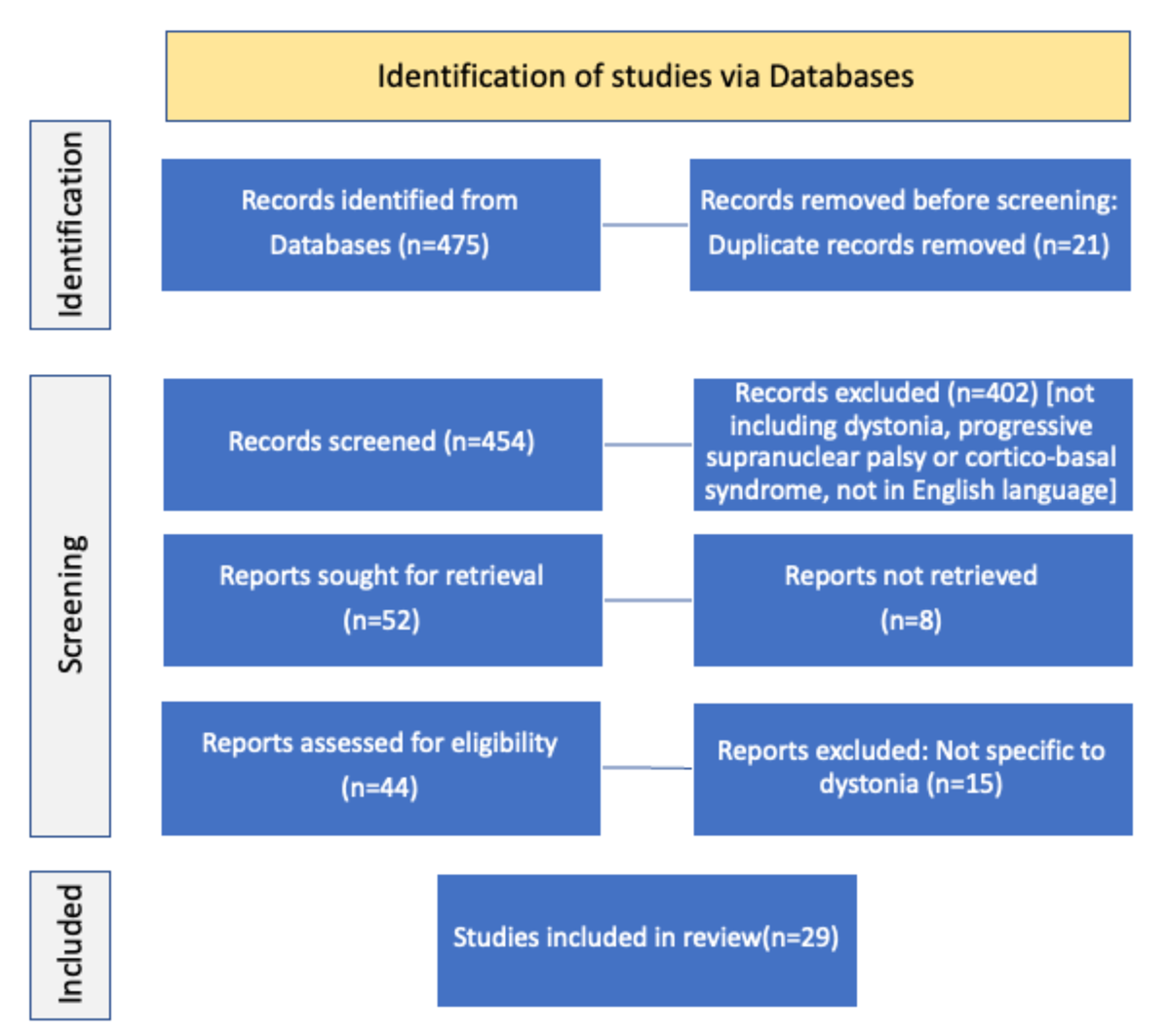
Figure 1
Search strategy for dystonia in Progressive supranuclear palsy.
Table 1
Distribution of Progressive supranuclear palsy subtypes in the study cohort.
| SUBTYPE (NUMBER OF CASES) | MEAN ±SD AGE OF ONSET(YEARS) | GENDER (M/F) | MEAN ± SD DISEASE DURATION (YEARS) | MEAN ±SD MDS-UPDRS PART III SCORE | MEAN ± SD MOCA SCORE | DYSTONIA % | MEAN ± SD TIME TO DYSTONIA (MONTHS) | TREMOR % | MEAN ± SD M:P | MEAN ± SD MRPI |
|---|---|---|---|---|---|---|---|---|---|---|
| PSP-RS (35) | 64.8 ± 7.7 | 63% M, 37% F | 3.9 ± 2.4 | 33.2 ± 4.8 | 16.1 ± 4.2 | 82.9% (n = 29) | 28.8 ± 21.2 | 22.9% (n = 8; action tremor) | 0.17 ± 0.1 | 19.1 ± 6.7 |
| PSP-P (23) | 67.1 ± 7.8 | 78% M, 22% F | 4 ± 2.6 | 30.1 ± 5.6 | 22.1 ± 2.2 | 39.1% (n = 9) | 30.0 ± 18.7 | 69.6% (n = 16; rest tremor 4, action tremor 8, both rest and action tremor 4) | 0.28 ± 0.0 | 10.3 ± 4.0 |
| PSP-CBS (21) | 65.7 ± 5.7 | 62% M, 38% F | 4 ± 1.9 | 27.5 ± 5.4 | 17.3 ± 4.4 | 85.7% (n = 18) | 19.1 ± 19.2 | 23.8% (n = 5; rest tremor 1, action tremor 4) | 0.26 ± 0.1 | 12.2 ± 6.0 |
| PSP-F (4) | 72.3 ± 10.5 | 100% M | 1.8 ± 0.5 | 29 ± 5.3 | 14.5 ± 4 | NA | NA | 50% (n = 2; action tremor) | 0.28 ± 0.2 | 14.7 ± 0.0 |
| PSP-PGF (2) | 63.3 ± 2.5 | 100% F | 2.3 ± 2.5 | 28 ± 8.5 | 24 ± 1.4 | 50% (n = 1) | NA | 50% (n = 1; action tremor) | 0.36 ± 0.1 | 12.3 ± 1.3 |
| PSP-C (2) | 63.5 ± 2.1 | 50% each | 4 ± 2.8 | 29 ± 1 | 22 ± 2.8 | NA | NA | 50% (n = 1; action tremor) | 0.33 ± 0.1 | NA |
| PSP-SL (1) | 72 ± 0 | 100% F | 5 ± 0 | 18 ± 0 | 19 ± 0 | NA | NA | 0% | 0.4 ± 0.0 | NA |
[i] Footnotes: PSP Progressive supranuclear palsy, PSP-RS Richardson’s syndrome, PSP-P Parkinsonism, PSP-F Frontal, PSP-PGF Progressive gait freezing, PSP-CBS Cortico-basal syndrome, PSP-C Cerebellar ataxia, PSP-SL Speech/language disorders, SD Standard deviation, M Male, F Female, MDS-UPDRS Movement Disorder Society-Unified Parkinson’s Disease Rating Scale, MoCA Montreal Cognitive Assessment, M:P Midbrain to pons ratio, MRPI Magnetic Resonance Parkinsonism Index, NA Not applicable.
Video 1
A patient with Progressive Supranuclear Palsy–Corticobasal Syndrome (PSP-CBS), demonstrating groping behaviour and left upper limb dystonia consistent with alien limb phenomenon.
Video 2
A patient with Progressive Supranuclear Palsy–Corticobasal Syndrome (PSP-CBS) demonstrating left upper limb dystonia, myoclonus, and alien limb phenomenon.
Table 2
Comparison of demographic, clinical and imaging characteristics between Progressive supranuclear palsy patients with and without dystonia.
| VARIABLES | PATIENTS WITH DYSTONIA (n = 57) | PATIENTS WITHOUT DYSTONIA (n = 31) | P VALUE |
|---|---|---|---|
| Age of onset (Mean ± SD) (Years) | 63.5 ± 7.2 | 70.1 ± 7.3 | 0.139 |
| Gender (M/F) | 63% M, 37% F | 71% M, 29% F | 0.982 |
| Disease duration (Mean ± SD) (Years) | 3.9 ± 2.3 | 3.6 ± 2.4 | 0.464 |
| Distribution of PSP subtype | PSP-RS 51% (n = 29), PSP-CBS 31% (n = 18), PSP-P 16% (n = 9), PSP-PGF 2% (n = 1) | PSP-P 45% (n = 14), PSP-RS 19% (n = 6), PSP-F 13% (n = 4), PSP-CBS 10% (n = 3), PSP-C 6% (n = 2), PSP-PGF 3% (n = 1), PSP-SL 3% (n = 1) | <0.001 |
| Mean MDS-UPDRS score | 30.5 ± 5.7 | 30.3 ± 6.0 | 0.883 |
| Mean MoCA score | 17.8 ± 4.7 | 19.5 ± 3.7 | 0.08 |
| M:P ratio | 0.22 ± 0.08 | 0.27 ± 0.07 | 0.005 |
| MRPI | 17.7 ± 4.5 | 14.4 ± 2.6 | 0.003 |
[i] Footnotes: PSP Progressive supranuclear palsy, PSP-RS Richardson’s syndrome, PSP-P Parkinsonism, PSP-F Frontal, PSP-PGF Progressive gait freezing, PSP-CBS Cortico-basal syndrome, PSP-C Cerebellar ataxia, PSP-SL Speech/language disorders, SD Standard deviation, M Male, F Female, MDS-UPDRS Movement Disorder Society-Unified Parkinson’s Disease Rating Scale, MoCA Montreal Cognitive Assessment, M:P Midbrain to pons ratio, MRPI Magnetic Resonance Parkinsonism Index.
Table 3
Comparison of demographic, clinical and imaging characteristics across different dystonia patterns in Progressive supranuclear palsy.
| VARIABLES | PATIENTS WITH LIMB DYSTONIA ONLY (n = 28) | PATIENTS WITH CRANIO-CERVICAL DYSTONIA ONLY (n = 14) | PATIENTS WITH BOTH LIMB AND CRANIO-CERVICAL DYSTONIA (n = 15) | P VALUE |
|---|---|---|---|---|
| Age of onset (Mean±SD) (Years) | 62.6 ± 5.9 | 64.9 ± 9.5 | 66.6 ± 6.5 | 0.15 |
| Gender (M/F) | 71% M (n = 20), 29% F (n = 8) | 57% M (n = 8), 43% F (n = 6) | 53% M (n = 8), 47% F (n = 7) | 0.3 |
| Disease duration (Mean ± SD) (Years) | 3.9 ± 2.0 | 3.1 ± 1.6 | 4.8 ± 2.9 | 0.09 |
| Duration to dystonia onset (Mean ± SD) (Months) | 22.1 ± 17.6 | 27 ± 14.5 | 28.2 ± 25.7 | 0.6 |
| Distribution of PSP subtype | PSP-CBS 43% (n = 12), PSP-RS 36% (n = 10), PSP-P 18% (n = 5), PSP-PGF 3% (n = 1) | PSP-RS 86% (n = 12), PSP-P 14% (n = 2) | PSP-RS 47% (n = 7), PSP-CBS 40% (n = 6), PSP-P 13% (n = 2) | 0.02 |
| Mean MDS-UPDRS score | 28.9 ± 5.7 | 31.5 ± 5.4 | 32.6 ± 4.7 | 0.81 |
| Mean MoCA score | 18.4.9 ± 4.8 | 17.2 ± 4.4 | 16.6 ± 4.7 | 0.73 |
| M:P ratio | 0.24 ± 0.07 | 0.19 ± 0.08 | 0.2 ± 0.09 | 0.11 |
| MRPI | 16.3 ± 3.1 | 19.4 ± 5.3 | 20.5 ± 6.4 | 0.22 |
[i] Footnotes: PSP Progressive supranuclear palsy, PSP-RS Richardson’s syndrome, PSP-P Parkinsonism, PSP-PGF Progressive gait freezing, PSP-CBS Cortico-basal syndrome, SD Standard deviation, M Male, F Female, MDS-UPDRS Movement Disorder Society-Unified Parkinson’s Disease Rating Scale, MoCA Montreal Cognitive Assessment, L Limb, CC Cranio-cervical, M:P Midbrain to pons ratio, MRPI Magnetic Resonance Parkinsonism Index.
Video 3
A patient with Progressive Supranuclear Palsy–Richardson’s Syndrome (PSP-RS), demonstrating predominant blepharospasm and bradykinesia on examination.
Video 4
A patient with Progressive Supranuclear Palsy–Richardson’s Syndrome (PSP-RS) demonstrating cervical and limb dystonia along with vertical supranuclear gaze palsy.
Video 5
A patient with Progressive Supranuclear Palsy–Richardson’s Syndrome (PSP-RS) demonstrating apraxia of lid opening, limb dystonia, and severe bradykinesia on examination.
Table 4
Major published studies on dystonia in Progressive supranuclear palsy.
| AUTHOR AND YEAR | NUMBER OF CASES | DYSTONIA PREVALENCE | PHENOMENOLOGY | ADDITIONAL FEATURES |
|---|---|---|---|---|
| Rafal 1987 [14] | N = 30 PSP cases | 26.7% (n = 8) | Details not available | 62.5% dystonia was not on any medication; 50% dystonia presented before ophthalmoplegia |
| Rinne 1994 [38] | N = 36 clinically probable/pathologically proven CBD | Fixed dystonic posture 18.5% (n = 6) | Details not available | Cortical sensory loss 25% (n = 9); unilateral ‘clumsy, stiff or jerky arm’ 55.6% (n = 20); gait difficulties and supranuclear ophthalmoplegia emerged after a mean follow-up of 5.2 years |
| Barclay 1997 [16] | N = 83 PSP cases | 45.8% (n = 38) | 24% blepharospasm, 27% limb dystonia, 17% axial dystonia in extension | Early dystonia 7.2% (n = 6); levodopa-induced dystonia 3.6% (n = 3), concurrent diseases 3.6% (n = 3) hydrocephalus, arteriosclerotic disease |
| Vanek 2001 [39] | N = 66 clinically probable/pathologically proven CBD | 59% (N = 39) | Arm dystonia 92%; leg dystonia 28%; cranio-cervical and truncal dystonia 31% | 51% had early dystonia in arm; 33% had initial leg involvement. Axial or leg dystonia, without significant arm involvement was rare. |
| Godeiro-Junior 2008 [17] | N = 38 (23 MSA; 7 CBD; 8 PSP) | Overall 50% MSA 30.4% (n = 7); PSP 62.5% (n = 5); CBD 100% (n = 8) | Camptocormia; retro/anterocollis; blepharospasm; oromandibular; limb dystonia | None had dystonia as first symptom; Levodopa therapy did not influence dystonia |
| Stamelou 2012 [37] | N = 296 pathologically proven CBD cases (54% CBS; 15% FTD; 10.7% PSP) | 37.5% (n = 111) | CBS phenotype early upper limb dystonia; dementia phenotype late cranio-cervical dystonia | Akinetic-rigid syndrome 100%; apraxia 86.3%; myoclonus ~50% |
| Yoon 2018 [40] | N = 1278 patients with parkinsonism | Overall 13.8% (n = 176) PD 11%; MSA 20.9%; PSP 40.7%; CBD 66.7% | Cranio-cervical dystonia frequent in atypical parkinsonism; limb dystonia frequent in PD and CBD; truncal dystonia frequent in PD | Levodopa-related limb and truncal dystonia frequent in PD; levodopa non-related cranio-cervical dystonia frequent in atypical parkinsonism |
| Wagle-Shukla 2019 [15] | N = 217 PSP cases | 30% (n = 66) | Cervical 50% (n = 33); blepharospasm, 25.8% (n = 17); limb 65.2% (n = 43); cranial (face, jaw, tongue) 6.1% (n = 4); generalized 7.6% (n = 5) | 33% had tremor (n = 71); only 12% (n = 27) had both tremor and dystonia |
| Present study | N = 88 PSP cases | 64.8% (N = 57) | Limb dystonia 49.1%; cranio-cervical 24.6%; both limb and cranio-cervical 26.3% | Limb dystonia frequent in PSP-CBS (43%); cranio-cervical dystonia frequent in PSP-RS (86%). Early dystonia common in PSP-CBS (42.9%); while PSP-P predominated in patients without dystonia. Patients with dystonia had lower M:P ratios and higher MRPI. |
[i] Footnotes: PSP Progressive supranuclear palsy, PSP-RS Richardson’s syndrome, PSP-P Parkinsonism, CBS Cortico-basal syndrome, CBD Cortico-basal degeneration, PD Parkinson’s disease, MSA Multiple system atrophy, M:P Midbrain to pons ratio, MRPI Magnetic Resonance Parkinsonism Index, n,N Number of cases.