
Table 1
Corpus formation issues and their resolution.
| Issue | Resolution |
|---|---|
| Should only studio pieces be included, or live performances? | Studio recordings were the mainstay of the corpus, though allowing that some pieces are the result of live performance in a studio. |
| Art music or popular music? | The decision was made to include examples from many styles and not try to impose a hard category boundary. |
| Representation of female composers | An effort was made to include such pioneers as Daphne Oram and Else Marie Pade; See below for more data. |
| Representation outside of standard Western canon | We attempted to include some composers outside of the typical European and North American spheres, but are limited by historical imbalance in access and critical coverage. |
| How electronic is electronic? | In some cases, iconic pieces of ‘electronic music’ involve part acoustic or standard rock instrumentation. |
| How obscure is permissible? | We try to include works that are discussed in critical texts or representative of trends in electronic music, even if not a mass market release or unambiguously acknowledged in histories. |
| How minimal can works be? | Some drone pieces should be represented. Eliane Radigue’s Transamorem – Transmortem (1973) is a very subtly and slowly shifting 67 minute work. Its inclusion potentially distorts feature averages taken across works, but to ignore it is to ignore a rich territory of electronic drone music. Nonetheless, Raymond Scott’s repetitive Tic Toc (1963, from Soothing Sounds for Baby Vol. 1) was not included, though other pieces from the same album were. |
| What source is best? | Audio CDs were the primary source, but there are still issues of original releases versus remastered CDs, edited or mixed versions. Resolution here is often pragmatic because of the availability of particular releases to purchase. |
| Are humour and kitsch acceptable? | Some representation is necessary to capture the breadth of musical life. For instance, selected pieces from Perrey & Kingsley’s The Out Sound From Way In! The Complete Vanguard Recordings (1966–7) were included. |
| Exact date to attribute | In metadata we initially separated Year of Composition from Year of Release/First Performance but in practice the two were so often close together as to provide no real gain to the database, and too difficult to get data on for every piece. Year of Composition is the standard one used in this study. If a range of years of composition was provided, only the latest year was taken. |
| Complete works versus movements | Occasionally, works would appear split into movements (one movement per audio file). We would allow this, except where it became unmanageable for many very small segments, when we joined the snippets back together as one file. |
| Exact name to attribute | A producer (such as Tim Simenon) may hide behind an alias (such as Bomb the Bass). Well known aliases as attributed on releases themselves are used rather than producer names (we use Aphex Twin rather than Richard James, for instance). |
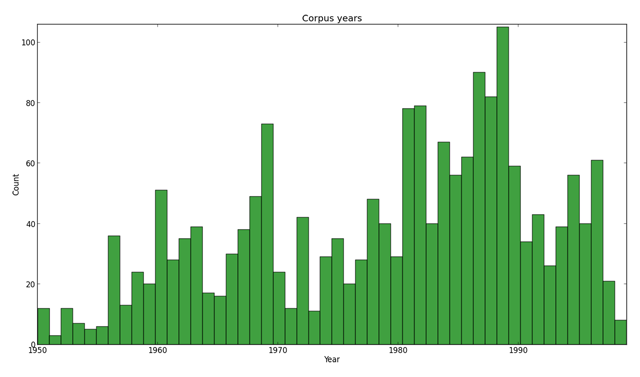
Figure 1
Number of pieces per year in the corpus, 1950 to 1999.
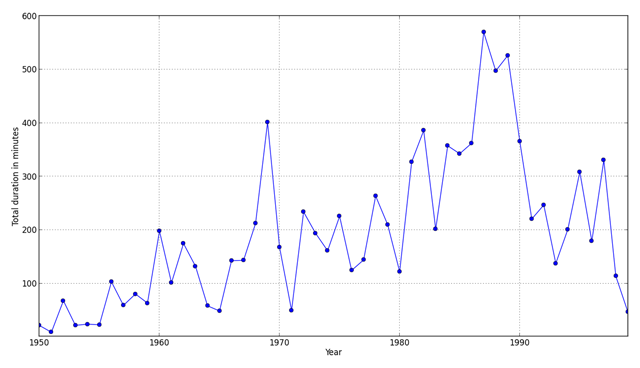
Figure 2
Total duration in minutes summing across all pieces from each year in the corpus.
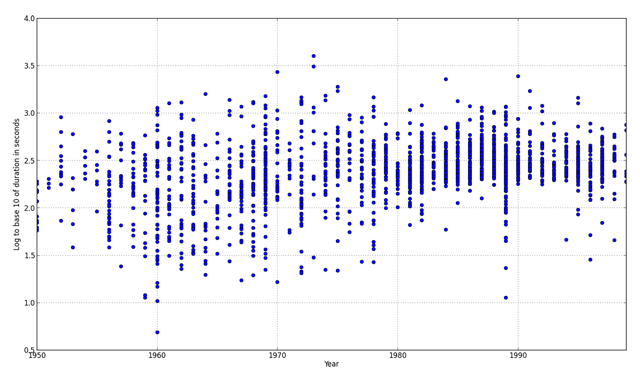
Figure 3
Log to base 10 of duration of each piece, plotted for its year of composition.
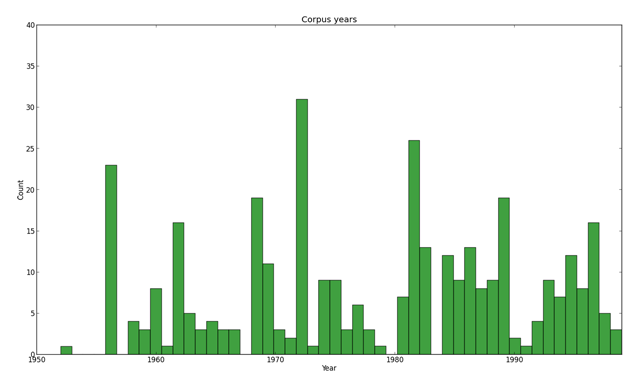
Figure 4
Incidence counts for music from female artists (either solo or within a group).
Table 2
The 22 features extracted.
| Feature number | Feature | Description |
|---|---|---|
| 0 | Loudness | Psychoacoustic model of loudness |
| 1 | Sensory dissonance | Psychoacoustic sensory dissonance model after Sethares (2005) |
| 2 | Spectral centroid | Measure of brightness |
| 3 | Attack slope | Average of the last ten attack slopes in the signal (with detection of attacks via an energy based onset detector) |
| 4 | Jensen-Shannon divergence | Compare the spectral distributions over ERB bands within the last two seconds; acts as a spectral change detector (so, similar spectral frames mean little divergence) |
| 5 | Transientness | Measure of transient energy in the signal, based on a wavelet transform |
| 6–8 | Onset statistics | In the last two seconds, the density (raw count) of attacks, and the mean and standard deviation of inter-onset intervals |
| 9–12 | Beat statistics | Beat histogram statistics; the entropy of the beat histogram, the ratio of the largest to the second largest entries in the beat histogram, the diversity (Simpson’s D measure) of beat histogram, and metricity (consistency of high energy histogram entries to integer multiples or divisors of strongest entry) |
| 13 | Harmonicity | Root mean square amplitude (over 1024 sample windows) of tonal (harmonic) component of signal after median source separation |
| 14 | Percussiveness | Root mean square amplitude (over 1024 sample windows) of percussive component of signal after median source separation |
| 15 | Key clarity | Acting on the tonal part of the signal, the degree of presence of a clearcut major or minor key mode (note this does not assume the work has to be in 12TET, just that ‘clarity’ is an interesting attribute varying between pieces) |
| 16 | Spectral entropy | Spectral entropy of spectral distribution of tonal component of the signal. |
| 17–19 | 3 Energy bands | Energy for low (400 Hz cutoff), mid (centred 3000 Hz), and high frequency (cutoff 6000 Hz) regions |
| 20 | Stereo spatial ebb | Spectral movement measure comparing left and right channels (see text) |
| 21 | Two channel loudness difference | Absolute difference in perceptual loudness between the left and right channels |
Table 3
Linear regression results for average feature means against year of composition (no Bonferroni correction on p-values).
| Feature number | Feature | Slope (gradient) | Intercept | Regression coefficient | p-value |
|---|---|---|---|---|---|
| 0 | Loudness | 0.00278 | 0.123 | 0.867 | 3.821e-16 |
| 1 | Sensory dissonance | 0.00049 | –0.0002 | 0.841 | 2.172e-14 |
| 2 | Spectral centroid | 0.00146 | 0.105 | 0.719 | 4.092e-09 |
| 3 | Attack slope | 0.00046 | 0.009 | 0.689 | 3.240e-08 |
| 4 | Jensen-Shannon divergence | –0.00038 | 0.036 | –0.557 | 2.609e-05 |
| 5 | Transientness | 0.00104 | 0.013 | 0.857 | 1.904e-15 |
| 6 | Attack density | 0.00386 | 0.297 | 0.826 | 1.566e-13 |
| 7 | Mean of IOIs | –0.00064 | 0.095 | –0.795 | 5.658e-12 |
| 8 | Standard deviation of IOIs | –0.00127 | 0.102 | –0.921 | 2.716e-21 |
| 9 | Beat histogram entropy | 5.1e-05 | 0.993 | 0.394 | 0.005 |
| 10 | Beat histogram ratio first to second largest entries | 0.00051 | 0.356 | 0.885 | 1.603e-17 |
| 11 | Beat histogram diversity | –1.3e-05 | 0.982 | –0.633 | 8.283e-07 |
| 12 | Metricity | 0.00066 | 0.299 | 0.681 | 5.397e-08 |
| 13 | Strength of tonal part | 0.00267 | 0.047 | 0.895 | 1.888e-18 |
| 14 | Percussiveness | 0.00157 | 0.013 | 0.924 | 1.175e-21 |
| 15 | Key clarity of tonal part | 0.00118 | 0.404 | 0.744 | 5.983e-10 |
| 16 | Spectral entropy of tonal part | 2.3e-05 | 0.015 | 0.125 | 0.386 |
| 17 | Low frequency energy | 0.0022 | 0.034 | 0.901 | 4.818e-19 |
| 18 | Mid frequency energy | 0.00085 | 0.017 | 0.839 | 2.854e-14 |
| 19 | High frequency energy | 0.00111 | –0.003 | 0.912 | 3.333e-20 |
| 20 | Stereo spatial ebb | 0.00055 | 0.017 | 0.668 | 1.186e-07 |
| 21 | Two channel loudness difference | –4e-06 | 0.036 | –0.004 | 0.978 |
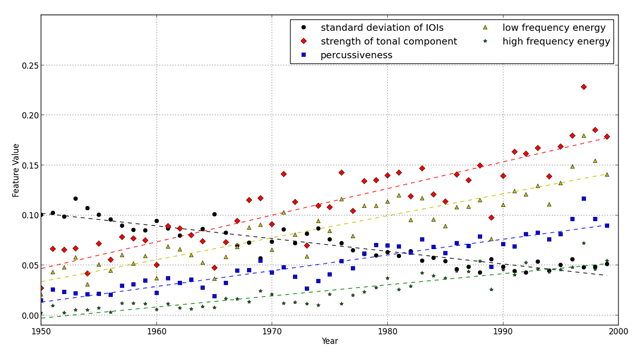
Figure 5
The five most significant feature mean trails against years of composition. The features are: 1) standard deviation of IOIs 2) strength of tonal component 3) percussiveness 4) low frequency energy 5) high frequency energy.
Table 4
Database fields.
| Field | Detail |
|---|---|
| Popular vs art | Integer, 0 for popular music, 1 for art music, 2 for a borderline case |
| Gender | 0 for male composed, 1 for female composed, 2 for a mixed group |
| Path name | Relative to a base directory for the project, with subfolders helping to group associated pieces |
| Artist | Artist name |
| Title of work | Title of work |
| Year of composition | Year first noted as completed as a composition (for a range, last year taken) |
| Year of release/first performance (if different to year of composition) | For some works in the corpus, the year of release or public performance is slightly different to the year of composition. Nonetheless, the year of composition is taken as the standard, and this data is not supplied for all works in the corpus |
| Source title | Title of audio CD from which music was ripped |
| Source record label | Record label of source audio CD |
| Source year of release | Source CD release; for example, some works were only available through remasters or re-releases with a more recent date than might otherwise be expected; historic works can only have appeared on CD from 1982 |
| Source record label release code | Record label’s own internal catalogue code for a release to help identify an exact source recording if necessary |
| Additional notes | Indicates, for instance, if there is slight mixing between works at the beginning or ending of a track (as appears in some electronic dance music releases in particular), or other matters |
| MusicBrainz recording ID | As found by an automated search based on strict match by artist name and track title, or where that failed, by closest match according to a non-strict inquiry to the MusicBrainz API |
| MusicBrainz strict match found | Flag to indicate those tracks where the recording ID was found through an exact artist and title match, and thus, most likely to be accurate |