
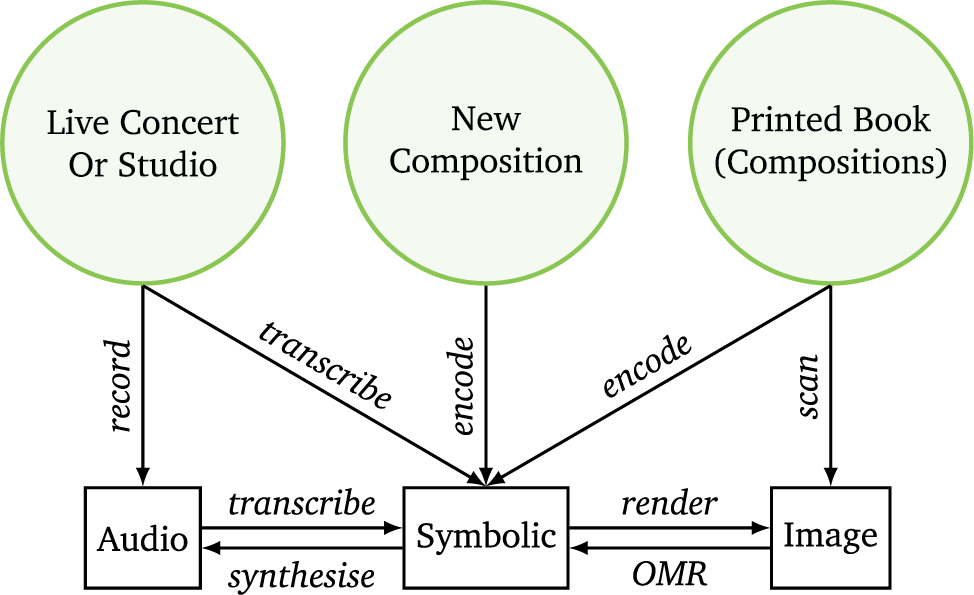
Figure 1
Extended representation of an illustration provided in Müller (2021, p. 30) showing different original sources (circles) and media (boxes).
Table 1
Proposed conceptual framework of 12 themes of music data, broken down into three phases—phase −1, ‘before’ the music (leading to); phase 0, the ‘actual’ music (itself and around it); and phase +1, ‘after’ the music (uses of and responses to)—and five focus areas. Example sources and media/representations are provided for each.
| Theme | Source examples | Media/representation examples | |
|---|---|---|---|
| Phase −1: ‘Before’ the music | Focus area: ‘Leading to’ the music | ||
 Context (§4.1) Context (§4.1) | Personal biography | Symbolic (text as linked open data) | |
| Socio‑cultural history, network | Symbolic (text as linked open data) | ||
| Economic: e.g., commission | Symbolic (text as linked open data) | ||
| Technical: e.g., textbooks | Symbolic (text) | ||
 Preparation (§4.2) Preparation (§4.2) | Composition sketches | Image, symbolic (text as version control) | |
| Performer practice | Symbolic (text), video, other signal (motion capture) | ||
| Phase 0: The ‘actual’ music | Focus area: The music ‘itself’ | ||
 Composition (§4.3) Composition (§4.3) | Edition | Image | |
| Score | Symbolic (score) | ||
| Live coding | Symbolic (text as code) | ||
 Performance (§4.4) Performance (§4.4) | Live performance | Audio, image, video, other signal (thermal, seismic time series) | |
| Studio recording | Audio, image, video | ||
| Instruments | Symbolic (text as taxonomy) | ||
| Playing action: explicit | Symbolic (text) | ||
| Playing action: observed | Symbolic (text), video, other signal (motion capture) | ||
| Focus area: ‘Around’ the music | |||
 Associated media (§4.5) Associated media (§4.5) | Album artwork | Image | |
| Lyrics | Symbolic (text) | ||
| Promotional photo shoot | Image | ||
| ‘Music video’ | Video | ||
| Phase +1: ‘After’ the music | Focus area: ‘Uses’ of music | ||
 Other media (§4.6) Other media (§4.6) | In video games | Symbolic (text as mapping of music cues to game event triggers) | |
| In film, television, advertisements | Video | ||
 Meta‑composition (§4.7) Meta‑composition (§4.7) | In album | Symbolic (text as ordered list) | |
| In playlist | Symbolic (text as ordered list) | ||
| In recommender sequence | Symbolic (text as code) | ||
| In setlist | Symbolic (text as ordered list) | ||
| As sample | Symbolic (text as list of time events) | ||
 Popularity (§4.8) Popularity (§4.8) | Charts | Other signal (time series of rank, dates, sales) | |
| Streams, likes, shares, skips | Other signal | ||
 Culture/occasion (§4.9) Culture/occasion (§4.9) | Specific: e.g., a coronation | Symbolic (text, also as date or GPS location) | |
| Generic: e.g., weddings | Symbolic (text) | ||
| Focus area: ‘Responses’ to music | |||
 Physiology (§4.10) Physiology (§4.10) | Heart rate | Other signal (time series) | |
| Skin conductivity | Other signal (time series) | ||
| Brain signals | Other signal (EEG) | ||
| Seismic | Other signal (time series) | ||
 Analysis (§4.11) Analysis (§4.11) | Analysis | Symbolic (text as fixed syntax or free prose) | |
| Genre labels | Symbolic (text based on taxonomy) | ||
| Journalistic writing | Symbolic (text) | ||
| Fan/open writing | Symbolic (text) | ||
 Legal (§4.12) Legal (§4.12) | Court precedents | Symbolic (text) | |
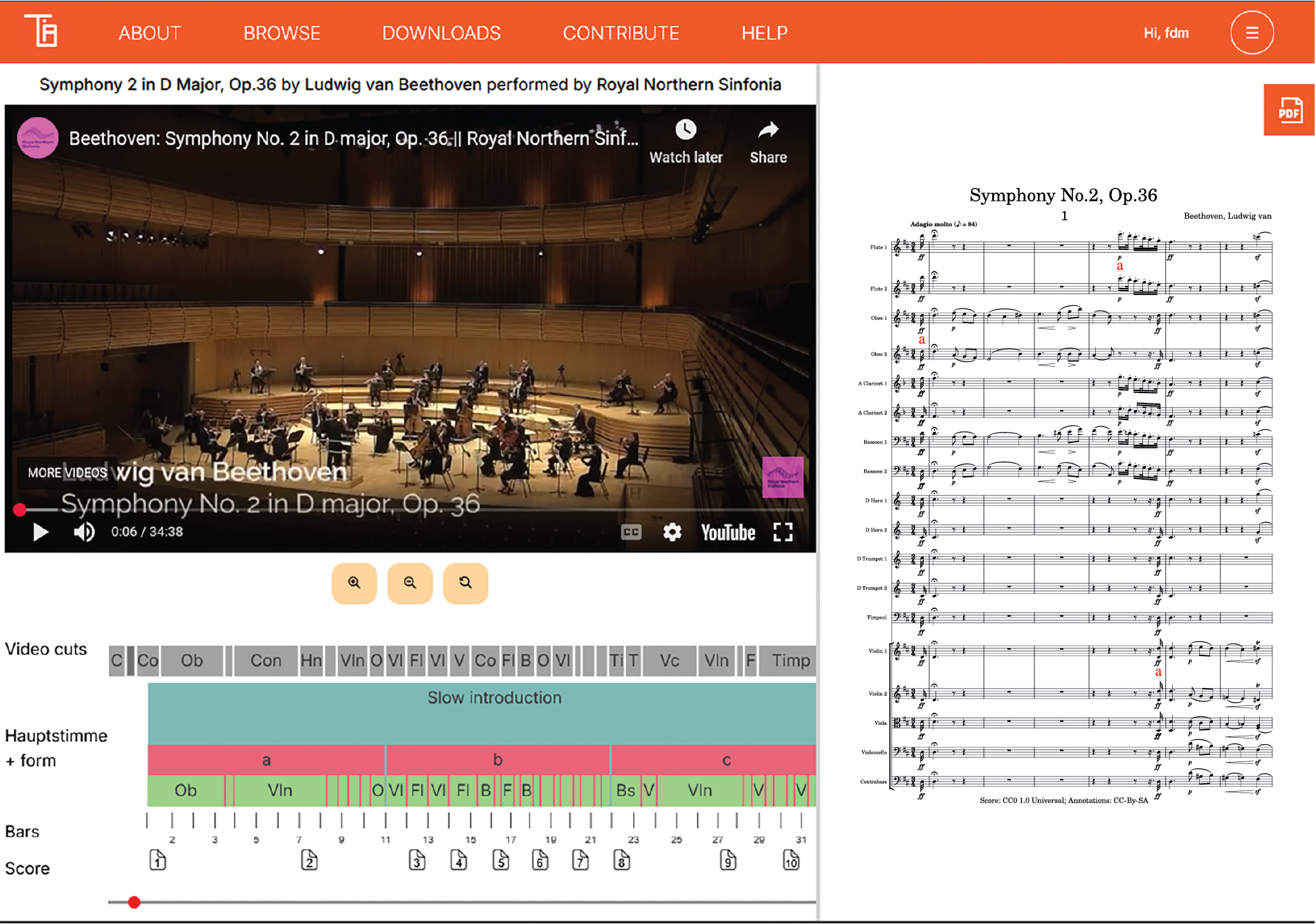
Figure 2
Excerpt of a timeline analysis (TiLiA) consisting of two hierarchy timelines (‘video cuts’ and ‘Hauptstimme + form’), a beat timeline (‘Beats’), and multiple PDF timelines.
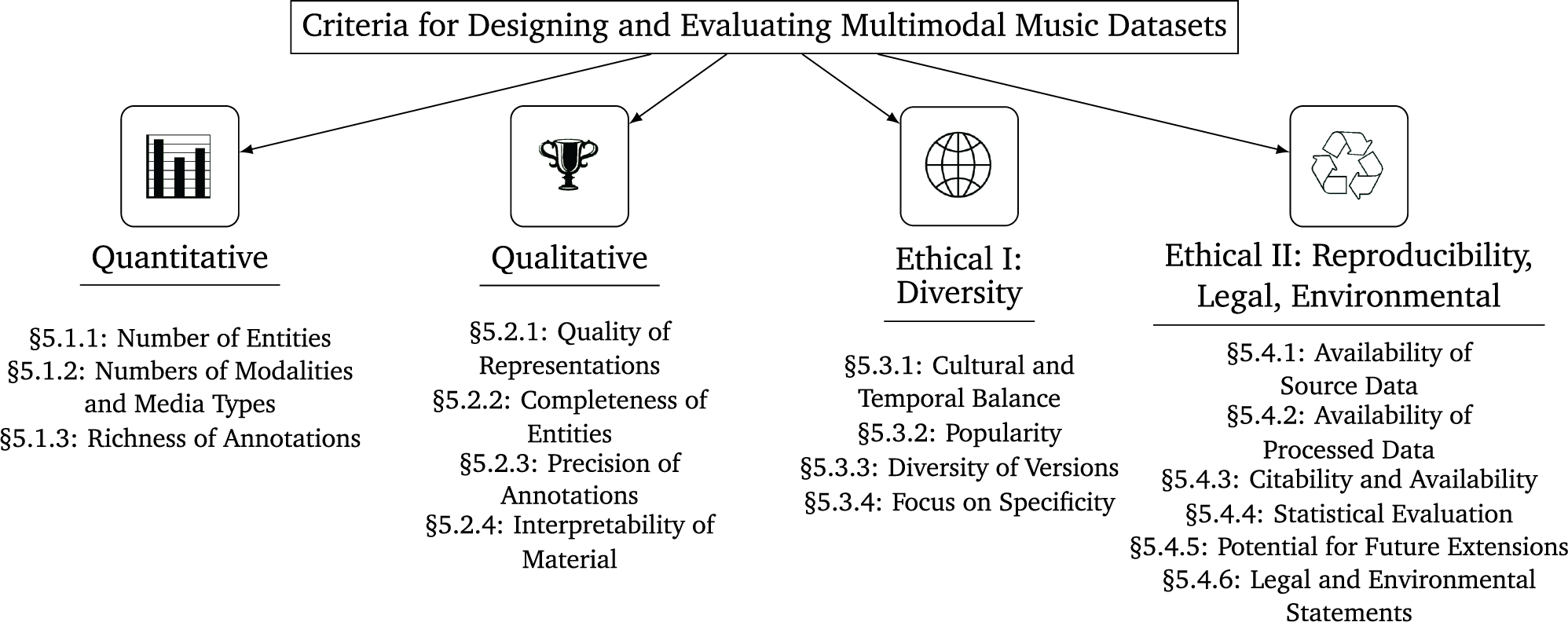
Figure 3
Overview of the 17 proposed criteria, organised into four broad categories, for the design and evaluation of multimodal music datasets.