
1 Preliminary Remarks
Thousands of polyphonic arrangements of Protestant hymn tunes exist and therefore represent a large corpus, the exploration of which can be greatly facilitated by the use of digital analysis. Digital queries therefore represent a mass task1 that arises above all in the exploration of an “everyday setting” of church music. Such investigations are therefore not aimed at the particularly prominent contributions of J. S. Bach, for example, whose approximately 380 hymns represent an extraordinarily artistic sub‑corpus2 that has often been the subject of digital analysis (cf. for example Moraitis, 2015, pp. 456–475). On the one hand, the “everyday settings” described here are arrangements of hymns that have often only survived with melody and figured bass (outer voice settings). On the other hand, the “everyday setting” also includes the countless compositions in chorale books which – as was increasingly common from around the mid‑1780s and eventually became standard – have survived fully notated for four voices (and with or without figured bass). The primary purpose of all these settings was the organ accompaniment of congregational singing in church services, such that this repertoire initially has liturgical‑hymnological significance. However, other questions are also possible: Basically, it can be assumed that a development of the “harmonic standard” per se can be shown and represented in the sequence of sonorities in such settings.
The reason for this is that, from the Reformation until around 1800, a core stock of around 100 hymn melodies had developed,3 which remained relatively stable in the repertoire for many decades thereafter, while their harmonized versions were always based on common contemporary procedures. In terms of compositional technique, hymn arrangements can therefore be seen as a genre that reacts to contemporary tonal differentiations and “records” them in a certain way.
One of the main aims in creating data sets of hymns is therefore to make their harmonic information “readable” in some way. There are several possible ways of doing this: On the one hand, “harmonies” can be determined on the basis of the notes they contain, which has been done successfully in several projects (albeit relating to other genres) with the help of manual annotation and the use of chord labels.4 On the other hand, the figured bass (where available) should also be seen as informative in terms of harmony. It offers a short and, moreover, source‑authentic way of determining sequences of sonorities. Of course, this method presupposes that figured bass figures are in fact “coded” and not suppressed as negligible written additions when a corpus is constructed. Our intended project deliberately takes an analytical approach at this point.5
2 The Choralbücher
As part of our preliminary work, we initially concentrated regionally on the chorale books of the Duchies of Schleswig and Holstein (part of the Danish state before 1864).
Currently, we are preparing a long‑term project to catalogue and analyse these and other choral books.6 We are not necessarily breaking new ground with this repertoire: The chorale books (listed below) were already the subject of scholarly research by Carl v. Winterfeld in the 19th century (Winterfeld, 1850, p. 316 et sqq.), and it is precisely these sets that now form our first complete corpus (a total of 733 hymn settings), which we want to examine more closely with digital queries. All four collections have survived in print, suggesting a certain degree of dissemination, and their contemporary approval by church authorities accentuates the expertise of the respective arrangers. The repertoire in question can therefore be considered relevant to music history, at least regionally. All four collections are easily accessible as online resources in the form of scans (Table 1).7
Table 1
Choralbücher already transcribed.
| Choralbücher | Number of settings |
|---|---|
| Rein, 1755 | 202 |
| Zinck, 1785 | 162 |
| Kittel, 1803 | 162 |
| Apel, 1832 | 207 |
| 733 |
The chorale books always begin with a Vorbericht (preface) that contains information about the following hymns and allows conclusions to be drawn about musical and liturgical contexts. These prefaces are important sources for our intended project and have already influenced several questions. For example, the Vorbericht to Kittel’s four‑part chorales with preludes states that Kittel “did not find the choral singing of the parishes [in the North German churches] nearly as pure as in the churches of his region” (Kittel, 1803, p. 18). The chorales he set were therefore:
so artless and natural [...], that they can be performed well and correctly by an organist with even little practice, and through such a performance the congregation, which is easily confused by impure and merely artificial playing, or even by very elaborate harmonies, gradually becomes accustomed to good chorale singing (ibid9).
The distinction formulated here is a good example of numerous similar phrases that are often found in such prefaces and which in themselves can give rise to research questions. However, comparisons of different settings of the same melody are certainly particularly obvious. The aforementioned core corpus of 96 melodies, which are represented by at least one setting in each of the four chorale books, lends itself to this. We have assigned a Set‑ID to each of these settings, which allows compositions with the same melodies to be grouped together, even if they are part of different chorale books.
The structure of the chorale books is broadly similar: All four books contain numbered sets of songs, which are sometimes divided into different versions and in this case are differentiated with a, b, c...10 (the numbering therefore does not correspond to the actual number of chorales). In addition to their main titles, numerous song settings refer to other, metrically and strophically appropriate songs by means of further alternative titles. Two of the chorale books (Rein and Zinck) only contain figured outer part settings, while Kittel’s chorale book contains figured and notated four‑part settings, and Apel’s collection contains notated four‑part settings without figures.
The appearance of the four collections differs only in details: Kittel’s collection, for example, often contains (in addition to brief organ preludes before each chorale) individual measures or phrases as variants after the individual settings, whose reference points in the score are marked with Roman numerals or the addition “NB” (nota bene, or “note well”). Kittel and Zinck also provide a list of errata at the end of each collection. In addition, the arrangers provide indexes in which the melodies are assigned to other (known) titles. Apel also frequently gives the names of presumed authors directly above the chorales or notes the date of origin and connections to other songs in the collection. The copy of Zinck’s collection that we used also contains handwritten entries on alternative titles and additions to the figured bass. Overall, however, our four collections present a relatively uniform picture and therefore required hardly any major adaptations for the planned investigations.
3 The Transcriptions
The transcriptions of the chorale books were made manually in MuseScore,11 as displacements, handwritten entries and, in particular, indistinct figures in the optical reproduction led to a high error rate in optical music recognition (OMR) with the computer.
Even in the manual transcription, the illegible figures still presented a certain obstacle. The chorales were digitized using the four‑eyes principle by transcribing two versions of each chorale and then checking them using MuseScore’s own score comparison tool.12 In cases of doubt, the preferred reading was decided in an editorial process. Any ambiguous corrections were documented for the subsequent publication of a critical report. Additions, handwritten entries or subsequent corrections were not included (for the time being, see Figure 1). Kittel’s chorales were also initially notated as outer part settings with figured bass, omitting the middle parts, to align them with Rein and Zinck. Apel’s collection was transcribed for four voices and then figured manually. The subsequent figuring in this case is therefore a modern addition based on the reduction of the four‑part setting given by Apel. We assume that Apel’s musical thinking can still be basically related to the outer‑voice setting and is therefore comparable with the other three books. In this respect, the addition serves the purpose of faster comparability based on uniform queries with the help of the existing (figured bass) queries.13 In all four collections, fermatas have been added and superfluous repetition signs removed to avoid obstacles for later analysis that could result from inconsistent arrangement (Figure 2).
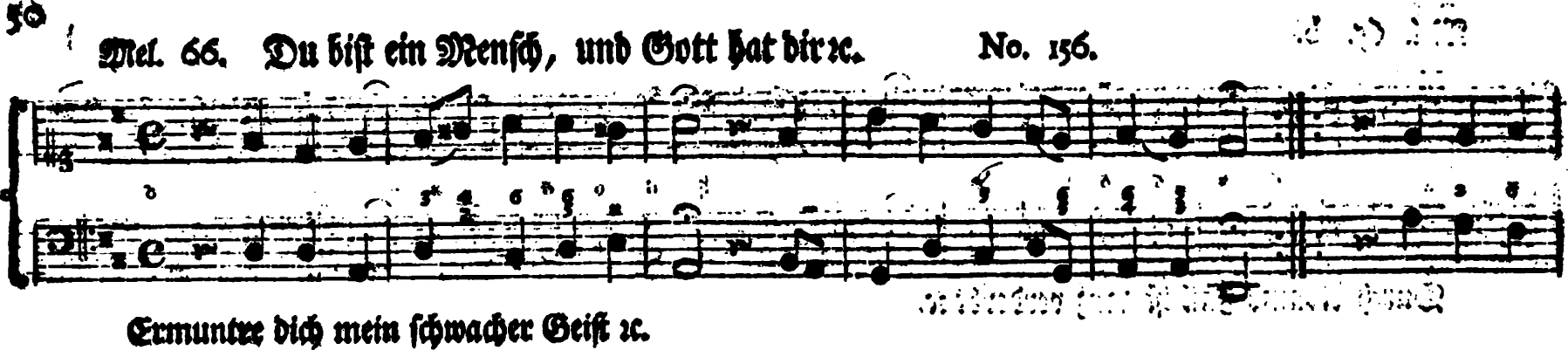
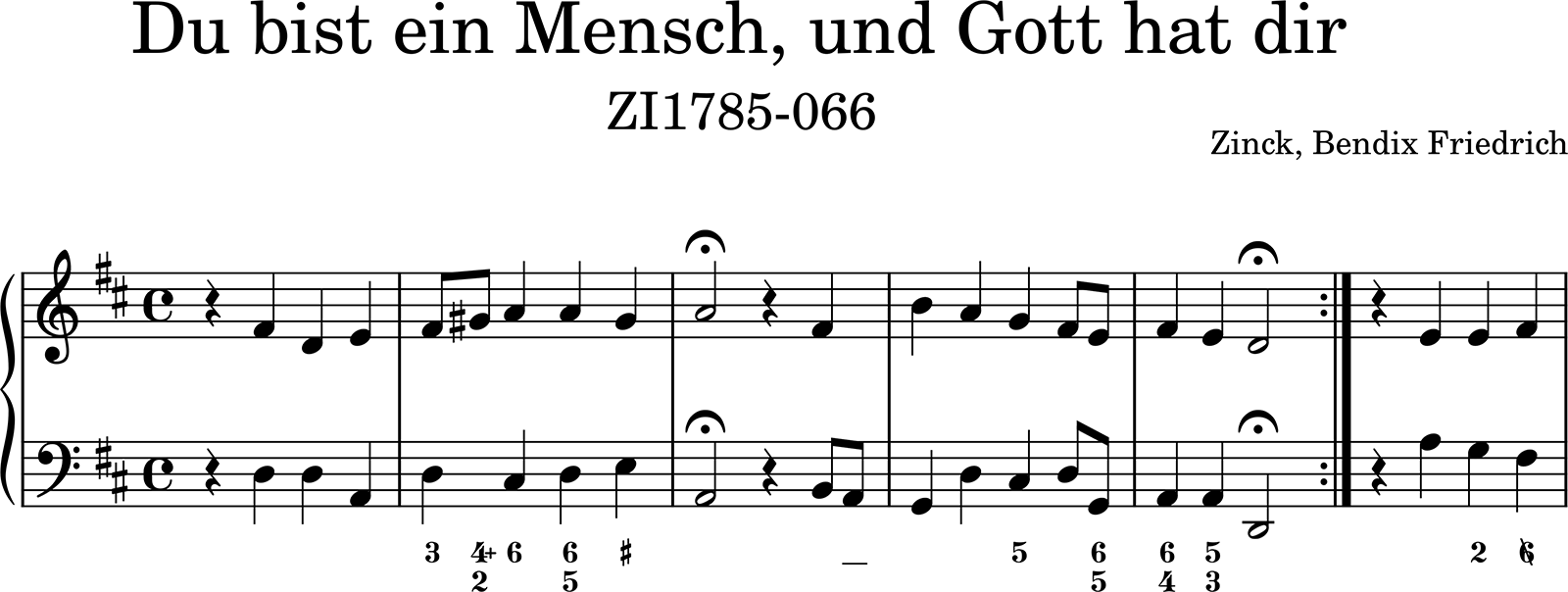
Figure 1
B. F. Zinck, Vollständige Sammlung, No. 66, “Du bist ein Mensch, und Gott hat dir”, m. 1–6 [no transcription of the handwritten addition “6” in measure 4].

Figure 2
J. Chr. Kittel, Vierstimmige Choräle mit Vorspielen, No. 4, “Ach Gott vom Himmel sieh’ darein”.
Irrespective of the basically identical publication type “chorale book,” the selected collections thus appear diverse and varied, such that transcriptions with the aim of comprehensive encodings already require several quasi‑editorial decisions. However, some of the changes made during transcription are exclusively for computer‑aided analysis and would not be necessary for an edition or even contradict the aim of a critical edition. For this reason, duplicates of the data records are kept which do not contain these additions. One particularly characteristic change goes back to conventions in contemporary figuring practice and reflects a certain act of “thinking along” on the part of contemporary players, which the computer, in contrast, cannot easily achieve. Figure 3 is an example of the adaptation of fifths not explicitly raised in the figured bass, which could lead to undesirable diminished triads.14
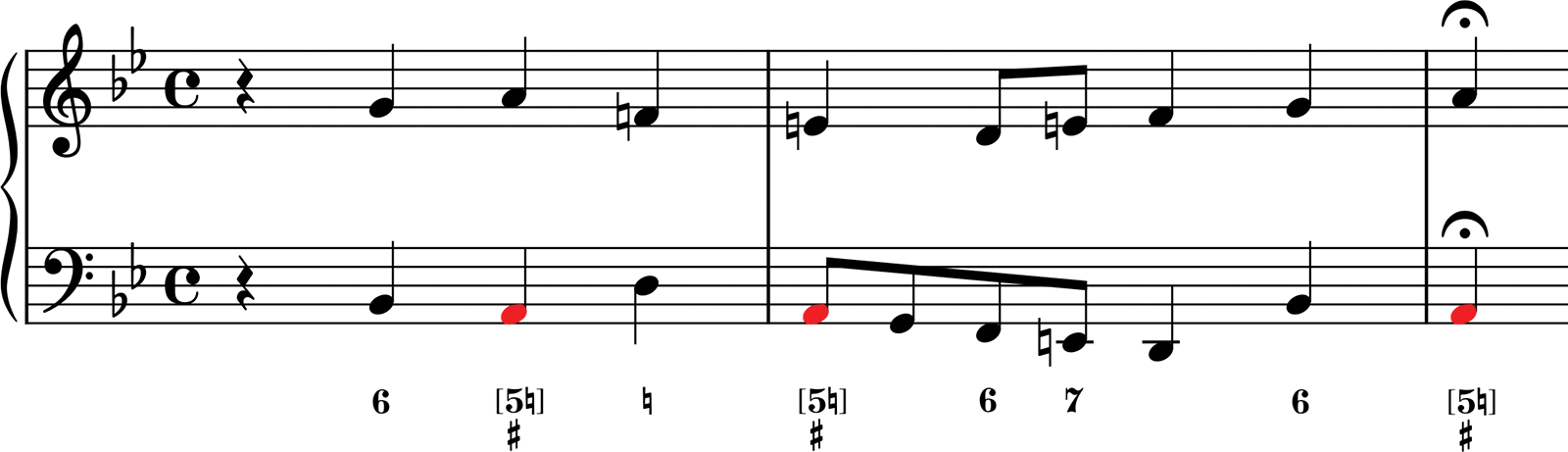
Figure 3
Excerpt from the previous example: added figures for rectified fifths in brackets.
In none of the three marked places does the source note the “intended” pure fifth above the reference note a that should actually be played. Additional figures such as the bracketed references to the perfect fifth would therefore be necessary for a possible selection process. The presumed locations of this problem were filtered with the help of a query. Adjustments were initially only made in chorales assigned to a Set‑ID15 and were always saved in a second file version, which is intended only for computer‑aided analysis. For the aims of our investigations, it is important to be able to name the extent of such figuring practice. We therefore strive for statements that provide more clarity here (e.g. “Choral book x is consistent in omitting any references to unfigured diminished fifths, choral book y includes such figures in almost half of the cases,” etc.). Yet there is no firmly established procedure for characterizing such observations.
In connection with the rectifiable fifths (Figure 3), it becomes clear that any handling of figures in the context of a computer‑aided study raises some fundamental questions: Due to the historical focus of our corpus study, we have decided to treat figures primarily as source findings. Therefore, the main focus of our study is to represent the great variety of possible figurings and (in the second place) the finding of certain designation‑traditions in this field. So, the fully appropriate interpretation of our bass lines by computer with the aim of a correct harmonic chain is not intended in this study yet. Nonetheless, to make notation computationally readable in a stricter sense might be possible when it comes to a few points. For the time being, the size of fifths will be the only point at which our project will attempt to actually carry out a genuine digitally evaluable standardization. Other complexes from the broad field of figured bass notation (e.g. stop lines, the exact form of sounds with a six‑figure notation, the exact arrangement of figures in sources, etc.) raise problems in a similar way. At the present time, however, the available resources (an application for funding has been submitted, but for now there is no concrete funding) unfortunately do not permit any further work in this field.
The project corpus thus consists of two larger sub‑corpora: a source corpus, which only contains clear error corrections, and an analysis corpus with additional “help” for the computer. In addition to these two corpora, the first test queries that have already been programmed can also be accessed via GitHub.16
The code is stored in the repository musicau‑demo in the organization cau‑mi (Musicological Institute, Kiel University, 2024). The transcriptions are published in a different organization (Chorale‑Corpus, 2024), that is not assigned to a specific institution. This organization was created to gather transcriptions of chorale books from different projects or scientists at one central place. Therefore, it will be expanded with chorale books for the intended project and beyond.
The Chorale‑Corpus organization contains individual repositories for each composer. The two sub‑corpora (source/analysis) are stored in sub‑folders in the form of .mscz files. The musicau‑demo repository contains the code of the queries designed so far and the analysis corpus in .musicXML format. This means that the queries can be reused by downloading the musicau‑demo repository without the need for an additional download from Chorale‑Corpus. All data are published under the licences CC‑BY‑SA or GPL3/LGPL3.
4 Methodological Remarks
Basically, queries for the data sets described here can be carried out in two different ways: (1) a query can either be applied to complete (partial) corpora (this is the simpler case), or (2) it can be directed only to the Set‑ID sets as part of a more specific question and then enables a historical‑dynamic overview for each song arrangement.
The possibility of presenting, for example, the sequence of sonorities for certain places in the melody (such as verse endings) in the sense of this “more specific question” seems particularly attractive. Four different settings on one and the same hymn melody then inevitably reveal (with a historical‑temporal spread, as can be seen from the table above) that the sequence of sonorities is further differentiated. Hymn corpora can illustrate this very quickly.
Some queries have already been carried out as part of the pilot project presented here:
Expansions – counting sound positions
This query was originally programmed to be able to detect any significant “scarcity” of the extensions of certain songs over a longer period of time. Such shortages can now be narrowed down to individual songs and described more precisely. However, there is no evidence of a general trend towards noticeable shortening.
A characteristic form of the Phrygian half‑closure
A particularly frequent form of the Phrygian half‑closure – that with the tenor clausula (as a diatonic semitone step) in the bass – was systematically documented with this query. This query is also suitable for the targeted qualitative examination of relevant verse endings in selected song melodies in which the same sequence of sonorities can traditionally be expected.
These two queries are representative of further investigations, as they are to be applied to as many collections as possible in our intended project through increasing transcription.
The more complex method just described is contrasted with the simpler consideration of complete corpora (i.e. entire collections in the form of a complete chorale book, for example). Here, one and the same query is posed to different chorale books one after the other. The results can thus be regarded, with some justification, as a reflection of a “typical” disposition of features that is characteristic of the collection in question.
Diastematics – phrase detection
With the help of phrase detection, similarities and even correspondences between all zones of the song melodies can be found. This makes it possible to quickly assign phrases to specific Set‑IDs. In addition, this query helps find certain phrases in the newly composed song melodies of the 18th century, which are perhaps perceived as typical of chorales and which repeatedly make use of such common melodic fragments.17
Figuring density – query by trigrams18
In this test, the bass line of each setting is divided into groups of three sound positions each to measure the “density” of the associated figures (sorted by inner zone and closure). As expected, the zones of the closure tend to have a greater density of figures than those of the inner zone, although this must be interpreted with consideration of the partial corpora publication dates.
Ambiguities in the marking of fifths above the reference note (cf. Section 3 above)
Non‑diatonical fifths above the reference note are only recorded unsystematically by figured bass signatures and often according to no recognizable principle. Very often they remain completely unmarked. With corresponding queries that are geared to this circumstance, marking conventions can at least be described with a certain approximation. If a subsequent addition to the figuring is to be undertaken, this query is a suitable aid.
Suspensions on verse endings
This query can be used to investigate whether accidentals on final notes (fourths or ninths) are required significantly frequently in certain sub‑repertoires. Such queries can even be applied with a view to historical differentiations in tonal technique if the temporal “spread” of the corpora under investigation is sufficiently large. Of course, stylistic and genre‑specific characteristics of the corpora act as a “confounding variable” here.
Ninth suspensions and their environment
The special case of a ninth suspension on final notes (usually on those of internal closures) also has an impact on the quality of the setting: If the “9” is preceded by a “7” on the penultima, and if this “7” is in the melody, the ninth suspension takes on a technical significance for the setting, as it may prevent consecutive perfect intervals.
It is no coincidence that the last‑mentioned investigations and queries (items 2–5) are all focused on questions of figuring: In the course of the preparatory work, our project has increasingly focused on the figured bass, which we continue to regard as having hardly been digitally analysed to date. The careful arrangement of the coded settings, their manual examination in random samples and the variety of figuring conventions revealed in the process (since the chorale books recorded cover a period of almost eight decades) made it very clear that a truly appropriate treatment of the semantics and statistics of all figuring found in chorale books will remain a pending project for the time being. We hope to be able to continue our preliminary work on this point in the nearer future. Writing conventions of the historical figured bass are undoubtedly a worthwhile subject of investigation, which has so far hardly been represented in musicological research.
5 An Example: Trigrams Illustrating the Density of Figuring
The query on trigrams and figuring density presented under item 2 above illustrates how results can be generated and interpreted with reference to figured bass. Dealing with the corpora described here proves to be classic corpus research. Figurations can be used to identify intended sequences of sonorities, at least in relation to individual zones in the settings. However, this fact does not apply equally to all places in the scores: In our three figured sub‑corpora (Rein/Zinck/Kittel, cf. the overview above; Table 1), those areas which produce final figures and which are traditionally thought to have a greater accumulation of figures appear to be clearly preferred. However, whether this “perceived truth” is actually supported by clear findings can only be decided if a corresponding survey is carried out. If we assume that verse endings comprise two to three sound positions, then a query mode that breaks down the entire setting into overlapping “trigrams” makes sense (Figure 4).
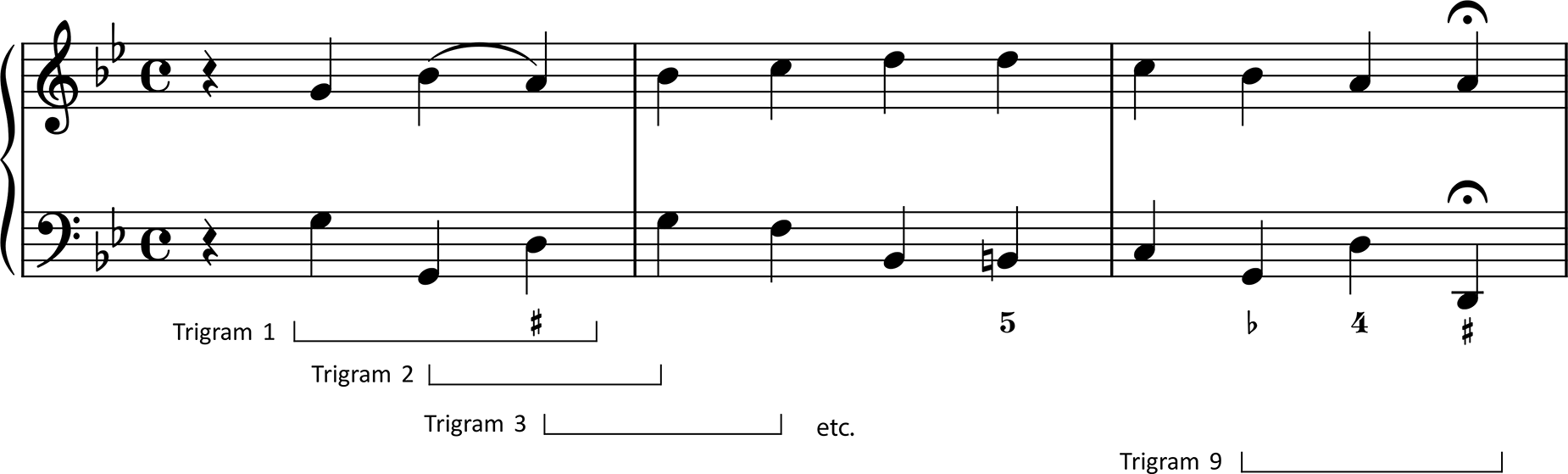
Figure 4
B. F. Zinck, Vollständige Sammlung, No. 59a, “Lobt unsern Gott mit frölichem Gemüthe”, first verse: Decomposition into trigrams.
A clear distinction can be made here: As shown in the given example, we abstract the genre‑typical convention “closure” for our query and understand it as a trigram with a fermata (= final mark) in the last position (here trigram 9). All other trigrams represent the “inner zone,” i.e., the verse. This makes it possible to describe any deviating figuring densities in a meaningful way. The results of the evaluated query for the three sub‑corpora (i.e. for the Choralbücher of Rein, Kittel and Zinck) can then be presented in tabular form as seen in Table 2.
Table 2
Density of figuring: number of figures for inner‑zone trigrams versus closure trigrams.
| Collection | Number of figures for inner‑zone trigrams (average value) | Number of figures for closure trigrams (average value) |
|---|---|---|
| Rein, 1755 | 1.72 | 2.21 (+29%) |
| Zinck, 1785 | 1.99 | 2.49 (+25%) |
| Kittel, 1803 | 2.65 | 3.93 (+48%) |
The values in the right‑hand column thus indicate the extent to which the numbering density of the closures exceeds that of all other zones. In concrete terms, the values in the table initially only show the results of counting operations as average values. However, if these values are now interpreted, the greater number of figures is actually found on the closure trigrams for all three collections. But even if the basic assumption (= more figures on closures) is immediately confirmed here, there are still differences that need to be interpreted. Kittel’s settings obviously differ from those of Rein and Zinck in terms of the characteristic “density of figures”. The latter two are similar in the increase in signature density towards the closures. There is a rather small difference between the settings by Rein and Zinck when it comes to the “inner‑zone” trigrams too. Despite the generational difference, a similar culture of figuring is evident here. In this respect, Kittel’s settings clearly follow different principles, as their density of figures increases by half, even though the general number of figures is already higher than those of Rein and Zinck. This is certainly a consequence of the concrete structure of the bassline in Kittel’s settings. After all, it is of the utmost importance for figuring whether basses frequently leap or tend to run in steps. And “walking” (stepwise) basses require more figures for structural reasons: In fact, first queries19 right away revealed the extent to which the fundamentally more stepwise bass progression of Kittel’s setting helps determine the ratios here (Figure 5).

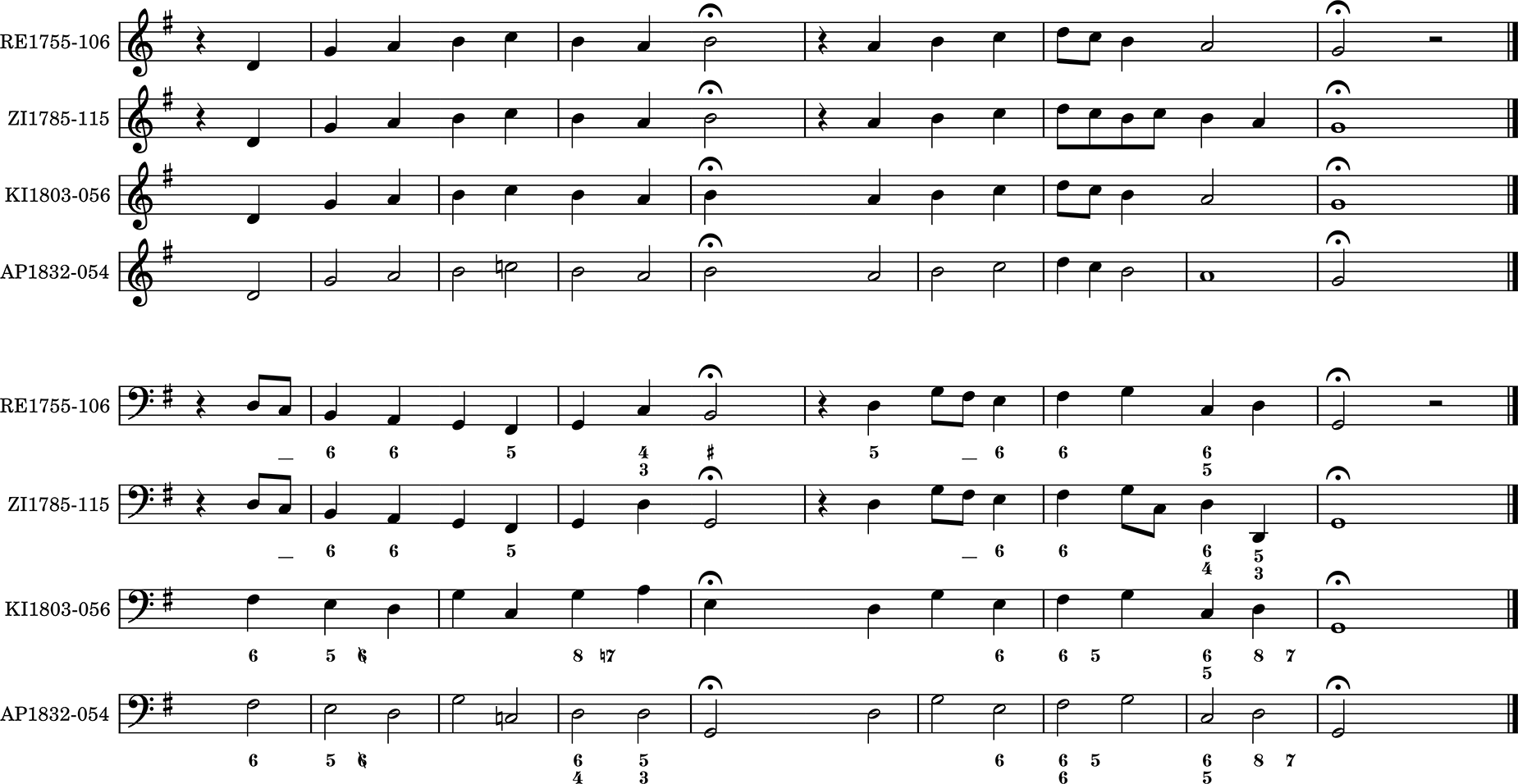
Figure 5
Synopsis of “Es spricht der Unweisen Mund” (SID027).20
Even at this simple structural level in dealing with the phenomenon of figured bass, it becomes clear that fundamental differences between partial repertoires can be described well with the help of digital queries. The prerequisite is the development of large repertoires of coded settings, which can then be analysed in different ways.
6 Future Work
An in‑depth investigation of the sequence of sonorities, as can be observed in North German hymn settings from around 1750 to 1850, represents a worthwhile field of work for computer‑aided methods. Relevant hymn arrangements have survived in large numbers and in different types of setting (notated four‑part settings and above all figured outer voice settings). This repertoire can be prepared in modular form for corpus research. For this purpose, further sub‑corpora (in the form of individual chorale books) will be added to the complete corpus that is currently being created. An extension to the entire complex of choral compositions without regional restrictions makes sense and should be made possible in a simple way (perhaps through crowdsourcing and the creation of a corresponding database). At present, however, the regional limitation offers a certain manageability and the prospect of fundamental experience. The constant change of possible research perspectives – two of which have been briefly described above – is a particular attraction. However, to make the research results comprehensible, it is necessary to develop means of presentation that enable, for example, synopses of functionally identical places in the score (usually individual verse closures, but also entire verses) from different song sets.21 One aim of our intended project is therefore also to simplify comparative observations of different settings to nominally identical song melodies or to make them possible in the first place. Comparisons of verses or endings can methodically enrich elementary theory and figured bass lessons and illustrate them with authentic reference to sources. Synoptic representations are also of interest in classical research contexts. Of course, studies on the sequence of sonorities technique, where they are carried out in the manner shown, always have a general musical‑historical value. As part of our intended project, we want to at least carry out preliminary work on this and incorporate initial user experience with suitable forms of presentation back into the development process.
Competing Interests
The authors have no competing interests to declare.
Notes
[1] On digital analysis and the “mass task”, see Steinbeck (1982, p. 371).
[2] Thomas Daniel (2000, pp. 333–337) provides a concise discussion of the questions of authenticity and the resulting (actual) number of Bach's “chorales”.
[3] Cf. the corresponding remarks in Section 2 below.
[4] The DCML harmony annotation standard, for example, is used intensively here; cf. Digital and Cognitive Musicology Lab (2023).
[5] The preparatory work for this study was accompanied and supported by Prof. Kathrin Kirsch from the Institute of Musicology at Kiel University. For this article, we acknowledge financial support by Deutsche Forschungsgemeinschaft (DFG) within the funding program Open Access‑Publikationskosten.
[6] Cf. Gerhardt et al. 2023. All settings transcribed so far can be viewed on the following GitHub page: https://github.com/Chorale-Corpus.
[7] The copies of these four Choralbücher used by us belonged to the collection of the German hymnologist Johannes Zahn (1817–1895) in the 19th century and are now in the Bavarian State Library in Munich. A URL for each of the four books is stored in the README of our Git repository.
[8] Original in German: “in welchen [= norddeutsche Kirchen] er das Choralsingen der Gemeinen bey weitem nicht so rein fand, als in den Kirchen seiner Gegend”.
[9] Original in German: “daher es ihm besonders nöthig schien, die Choräle so kunstlos und natürlich zu setzen, daß sie von einem auch nur wenig geübten Organisten ohne Mühe gut und richtig vorgetragen werden können, und durch einen solchen Vortrag die Gemeine, welche leicht durch ein unreines und blos gekünsteltes Spiel, oder selbst durch sehr kunstreiche Harmonien in Verwirrung geräth, allmählig zum guten Choralsingen gewöhnt wird.”
[10] The original counts in Zinck and Apel use such letters in several cases. In Kittel's settings we have added them as required.
[11] Unlike other notation programs, the figured bass is notated in MuseScore using a tool specifically implemented for this purpose, which can easily realize passages over the same bass note. In other programs, this can only be done in an auxiliary way by inserting a hidden additional note, but this would introduce an avoidable source of error when reading out the file code for digital analysis. Another argument in favour of using MuseScore is that, as an open source program, it allows third parties to process the project files without restriction.
[12] When editing files and corpora, the authors were supported by Sina Schneider and Alexander Hofmann, research assistants at Kiel Institute of Musicology.
[13] To enable queries with the already programmed tools based on Music21, we have initially only stored those of Apel's settings with a Set‑ID on GitHub in a reduced form (only outer voices with figured bass). However, all other Apel settings will also be made available in reduced form at the same location in the near future.
[14] A separate publication on the digital‑analytical side of the problem described here (“rectification of fifths”) is in preparation.
[16] Luca Evelyn Bruder, research assistant at Kiel Institute of Musicology, provided a substantial part of the programming work for this project.
[17] There is a considerable number of solution approaches to the problem of melody comparisons, incipit searches and general similarities. On this problem, see, for example, Janssen et al. (2015) and Cheng et al., 2018.
[18] The investigations based on trigrams are partly inspired by methods used in general linguistics. In the context of musicology, such methods form an important basis for the well‑known VIS framework (Antila and Cumming, 2014, pp. 71–76).
[19] The possibility of such observations is well illustrated by the various arrangements of the song “Es spricht der Unweisen Mund wohl” and their respective bass figures (Rein no. 106, Zinck no. 115, Kittel no. 56 and Apel. no. 54; see the following example). Differences are clearly visible in the basses of verses 1, 2 and 3. An integrated query that works on several levels and also includes the specific bass progression for each setting should produce even more differentiated results.
[20] This synopsis has been created by hand, though an automation of this process (as far as possible) is planned. It is already possible to find and assign Set‑IDs, combine the songs in MuseScore and sort the voices by melody and bass line via MusiCAU. If the songs share the same structure (as with Rein and Zinck in this example), a synopsis can therefore already be generated automatically. Shifts and different time signatures however need to be altered by hand, since it is not possible to display them synchronously in MuseScore without auxiliary solutions. Apel’s version (original bass without figures), for example, was in this case entered with the local time signature 4/2, which has then been hidden. This results in the lack of the original  in the MuseScore‑Synopsis.