
Events in recent years have highlighted the need for governments to prepare for unforeseeable and uncertain challenges, such as the COVID-19 pandemic. The importance of such preparation is also reflected in current research, which increasingly focuses on anticipatory decision-making and governance. Thus, the interest in resilience has grown. Resilience is defined as the ability to recover successfully despite the exposure to challenges (Vickers & Kouzmin, 2001, p. 95). However, when facing challenges in an interconnected world, governments might have a particular interest in preventing failures rather than solely react to them, as their decisions heavily influence their own but also global developments.
One potential tool to aid in tackling future challenges for organizations is foresight (Schoemaker, 1995, p. 25). It is thereby thought that by understanding potential future events and outcomes, resilience can be increased through the minimization of unexpected challenges. More specifically, “Governments worldwide are using strategic foresight to get early warnings of oncoming disruptions, to build resilience and future-proof their plans” (OPSI, 2021). Furthermore, foresight can minimize projection bias, which decreases the optimality of the basis of decisions (Loewenstein et al., 2003, p. 1209). Due to these advantages, resilience in the public sector is closely linked with the practice of foresight. Increasingly, governments apply methods of foresight in their projects focusing on state resilience. However, a current gap in the literature entails a systematic link between the two concepts of foresight and resilience. The concepts, as of today, are only analyzed individually without making a systematic link. Thus, the present paper aims to explore and create a systematic link and framework between resilience and foresight. More concretely, the study aims at answering the following question: What are the decisive factors for the use of foresight in enhancing state resilience, and what are the effective strategies for its practical implementation?
To do so, the paper is divided as follows. After explaining the theoretical background, the methodological basis is presented. Then, the systematic literature review aims to foster the conceptual understanding of the different theories of government activities in foresight for resilience. In a next step, the case is analyzed as an illustrative element of the conceptual framework. The last section brings together theoretical and empirical results in a synthesis, where research propositions are formulated. The paper ends with the contributions for theory and practice.
Theoretical Background
Recent research suggests that governments mainly consider resilience to cope with increasing uncertainties in their respective environment. According to Quay (2010, p. 497), resilience focuses on the ability of a system to retain essential functions under pressure. Research has increasingly focused on the impact of foresight in specific situations that require resilience, such as flooding (Daniels et al., 2021) or the climate crisis (Rutting et al., 2022). As the interest in foresight and resilience has increased both in research and practice, both concepts are not novel in public administration and governments. This makes sense when considering that challenges requiring resilience and foresight are a reoccurring phenomenon. In fact, by applying scenario planning, governments have engaged with foresight since the cold war. This was due to the necessity of systematically exploring previously unthinkable futures, for example, a nuclear war. (Schoemaker, 2022, pp. 30–33) Since then, a considerable number of governments in various political systems have already engaged with foresight projects (Janzwood & Piereder, 2019, p. 606).
This historical link between building capacities for an uncertain future and the desire to at least partially be able to identify upcoming plausible challenges is relevant until this day. Hence, the assumption is made that foresight activities and public sector resilience are concepts that are profoundly linked, and ought to be analyzed in relation to each other. Importantly, in the following, the building of resilience capacities is perceived as the outcome of foresight engagements. Nevertheless, despite such conceptual and theoretical links, research has yet to systematically link foresight and resilience within public administration contexts. Hence, the present paper aims to contribute to a clearer understanding of the relationship between exploring plausible futures and the decision making for allocating strategic resources and resilience. In doing so, decisive factors for the use of foresight in enhancing state resilience as well as effecting strategies for its implementation are explored, with an in-depth case analysis of foresight implementation and resilience in the United Kingdom (UK).
Method
The paper aims to explore the link between foresight and resilience by following a multi-method approach, combining a literature review with an illustrative case study. First, the question of how the data necessary for the present study was collected in a two-step approach is elaborated. Then, an explanation of how the data was analyzed to provide the necessary theoretical and empirical insights is presented. The combination of the methods is useful to triangulate and complement the findings of the present study (Johnson & Onwuegbuzie, 2004, p. 22).
The following illustration Figure 1 gives a graphic overview of the overall methodological approach of the present paper, with the dotted line showing the impact of the snowball approach on the analysis and the dashed line symbolizing the testing of the framework though the illustrative case study. Each step will be further elaborated on in the following.
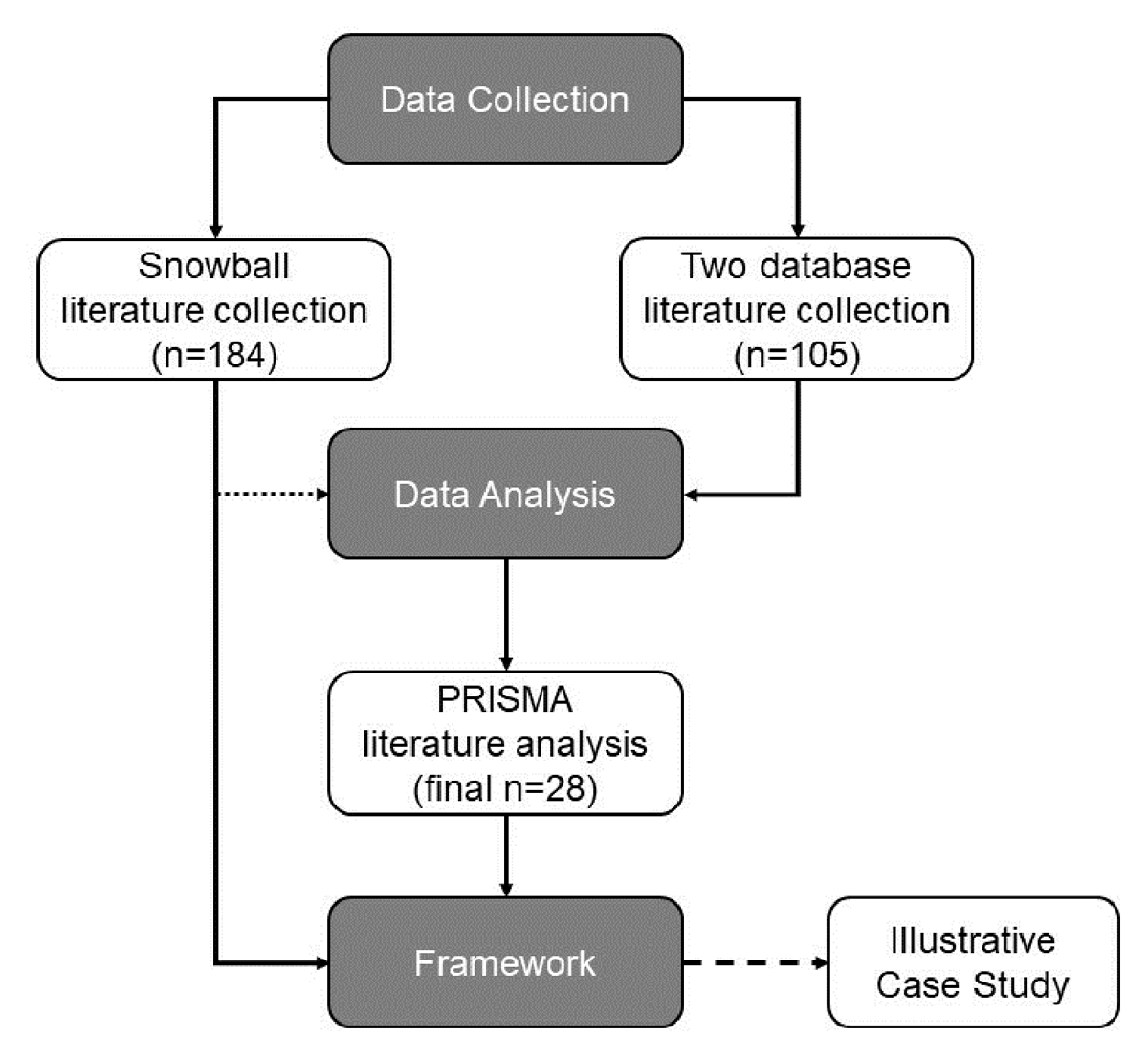
Figure 1
Graphical overview of applied methods.
Data collection
Two levels were incorporated for data collection. First, on a theoretical level, the author identified key research in the fields of resilience and foresight by following the PRISMA framework for literature review. This is especially usable when reporting a systematic literature review and aiming to find the most adequate set of literature available. Two databases, Scopus and Web of Science, were searched using the exact search terms foresight AND resilien*. The Boolean operator * was used to include various terms for resilience (resiliency, resilient, etc.).
To address foresight in public administrations, an extensive inductive approach was applied. Literature was identified following the “snowball” approach, in which relevant sources were identified by following citations of important papers (Wohlin, 2014). The list of literature on foresight in the public sector consisted of 184 sources. These sources were not analyzed with the PRISMA framework but give the context to understand how foresight is implemented in the public sector.
Second, on an empirical level, the UK is analyzed as an illustrative case to demonstrate how the public sector benefits from active integration of foresight to build resilience. The UK was chosen as a case for two key reasons. First, it has an active foresight project focusing on resilience. This was crucial, as it enabled the author to analyze a project which includes recent disruptions. Second, the UK matched the data requirements: publicly accessibility and publication of data in either English or German.
Data analysis
As mentioned above, the PRISMA framework was used in the methodological stage to synthesize research in the field of foresight and resilience. The two databases provided a total number of 498 papers, of which 122 were duplicates. Thereafter, a total of 376 sources remained. This literature was filtered to match the following criteria: 1) Document type = Article (peer reviewed); 2) Categories in Social Science (specifically: Business, Management, Political Science, Public Management, Decision Sciences); and 3) Language English or German. This limited the n to 105 unique papers.
The remaining papers were analyzed by reading title and abstract to determine appropriateness for the in-depth review (being resilient through foresight within public administrations). Any paper that did not match this exact focus and context criteria was excluded. Furthermore, papers focusing solely on the building of resilient cities were not included, as the scale of decisions is significantly different. This narrowed the final n of papers down to 28, ranging from 2009 to 2023.
Journals that are mentioned more than once include International Journal of Disaster Risk Reduction, European Journal of Futures Research (each n = 2), Technological Forecasting And Social Change, Futures, and Foresight (each n = 3). In a next step, the papers were scanned for valuable insights, that are discussed in the next chapter.
Based on this literature review, the author created a comprehensive framework linking the use of foresight with the objective of increasing a state’s resilience. This was achieved by linking both strings of literature mentioned above and analyzing the existing overlaps. By combining the literature, 212 articles were considered in the development of the framework. This led to a differentiation into three distinct pillars within the framework, as they emerged from the previous step. These will be further expanded on in the results.
The framework helps to understand individual projects in-depth and could provide a basis for between-case comparisons. To ensure the compatibility with what real world applications of strategic foresight projects in resilience building, the framework is tested on a concrete case (Eisenhardt, 1989, p. 541). Generally, an illustrative case analysis serves two purposes: it illustrates how the analytical tool developed in the paper works in a concrete, real world example and demonstrates the relevance of a theory from an empirical standpoint (Eckstein, 1975). Thus, the author can go beyond the initial impressions given by the literature and find potential incompatibilities of the framework with real world data using a structured approach.
Results
In the following chapter, a conceptual framework is developed based on the results of the literature analysis. This framework consists of three pillars. The first two pillars, explaining why and how foresight is incorporated, are developed mainly based on the literature of foresight in the public administration. The third pillar is focusing on foresight-based approach of resilience, based on the PRISMA analysis. There, the central aim is extrapolating the spheres in which foresight for resilience can be applied in the public sector.
What are the theoretical reasons for engaging in foresight?
Several reasons explain why governments would engage in foresight. However, the reasons can broadly be divided into two distinct sub-categories, namely internal motivations or external factors. These are again divided into more concrete drivers that lead to foresight engagement, which shall be discussed.
Firstly, an internal initiative of the government or public administration officials may ignite foresight projects. More specifically, political will may be a main driver for governments’ engagement with foresight (Bowers & Glenday, 2021). This is important as research suggests that the support of political decision-makers and their interest are crucial factors for the long-term success of the engagement (Schmidt, 2015, p. 496). Occasionally, institutional experience with foresight may already exist within the government, which can reduce initial hesitations and also be a positive impact, as will be discussed in the following chapter (Habegger, 2010, p. 50; Rosenström & Raleigh, 2015, p. 3).
Secondly, internal research activities can also initiate foresight projects. The relevant literature asserts that a government’s research priorities and the resulting investments are a key explanation for the creation and focus of foresight projects (Georghiou & Cassingena Harper, 2011, p. 243). Therefore, the formulation and communication of research aims of a government can be the origin of a foresight project.
Thirdly, the element of reputation links both internal and external reasons. It is in both the internal signaling that could positively influence the willingness of governments to engage in foresight, but also external stakeholders’ expectations that then may exert a positive or negative influence on the reputation of the respective government. (Tõnurist et al., 2015, p. 9) Hence, governments may note a positive reputational effect when their decision-makers engage in foresight projects.
Apart from internal reasons, there are two exogenous drivers leading to public administrations’ engagements in foresight projects. The first external reason for governments to engage in foresight activities are international foresight projects. The Observatory of Public Sector Innovation (OPSI), a sub-entity of the OECD, actively supports governments in understanding what foresight entails and further fosters collaboration on the tools (OPSI, 2023). By independently consulting governments, OPSI actively fosters foresight activities within public sector entities as an external organization. Thus, this is a further key reason for the engagement of states in foresight. As a second reason, unexpected challenges may lead to governments engaging in foresight. A recent, most prominent example for this is the COVID-19 pandemic which highlighted the desire for and value of foresight activities (Gariboldi et al., 2021). These events can raise government awareness of a lack of perspectives or preparedness.
Overall, it can therefore be said that the reasons to engage in foresight can vary based on experience with previous foresight projects, but also on the circumstances in which a project is created.
How do they do foresight?
One of the main questions in foresight applications is how governments approach projects. The response to this question entails two elements, namely the decision of how foresight engagement is positioned within the public administration; as well as the decisions that must be made before and during a specific foresight project.
Considering the positioning within the organization, three approaches for foresight entities exist according to Schmidt (2015, p. 495): Firstly, the projects may be led by a single central entity, focusing on issues and topics that are relevant across departmental lines; secondly, projects can be located within individual departments and thus focus primarily on the departmentally relevant topics; or lastly, a mixed approach may be chosen. For the third approach, Schmidt creates different possibilities with a cross-departmental team focusing on foresight (2015, pp. 499–500).
The second element of foresight implementation entails the actual work on the foresight projects. The points that are included within this element are different from the positioning within the organization, as they are not mutually exclusive in themselves. They work in conjunction and bring with them separate sub-decisions. This means that instead of being distinctive between approaches, the second element should be understood as descriptive. In the following, the four sub-parts of this element, namely the adequate methods; achieving the right level of participation; keeping the relevance of project and the support of the decision-makers; and translating the results of the foresight into the organization, will be defined.
Considering selecting the adequate methods, literature highlights that certain points in a project must be considered, especially the project’s aim and the knowledge within the organization on which can be drawn. Once this has been answered, there is a range of potential techniques that can be applied. These include, among others, Delphi, Horizon Scanning, and Scenario Planning (see, for example, Kishita, 2021).
Furthermore, research has highlighted the importance of the level of participation. Fung (2006, pp. 67–68) differentiates participant selection methods, ranging from the exclusive selection of experts to the inclusive participation of the public. Generally, this can have an influence on the legitimacy of government actions, as exclusion can seem to undermine democratic principles. In foresight literature, participation is seen as a resource that can be benefited from (Pernaa, 2017). This can range from the mere inclusion of interested stakeholders in the process (Schoemaker, 1995, p. 28) to people actively raising points for discussion in specific projects (Heo & Seo, 2021).
Additionally, it is equally as important to upkeep the internal relevance of the project. Researchers have identified multiple factors that must be considered to ensure the willingness of continuing foresight projects. These are especially important as the projects may be considered intangible and compete with other ideas of how the future could look like (Hines & Gold, 2015, p. 103). The two most critical factors thereby include support of decision-makers within the organization, and the identification and support of internal “champions” (Hines & Gold, 2015; Schmidt, 2015). These champions actively support the implementation of foresight and encourage others to either engage in or continue the endeavors.
Lastly, the results must be translated into the context of the organization. This is identified as a critical issue for foresight projects to succeed. Research identifies the deliberate integration of the results and also the general methodology of foresight into strategy processes as an essential asset (GCPSE, 2018, pp. 15–16).
What do they want to achieve?
By engaging in foresight activities, governments expect to increase their “ability to being flexible in the eye of emerging challenges and having a plurality of points of view” (Havas et al., 2010, p. 92). Additionally, governments aim to move from a reactive approach to preventing risks and thereby increasing resilience. Through the literature analysis, three contexts were identified in which the state tries to increase its resilience: In political matters, on the organizational level, and for the society. These three contexts of resilience building shall be analyzed.
In the political sphere, three sub-elements relevant to resilience building through foresight exist. These include the formulation of future-proof policies, the creation of space for debate, and the (re-)formulation of strategies. First, foresight creates the possibility to formulate future-proof policies. According to the OECD, by using foresight in the policy formulation process, this allows decision-makers to look beyond the near-future and include uncertainty (OECD, 2020, p. 23). Second, as discussed in the participation paragraph, foresight creates space for debate. This is also supported by research, highlighting the value of participative elements in both foresight and democracy (Pernaa, 2017). Lastly, foresight can help political decision-makers to create and reformulate strategies (Meissner, 2012, p. 909). As such, foresight is especially helpful in the field of challenging given assumptions and creating knowledge of emerging issues, which in turn allows for flexibility and recognizing weak signals (Havas et al., 2010, p. 92). Three of the analyzed papers focus on political resilience.
The second level of resilience building through foresight contains the organizational level. Organizational resilience is defined as “a function of an organization’s overall situation awareness, management of keystone vulnerabilities, and adaptive capacity in a complex, dynamic, and interconnected environment” (McManus, 2008). Hence, foresight is a key tool to increase the awareness and thereby reduce uncertainties in an organization. Additionally, foresight has a strong link to organizational learning. Using different techniques, foresight can mobilize actors within an organization to have a collective approach to challenges, even though they may not have materialized at that stage. (Bootz, 2010) This means that not only the individuals gain knowledge, as discussed in the strategy reformulation above, but also the organization (Kimbell & Vesnić-Alujević, 2020, p. 97). Three of the analyzed papers focus on organizational resilience.
Lastly, there are projects focusing on the importance of societal resilience. In this context, Kohler (2021, p. 17) argues that societal risks and, therefore, resilience against them, require focused foresight activities. Hence, it is not surprising to see governments engaging in foresight projects that aim at enhancing the preparedness for plausible future challenges for their respective society. The societal resilience field lacks a clear definition of what it comprises (Anholt et al., 2021). In the analyzed literature, the fields of public health, technology, national economy & national economic supply, and environmental change are discussed. This is the emphasis of 22 papers.
Resilience through foresight
By combining the relevant literature of foresight and resilience, the following conceptual framework is created. It links the path of foresight to resilience building in the public sector, from conception through the process to the final aim. This builds on research in the fields of foresight in the public sector and how foresight is an appropriate approach to enhance the preparedness of states to face uncertainty.
The framework shown in Figure 2 includes multiple layers which must be considered before and during foresight engagements aiming to increase a state’s resilience and serves as a structured approach that helps to understand and analyze given projects. To highlight the analytical relevance of the framework, the following chapter describes a case by applying the three steps to a real-world foresight project.
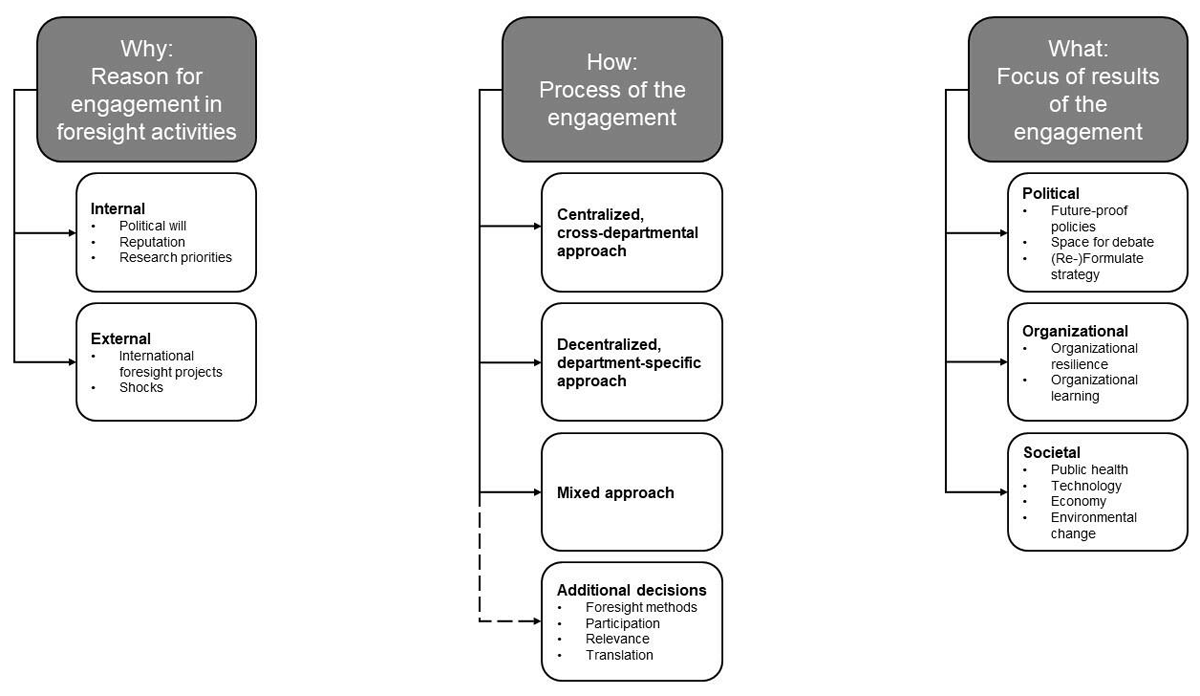
Figure 2
Structured framework to analyze foresight for resilience.
Integrating Foresight and Resilience
The UK has a pioneering role in public applications of foresight (Schmidt, 2015, p. 497; SOIF, 2021, p. 93). Today, the Prime Minister and the members of the Cabinet are advised by the Government Office for Science (GOS) to ensure that policies are formulated based on the best information available. In this advisory role, the GOS uses various foresight methods to enhance the preparedness in times of uncertainty and identify plausible future trade-offs of policies. Furthermore, the GOS supports the government by increasing the resilience of strategies by enhancing their adaptability to a changing environment. (GOS, 2021, pp. 2–6) As the UK has considerable experience in running foresight activities, the author considers it a suitable environment to assess the appropriateness of the conceptual framework describing the path of foresight aiming to increase resilience. It was chosen based on multiple factors highlighted in the Methods section above.
In the following, the concrete project called “The UK Government Resilience Framework”, published in December 2022, will be analyzed. It was developed by the GOS with the main purpose of strengthening the resilience of the UK and its society. In the following, the project is discussed in further detail, with the main goal to understand the project within the structured framework developed above.
Reason for engagement in foresight activities
Within the UK Government, multiple foresight projects are ran simultaneously, most of them focus on concrete high impact issues, such as climate change or demographic change (GOS, 2022). Other than these issue specific projects, the relevant case for the present study has a focus on resilience as a broad topic. In this project, the UK Government emphasizes its long-term strategic objectives. The Resilience Framework has the central goal to consolidate endeavors from different departments and specialized sub-groups in a broader and more comprehensive report. This, thus, allows for a report of risks which are more interconnected and, hence, more complex.
By approaching risk and resilience from a broad perspective, the government indicates that it is primarily political will fostering the foresight project, notwithstanding being partially linked to external shocks. The political will is also particularly visible in the formulations where preparedness despite unpredictability is highlighted. (UK Government, 2022, p. 2) Therefore, in the structure of the framework, the UK has an internal approach to foresight.
Process of the engagement
The UK is engaging in a centralized process which cuts over the lines of department silos. This happens in two ways. Firstly, the National Security Risk Assessment assesses and prioritizes what are considered top-level risks for the UK. These risks are not department specific. Secondly, the assessments are complimented by an even longer view that is provided by the GOS, also keeping a broad view and anticipating change under uncertainty. (UK Government, 2022, pp. 11–12) Additionally, a central unit was created to enhance this collaborative long-term perspective (2022, p. 21). Therefore, the approach to foresight of the UK is the centralized, cross-departmental approach in the framework.
As per the framework, certain additional decisions exist that are not mutually exclusive but still have a direct and significant impact on the project. First, concerning the methods of foresight that are used, the Resilience Framework implements a variety of approaches, but mostly relies on horizon scanning (UK Government, 2022, p. 12). Horizon scanning is a method frequently used in UK foresight projects (Habegger, 2010, p. 53). Concerning participation, the Resilience Framework practices a participatory approach. This is especially visible in the active seeking for the engagement of various groups, including the public, experts, and parliament. Thereby, the formulation of the project and the contents of the engagement was based on a variety of perspectives. (UK Government, 2022, p. 71) Furthermore, the project aims to upkeep especially the public engagement by conducting an annual survey of public perception of risk, resilience, and preparedness (2022, p. 15).
Moreover, to maintain the relevance of the project – also in the eyes of government decision-makers – the projects foresees the introduction of an annual statement to the parliament on questions of risks and resilience (UK Government, 2022, p. 15). This ensures that the topic stays on the national agenda. Furthermore, combining the elements of relevance and translation into the appropriate organizational context, the UK has created local resilience forums (NRFs) that provide a deeper understanding of the local circumstances and connect the teams that immediately react to risks (2022, pp. 16–24).
Focus of results of the engagement
The project at hand argues that “[t]he starting point of all resilience work is understanding risk” (UK Government, 2022, p. 10). Thus, capacity building in resilience first needs to start by understanding, which risks the parties are aware of, and which may still be unclear or completely unknown.
Resilience in the public sector in the UK is approached on different levels. Nevertheless, this specific foresight project specifies that the results are in the societal sector, with security and the economy defined as the central issues (UK Government, 2022, p. 20). This is also notable in the focus on the perception of risk in the population that is mentioned beforehand. The government prioritizes a long-term perspective on societal well-being in this project. Critically, the government includes the relevant actors in each topic. As certain elements of the UK’s critical national infrastructure are privately owned, alignment of parts of the private sector are of crucial importance for resilience to work (2022, p. 35). Hence, the UK aims at achieving resilience through strategic investments and alignment with private actors (2022, p. 55).
As the end of the report states, emergencies are not only happening on national level. Resilience and long-term planning need a systemic perspective, integrating various actors. The UK mentions that “this framework is only the start. […] [T]his framework provides a starting point to refocus and extent the civil protection system […].” (UK Government, 2022, p. 79)
Synthesis
In the present paper, a three-pillar framework developed from the relevant literature in state foresight and resilience building activities was presented. By linking the application of foresight with resilience and showing the concrete implementation within the case of the UK, the framework is tested as a method to understand and analyze a given project using a structured approach. The outcome can be summarized as follows. The analyzed literature suggests various reasons for states to engage in foresight. These can be divided into internal and external ones. Furthermore, the integration of foresight engagements within the structures of public administrations can range from cross-departmental to fully department-specific approaches. In this, states have several additional decisions to make, such as the appropriate method or participatory elements. Lastly, concerning the focus of resilience, the fields of political resilience, organizational resilience, and societal resilience were identified.
With the illustrative case analysis of the UK, the framework has indicated its appropriateness to accurately analyze a concrete foresight project aimed to foster foresight. When aiming to make between-case analyses, the framework can be the fundament which would highlight differences between the case, allowing for an in-depth comparison of cases with similar or distinctly different attributes. For the UK, the choices made in the analyzed “Resilience Framework” are highlighted in the following adaptation of the structured framework in Figure 3. Thereby, the relevance for future applications is emphasized.
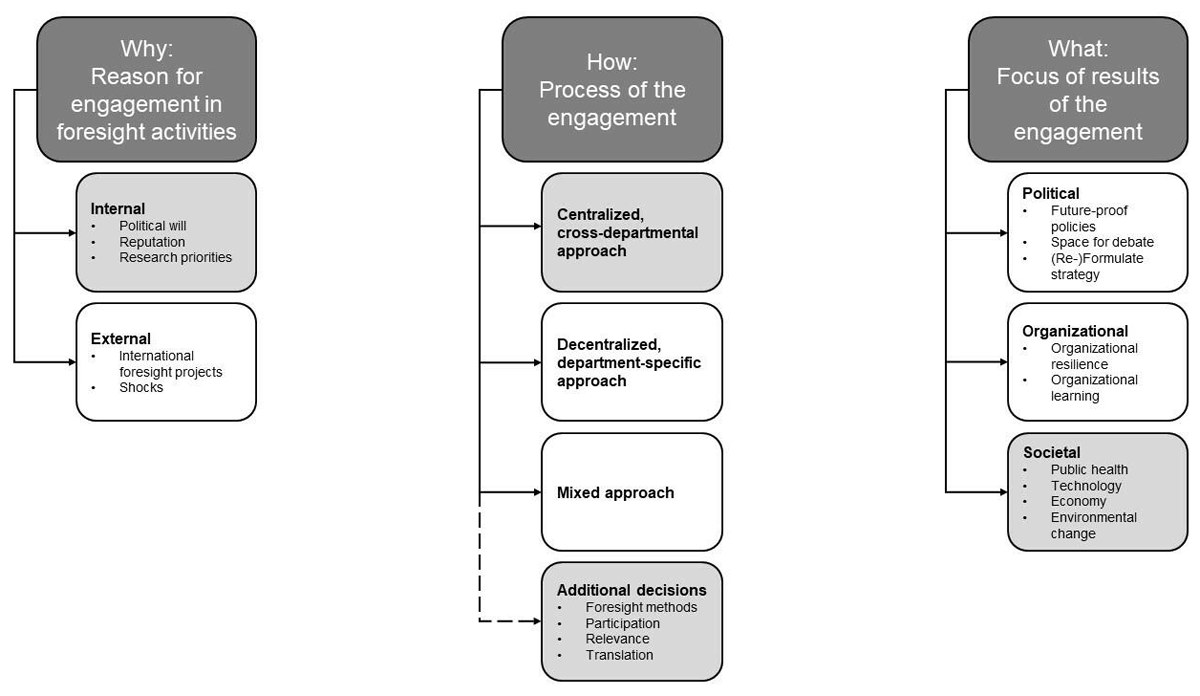
Figure 3
Choices of UK Resilience Framework in the structured framework.
Creating the above-mentioned framework is the central contribution. However, by linking two concepts, certain assumptions ought to be made. Therefore, the following propositions are stated. They ought to be tested in further research with the aim to find further evidence or testable hypotheses.
P1: Foresight serves to increase the resilience of states
By using foresight, a state implements a strategic tool which is well suited to understand uncertainties, show potential gaps of knowledge and information, and set priorities in politics and investments. Therefore, foresight is a suitable methodology to increase a state’s resilience. This proposition is the foundation for the connection between the concepts of foresight and resilience. It is therefore crucial for the overall creation of the framework.
P2: Resilience is a crucial attribute in navigating high uncertainties within a political context
In a political context, decisions are made considering highly uncertain circumstances. As political reasoning is influenced by the circumstances of the situation, increasing resilience means that decisions can become more sustainable. In other words, increasing resilience allow political decisions to maintain relevance despite changes in the surrounding environment. This also considers the societal relevance of a of a topic. When the societal relevance of a topic is high, environmental shifts may cause even higher pressure for decisions to stay relevant. Therefore, focusing on long-term perspectives that persist under high uncertainty is a top priority. This proposition links to both the first and third pillar, emphasizing the importance of the reasons behind and focus of the foresight project.
P3: Increased participation by the public increases the acceptance of foresight in resilience
As resilience is often considered a “whole of society” project, and research also shows the positive potential of increased participation in foresight projects, public engagement before and during a project is beneficial. More specifically, participation not only increases the understanding of the endeavor from a public perspective but can potentially increase the relevance of the topics discussed by understanding weak signals from the population. This proposition focuses on the importance of the decisions necessary to conduct a foresight project for resilience, presented in the second pillar.
Contributions
In conclusion, the analyzed process of linking foresight with resilience building in a state shows that the potential of well-structured foresight projects is a central tool to face uncertainty. Thereby, the information base is increased, and unknown factors and path dependencies are uncovered, creating a better basis to make resilience-relevant decisions.
With the creation of the structured framework, the paper contributes both to theory and practice. More specifically, theory benefits from the structured framework, allowing to analyze and potentially compare cases of state foresight engagements for resilience. Furthermore, the present paper closes a gap in literature by explicitly and systematically linking the literatures of foresight in states with resilience on a conceptual basis. This adds to the literature by not focusing on a single issue on which governments put an emphasis, but providing a more systematic overview over approaches that may be taken for concrete projects.
Additionally, the practical benefits from gaining an overview of structures that are the foundation of a resilience-building process through foresight are highlighted. This is especially beneficial for states which do not yet have a lot of experience. For more experienced states, however, the framework allows to recognize potential areas of improvement, notably when they are aiming to re-focus their resilience activities.
Other than the propositions described in detail above, there is a variety of potential research for scholars both in public administrative science as well as for researchers in foresight. Concerning resilience, the tendency of nationalizing the structural resilience and focusing mainly on national implications that emerge from the analysis exists. Critically, this is not analyzed in the present paper. Hence, future research should analyze how foresight may create international connections to increase global resilience. Additionally, by using the proposed framework, cases can be either analyzed in-depth by using process tracing and understanding the foundation of how the three pillars are interconnected. An alternative approach also allows for between-case analyses, researching if and how different choices within the framework lead to varying outcomes concerning resilience-building. This is the final limitation, as the framework has not yet been tested in explaining between-case differences, hence making further research necessary.
Competing Interests
The author has no competing interests to declare.