
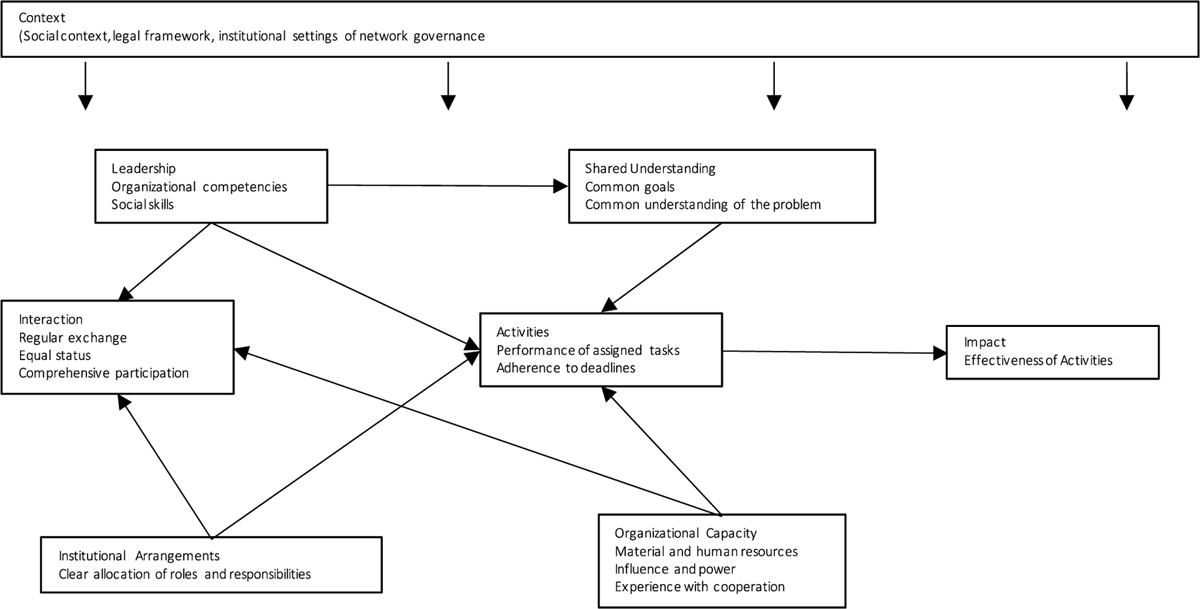
Figure 1
Conceptual Model of the Collaborative Governance Framework.
Note: Arrows indicate positive relationship; model adopted from Lang and Brüesch (2020: 108).
| Socio-economic context | Geographic context | Initial level of IT equipment | Size | |
|---|---|---|---|---|
| School 1 | Privileged, favorable attitude of the municipal authorities toward the project5 | Rural | High, but unequal across different school sites | Approx. 1000 students and 120 teachers |
| School 2 | Privileged, high resistance of teachers toward the project | Urban | Mid-range at all school sites | 1024 students, 123 teachers |
| School 3 | Privileged and innovative, favorable attitude of the municipal authorities toward the project | Urban | High at all school sites | Approx. 1000 students and 120 teachers |
| School 4 | Neither privileged nor underprivileged, favorable attitude of the municipal authorities, high resistance of teachers toward the project | Urban | Mid-range, unequal across different school sites | Approx. 1300 students and 120 teachers |
| School 5 | Underprivileged, unfavorable attitude of the municipal authorities toward the project | Rural | Low and unequal across different school sites | 1285 students, 143 teachers |
| School 6 | Underprivileged, unfavorable attitude of the municipal authorities toward the project | Rural | Low and unequal across different school sites | 1430 students, 65 teachers |