
Table 1
Search terms in Medline on the Ovid platform.
| MEDLINE (OVID PLATFORM) |
|---|
| 1. Mindfulness/ |
| 2. Meditation/ |
| 3. (medit* or mindful*).ti,ab,kf |
| 4. 1 or 2 or 3 |
| 5. exp Fatigue/or Fatigue Syndrome, Chronic/ |
| 6. (fatig* or exhaust* or tired*).ti,ab,kf |
| 7. 5 or 6 |
| 8. 4 and 7 |

Figure 1
PRISMA flowchart with the different studies (MeBI: Meditation-Based Intervention).
Note: Adapted from Moher et al. (2009).
Table 2
Results table ordered by pathologies and by kinds of control groups (active then passive).
| PATHOLOGICAL CONDITIONS | STUDY, DATE | INTERVENTION AS STATED IN THE STUDIES | CONTROL GROUP | ASSESSMENT |
|---|---|---|---|---|
| Cancer | Bruggeman-Everts et al., 2017 | Web-based MBCT (N = 55)3 | AAF (N = 62) | Checklist Individual Strength (CIS-F) |
| Carlson et al., 2016 | Mindfulness-Based Cancer Recovery (N = 134)1 | SET (N = 118) | The Profile of Mood States (POMS) – fatigue | |
| Johns et al., 2016 | MBSR (N = 35)2 | PES (N = 36) | Fatigue Symptom Inventory (FSI) | |
| Gok Metin et al., 2019 | Mindfulness Meditation (N = 33)1 | PMR (N = 30) | Brief Fatigue Inventory (BFI) | |
| Witek Janusek et al., 2019 | MBSR (N = 84)1 | Health Education (N = 80) | Multidimensional Fatigue Scale Inventory – Short Form (MFSI-SF) | |
| Wren et al., 2019 | Lovingkindness Meditation (N = 23)2 | Music (N = 16) | FACIT Fatigue scale | |
| Blaes et al., 2016 | Mindfulness-Based Cancer Recovery (N = 28)1 | Waitlist/TAU (N = 13) | Functional Assessment in Cancer Therapy-Fatigue (FACT-F) | |
| Bower et al., 2015 | Mindful Awareness Practices program (N = 39)1 | Waitlist (N = 32) | Fatigue Symptom Inventory (FSI) – total | |
| Dodds et al., 2015 | Cognitively-Based Compassion Training (N = 12)2 | Waitlist (N = 16) | Medical Outcomes Study Short Form 12-Item Health Survey (SF-12) | |
| Hoffman et al., 2012 | MBSR (N = 103)1 | Waitlist (N = 111) | The Profile of Mood States (POMS) – fatigue | |
| Jang, 2016 | Mindfulness-based art therapy (N = 12)4 | Waitlist (N = 12) | European Organization for Research and Treatment of Cancer Quality of Life Questionnaire | |
| Johns et al., 2015 | MBSR for cancer related fatigue (N = 18)2 | Waitlist (N = 17) | Fatigue Symptom Inventory (FSI) | |
| Kim et al., 2013 | Brain Wave Vibration meditation (N = 51)4 | TAU (N = 51) | Revised Piper Fatigue scale (PFS) | |
| Kubo et al., 2019 | Headspace smartphone app (N = 40)3 | Waitlist (N = 32) | Brief Fatigue Inventory (BFI) | |
| Lengacher et al., 2012 | MBSR (N = 41)1 | TAU (N = 43) | M.D. Anderson Symptom Inventory (MDASI) | |
| Lengacher et al., 2016 | MBSR for Breast Cancer (N = 167)1 | Waitlist (N = 155) | Fatigue Symptom Inventory (FSI) – severity | |
| Liu et al., 2019 | MBSR (N = 49)1 | TAU (N = 53) | QoL Questionnaire Core 30Items (QLQ-C30) | |
| Meiklejon, 2008 | Shortened MBSR (N = 26)1 | Waitlist (N = 21) | The Profile of Mood States (POMS) – fatigue | |
| Messer et al., 2019 | Internet-delivered mindfulness treatment (N = 11)3 | TAU (N = 10) | The Fatigue Symptom Inventory (FSI) – total | |
| Milbury et al., 2013 | Tibetan Sound Meditation program (N = 23)4 | Waitlist (N = 24) | Brief Fatigue Inventory (BFI) | |
| Park et al., 2020 | MBCT (N = 38)1 | Waitlist (N = 36) | Brief Fatigue Inventory (BFI) | |
| Speca et al., 2000 | Mindfulness Meditation-Based Stress Reduction Program (N = 53)1 | Waitlist (N = 37) | The Profile of Mood States (POMS) – fatigue | |
| Van Der Lee et al., 2012 | MBCT (N = 59)1 | Waitlist (N = 24) | Checklist Individual Strength (CIS) | |
| Multiple sclerosis | Carletto et al., 2017 | Body-Affective Mindfulness Intervention (N = 45)2 | Psycho-Educational Intervention (N = 45) | Fatigue Severity Scale (FSS) |
| Cavalera et al., 2019 | Online MBSR (N = 54)3 | Online psychoeducation treatment (N = 67) | Modified Fatigue Impact Scale (MFIS) | |
| Senders et al., 2019 | MBSR (N = 33)2 | MS Education (N = 29) | PROMIS | |
| Grossman et al., 2010 | Mindfulness-Based Intervention (N = 76)1 | TAU (N = 74) | Modified Fatigue Impact Scale (MFIS) | |
| Bogosian et al., 2015 | Adapted Skype Distant-Delivered Mindfulness Intervention (N = 19)3 | Waitlist (N = 21) | Fatigue Severity Scale (FSS) | |
| Simpson et al., 2017 | MBSR (N = 25)1 | Waitlist (N = 25) | Modified Fatigue Impact Scale (MFIS) | |
| Myalgic encephalomyelitis | Rimes et al., 2013 | MBCT (N = 15)1 | Waitlist (N = 19) | Chalder Fatigue Scale |
| Surawy et al., 2005 | Mindfulness-based program based on MBSR and MBCT (N = 9)1 | TAU (N = 8) | Chalder fatigue scale | |
| Fibromyalgia | Cash et al., 2015 | MBSR (N = 51)1 | Waitlist (N = 40) | Fatigue Symptom Inventory (FSI) – total |
| Acute brain injury | Johansson et al., 2012 | MBSR (N = 12)1 | Waitlist (N = 14) | Mental fatigue Scale (MFS) |
| Kidney disease | Gross et al., 2017 | Telephone-adapted MBSR (N = 27)3 | Telephone-Based Support Group (N = 28) | Patient-Reported Outcomes Measurement Information System (PROMIS) |
[i] Note: MBCT: Mindfulness-Based Cognitive Therapy; AAF: Ambulant Activity Feedback therapy; SET: Supportive Expressive Therapy; MBSR: Mindfulness Based Stress Reduction; PES: PsychoEducation and Support; PMR: Progressive Muscle Relaxation procedure; TAU: Treatment As Usual; MS: Multiple Sclerosis; 1-4 labelling of the interventions according to the literature: 1 Mindfulness-based interventions, 2 Compassion MeBI only or with Mindfulness components, 3 Delivered remotely, 4 Other type of meditation.

Figure 2
Cochrane Risk of bias assessment. The graph presents ratings for all 34 studies included in the systematic review.
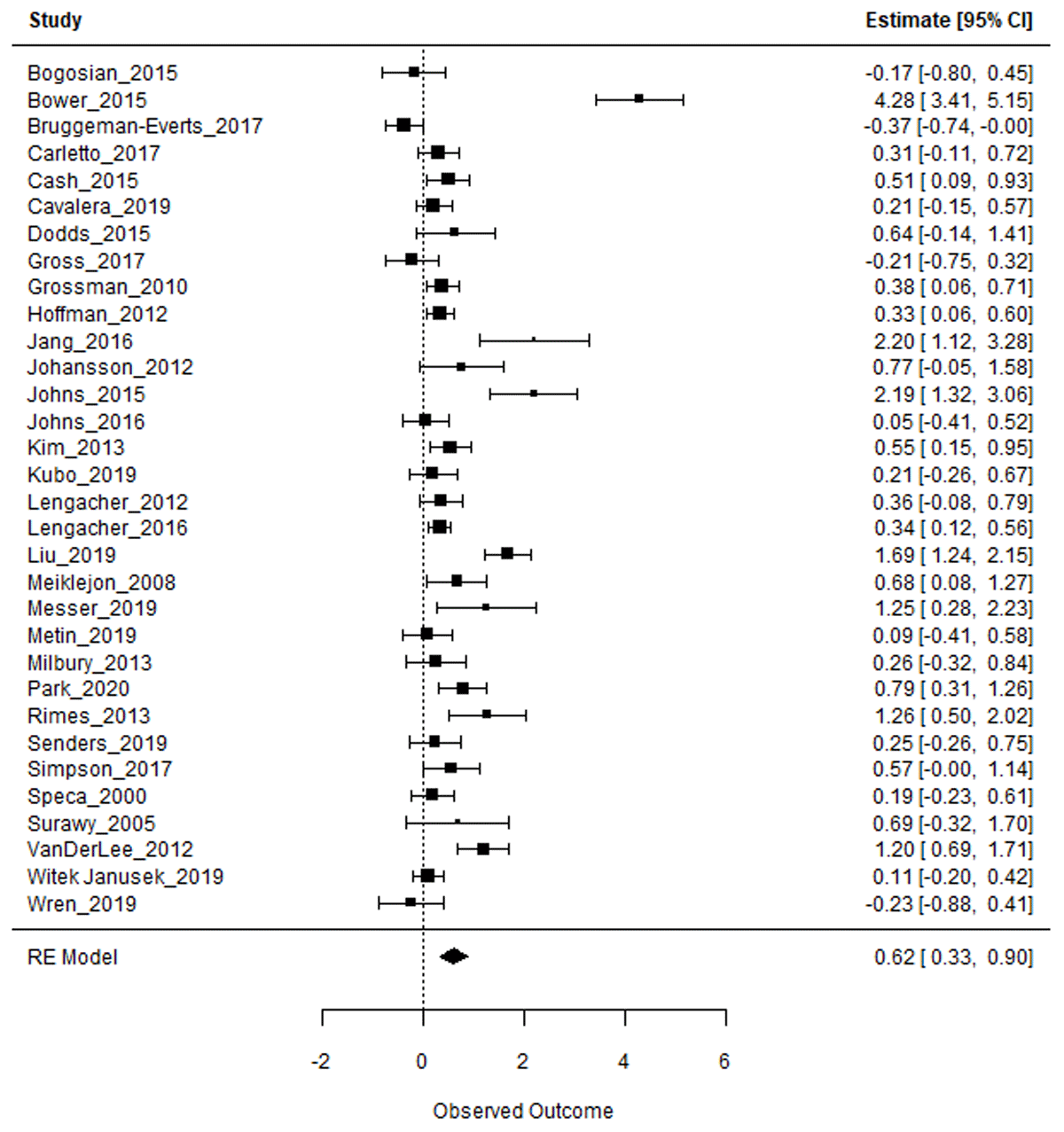
Figure 3
Forest plot of the standardized mean differences of all studies (negative values correspond to evidence in favor of the control group and positive values represent evidence in favor of the MeBI group, CI: Confidence Interval, RE: random-effects).
Table 3
Meta-analyses with or without moderators with Knapp-Hartung correction.
| MODERATORS | g | 95% CI | STATISTIC (df) | P-VALUE | TAU2 | I2 |
|---|---|---|---|---|---|---|
| No moderator | 0.62 | 0.30:0.93 | t(31) = 4.04 | <.001 | .59 | 91.51 |
| Control group moderator | / | / | F(1,30) = 7.64 | <.01 | .44 | 88.83 |
| Active control group | 0.03 | –0.48:0.54 | t(30) = 0.10 | .92 | / | / |
| Passive control group | 0.83 | 0.22:1.43 | t(30) = 2.76 | <.01 | / | / |
| MeBI moderator | / | / | F(3,28) = 1.03 | .33 | .58 | 91.27 |
| Mindfulness | 0.79 | 0.35:1.23 | t(28) = 3.70 | <.001 | / | / |
| Compassion or Mindfulness and Compassion | –0.26 | –1.06:0.54 | t(28) = –0.66 | .51 | / | / |
| Other | 0.10 | –1.04:1.23 | t(28) = 0.17 | .86 | / | / |
| Remotely | –0.68 | –1.52:0.16 | t(28) = –1.65 | .11 | / | / |
| Pathology moderator | / | / | F(5,26) = 0.51 | .77 | .66 | 92.58 |
| Cancer | 0.74 | 0.33:1.14 | t(26) = 3.73 | <.001 | / | / |
| Multiple Sclerosis | –0.48 | –1.32:0.37 | t(26) = –1.16 | .26 | / | / |
| Fibromyalgia | 0.26 | –1.21:1.73 | t(26) = 0.36 | .72 | / | / |
| Acute brain injury | 0.03 | –1.97:2.03 | t(26) = 0.03 | .98 | / | / |
| Myalgic Encephalomyelitis | –0.23 | –2.08:1.63 | t(26) = –0.25 | .80 | / | / |
| Kidney Disease | –0.95 | –2.84:0.93 | t(26) = –1.04 | .31 | / | / |
[i] Note: Meta-analyses on 32 studies. g: Hedges’ Standardized Mean Difference (effect size, positive value = less fatigue), CI: Confidence Interval, MeBI: Meditation-Based Interventions.
Table 4
Subgroups analyses with Knapp-Hartung correction to assess the effect of each moderator (type of control group, MeBI and pathology) separately.
| MODERATORS | GROUPS | K | g | 95% CI | STATISTIC (df) | P-VALUE | TAU2 | I2 |
|---|---|---|---|---|---|---|---|---|
| Type of control groups | Passive | 23 | 0.87 | 0.47:1.27 | t(22) = 4.55 | <.001 | 0.68 | 92.01 |
| Active | 9 | 0.04 | –0.15:0.22 | t(8) = 0.49 | 0.64 | 0.01 | 23.40 | |
| Types of interventions | Mindfulness | 16 | 0.80 | 0.28:1.32 | t(15) = 3.29 | <.01 | 0.80 | 94.54 |
| Compassion or Mindfulness and Compassion | 7 | 0.52 | –0.17:1.21 | t(6) = 1.86 | .11 | 0.39 | 83.36 | |
| Remotely | 6 | 0.05 | –0.45:0.54 | t(5) = 0.24 | .82 | 0.09 | 59.71 | |
| Other | 3 | 0.91 | –1.57:3.39 | t(2) = 1.58 | .25 a | 0.78 | 88.81 | |
| Types of pathologies | Cancer | 21 | 0.75 | 0.28:1.22 | t(20) = 3.34 | <.01 | 0.91 | 94.61 |
| MS | 6 | 0.29 | 0.09:0.48 | t(5) = 3.83 | <.05 | 0.00 | 0.00 | |
| Fibromyalgia | 2 | 1.05 | –2.44:4.55 | t(1) = 3.83 | .16 a | 0.00 | 0.00 | |
| Acute brain injury | 1 | 0.77 | –0.05:1.58 | Z = 1.84 | .07 a,b | 0.00 | 0.00 | |
| Myalgic Encephalomyelitis | 1 | 0.52 | 0.09:0.93 | Z = 2.37 | <.05 a,b | 0.00 | 0.00 | |
| Kidney Disease | 1 | –0.21 | –0.75:0.32 | Z = –0.79 | .43 a,b | 0.00 | 0.00 |
[i] Note: a P-values are not reliable when df < 4, b Hartung-Knapp correction could not be applied. [k: Number of studies; g: Hedges’ Standardized Mean Difference (effect size, positive value = less fatigue); CI: Confidence Interval; MS: Multiple Sclerosis].