
Figure 1
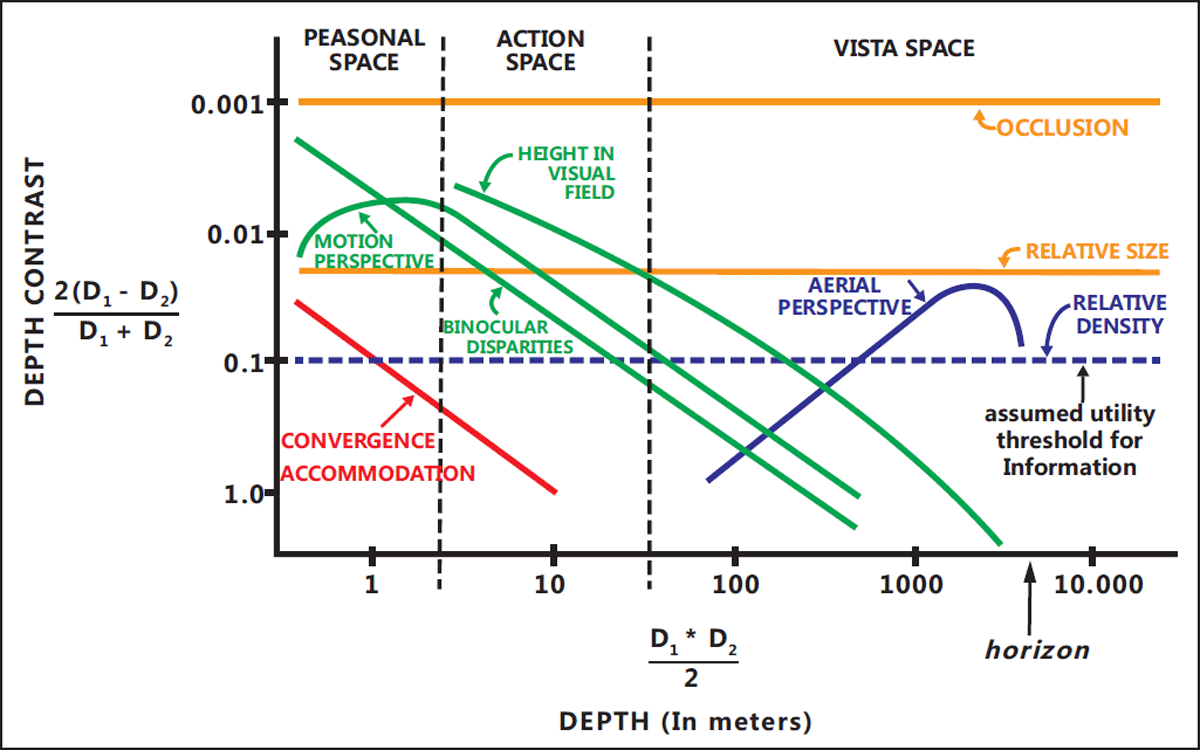
Depth contrast sensitivity of cues in personal, action and vista spaces. The horizontal axis represents distance, and the distance gradually increases from left to right. The vertical axis represents the discrimination threshold of depth, which means the shortest magnitude at which observers could distinguish two distances. The smaller the vertical axis value is, the more sensitive the observers. As we can see from the figure, the strength of binocular convergence and the sensitivity of lens accommodation are pretty high in the personal space; observers could sensitively perceive the cues provided by binocular disparities, motion perspective and relative height in the action space. In the vista space, area perspective and relative density cues play a key role. In all three spaces, the sensitivity to obstacles and relative size cues remained higher than the average (Cutting & Vishton, 1995).
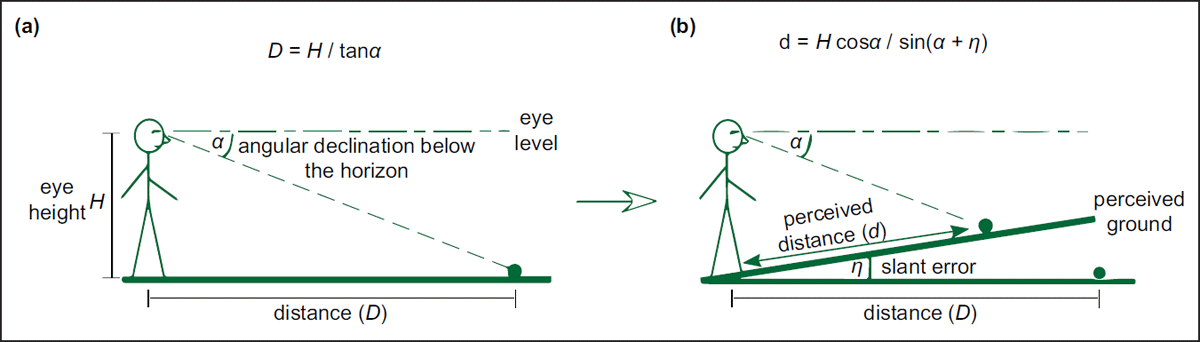
Figure 2
The formula for egocentric distance perception. (a) The distance between the target and observer can be calculated by the eye height (H) and the angular declination (α), that is, D = H/tan(α). (b) the visual system perceives the ground as an upwardly tilted surface in the distance (black slant line), and the slope η represents the angle between the tilted surface and the horizontal plane (grey horizontal line). Therefore, the egocentric distance D is determined by H, α and the slope η, that is, D = H cos α/sin (α + η) (Ooi & He, 2007).
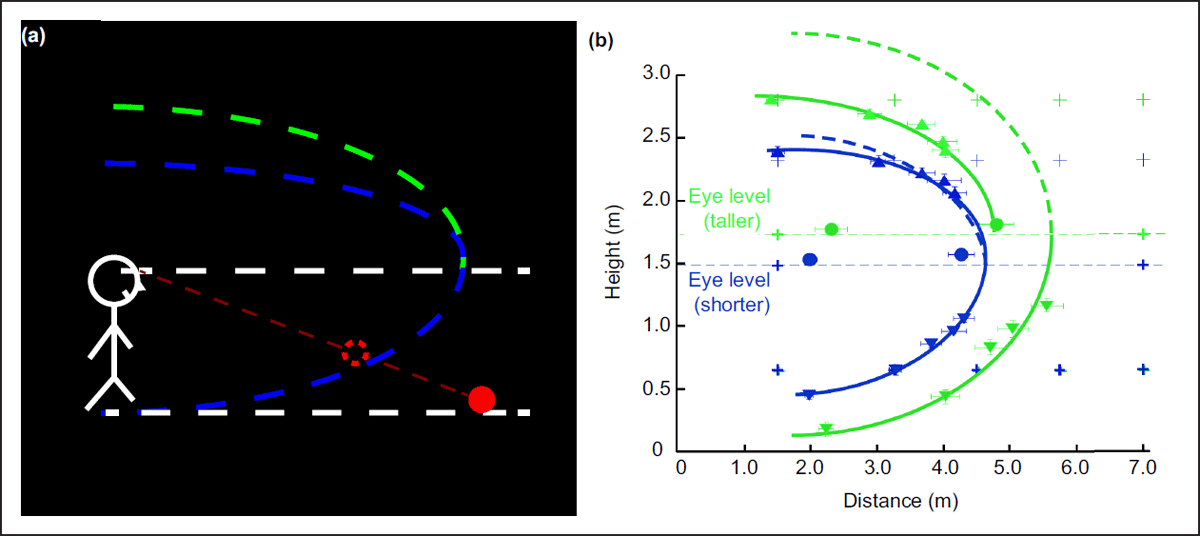
Figure 3
Schematic of intrinsic bias. (a) The intrinsic bias in three-dimensional space. Intrinsic bias is an asymmetric conicoid-like surface, including the lower and upper parts of intrinsic bias divided by the eye height level. The upper part with higher curvature is closer to the top of the participant’s head than the lower part is. In a dark environment, observers take the intrinsic bias as a frame of reference for space perception and locate the object at the intersection of line of sight and the intrinsic bias surface. (b) The effects of observer height on intrinsic bias. The blue line represents the intrinsic bias of short observers, while the green line represents the intrinsic bias of the tall observers. The solid line above is the actual intrinsic bias curve, and the dotted line is the curve symmetric with the intrinsic bias below. Therefore, for the taller, the curvature of the lower part is lower and the curvature above is higher than those of shorter. Reprinted/adapted from (L. Zhou, Ooi, & He, 2016). The Authors, some rights reserved; exclusive licensee AAAS. Distributed under a Creative Commons Attribution NonCommercial License 4.0 (CC BY-NC) http://creativecommons.org/licenses/by-nc/4.0/.
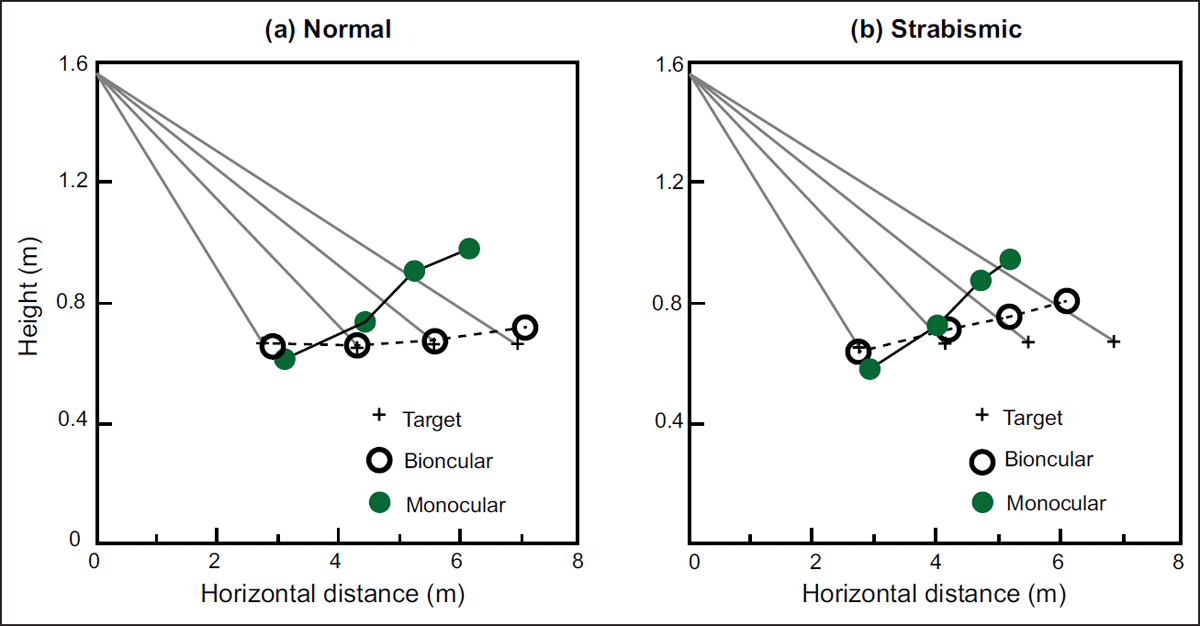
Figure 4
Amblyopic (a) and normal (b) participants’ judgement of distance in monocular viewing and binocular viewing in the action space. “+” represents the physical location of the target; the hollow and solid circles represents the location perceived by observers. The zero point on the horizontal axis represents the starting point of the participants, and the zero point on the vertical axis represents the ground. The results in this figure are the distance perception of observers when the target was suspended in the air (0.67 m). Therefore, for either patients with strabismus amblyopia or people with normal vision, egocentric distance perception is better under binocular viewing condition than under monocular viewing condition. In binocular viewing, healthy participants can determine the position of the target more accurately than amblyopes, but not in monocular viewing (Ooi & He, 2015).
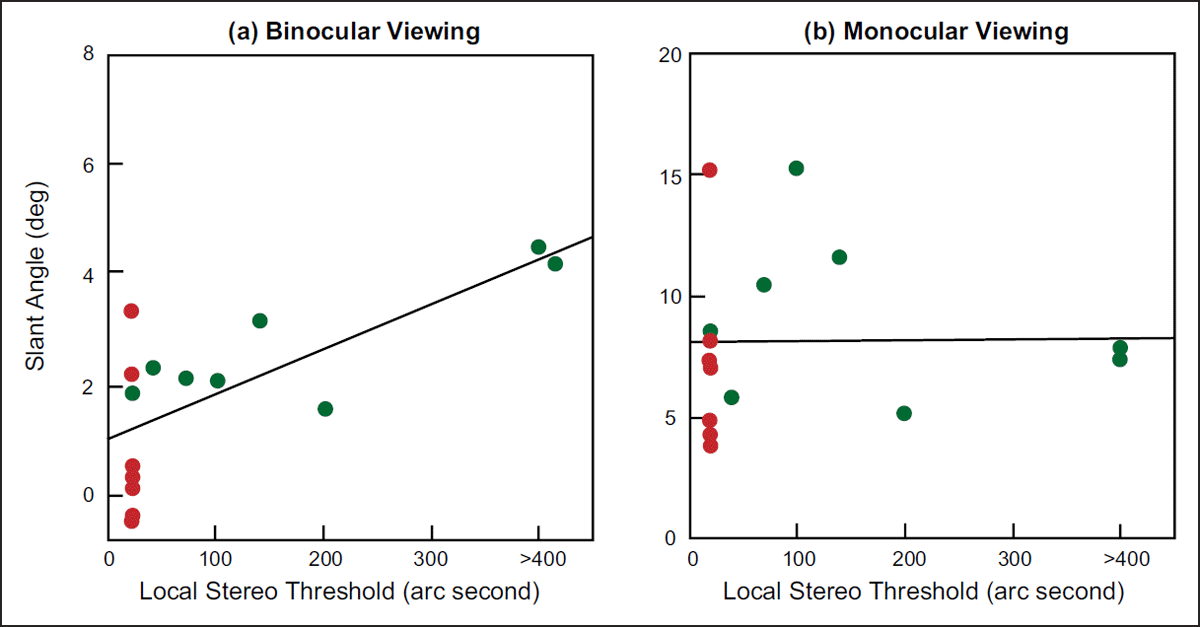
Figure 5
The relationship between distance perception disorders and stereoscopic vision for healthy people (a) and amblyopes (b) in binocular viewing and monocular viewing. The solid line shows the degree of fit. There is a strong positive correlation between distance perception defects and stereo perception thresholds in binocular viewing but not in monocular viewing conditions (Ooi & He, 2015).