
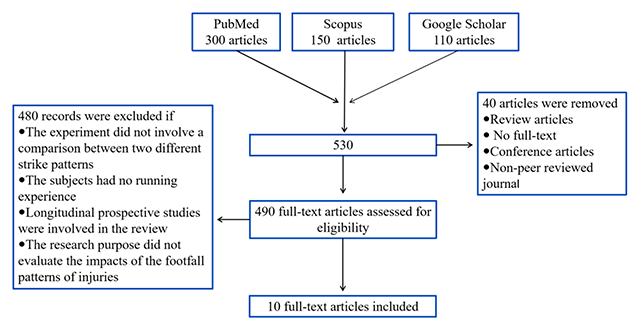
Figure 1
The search flowchart.
Table 1
Summary of main factors from the research papers included in this review.
| Source | Participant’s information and group size | Test parameter | Method | Main study outcomes |
|---|---|---|---|---|
| Altman et al., 2012 | Forty recreational and highly trained runners | Kinematics of ankle and knee, force loading rates, and joint loading patterns | Subjects ran at four speeds with barefoot and shod on a treadmill respectively | Shod runners produced a lower stride frequency and larger stride length than all other runners. FFS pattern runners presented the greater plantarflexed ankles and more vertical lower legs at first contact compared to RFS runners. |
| Joel et al., 2002 | 26 trained runners, age range from 18 to 40 years, who ran with a rearfoot strike pattern and no experience running in minimalist shoes were recruited | Kinematic changes at the knee and ankle joints | Participants ran with different strike pattern, then captured by 8-cameras | Ankle angle at initial contact was less and strike index was greater when running FFS pattern compared with RFS |
| Soňa Jandová1 et al. | 14 experienced recreational women runners, mean age is 31.92 ± 5.34 years | vertical force and plantar pressure | The subjects ran over a distance of 100 m with their different strike pattern | Greater plantar pressure in forefoot, higher foot loading at first contact in FFS when compared with RFS |
| Squadrone et al., 2009 | 8 healthy male runner, age 32 ± 5 years | Foot loading and lower limb kinematics | Subjects running on the treadmill with barefoot and conventional shoes respectively | More plantarflexion at the ankle joint, smaller impact forces, shorter strike length and contact time, higher strike frequency |
| Brandon et al., 2013 | 15 forefoot and 15 rearfoot strike runners (average age 22.46 ± 4 years) | internal loading of the joints | Using inverse dynamics to calculate the net joint moments and reaction forces | Larger net ankle joint moments, average contact forces at ankle and knee joint in FFS running than RFS |
| Divert et al., 2005 | 31 male runners (mean ± SD: age 28 ± 7 years) | Kinetic of lower extremity | Subjects ran two bouts of 4 minutes at 3.33 ms–1 on a treadmill with shod and barefoot running respectively | FFS presented significant lower contact and flight time, smaller passive peak, larger braking and pushing impulses |
| Dorsey et al., 2000 | 18 recreational runners | Kinematics and kinetics change of lower extremity | Subjects ran on a 25 m runway at a speed of 3.35 ms–1 with different strike pattern respectively | FFS showed lower peak vertical ground reaction force and lower peak ankle plantarflexion moment when compared with RES |
| Blaise et al. | 10 male runners (mean ± SD age: 25.4 ± 2.01 years) and 10 female runners (24.1 ± 1.37 years) | Kinematics of ankle angle, knee angle and hip angle. kinetics of ankle power, knee power, and total power | 8-cameras were used to collect kinematic data, and two forces plates recorded ground reaction forces when subjects ran whilst applying RFS and FFS conditions respectively at self-selected speed | Greater plantarflexion, smaller negative knee power, larger peak ankle power absorption and lower knee power absorption in FFS when compared to RFS |
| Joseph Hamill et al. | 5 male runners (mean ± SD age: 29.6 ± 2.9 years) and 5 female runners (mean ± SD age: 27.4 ± 2.9 years) | Kinematics and kinetics change of lower extremity | Kinematic data were attained form 8-camera, ground reaction force data were collected from AMTI force platform | Impact peak, ankle stiffness, and knee stiffness were differences between the shod and barefoot |
| Brigit et al. | 9 male runners (mean ± SD age: 27.3 ± 9 years) | spatio-temporal variables, ground reaction forces and kinematics details in the sagittal and frontal plane | Subjects running in barefoot and shod condition at three different velocities (3.5, 4.5, 5.5 ms–1), the data was captured by 3D camera and force platform | Greater external loading rate, higher leg stiffness during the stance phase in barefoot condition than shod |