
Table 1
Data availability requirements of journals sampled in this study.
| JOURNAL TITLE | PUBLISHER | DATA AVAILABILITY POLICY (ALL ACCESSED JUNE 2020) |
|---|---|---|
| Vegetation History and Archaeobotany | Springer | Encourages authors, where possible and applicable, to deposit data that support the findings of their research in a public repository – from 2016 (Lodwick 2019). |
| Archaeological and anthropological science | Springer | Encourages authors, where possible and applicable, to deposit data that support the findings of their research in a public repository. |
| Environmental Archaeology | Taylor and Francis | Encouraged to supply data – list of positives given. Supplementary information to be put in Figshare. |
| The Holocene | SAGE publishing | Acknowledges the need for data availability but does not require or encourage authors to submit primary data. If data is submitted, the data is made available whether article open access or not. |
| Journal of Archaeological Science | Elsevier | ‘This journal requires and enables you to share data that supports your research publication and enables you to interlink the data with your published articles. Research data refers to the results of observations or experimentation that validate research findings. To facilitate reproducibility and data reuse, this journal also encourages you to share your software, code, models, algorithms, protocols, methods and other useful materials related to the project’ -from 2018. Pre-2018 statement – all data must be available in supplementary files or repository but not explicit about facilitating reproducibility.
|
| Journal of Archaeological Science reports | Elsevier | Same as JAS above – requires. |
| Journal of Ethnobiology | Society of Ethnobiology | No data guidance. |
| Quaternary International | Elsevier | Same as JAS above – requires. |
| Journal of Wetland Archaeology | Taylor and Francis | Authors are encouraged to share or make open the data supporting the results or analyses presented in their paper where this does not violate the protection of human subjects or other valid privacy or security concerns. |
| Antiquity | Antiquity publications | No data guidance. |
| Journal of Field Archaeology | Taylor and Francis | No data guidance. |
| Oxford Journal of Archaeology | (Wiley) | No data guidance. |
| Journal of Anthropological Archaeology | Elsevier | Same as JAS above – requires. |
| Journal of World Prehistory | Springer | Encourages authors, where possible and applicable, to deposit data that support the findings of their research in a public repository. |
| PLOS One– Open access journal. | (PLOS) | Required to make all data necessary to replicate study’s findings publicly available without restriction – from 2014. Pre-2014 – all data not required but encouraged to deposit database in repository – Dryad. |
| Proceedings of the National Academy of Sciences – Open access after 6 months/free for developing countries to access. | (PNAS) | Authors must make material, data and associated protocols including code and scripts available to readers of publication – from 2011.
Pre-2011 – authors encouraged to deposit data and use Supplementary information. |
Table 2
List of journals and categories used by both Lodwick 2019 and this study.
| ARCHAEOBOTANICAL JOURNALS | ARCHAEOLOGICAL SCIENCE JOURNALS | GENERAL ARCHAEOLOGY | CROSS-DISCIPLINARY JOURNALS |
|---|---|---|---|
| Vegetation History and Archaeobotany (VHA) | Archaeological and anthropological science (AAS) | Antiquity (ANT) | PLoS One (PO) |
| Environmental Archaeology (EA) | Journal of Field Archaeology (JFA) | Proceedings of the National Academy of Sciences (PNAS) | |
| The Holocene (TH) | Oxford Journal of Archaeology (OJA) | ||
| Journal of Archaeological Science (JAS) | Journal of Anthropological Archaeology (JAA) | ||
| Journal of Archaeological Science reports (JASR) | Journal of World Prehistory (JWA) | ||
| Journal of Ethnobiology (JE) | |||
| Quaternary International (QI) | |||
| Journal of Wetland Archaeology (JWA) |
Table 3
Comparison of the number of articles for macro-botanical remains and phytoliths in the period 2009 to 2018.
| NAME OF JOURNAL | NUMBER OF ARTICLES FOR MACRO-BOTANICAL REMAINS (LODWICK 2019) | NUMBER OF ARTICLES FOR PHYTOLITHS |
|---|---|---|
| Vegetation History and Archaeobotany | 81 | 24 |
| Archaeological and anthropological science | 22 | 21 |
| Environmental Archaeology | 19 | 14 |
| The Holocene | 12 | 35 |
| Journal of Archaeological Science | 24 | 62 |
| Journal of Archaeological Science reports | 16 | 20 |
| Journal of Ethnobiology | 1 | 0 |
| Quaternary International | 18 | 115 |
| Journal of Wetland Archaeology | 6 | 0 |
| Antiquity | 12 | 6 |
| Journal of Field Archaeology | 4 | 1 |
| Oxford Journal of Archaeology | 1 | 0 |
| Journal of Anthropological Archaeology | 8 | 4 |
| Journal of World Prehistory | 1 | 0 |
| PLOS One | 11 | 25 |
| Proceedings of the National Academy of Sciences | 3 | 15 |
| Total number of articles | 239 | 341 |
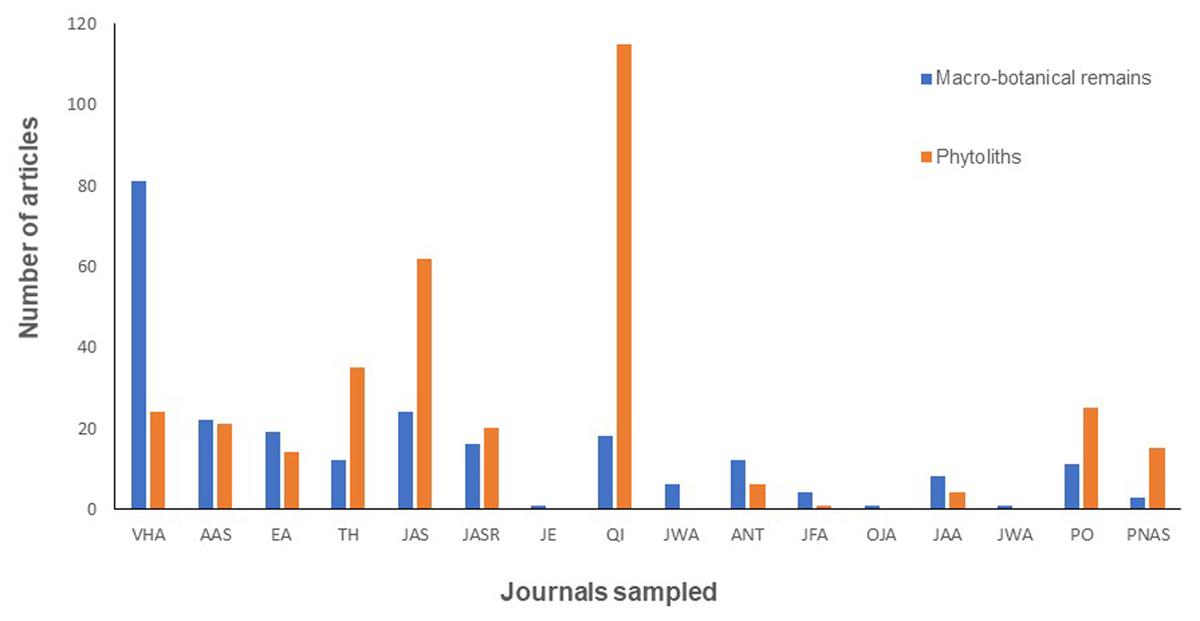
Figure 1
Chart showing a comparison of the number of journal articles per journal in the current study with Lodwick (2019).
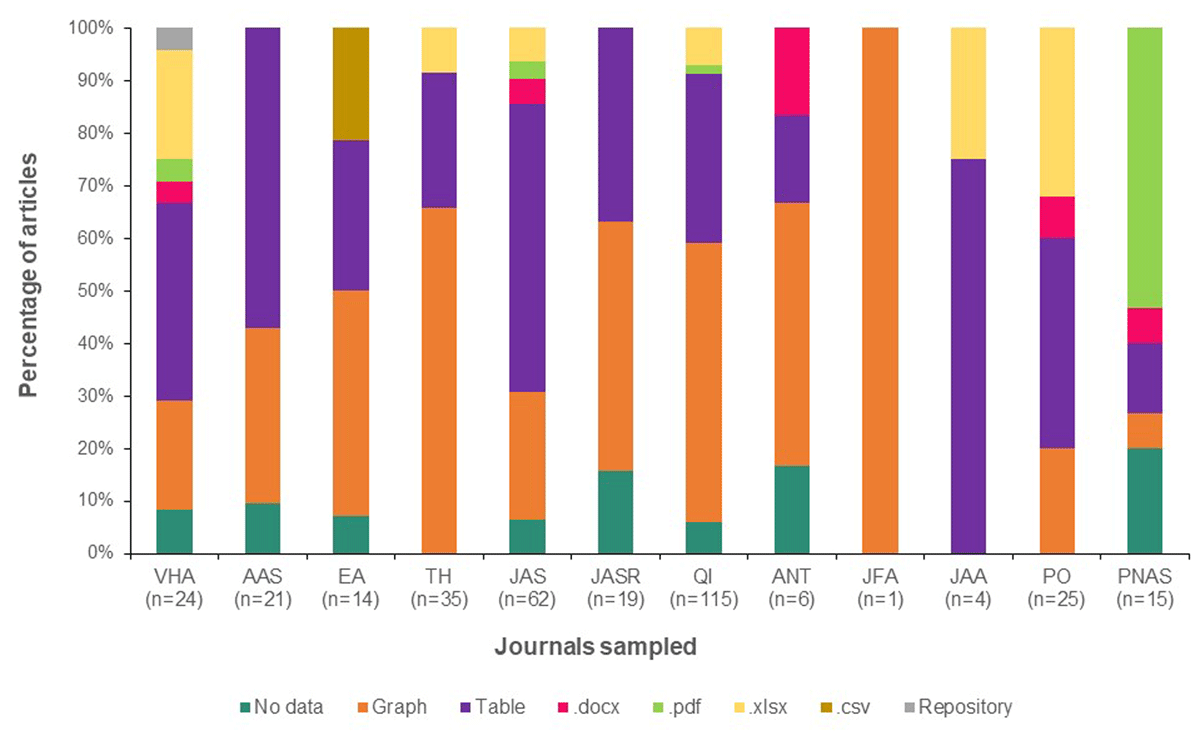
Figure 2
Chart showing the location of primary phytolith data in journals sampled (excludes the four journals that contained no articles with primary phytolith data).
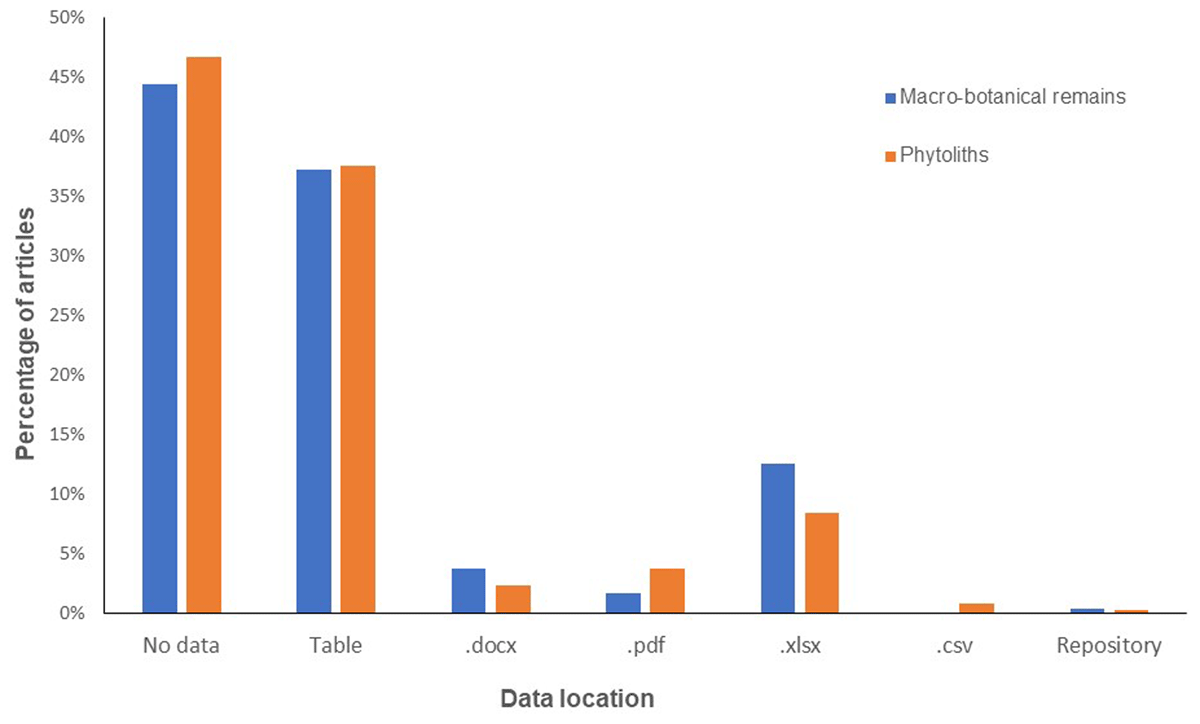
Figure 3
Chart showing the percentage of articles per data location in macro-botanical remains (data taken from Lodwick 2019) and phytoliths.
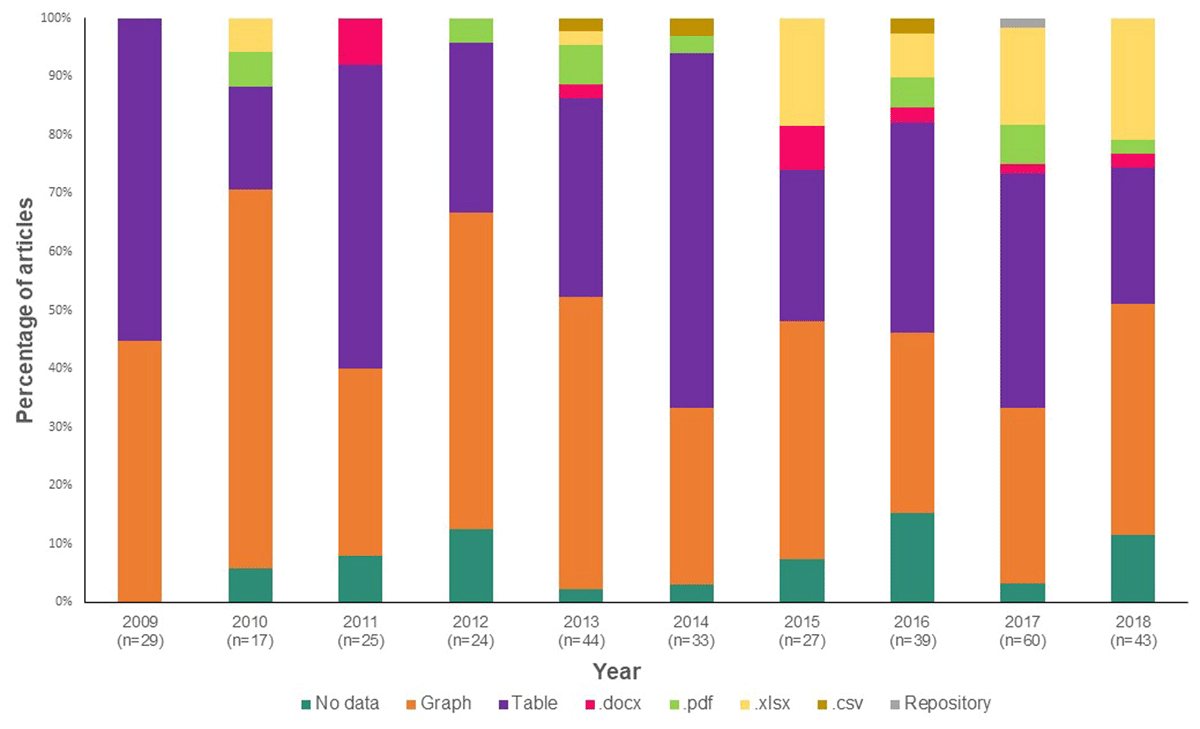
Figure 4
Chart showing the location of phytolith data per year (2009-2018) in the primary phytolith data publications in this study.
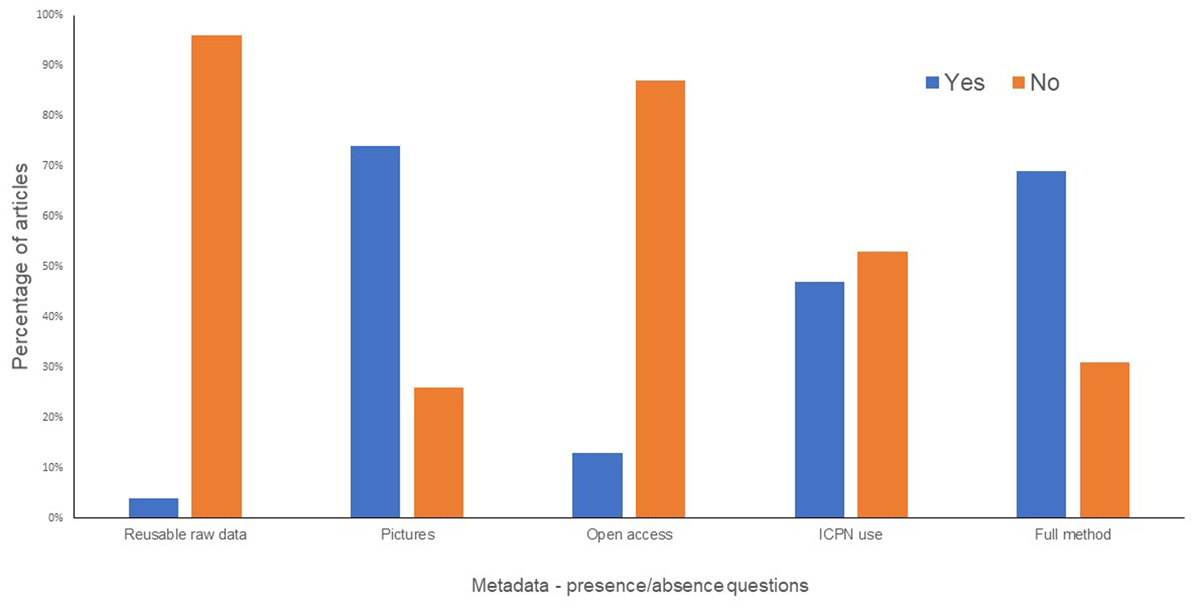
Figure 5
Chart showing percentages for presence/absence data categories (recorded as Yes or No): Reusable raw data, Pictures, Open access, ICPN use, Full method.
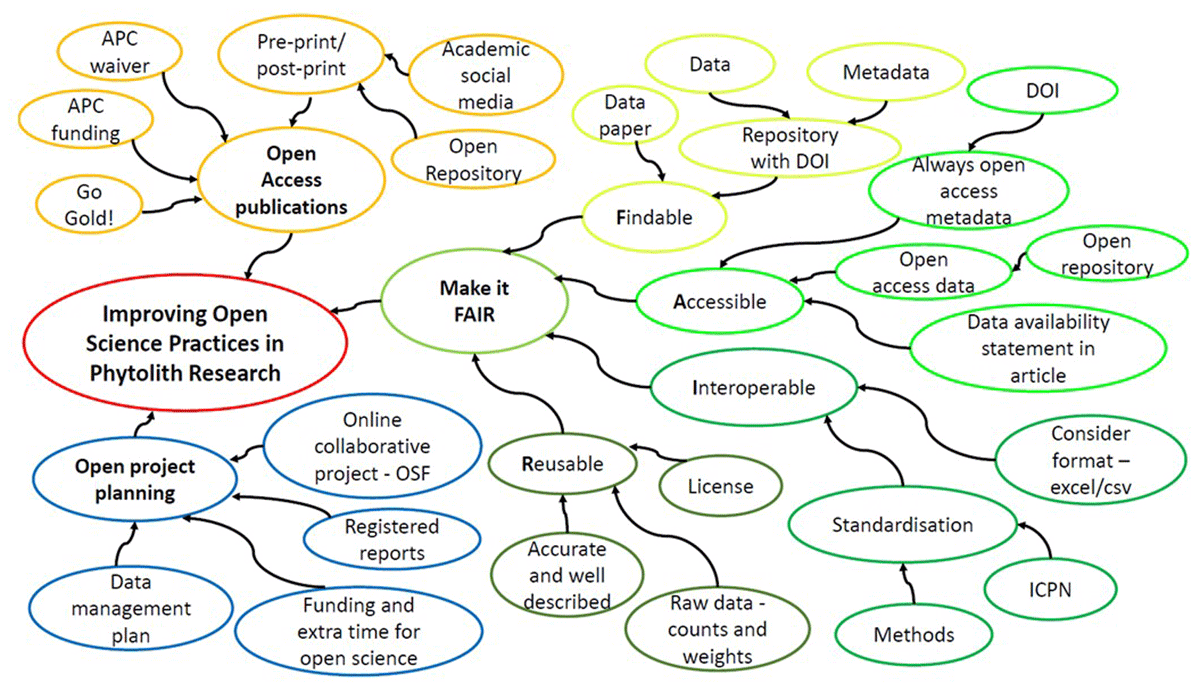
Figure 6
Summary of proposed steps for improving open science practices in phytolith research. An alternative version of this diagram as a table can be found here: https://osf.io/9wa2f/.