
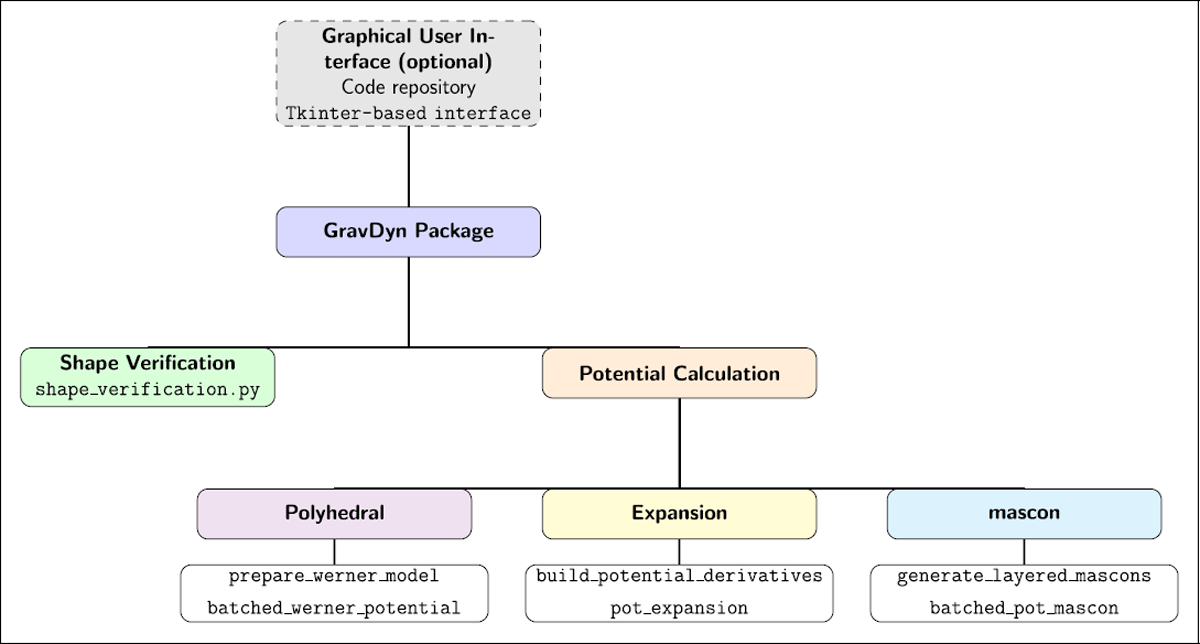
Figure 1
Structure of the GravDyn package. The software is organized into two main modules: shape verification and potential calculation. The potential calculation module includes polyhedral, expansion, and mascon-based approaches.
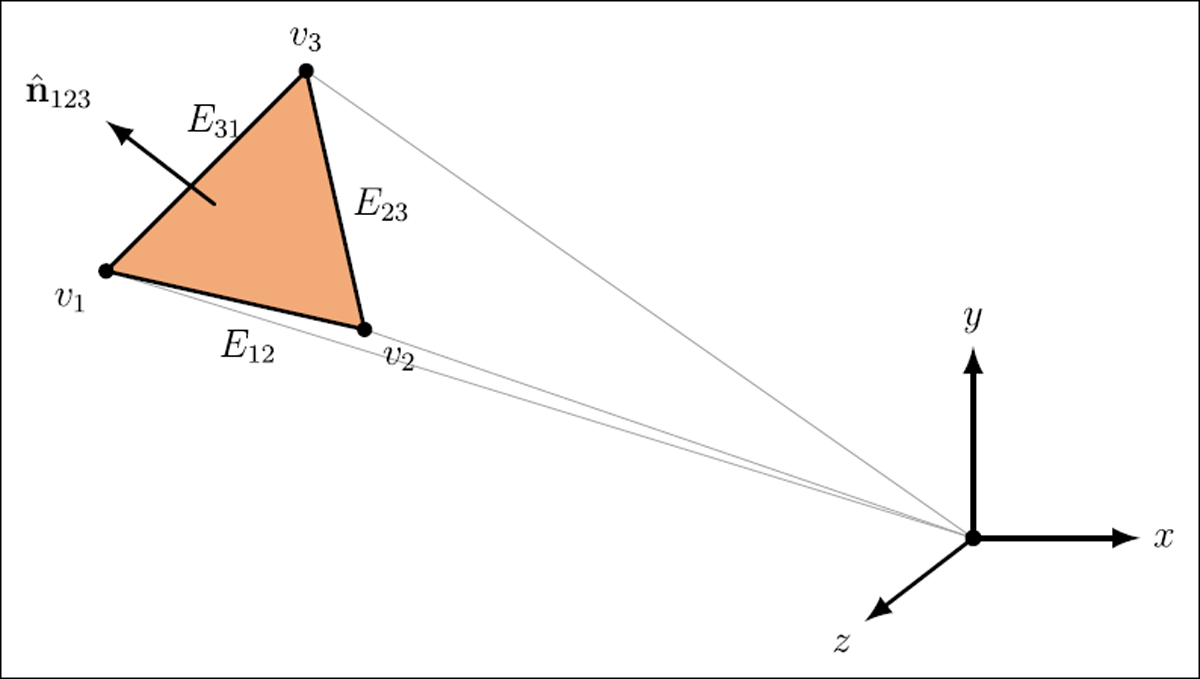
Figure 2
Redrawn schematic of the geometric entities associated with a triangular facet in the polyhedral gravity model of Werner and Scheeres (6), Scheeres (2). The facet is defined by the ordered vertices , , and , with edges E12, E23, and E31, and outward unit normal . The field point is represented in the body-fixed frame (x,y,z).
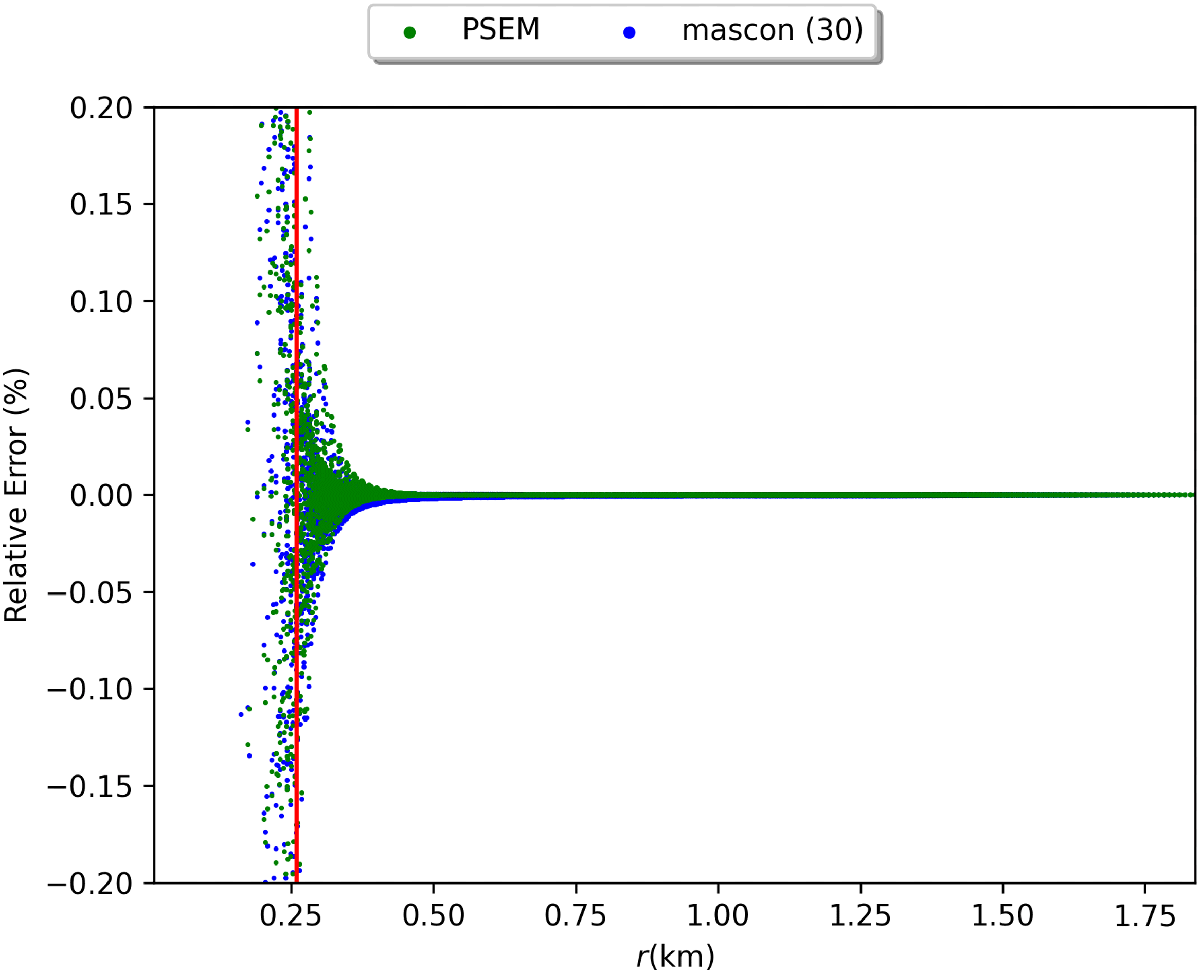
Figure 3
Example comparison of relative error in the gravitational potential as a function of radial distance r. The polyhedral method is used as a reference solution. The expansion method (green) and mascon approach (blue) show convergence toward the reference as the distance increases. The vertical red line indicates the approximate radius of the body.
Table 1
Performance comparison of gravitational modeling methods for asteroid (99942) Apophis. The test consists of evaluating the gravitational potential at 40,000 field points using a shape model with 3,996 faces. Timings were obtained on a system equipped with an Intel(R) Core(TM) i7-14700 processor (20 physical cores, 28 logical CPUs), with a maximum clock frequency of 5.4 GHz and 33 MiB of L3 cache.
| METHOD | EXECUTION TIME (s) | RELATIVE SPEED | MEAN RELATIVE ERROR (%) |
|---|---|---|---|
| Tsoulis | 155.21 | Reference | |
| Werner | 9.96 | Reference | |
| Mascon (30 layers) | 20.14 | ||
| PSEM | 1.50 |