
(1) Overview
The dataset is a morphologically annotated Classical Arabic corpus containing word forms, stems, lemmas, roots, part-of-speech tags, and affix information. It is designed to support research in morphological analysis, stemming, and Arabic natural language processing (NLP). The dataset focuses on Classical Arabic as used in religious and traditional texts, with particular emphasis on the linguistic structure of the language. The Noor-Sharaye corpus contains approximately 205,000 word instances extracted from 17 different Classical Arabic books, including Quranic, Fiqh, Hadith, and historical texts. The publicly available dataset consists of 6,838 manually validated morphologically annotated entries released for open access, reproducibility, and benchmarking.
Repository location
Context
The dataset was created within a doctoral research effort aimed at advancing computational resources for Classical Arabic morphological processing. It addresses the limited availability of large-scale, high-quality datasets suitable for stemming and morphological analysis of Classical Arabic texts.
It was developed as part of an academic project conducted at the Computer Research Center for Islamic Sciences (Noor) and the School of Computer Engineering at Iran University of Science and Technology (IUST), under the supervision of Prof. Behrouz Minaei-Bidgoli.
The dataset has been used within the scope of a PhD dissertation focusing on Arabic morphological analysis tasks such as stemming, root extraction, and word segmentation.
(2) Literature Review
2.1 Existing Datasets
To evaluate the performance of any model, we utilize existing datasets for Arabic stemming. Table 1 represents some of them.
Table 1
Datasets stemming.
| DATASET | WORD COUNT | LANGUAGE | IMPLEMENTATION |
|---|---|---|---|
| Noor-Sharaye Dataset | 205,000 | Classical texts | |
| CBAS Dataset | 20,291 papers | MSA (Modern standard Arabic) | (El-Defrawy, El-Sonbaty & Belal, 2015) |
| ICA (International Corpus of Arabic) dataset | 100 million words | MSA | (Alansary, Nagi & Adly, 2007) |
2.2 existing Arabic stemmers
In the following section, we present and evaluate a set of widely used Arabic stemming approaches within a unified experimental framework. Table 2 shows that.
Table 2
Overview of Arabic Stemming and NLP Tools.
| TOOL | TYPE | MAIN APPROACH | KEY FEATURES | IMPLEMENTATION |
|---|---|---|---|---|
| Khoja Stemmer | Root-based stemmer | Removes prefixes/suffixes + pattern matching | Uses lexicons, stopwords, root/stem dictionaries | (Khoja & Garside, 1999) |
| Light-10 Stemmer | Light stemmer | Affix stripping + normalization | Handles common prefixes/suffixes, removes stopwords | (Soudi, Neumann & van den Bosch, 2007) |
| Tashaphyne | Light stemmer | Rule + lookup-based stemming | Diacritics removal, affix segmentation | (Al-Khatib et al., 2023) |
| NLTK | NLP toolkit | Multi-functional NLP library | Tokenization, stemming, parsing, classification | (Elbes et al., 2019) |
| P-Stemmer | Light stemmer | Improved light stemming | Removes only prefixes for better accuracy | (Kanan et al., 2019) |
| CAMeL Tools | NLP framework | Full Arabic NLP pipeline | Tokenization, tagging, sentiment, morphology | (Obiad, 2020) |
| Al-Khalil Analyzer | Morphological analyzer | Rule-based morphological parsing | Root extraction, diacritization support | (Boudlal et al., 2010) |
2.3 Existing Arabic resources
Several Arabic NLP resources and analyzers have been developed to support morphological analysis and text processing. Table 3 compares the dataset with some widely used Arabic resources.
Table 3
Comparison of Noor-Sharaye Dataset with Existing Arabic NLP Resources.
| RESOURCE | TYPE | LANGUAGE VARIETY | MAIN FEATURES | IMPLEMENTATION |
|---|---|---|---|---|
| Noor Sharaye Dataset | Morphologically Annotated Corpus | Classical (17 sources) | Full morphology + stemming + benchmarking | |
| Quranic Arabic Corpus | Annotated Corpus | Classical Arabic (Quranic Arabic) | Lemma, POS, Root | (Dukes & Habash, 2010) |
| MADAMIRA | Morphological Analyzer and Disambiguator | Modern Standard Arabic and Arabic Dialects | Full morphology | (Pasha et al., 2014) |
| Farasa | Arabic NLP Toolkit | Modern Standard Arabic | Segmentation, stemming, POS tagging, named entity recognition | (Ahmed Abdelali et al., 2016) |
| Buckwalter Analyzer | Morphological Analyzer | Modern Standard Arabic | Morphological analysis | (Buckwalter, 2004) |
Unlike existing Arabic NLP tools, the dataset provides a manually validated Classical Arabic corpus for morphological analysis, benchmarking, and model evaluation.
(3) Method
The dataset is a large-scale morphologically annotated corpus derived from Classical Arabic texts. The dataset comprises approximately 205,000 linguistically enriched word instances, each represented as a fully annotated morphological unit rather than a simple lexical item. The primary objective of the dataset design is to support fine-grained computational modeling of Arabic morphology, enabling both linguistic analysis and deep learning–based sequence modeling. Each token is encoded as a structured representation integrating multiple morphological dimensions, making the dataset suitable for supervised learning tasks in Arabic natural language processing.
Steps
1. Text Preparation and Normalization
The source Classical Arabic texts were first digitized and carefully prepared for annotation. All preprocessing steps, including orthographic normalization and unification of Arabic character variants, were conducted manually under linguistic supervision to preserve textual integrity. The text was then segmented into individual word units while maintaining contextual and morphological boundaries. This manual preparation ensured that the dataset remained faithful to the original linguistic structure of Classical Arabic.
2. Human Morphological Annotation Scheme
Each word in the dataset was manually annotated by trained linguistic researchers using a structured morphological schema. Every token was assigned a rich set of linguistic attributes, including:
Surface word form
Lemma
Part-of-speech (POS) tag
Grammatical case
Affix and clitic segmentation (prefixes and suffixes)
Additional morpho-syntactic features where applicable
All annotations were performed manually without the use of external morphological analyzers, ensuring that the dataset reflects expert linguistic judgment rather than automated predictions.
3. Data Representation
The dataset is provided in multiple formats to support different usage scenarios. The data is available in XLS, JSON, and XML formats. Figure 1 shows that.
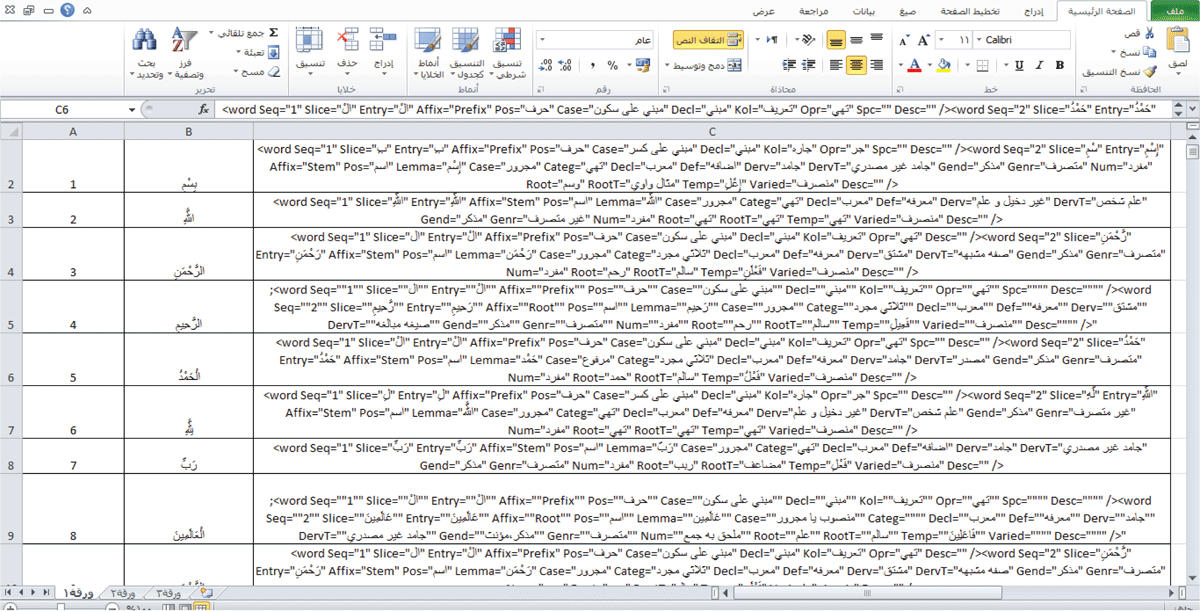
Figure 1
Sample of the dataset in xls format.
3.1 Dataset Schema
Table 4 summarizes the main fields included in the dataset and their linguistic descriptions.
Table 4
Main Fields of the Noor-sharaye Dataset.
| FIELD | DESCRIPTION |
|---|---|
| Entry | Surface word form |
| Stem | Stem extracted from the word |
| Lemma | dictionary form |
| Root | Arabic root of the word |
| POS | Part-of-speech tag |
| Affix | Prefixes and suffixes associated with the word |
| Gender | Grammatical gender |
| Number | Singular, dual, or plural |
| Case | Grammatical case information |
| Categ | Morphological category |
A sample of the morphological annotations included in the dataset is presented in Table 5.
Table 5
Presents a sample morphological annotation from the dataset.
| SURFACE FORM | LEMMA | ROOT | POS | SEGMENTATION | MORPHOLOGICAL FEATURES |
|---|---|---|---|---|---|
| فَسَأَلْتُمُونِيهَا (You asked Me for it.) | سَأَلَ | س-أ-ل | VERB | فَ + سَأَلْ +تُمُو + نِي + هَا | Tense: Past, Person:2, Gender:Masc, Number: Plural, Voice: Active |
| عِبَادَتُكُمْ (Your worship) | عِبَادَة | ع-ب-د | NOUN | عِبَادَة + كُمْ | Case: Nominative, Number: Singular, Gender: Feminine |
| بِالْحَقِّ (With truth) | حَقّ | ح-ق-ق | NOUN | بِ + الْ + حَقِّ | Case: Genitive, Number: Singular, Gender: Masculine, Definite |
Sampling Strategy
The released dataset consists of 6,838 manually annotated and validated word instances extracted from the larger Noor-Sharaye corpus of approximately 205,000 word instances. The released subset was extracted from Surah Al-Fatihah and Surah Al-Baqarah due to their complementary linguistic characteristics. This combination ensures a balanced and representative sample of Classical Arabic, capturing a wide range of word formation, affixation, and grammatical structures. The resulting subset is suitable for benchmarking and reproducible experimental evaluation, as illustrated in Figure 2.
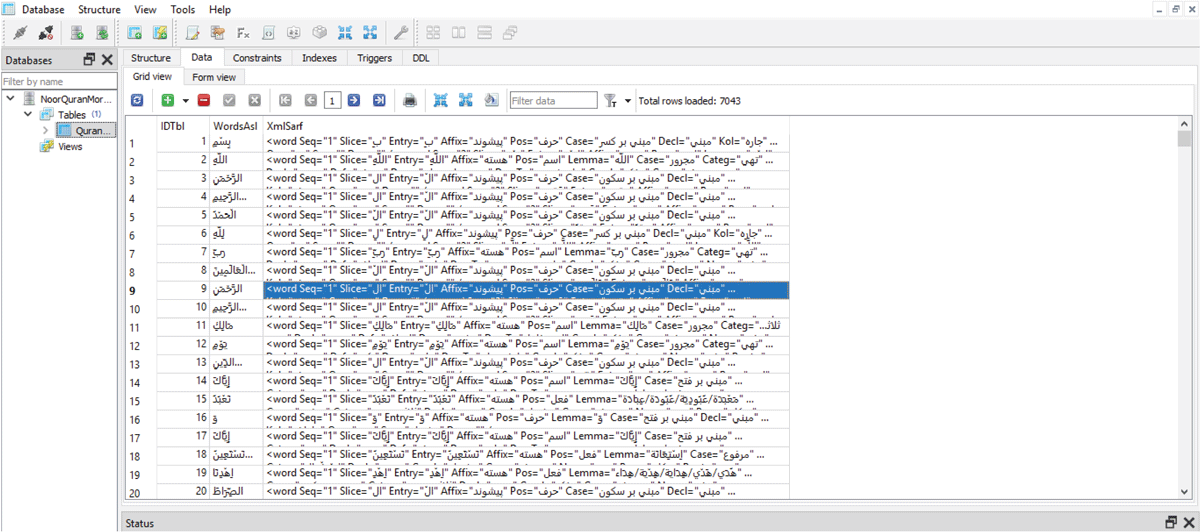
Figure 2
Sample records from the released Noor-Sharaye dataset.
Quality control
A quality control procedure was applied to ensure the accuracy and consistency of the Noor-Sharaye dataset. All entries were manually reviewed by trained linguists specializing in Classical Arabic morphology, and consistency checks were performed to verify morphological annotations. To assess annotation reliability, three trained linguists independently annotated a random sample of 500 tokens. Inter-annotator agreement was measured using token-level F1-score across five annotation tasks: POS tagging, root extraction, lemma assignment, affix segmentation, and morphological features. The annotation process achieved an overall F1-score of 97.54%, indicating high annotation reliability. Disagreements were resolved through consensus discussion and consultation with a senior linguist.
(4) Dataset Description
Repository name
Zenodo
Object name
Noor- Sharaye dataset.
Format names and versions
xls, xml, and json.
Creation dates:
2/3/2021 to 1/7/2022.
Dataset creators
This dataset was developed by a research team working in the field of Arabic natural language processing. Computer Research Center for Islamic Sciences (Noor) data preparation and linguistic support, Behrouz Minaei-Bidgoli provided academic supervision, while Azal Alaswaad conducted dataset analysis, preprocessing, development, and validation.
Language
Arabic
License
Creative Commons Attribution 4.0 International.
Publication date
6-7-2026
Source Documentation
The Noor-Sharaye corpus contains 205,000 morphologically annotated words from 17 Classical Arabic books. A validated subset of 6,838 entries is publicly available via Zenodo. The full corpus is maintained by the Noor Center and is available upon reasonable request.
Representativeness of the Classical Arabic Domain
The dataset is grounded in Classical Arabic as represented across 17 diverse textual sources, including the Quran, Fiqh, Hadith, and historical texts. This diversity ensures comprehensive coverage of linguistic variation across different genres and periods of Classical Arabic. These texts are characterized by:
Highly structured and systematic lexical formation
Frequent use of morphological variation and derivation
Rich inflectional and root-based word formations
The Classical Arabic domain holds exceptional religious, linguistic, and scholarly significance. As the foundation of Arabic linguistic tradition, these texts have been central to grammatical theory, morphological analysis, and lexical studies for centuries. Transforming these texts into a structured computational dataset enables several key contributions:
Supporting computational analysis of Classical Arabic morphology
Enabling the development and evaluation of Arabic stemming and deep learning models
Providing a benchmark resource for sequence-to-sequence and neural architectures
Facilitating comparative studies between rule-based and data-driven approaches
Enhancing reproducibility in Arabic NLP research through a standardized gold dataset
(5) Reuse Potential
The Noor-Sharaye dataset represents a valuable asset for researchers working in computational linguistics, machine learning, and Arabic natural language processing. Owing to its detailed manual annotations and well-structured design, it can be effectively utilized for both model training and performance evaluation in a variety of applications.
5.1 Training AI Models
The dataset can be used as a training corpus for sequence-to-sequence and transformer-based Arabic NLP models. A sequence-to-sequence deep learning architecture combining Bi-LSTM and Transformer models was adopted to model the relationship between input word forms and their corresponding stems, allowing the system to effectively learn and generalize complex morphological structures in Classical Arabic. Figure 3 illustrates an example Python script for loading the dataset.
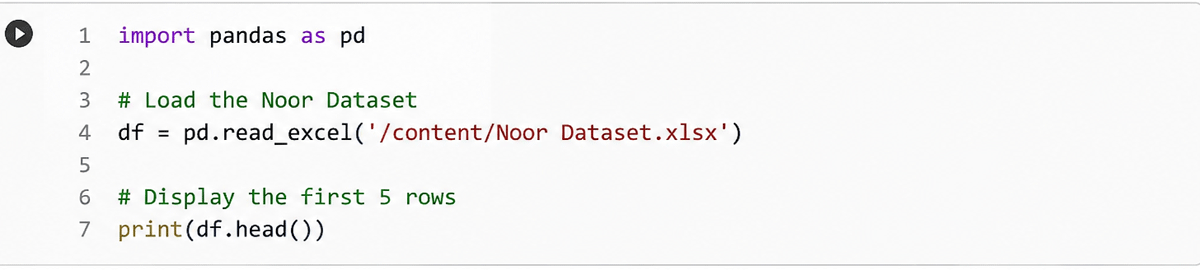
Figure 3
Example Python code for loading the dataset.
5.2 Benchmarking and Comparison
We utilized the dataset to perform a systematic comparison between several widely used Arabic stemming approaches, such as Al-Khalil, Light10, PStemmer, NLTK stemmer, Light8, CAMeL, Khoja, and Tashaphyne. This evaluation was conducted as part of our research work, where the dataset served as a consistent benchmark for assessing and comparing different stemming techniques under a unified experimental setting (Al-Aswad et al., 2024).
(6) Limitations
The publicly available subset represents only a small portion of the full dataset, which may limit its coverage of linguistic variability. In addition, since the dataset is specifically designed for Classical Arabic, its direct application to Modern Standard Arabic or dialectal forms may require preprocessing adjustments or model adaptation to ensure reliable performance. The dataset is exclusively composed of Classical Arabic and does not include Modern Standard Arabic (MSA) or dialectal variations.
Acknowledgements
The authors would like to acknowledge the Computer Research Center for Islamic Sciences (Noor) for its contribution to the preparation of the dataset.
AI Declaration
The authors declare that no generative AI tools were used in the preparation of this manuscript.
Author Contributions
Behrouz Minaei-Bidgoli: supervisor, methodology, review, Conceptualization.
Azal Alaswaad: writing, original draft preparation, editing, software.