
(1) Introduction
Quantitative approaches have become increasingly prominent in diachronic linguistics, as large historical corpora and computational tools enable the analysis of linguistic patterns across extended time spans (Hilpert & Gries, 2016). Recent developments in computational approaches to semantic change have further expanded the range of methods available for modelling diachronic linguistic patterns, including distributional, embedding-based, and network-oriented approaches (Hamilton, Leskovec, & Jurafsky, 2016; Tahmasebi et al., 2021). At the same time, these developments have also raised methodological questions concerning the relationship between analytical approach, dataset structure, and the kinds of diachronic patterns that become observable through computational analysis.
However, the growing availability of historical datasets also raises an important methodological question concerning how different forms of linguistic structure are represented, operationalised, and interpreted in quantitative research. As computational approaches are increasingly applied across heterogeneous historical corpora, questions of methodological fit, transparency, and dataset constraints become central to understanding what kinds of diachronic patterns can be reliably identified and interpreted.
This discussion paper argues that observable patterns of diachronic change are shaped by the interaction between dataset properties and analytical methods. Rather than treating change as an inherent property of language itself that can be directly recovered from data, we suggest that what counts as observable change is also shaped by how datasets encode linguistic context and what analytical methods make visible. Different datasets encode linguistic structure in different ways, and computational approaches operationalise this structure through specific assumptions and preprocessing steps. As a result, methods do not simply analyse historical data, but actively shape the forms of change that become visible. This paper therefore does not present a controlled comparison or benchmarking of methods, but instead offers a methodological reflection on how different corpus conditions enable different forms of quantitative diachronic analysis.
To examine this interaction, the paper presents two worked examples based on openly available historical English datasets. The first applies quad-based concept modelling to the Early English Books Online Text Creation Partnership corpus (EEBO-TCP),1 a large and heterogeneous collection of Early Modern English texts (c.1470s-1690s). The second uses SynFlow dependency-based analysis to examine syntactic co-occurrence patterns in a subset of the Royal Society Corpus (RSC) 6.0.4,2 focusing on eighteenth-century scientific writing (1750–1799). Each approach relies on different assumptions about linguistic structure and is applied to datasets with distinct properties, allowing us to explore how method-data interaction shapes the forms of diachronic change that become analytically visible.
The aim of the paper is not to propose a new method or to provide a full empirical evaluation, but to offer a methodological reflection grounded in comparative analysis. By placing these approaches in parallel, we show how different methods foreground different dimensions of conceptual change and how dataset constraints condition what can be reliably modelled. In doing so, the paper contributes to ongoing discussions on transparency, reproducibility, and methodological fit in quantitative diachronic research. More broadly, the paper highlights that quantitative analysis in historical linguistics is not method-neutral. Analytical choices are conditioned by the affordances and limitations of the data and interpretations of change must therefore be understood in relation to the interaction between method and dataset. Recognising this relationship is essential for developing more robust and context-sensitive approaches to the study of language change over time.
(2) Case study 1: Quad-based Concept Modelling
This section presents the first case study, which examines quad-based concept modelling applied to EEBO-TCP. The aim is not to provide a comprehensive methodological evaluation, but to illustrate how dataset properties interact with computational methods to shape the kinds of patterns that become observable in historical corpora. The discussion therefore considers the properties of the dataset, the analytical assumptions of the method, and the types of conceptual structures that become visible through this interaction.
(2.1) Dataset properties: variation and heterogeneity in EEBO-TCP
EEBO-TCP is a large openly available dataset of Early Modern English texts containing approximately 765 million words spanning the late fifteenth to the late seventeenth centuries (c.1470s–1690s) (Text Creation Partnership, 2020). The corpus consists of transcribed and encoded texts derived from the Early English Books Online (EEBO) collections, including materials catalogued in the Pollard and Redgrave and Wing short-title catalogues. It encompasses a wide range of early printed genres, including religious writings, political tracts, pamphlets, sermons, and literary works. As a result, EEBO-TCP represents a highly heterogeneous discursive environment in which different registers and domains of early modern public life intersect.
Like many historical corpora derived from early print sources, EEBO-TCP exhibits substantial orthographic variation and uneven linguistic regularity. Spelling variation, editorial normalisation practices, and the absence of consistently recoverable syntactic structure can complicate analyses that depend on stable lexical forms or reliable dependency relations. In practice, this means that approaches relying on fine-grained syntactic annotation or stable surface forms may produce inconsistent analytical results across different portions of the corpus, particularly where orthographic and grammatical variation are substantial. At the same time, the scale and diversity of the dataset make it particularly well suited to approaches that identify patterns through aggregated lexical co-occurrence across large textual environments. These characteristics favour analytical approaches that identify conceptual structure through aggregated lexical co-occurrence rather than fine-grained syntactic relations. In this context, methodological choice is not simply a matter of analytical preference, but is constrained by the extent to which different forms of linguistic structure can be reliably recovered from the dataset. The next section outlines one such approach developed in the Linguistic DNA project (Fitzmaurice et al., 2017; Fitzmaurice & Mehl, 2022).
(2.2) Analytical approach: quad-based concept modelling
Quad-based concept modelling, developed in the Linguistic DNA project, provides a computational approach for identifying discursive conceptual structures in historical English corpora. Rather than focusing on pairwise collocation, the method identifies sets of four strongly co-occurring lemmas, known as quads, within a moving window of textual context (typically 100 words). These quads capture recurrent patterns of lexical association that reflect how concepts are embedded within discursive environments (see Wong, Fitzmaurice, and Lam, under review).
The LDNA pipeline operates on normalised and lemmatised historical text, allowing spelling variation in the EEBO corpus to be standardised before quad extraction. This preprocessing step enables recurring lexical associations to be identified despite the orthographic variability typical of early printed materials. By working with normalised and lemmatised text and filtering for meaningful lexical items, the method is designed to capture conceptual relationships that may remain obscured when using approaches based solely on frequency or pairwise collocation. The combination of normalisation and lemmatisation is therefore not only a technical step, but a necessary condition for enabling meaningful patterns of lexical association to emerge from a corpus characterised by substantial orthographic variability.
Building on this approach, the present project aggregates quads around focal lemmas to form larger networks of association, referred to as constellations. As quads recur across multiple windows of textual context, overlapping lexical associations accumulate around focal lemmas and form broader constellation structures within the corpus. Individual quad instances are interpreted as recurring patterns of lexical association surrounding a focal lemma across multiple textual contexts. Rather than identifying isolated collocations, the method captures broader patterns of conceptual organisation emerging through aggregated co-occurrence patterns. These constellations represent the broader discursive contexts in which particular terms occur, allowing conceptual structures to emerge across large corpora.
In heterogeneous historical datasets such as EEBO-TCP, where orthographic and linguistic variation complicate the reliable recovery of syntactic structure, this aggregation-based approach provides a way of modelling conceptual structure at the level of discourse rather than relying on fine-grained syntactic relations. Under these conditions, aggregation-based modelling provides a robust means of capturing conceptual structure, as recurrent lexical environments and overlapping associations can stabilise across diverse textual contexts despite local variation and noise.
(2.3) Pattern stabilisation in heterogeneous textual environments
When applied to a large and heterogeneous corpus such as EEBO-TCP, quad extraction reveals recurring patterns of lexical association that stabilise across diverse textual contexts. Rather than reflecting isolated collocations, the resulting quad structures highlight clusters of lemmas that repeatedly co-occur within discursive environments. Aggregated around focal terms, these clusters form constellations that provide a view of the conceptual terrain in which particular lexical items operate.
Individual quad instances are interpreted as recurring patterns of lexical association surrounding a focal lemma across multiple textual contexts. Figures 1 and 2 provide illustrative examples of such constellations generated for liberty and freedom in EEBO-TCP. The visualisations show how overlapping lexical associations aggregate around a focal lemma through recurring quad structures.
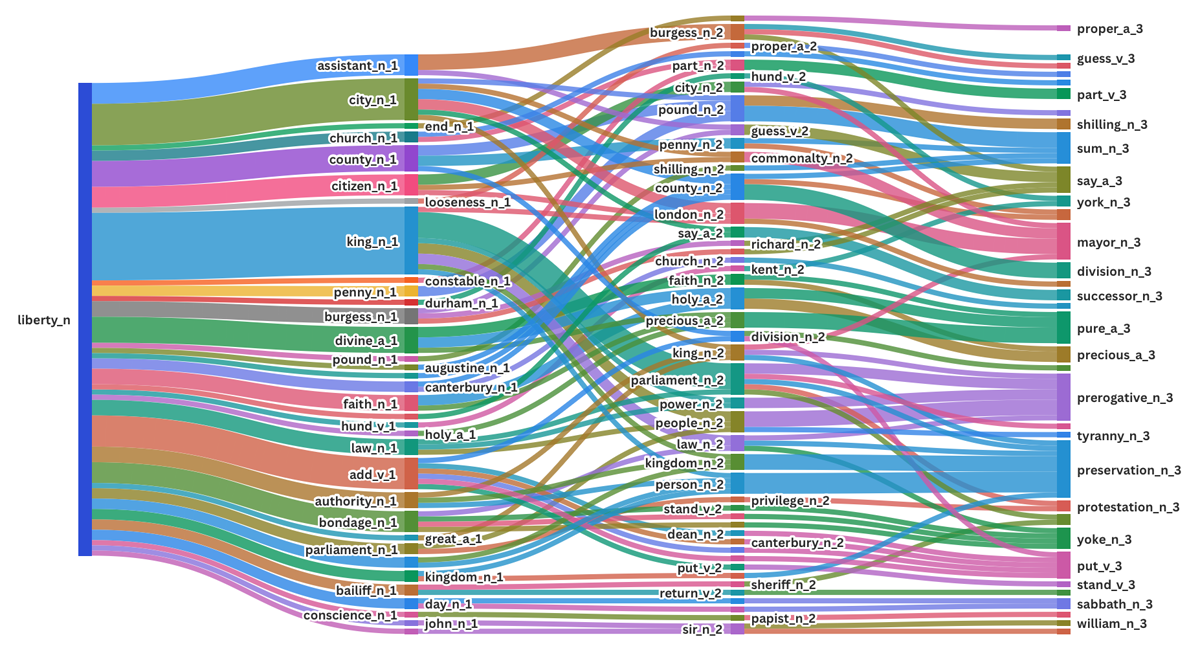
Figure 1
Illustrative conceptual constellation for liberty generated from aggregated quad-based co-occurrence relationships in EEBO-TCP.
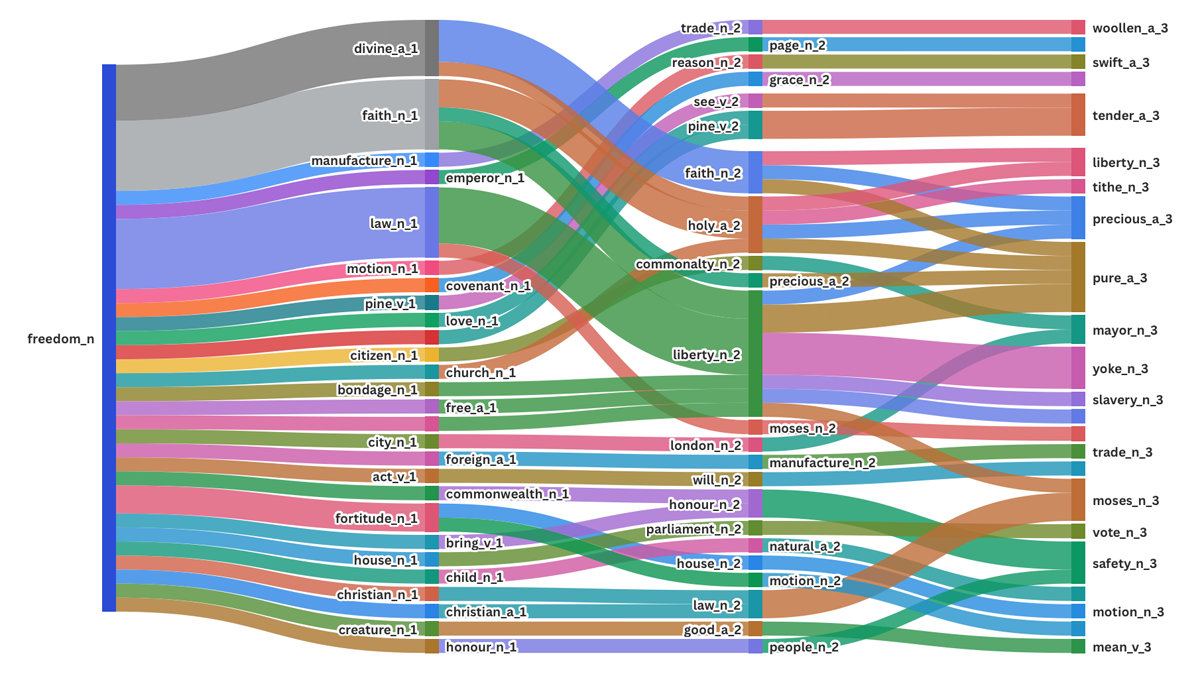
Figure 2
Illustrative conceptual constellation for freedom generated from aggregated quad-based co-occurrence relationships in EEBO-TCP.
The comparison of the near-synonymous keywords liberty and freedom in Early Modern English discourse illustrates this pattern. Although the two terms frequently co-occur and appear interchangeable at the lexical level, their quad constellations reveal distinct patterns of association across the corpus. Quads associated with liberty frequently contain terms such as law, parliament, king, and privilege, while freedom appears in associations involving bondage, grace, pain, and related moral or spiritual lexical items. These overlapping associations aggregate into broader conceptual constellations that reveal distinct discursive environments within the corpus. In this way, concept modelling highlights how conceptual structure can stabilise at the level of discourse even within a highly variable textual environment.
(2.4) What kind of conceptual change becomes visible
The patterns revealed through quad-based concept modelling suggest that conceptual organisation in historical discourse can be observed to emerge from recurrent lexical association rather than from the behaviour of individual lexical items alone. In the EEBO-TCP corpus, aggregation of quad structures across diverse textual environments allows discursive conceptual configurations to be identified as stabilising despite substantial variation in spelling, genre, and linguistic form.
The comparison of liberty and freedom illustrates this dynamic. Although the two terms frequently appear interchangeable at the level of lexical usage, their respective constellations reveal distinct discursive environments within the corpus. Liberty appears more strongly associated with civic and institutional discourse, while freedom is more concentrated around moral and spiritual associations. The distinction emerges at the level of aggregated discursive structure rather than through isolated lexical pairings alone. In this sense, conceptual divergence becomes visible not through changes in individual words, but through the patterned associations that organise discourse around them. Methods that capture these aggregated structures therefore provide a way of modelling conceptual change that complements more traditional frequency-based approaches to historical semantics.
(3) Case study 2: SynFlow analysis
This section uses SynFlow on a subset of the Royal Society Corpus (Fischer et al., 2020) as a worked example of method-dataset interaction. The aim is not to provide a full semantic case study, but to show how a dependency-based quantitative method depends on particular corpus properties and, in turn, makes certain dimensions of diachronic change more visible than others.
(3.1) Dataset properties (RSC subset)
The Royal Society Corpus 6.0.4 (Fischer et al., 2020) is a diachronic corpus of English scientific writing based mainly on the Philosophical Transactions and Proceedings of the Royal Society of London. It offers a relatively coherent scientific genre over a long time span, with the full release covering around 47,000 texts and 295.9 million tokens (1665–1996), and the open release covering around 78.6 million tokens (1665–1920). Its main strengths are genre continuity, diachronic depth, and metadata richness. In our demonstrative case study, we only use a subset of the Open version, limiting it to the 1750–1799 period and 3 topics, namely Biochemistry, Chemistry 1, Chemistry 2 (the topics are obtained from Menzel et al., 2021). Our corpus contains only 913 texts and 351,849 tokens, with a vocabulary size of 73,628. Because SynFlow requires dependency-parsed corpora, we re-parsed the dataset using Stanza (Qi et al., 2020), the state-of-the-art parser for English.
Upon qualitative inspection, we noticed some limitations of this corpus, which are also typical of historical corpora: OCR noise (e.g., head – ach instead of headache), historical spelling variations (e.g., inconveniency for inconvenience), and residual preprocessing error. Even though these problems have been documented and claimed to be ‘optimised’ throughout the development of the dataset (Kermes et al., 2016; Knappen et al., 2017), they are still present in our version, which is the latest release. These have negatively affected the parser, which is reflected in some wrong lemmatisations, wrong or unrecognised POS tags (labelled as X by Stanza), and wrong dependency relations. However, instead of trying to fix the problem, we want to see how using the original corpora and off-the-shelf tagger affects our analysis.
(3.2) SynFlow
SynFlow (Phan-Tất, 2025) builds on the principle of syntactic co-occurrence, according to which a concept is understood through the grammatical relations that structure its contextual behaviour. In this framework, a concept is represented not by linear word proximity alone, but by the distribution of lexical fillers in dependency-based slots, such as adjectival modification, subjecthood, objecthood, and prepositional complementation. This slot-based representation makes it possible to trace how the internal semantic profile of a concept is distributed across different functional dimensions of use. When applied diachronically, SynFlow enables the comparison of these structured profiles across time, revealing not only whether a concept has changed, but also which semantic dimensions have shifted and how. In this sense, SynFlow aims to provide a more explainable and linguistically interpretable account of semantic change than approaches based solely on surface co-occurrence. Because it requires dependency parsing, it can only be applied to corpora which have already been parsed.
(3.3) SynFlow × RSC
Using SynFlow, we analysed the conceptual development of air, water, and acid in the RSC during the Chemical Revolution. Our findings indicate that SynFlow is able to capture the dynamic semantic profiles of all three concepts, uncovering historically interpretable patterns of conceptual stability, shift, and reorganisation. For example, the concept of air shifted from a general, undifferentiated substance to a chemically differentiated set of specific airs. More importantly, the effect of the known data issues appears to be minimal. In the high-frequency items and main dependency relations that are most relevant to the analysis, noise is limited, while errors associated with the target concepts tend to be sparse and readily identifiable. This suggests that, for this type of analysis, the original corpus data together with an off-the-shelf tagger can still yield reliable results.
However, caution is still required. Stanza is primarily trained on Modern/Contemporary English, and eighteenth-century English remains relatively close to it. This likely helps explain why the tagging quality is still sufficient in our case. Since SynFlow derives its evidence from dependency-based slot–filler distributions, parsing errors could influence the results by assigning fillers to incorrect syntactic slots, missing relevant relations, or exaggerating change in sparse slots. The same level of reliability cannot be assumed for earlier historical periods, where the linguistic distance from Modern English is greater and the approach may no longer be reliable without additional normalisation, parser adaptation, manual checking, or robustness tests.
(4) Comparative methodological discussion
The two case studies illustrate distinct but complementary interactions among dataset properties, analytical assumptions, and observable patterns of conceptual change. Rather than comparing methods in terms of performance, the discussion focuses on how each approach operationalises meaning within the constraints of its underlying dataset.
(4.1) Conceptualisation of meaning
The two case studies operationalise the notion of ‘concept’ in fundamentally different ways, reflecting both the analytical assumptions of each method and the structural properties of the datasets to which they are applied. In the quad-based approach, conceptual structure is modelled through recurring patterns of lexical co-occurrence within a broad discursive window. Concepts are not treated as properties of individual lexical items, but as configurations of associations that emerge from recurring co-occurrence across heterogeneous textual environments. Meaning is therefore modelled through recurring lexical associations at the level of discourse rather than at the level of individual tokens.
By contrast, the SynFlow approach models conceptual structure through syntactic co-occurrence patterns derived from dependency relations. Here, meaning is operationalised in terms of the functional roles that lexical items occupy within structured linguistic environments. Concepts are inferred from shifts in these relational patterns over time, with syntactic dependencies providing a more fine-grained representation of how lexical items interact within specific domains of usage. Whereas the quad-based approach models conceptual structure through broad patterns of lexical association across heterogeneous textual environments, the SynFlow approach foregrounds the relational behaviour of lexical items within more tightly structured syntactic contexts.
These differing operationalisations reflect not only methodological choices but also the constraints and affordances of the underlying datasets. In EEBO-TCP, where orthographic and stylistic variation, alongside uneven linguistic regularity in grammatical and syntactic structures, limits the reliability of syntactic analysis, concept modelling through aggregated lexical associations provides a robust way of capturing discursive structure. In the Royal Society Corpus, by contrast, the relative regularity of scientific prose enables dependency-based modelling of relational patterns, allowing conceptual change to be traced through shifts in syntactic co-occurrence.
(4.2) Data assumptions and constraints
The two approaches are grounded in different assumptions about the structure and reliability of the underlying data, which in turn shape the kinds of analytical procedures that can be applied. In the case of EEBO-TCP, the corpus is characterised by substantial orthographic variation, heterogeneous genre composition, and uneven grammatical and syntactic regularity across time. These properties limit the feasibility of approaches that depend on stable syntactic annotation or consistent surface forms. As a result, the LDNA pipeline relies on normalisation and lemmatisation to reduce variation at the lexical level, and on aggregation across large textual windows to identify recurring patterns of co-occurrence.
By contrast, the Royal Society Corpus provides a more controlled textual environment, consisting primarily of scientific prose with relatively consistent orthography and more regular syntactic structure. This makes it possible to apply dependency-based methods such as SynFlow, which rely on the identification of syntactic relations between lexical items. At the same time, the approach assumes the availability of sufficiently reliable part-of-speech tagging and dependency parsing, even when applied to historical data. This also means that for earlier historical stages or low-resource languages without reliable parsers, the method may be less applicable unless additional preprocessing, parser adaptation, or manual annotation is introduced. These constraints primarily affect the applicability of particular analytical approaches and the forms of diachronic pattern that can be reliably observed under different corpus conditions.
These differences highlight how methodological choices are conditioned by the affordances and limitations of each dataset. In EEBO-TCP, where linguistic variability complicates fine-grained structural analysis, conceptual patterns are more robustly captured through aggregated lexical associations. In the Royal Society Corpus, the relative stability of syntactic structure allows conceptual relationships to be modelled through dependency-based representations, even though this introduces its own assumptions about the reliability of automated annotation.
Beyond shaping methodological choices within individual datasets, these differences also affect the transferability of analytical approaches across corpus environments. Methods designed for dependency-based modelling depend on relatively stable syntactic annotation and parsing, whereas aggregation-based approaches are more tolerant of orthographic and grammatical variability. The applicability of each method is therefore conditioned not only by analytical goals but also by the linguistic and structural properties of the available data.
(4.3) Observable diachronic patterns
The interaction between dataset properties and analytical approach leads to different forms of diachronic pattern becoming visible in each case study. In EEBO-TCP, conceptual structure becomes visible through the stabilisation of recurring patterns of lexical association across heterogeneous textual environments. Despite substantial variation in spelling, genre, and linguistic form, aggregated co-occurrence patterns allow discursive conceptual configurations to persist and become identifiable at scale. Diachronic change, in this context, is observable in shifts in the relative prominence and composition of these constellations rather than in discrete changes to individual lexical items. As reported in Section 2, the distinction between liberty and freedom is reflected in different constellations of lexical associations, with liberty clustering around institutional and legal discourse and freedom around moral and spiritual contexts.
In the Royal Society Corpus, by contrast, diachronic patterns are captured through changes in syntactic co-occurrence within a more constrained domain of discourse. Dependency-based analysis makes it possible to trace how lexical items participate in evolving relational structures over time, revealing shifts in functional usage associated with developments in scientific discourse. As discussed in Section 3, for example, the reconceptualisation of the concept of air is reflected across several slots, most prominently in the adjective slot. It shifts from being described in relatively general terms to being modified by more chemically specific adjectives. Here, conceptual change is observable through the reconfiguration of structured (syntactic) co-occurrence rather than through the aggregation of broad (window-based) co-occurrence patterns.
These case studies demonstrate that different methodological approaches foreground different dimensions of diachronic change. In one case, conceptual organisation becomes visible through the persistence and restructuring of discursive associations; in the other, it is revealed through shifts in relational patterns within more tightly structured linguistic environments. The contrast highlights how the form of observable change is shaped not only by the analytical method, but by the nature of the dataset to which it is applied.
(5) Implications for quantitative diachronic research
The comparison of the two case studies highlights several implications for the use of quantitative methods in diachronic linguistics. First, the findings underscore the limitations of approaches that rely solely on lexical frequency or surface-level collocation. While such methods can capture broad distributional trends, they may obscure underlying conceptual organisation that becomes visible through more complex patterns of association or relational structure. The case studies demonstrate that different methodological approaches can reveal distinct dimensions of semantic change, depending on how linguistic context is operationalised.
Second, the analysis emphasises the importance of aligning analytical methods with the structural properties of the dataset. As shown in the contrast between EEBO-TCP and the Royal Society Corpus, the reliability of particular forms of linguistic representation, whether lexical co-occurrence or syntactic dependency, depends on factors such as orthographic consistency, genre composition, and the feasibility of preprocessing. Methodological choices are therefore not neutral, but conditioned by the affordances and limitations of the data.
Third, the discussion highlights the need for greater methodological transparency in quantitative diachronic research. Making explicit the assumptions underlying data preprocessing, annotation, and analytical modelling is essential for the interpretation and reproducibility of results, particularly when working with historical corpora characterised by variation and uncertainty. This is especially important in the context of open datasets, where reuse depends not only on data availability but also on clear documentation of how data has been transformed and analysed.
Finally, the paper points to the value of comparative, example-based approaches for methodological reflection. Rather than seeking a single optimal method, placing different analytical strategies in relation to one another makes it possible to identify how each approach foregrounds particular aspects of linguistic change. This perspective supports a more flexible and context-sensitive understanding of quantitative analysis, in which methods are evaluated in relation to the datasets they are designed to interrogate.
(6) Conclusion
This paper argues that observable patterns of diachronic change are shaped by the interaction between dataset properties and analytical methods and demonstrates this through two contrasting computational approaches. Diachronic change is not directly observable as an inherent property of language alone, but is shaped by the interaction between dataset properties and analytical methods. Through two case studies, we have shown that different approaches make different aspects of conceptual change visible, depending on how linguistic structure is operationalised and what forms of data are available.
In the case of EEBO-TCP, the heterogeneity and orthographic variability of early modern texts favour aggregation-based approaches that capture stabilised patterns of lexical association at the level of discourse. In contrast, the relative syntactic regularity of the Royal Society Corpus enables dependency-based modelling of relational patterns, allowing conceptual change to be traced through shifts in structured co-occurrence. These differences do not simply reflect methodological preference, but arise from the constraints and affordances of the underlying datasets.
The comparison highlights that quantitative approaches to historical linguistics do not merely analyse pre-existing patterns of change, but actively shape what counts as observable change. Methodological transparency, including explicit attention to data preprocessing, annotation, and analytical assumptions, is therefore essential for the interpretation and reuse of historical datasets. By foregrounding the relationship between method and data, this paper contributes to a more context-sensitive understanding of quantitative diachronic analysis, in which different approaches are evaluated in relation to the datasets they are designed to interrogate.
Notes
[1] EEBO-TCP is openly available through the Text Creation Partnership: https://textcreationpartnership.org/tcp-texts/eebo-tcp-early-english-books-online/.
[2] The Royal Society Corpus is available through the CLARIN-D repository: https://fedora.clarin-d.uni-saarland.de/rsc_v6/access.html#download.
Acknowledgements
This research builds on the Linguistic DNA project, Modelling concepts and semantic change in English 1500–1800, funded by the Arts and Humanities Research Council (AHRC AH/M00614X/1). The project was led by Susan Fitzmaurice (Principal Investigator), with Co-Investigators Michael Pidd, Justyna Robinson, and Marc Alexander, and was supported by research associates Fraser Dallachy, Iona Hine, and Seth Mehl. Technical development was carried out by Matthew Groves, Katherine Rogers, and Brian Aitken. Further information is available at https://linguisticdna.org (accessed 1 April 2026).
Data Accessibility Statement
The EEBO-TCP corpus is openly available through the Text Creation Partnership: https://textcreationpartnership.org/tcp-texts/eebo-tcp-early-english-books-online/.
The Royal Society Corpus 6.0 is available through CLARIN-D: https://fedora.clarin-d.uni-saarland.de/rsc_v6/access.html#download.
SynFlow is openly available via Zenodo: https://doi.org/10.5281/zenodo.17414457.
AI Declaration
No generative AI tools were used in the research or writing of this manuscript beyond basic manuscript refinement. The authors take full responsibility for the content of the manuscript.
Author Contributions
Catherine Wong: Conceptualization, Methodology, Investigation, Writing – original draft, Writing – review & editing.
Bách Phan Tất: Methodology, Investigation, Writing – original draft (Section 3), Writing – review & editing.
Susan Fitzmaurice: Conceptualization, Supervision, Writing – review & editing.