
(1) Overview
Repository location
Dataset 1 – Inscriptions from the temple of Atargatis, Dura-Europos (without Room 6) – DOI: https://doi.org/10.5281/zenodo.14935414; Dataset 2 – Inscriptions from Room 6, Temple of Atargatis, Dura-Europos – DOI: https://doi.org/10.5281/zenodo.14935471.
Context
A total of 45 inscriptions are included in the two datasets, representing the epigraphic corpus from the Temple of Atargatis (see Figure 1).
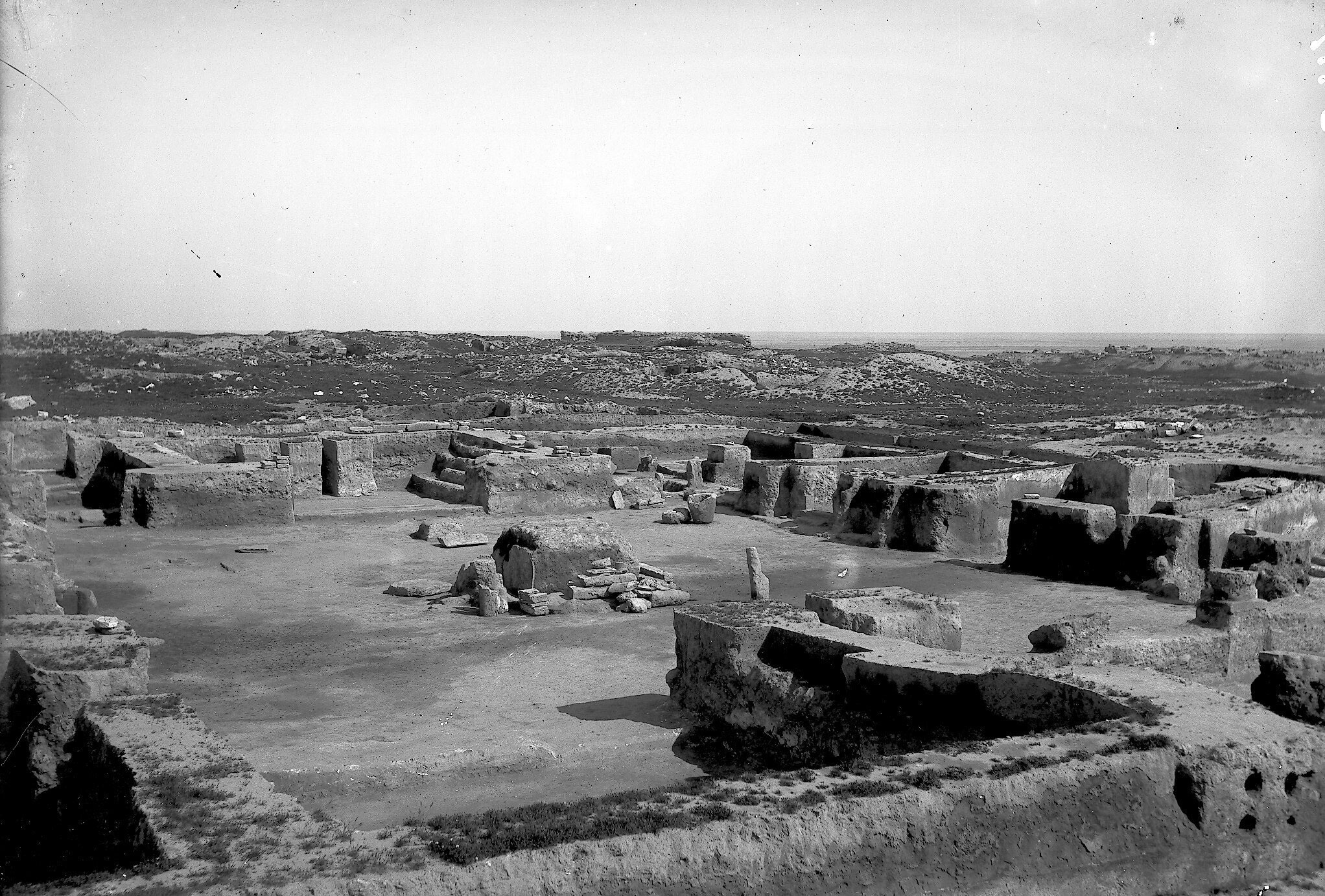
Figure 1
Archival picture of the Temple of Atargatis.
The location of the temple (shown in Figure 2) was in the centre of the ancient city on the insula designated as H2, with the Temple of Artemis as a neighbouring structure (see Figure 3).

Figure 2
Location of the Temple of Atargatis.
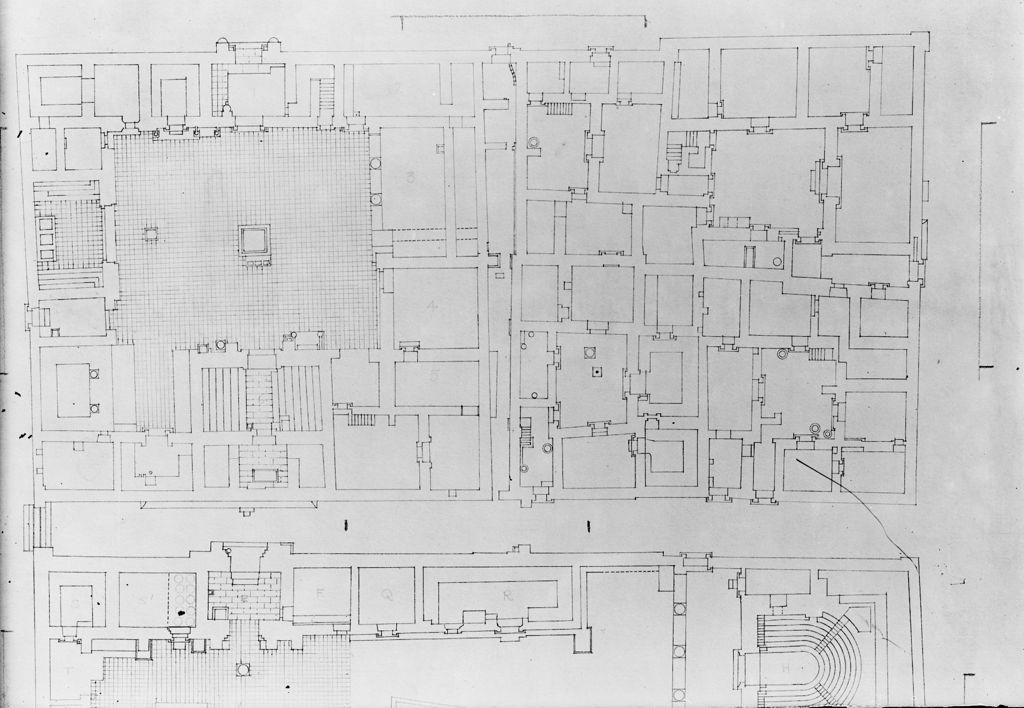
Figure 3
Plan of the Temple of Atargatis.
The epigraphic material dates from the 1st and 3rd centuries CE. The inscriptions are written mostly in Greek, while only two are in Middle Aramaic, presenting Hatrene and Old Syriac script. The datasets are the outcome of work within two projects: International (Digital) Dura-Europos Archive (IDEA, https://duraeuroposarchive.org, last accessed 19-11-2025) and Al-At (https://www.al-at.eu, last accessed 19-11-2025). The datasets’ content is published within Wikidata (https://www.wikidata.org/wiki/Wikidata:Main_Page, last accessed 19-11-2025) with assigned own Q-identifiers. These datasets represent an important component of the ongoing work on the epigraphy of Dura-Europos that still lacks a comprehensive corpus of inscriptions, either digital or printed. Based on archival material and the reports of the French-American (Yale) archaeological mission, it was possible to contextualize the inscriptions within the broader framework of the temple finds from the Temple of Atargatis (https://www.wikidata.org/wiki/Q109375494, last accessed 19-11-2025) and to rectify the inscriptional evidence from the temples of Atargatis and Artemis, which had been conflated in the publication of F. Cumont (Cumont, 1926).
(2) Method
Steps
The epigraphic data were collected in two stages: (1) the evidence from the temple (six inscriptions) and (2) the inscriptional material from the so-called Room 6 (39 inscriptions), characterized by stepped seats with women’s names located to the right and left of the entrance (Klaver, 2019, 115–116). Both the inscriptions and the arrangement of this room date to the 60s of the 1st century CE.
The data were drawn from various publications (Bertolino, 2004; Cumont, 1926; Rostovtzeff, 1937; Baur et al., 1932; Frye et al., 1955; Cussini & Hillers, 1999). The authopsy of the inscriptions was not possible because e.g. they went lost in the course of time or stayed in Syria in-situ. The Wikidata model permits to insert many editions of inscriptions, not only editio princeps. The inscriptions were organized in Excel spreadsheets (in .csv format) following the inscription data model of the IDEA project (https://www.wikidata.org/wiki/Wikidata:WikiProject_IDEA/Inscriptions, last accessed 26-11-2025). The categorization of the inscriptions by types follows the FAIR (Findable, Accessible, Interoperable, Reusable) vocabulary and was adapted to the USEP (US Epigraphy Project). The texts are not encoded into the EpiDoc-TEI, but follow the general rules of the epigraphic editions. The vocabulary used for the description of the data is based on the Wikidata.org ontology. The names of the columns follow the Wikidata properties and the contents are described using the terms of the statements and values. The inscriptions are also linked to the Trismegistos (https://www.trismegistos.org, last accessed 26-11-2025) and PHI Greek Inscriptions online (http://epigraphy.packhum.org/, last accessed 26-11-2025). Some of values in the datasets, e.g. display date, commentary, specific location with more detail, or genre, relate to the future import of the data into the US Epigraphy project and were not included in the Wikidata format. When the inscriptions were gathered in the relevant files, the import of the data was achieved thanks to the OpenRefine open source tool for working with messy data, transforming it from one format into another, and extending it with web services and external data and creating the entries to the Wikidata.org (https://www.wikidata.org/wiki/Q127835674, last accessed 19-11-2025).
Neither the paper nor the dataset is dedicated to palaeographical research. The author of this paper, who is also the data compiler, does not have the expertise required for such study, and Aramaic scripts still lack a comprehensive palaeographical analysis.
Sampling strategy
The process of sampling the data was driven by the description in the consulted books which related to the find spot indicating the Temple of Atargatis. Last but not least, the datasets were created following the models and instructions provided by the Principal Investigator (PI) of the IDEA project.
Quality control
Each inscription got a working ID, based on a shortened title of the editio princeps and number of the inscription. During conversion to Wikidata each of the epigraphic attestation acquired a Q-number, which is the inner Wikidata identifier. Where it was possible (like in e.g. https://www.wikidata.org/wiki/Q126728418, last accessed 19-11-2025) the inscription was combined with the photograph (see Figure 4).
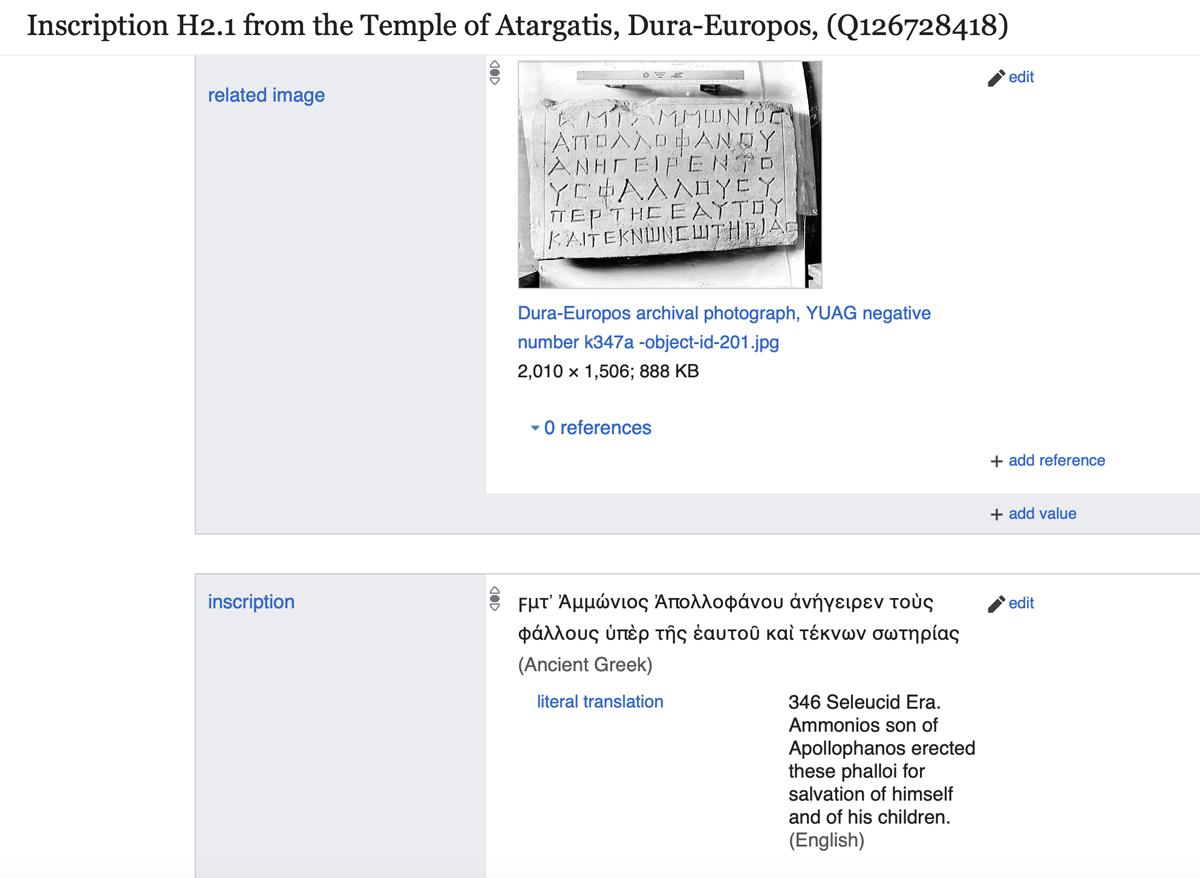
Figure 4
Inscription H2.1 from the Temple of Atargatis, Dura-Europos, (Q126728418).
The dataset files provide a column Image, which is related to a column Reference URL where the links to the archival images are given: https://www.jstor.org/stable/community.3918154 (last accessed 19-11-2025, see Figure 5).
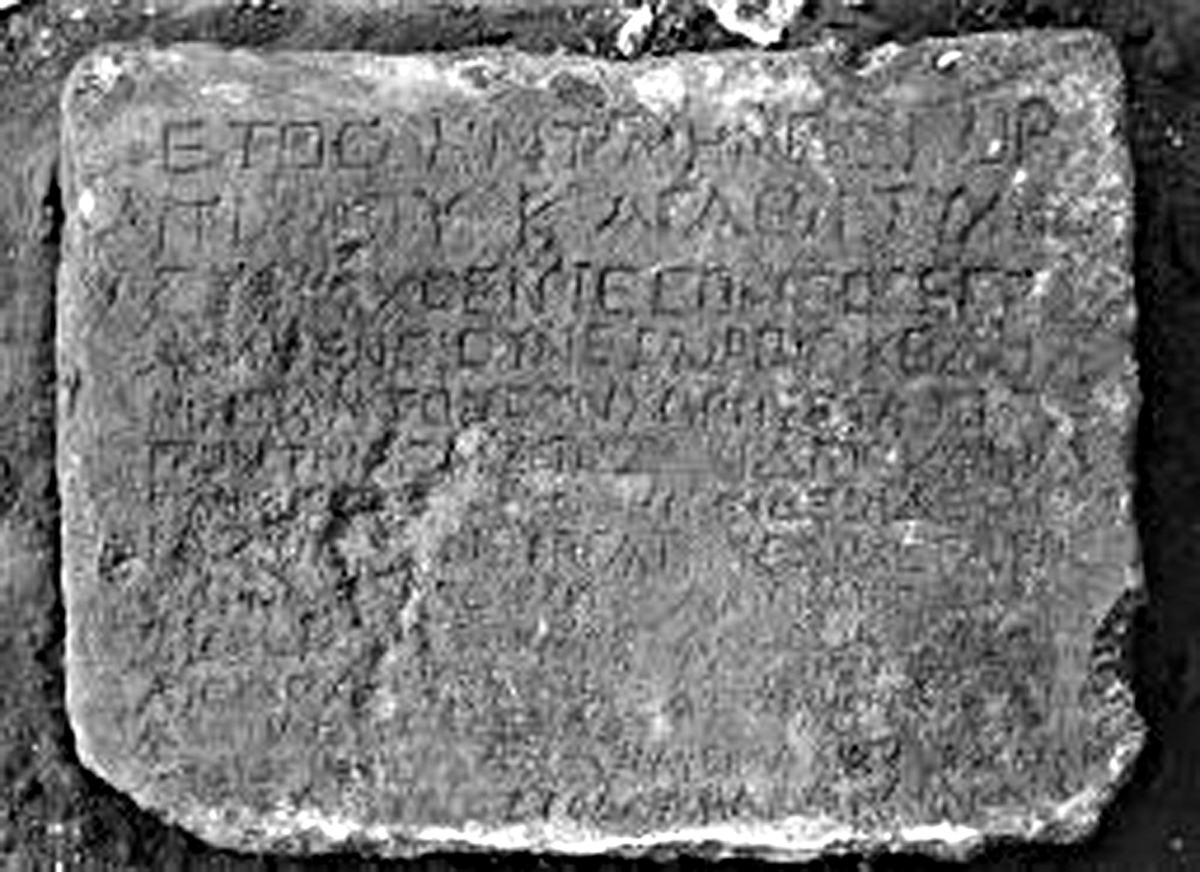
Figure 5
Archival picture of an inscription from Temple of Atargatis.
The epigraphic material from Dura-Europos is sometimes based on the figures of subjective drawings of the researchers in the publications from the 1920s and 1930s. It is not always possible to provide high-resolution imagery.
The datasets provide categorized and structured records of epigraphic attestations, classified according to their attribution to specific cultic buildings. A dedicated column, Specific Location, together with a complementary column (More detail if necessary), provides additional spatial information when needed. This is particularly useful for inscriptions found in Room 6 with the seats of the female collegium, as it allows for an overview of the distribution of personal names within the space.
The names of the text categories follow the FAIR Epigraphy (https://zenodo.org/records/17454135, last accessed 19-11-2025) typology and have been adapted for use in the U.S. Epigraphy Project (https://usepigraphy.brown.edu/projects/usep/collections/, last accessed 19-11-2025).
Chronological information is recorded in the Inception field, based on Wikidata property P571 (the time when an entity begins to exist). The property Instance of (P31) is used to specify the class or category to which a given item belongs. For more detailed description, the property Depicts (P180) is employed, allowing the annotation of e.g. iconographic features—such as in Q127976904 (https://www.wikidata.org/wiki/Q127976904, last accessed 19-11-2025, see Figure 6).
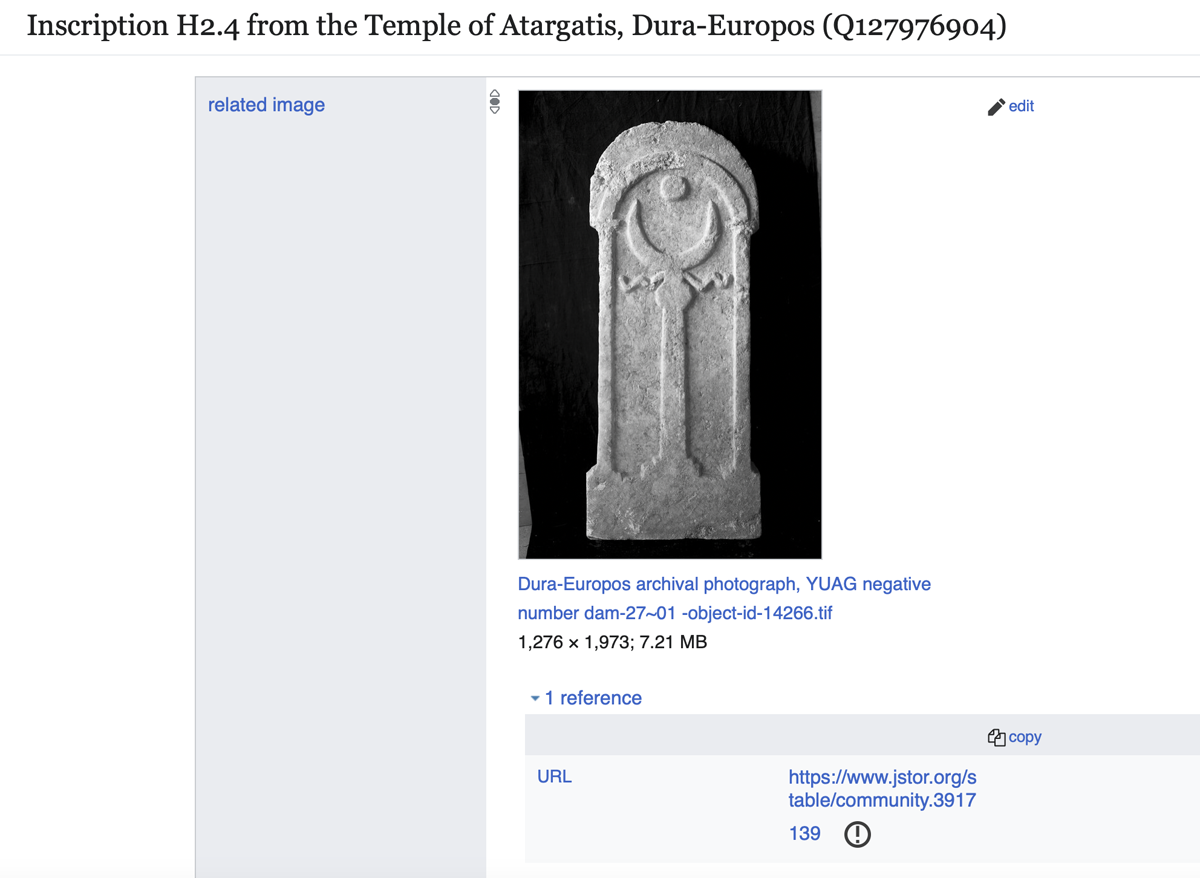
Figure 6
Image of the Crescent and Column.
(3) Dataset Description
Repository name
Zenodo.
Object name
Inscriptions from the temple of Atargatis, Dura-Europos (without Room 6)
Inscriptions from Room 6, Temple of Atargatis, Dura-Europos
Format names and versions
Excel, CSV. Versions 1.0.
Creation dates
From 2024-07-01 to 2024-12-27.
Dataset creators
Anne Chen, PhD, PI of the IDEA project, Bard College, USA – approving the data model and revising the datasets; Aleksandra Kubiak-Schneider, PhD, University of Wrocław, Poland – data collector and curator.
Language
English, Ancient Greek, Middle Aramaic.
License
CC4.0.
Publication date
2024-12-27.
(4) Reuse Potential
The datasets constitute part of the epigraphic material from Dura-Europos, published in the early excavation reports, either at preliminary or final stages. The inscriptions represent significant finds from one of the urban sanctuaries dating to the Late Parthian-Roman period (1st–3rd century CE).
The .csv files effectively create a form of digital corpus that includes the dimensions of the inscribed objects, their precise locations, and archival photographs. Wikidata, as a Linked Open Data environment, enables further semantic enrichment—for instance, by linking locations to the dedicated Wikidata entries. Inscriptions in the datasets and the Wikidata entries include translations into modern languages, addressing a gap in earlier publications, where editors often assumed readers’ familiarity with classical languages.
Wikidata provides space for multiple translations and transliterations (e.g. https://www.wikidata.org/wiki/Q127976904, last accessed 19-11-2025), highlighting variations in the interpretation of the same text.
Wikidata offers a space for ranking the values of information provided in the publications.
A good example is the bilingual Inscription H2.3 from the Temple of Atargatis in Dura-Europos (https://www.wikidata.org/wiki/Q127835674, last accessed 19-11-2025, see Figure 7), classified in the corpus of the Palmyrene inscriptions (Cussini & Hillers 1999, no. 2831) as written in the Palmyrene script. The drawings in two publications (Bertolino, 2004; Frye et al. 1955) show clearly the letter forms from Hatra. With the use of the ranks (indicated as two arrows on the side of the statement) within the Wikidata.org it was possible to indicate which script attribution is correct. It marks the appropriate value in green, while the incorrect one is highlighted in red.
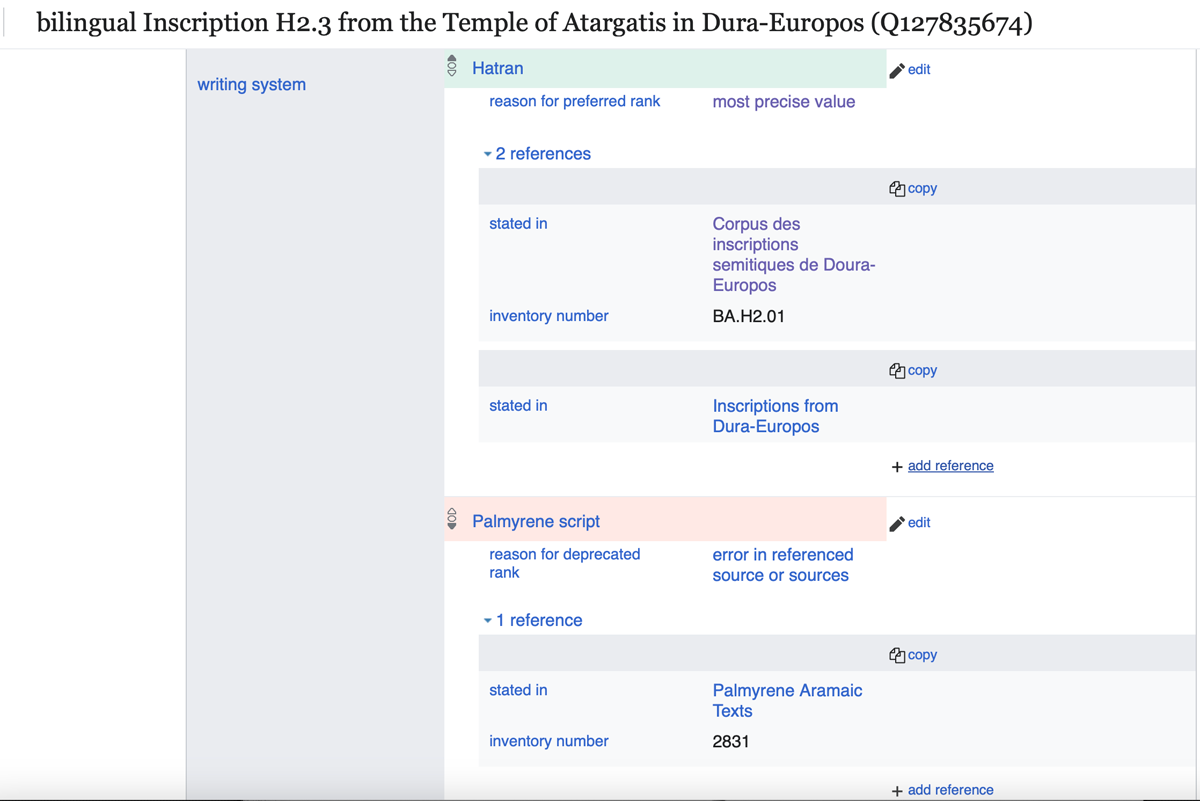
Figure 7
Ranking the values in Wikidata example.
The datasets modelled with the Wikidata identifiers are serving to conduct research on the society of Dura-Europos. The datasets presented here provide sufficient material for onomastic and prosopographic studies of the population of Dura-Europos. This material can be reused in research on the inhabitants of the city and can be accessed through specific entries, e.g. Seleukos (https://www.wikidata.org/wiki/Q130285374, last accessed 19-11-2025). The column Commissioned by concerns the property (P88) of Wikidata, where it is possible to insert the name of a person or institution (mentioned in the inscription in the case of this particular dataset), who commissioned the work (inscription, building, etc.). Such an approach facilitates and accelerates the study of ancient societies and the organization of temple life by linking diverse epigraphic data to individual persons.
The two tables also enable comparative studies of divine cults across different parts of the ancient world. They were recently reused in research on the worshippers of the goddess Atargatis and presented through social network analysis graphs, illustrating family entanglements in the cult of the goddess at Dura-Europos as one of the case studies (Kubiak-Schneider & Mazurek, 2025). Furthermore, grouping the datasets by the buildings supports quantitative analyses concerning the distribution of inscriptions within the city.
Unfortunately, several challenges arise when relying solely on Wikidata and exporting their large datasets.
The first challenge concerns the search engine, which requires the exact formulation of the queried item. It is not yet possible to search for individual words or specific aspects of an inscription.
A key limitation of using Wikidata as a tool for epigraphy is the lack of space for commentary, which is essential in any epigraphic corpus.
Another imperfection of the Wikidata model lies in its terminology conventions for labeling statements (https://www.wikidata.org/wiki/Q2684591, last accessed 19-11-2025) and values (https://www.wikidata.org/wiki/Q878143, last accessed 19-11-2025). One needs to have knowledge of how to describe according to this scheme.
Finally, Wikidata does not store raw datasets or their combinations for future reuse (Sahu-Hough, 2023).
Using Wikidata and the presented datasets—modelled according to the Wiki-format—makes the material open to interdisciplinary collaboration. They can form part of broader analyses or collaborative research projects in archaeology, the history of religions, and the study of ancient societies. They help organizing data for a comprehensive analysis of the epigraphic culture of Dura-Europos. The entry on the Temple of Atargatis (https://www.wikidata.org/wiki/Q109375494, last accessed 19-11-2025) demonstrates that the datasets can be integrated into broader analyses of the finds and the architecture of the ancient buildings.
The epigraphic datasets from the Temple of Atargatis at Dura-Europos have significant potential for reuse. Firstly, the two Middle Aramaic inscriptions contribute to the digital visibility of non-Classical sources. These datasets represent an important step toward the future creation of a comprehensive digital and printed corpus of inscriptions from Dura-Europos. They also provide information that would otherwise require extensive time and effort to retrieve from dispersed publications.
Acknowledgements
The author is thankful to Jen Baird for putting her into contact with the IDEA project and seeing a promising collaboration between the author and this ambitious venture. Another person who deserves great recognition in this matter is Anne Chen, the leader of the IDEA project. The author wants to thank her for her guidance in the use of Wikidata and for her confinement of the research task to concentrating on the epigraphy of Dura-Europos.
Competing Interests
The author has no competing interests to declare.
Author Contributions
Aleksandra Kubiak-Schneider: Conceptualization, Writing-original draft, Formal Analysis, Data curation.