
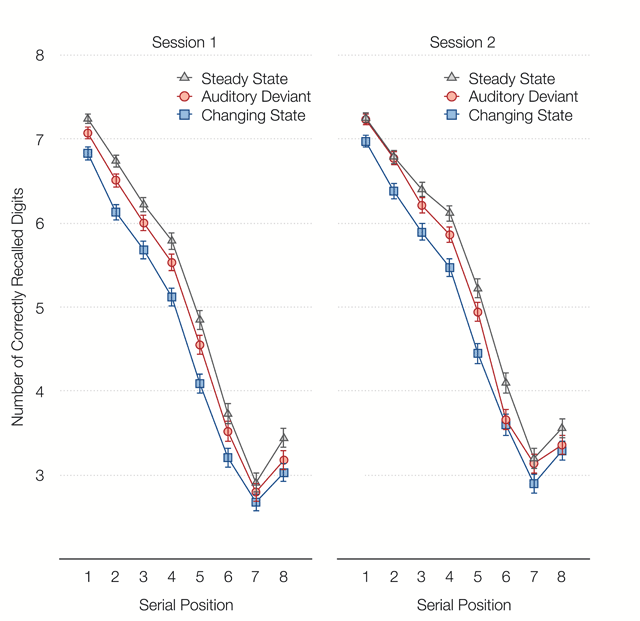
Figure 1
Serial Recall as a function of distractor condition (steady state, auditory deviant, changing state), serial position (1 to 8) and session (1, 2). The error bars represent the standard errors of the means.
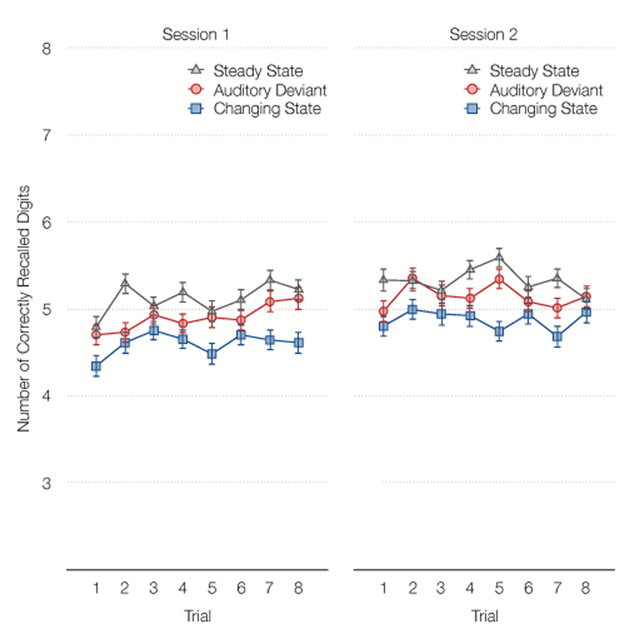
Figure 2
Serial Recall as a function of distractor condition (steady state, auditory deviant, changing state), trial of each condition in each session (1 to 8) and session (1, 2). The error bars represent the standard errors of the means.
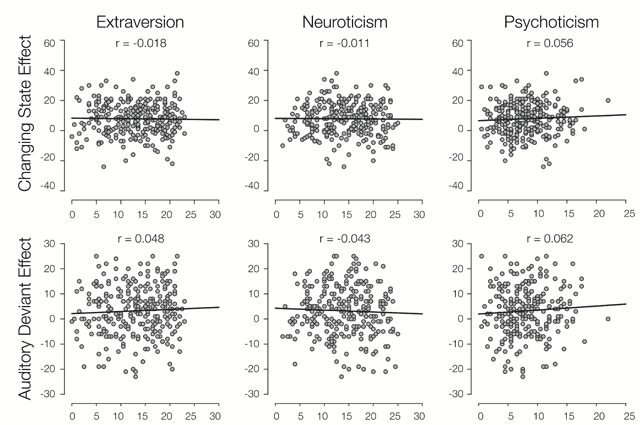
Figure 3
Correlations between the distraction effects and the personality scales. The changing-state effect corresponds to the difference in the total number of recalled digits between the steady-state condition and the changing-state condition, and the auditory deviant effect corresponds to the difference in the total number of recalled digits between the steady-state condition and the auditory deviant condition (higher values indicate more distraction). None of the correlations were significant at the .05 significance level. The figure was created with JASP (JASP Team, 2018).