
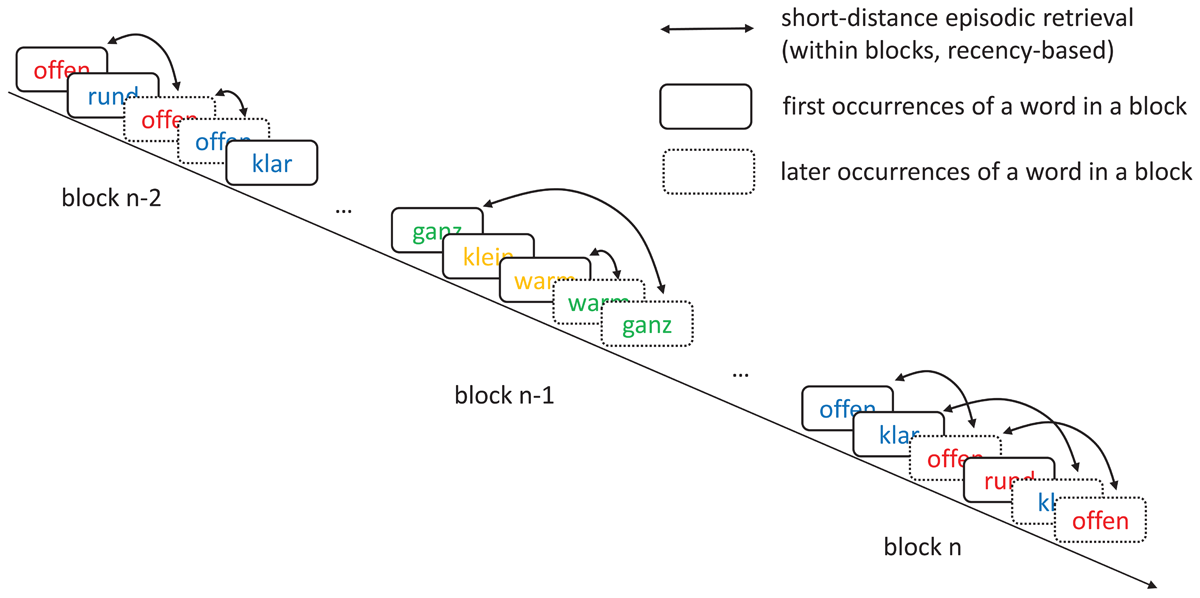
Figure 1
The alternating blocks paradigm: Two non-overlapping sets of color-word contingencies are presented in alternating blocks of the experiment. Responding to the first occurrences of a word within each block constitutes a pure measure of long-term contingency learning. Responding to later occurrences of a word within a block reflects a mixture of long-term learning and short-term retrieval.
Table 1
Color-word contingency manipulations in the color classification task. Numbers indicate frequencies of occurrence for color-word combinations for different parts of each block (initial part of a block [1st occurrences], central part [2nd–5th occurrences], and final part of a block [6th occurrence]) across the 20 blocks of the task; numbers in parentheses indicate the frequency of occurrences within a single example block.
| COLOR | WORD SET 1 | WORD SET 2 | ||||||
|---|---|---|---|---|---|---|---|---|
| OFFEN | WEICH | KLAR | RUND | WARM | LEICHT | GANZ | KLEIN | |
| 1st occurrences | ||||||||
| red | 10 (1) | 10 (0) | 10 (1) | 10 (0) | / | / | / | / |
| yellow | 10 (0) | 10 (1) | 10 (0) | 10 (1) | / | / | / | / |
| blue | / | / | / | / | 10 (1) | 10 (0) | 10 (1) | 10 (0) |
| green | / | / | / | / | 10 (0) | 10 (1) | 10 (0) | 10 (1) |
| 2nd–5th occurrences | ||||||||
| red | 60 (3) | 60 (3) | 20 (1) | 20 (1) | / | / | / | / |
| yellow | 20 (1) | 20 (1) | 60 (3) | 60 (3) | / | / | / | / |
| blue | / | / | / | / | 60 (3) | 60 (3) | 20 (1) | 20 (1) |
| green | / | / | / | / | 20 (1) | 20 (1) | 60 (3) | 60 (3) |
| 6th occurrences | ||||||||
| red | 10 (0) | 10 (1) | 10 (0) | 10 (1) | / | / | / | / |
| yellow | 10 (1) | 10 (0) | 10 (1) | 10 (0) | / | / | / | / |
| blue | / | / | / | / | 10 (0) | 10 (1) | 10 (0) | 10 (1) |
| green | / | / | / | / | 10 (1) | 10 (0) | 10 (1) | 10 (0) |
| Overall | ||||||||
| red | 80 (hc) | 80 (hc) | 40 (lc) | 40 (lc) | / | / | / | / |
| yellow | 40 (lc) | 40 (lc) | 80 (hc) | 80 (hc) | / | / | / | / |
| blue | / | / | / | / | 80 (hc) | 80 (hc) | 40 (lc) | 40 (lc) |
| green | / | / | / | / | 40 (lc) | 40 (lc) | 80 (hc) | 80 (hc) |
[i] Note. hc, high contingency color-word combinations; lc, low contingency color-word combinations. The specific assignment of words to colors represents only one instance of the counterbalanced design.
Table 2
Results of a stepwise multi-level regression analysis predicting RT based on contingencies (CL, step 1), contingency awareness (CA) and its interaction with CL (step 2).
| PREDICTOR | MODEL 1 | MODEL 2 |
|---|---|---|
| Intercept | 403*** [393.5, 411.5] | 403*** [393.6, 411.6] |
| CL (hc vs. lc) | –5** [–7.8, –1.5] | –5** [–7.7, –1.4] |
| CA (correct vs. incorrect) | –4* [–7.3, –0.2] | |
| CL × CA | –9** [–14.9, –2.1] | |
| BIC | 92425 | 92407 |
| ∆ BIC | – | –18 |
[i] Note. *p < 0.05, **p < 0.01, ***p < 0.001. CL, Contingency learning; hc/lc: high/low contingency trials. CA, contingency awareness; correct/incorrect: identification of the typical word/color combination. BIC, Bayesian information criterion. We implemented a person specific intercept to control for individual differences in RTs. All other variables were implemented on a trial level. Values in brackets indicate the 95% confidence interval (lower and upper limit) for each regression weight. Regression weights (ß) reflect the difference in milliseconds between the conditions that define a contrast.
Table 3
Results of a stepwise multi-level regression analysis predicting RT based on contingencies (CL, step 1), episodic retrieval (ER, step 2), contingency awareness (CA) and its interaction with CL (step 3).
| PREDICTOR | MODEL 1 | MODEL 2 | MODEL 3 |
|---|---|---|---|
| Intercept | 393*** [385.3, 401.6] | 393*** [385.3, 401.6] | 393*** [385.3, 401.6] |
| CL (hc vs. lc) | –8*** [–9.2, –6.3] | –2 [–3.2, +0.1] | –2 [–3.2, +0.1] |
| ER (matching vs mismatching) | –13*** [–14.3, –11.3] | –13*** [–14.3, –11.3] | |
| CA (correct vs. incorrect) | –0 [–1.8, +1.2] | ||
| CL × CA | –5*** [–8.4, –2.5] | ||
| BIC | 451971 | 451687 | 451670 |
| ∆ BIC | – | –284 | –17 |
[i] Note. *p < 0.05, **p < 0.01, ***p < 0.001. CL, Contingency learning; hc/lc: high/low contingency trials. ER, episodic retrieval; matching/mismatching response during the last occurrence of the word; CA, contingency awareness; correct/incorrect: identification of the typical word/color combination. BIC, Bayesian information criterion. We implemented a person specific intercept to control for individual differences in RTs. All other variables were implemented on a trial level. Values in brackets indicate the 95% confidence interval (lower and upper limit) for each regression weight. Regression weights (ß) reflect the difference in milliseconds between the conditions that define a contrast.