
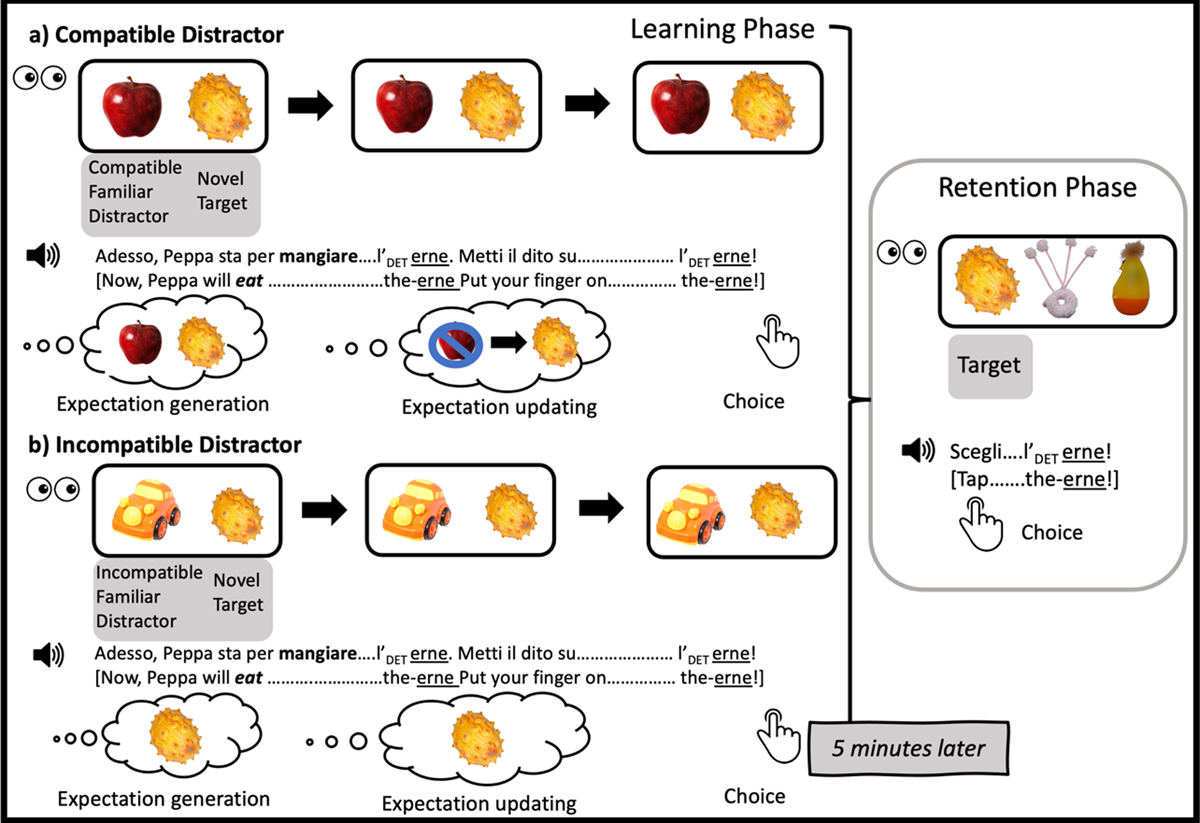
Figure 1
Schematic depiction of design, procedure and participant mental operations on different types of learning trials used in this study. Panel (a) illustrates Compatible Distractor trials, panel (b) Incompatible Distractor trials. In this depiction, we assume the participant chose the novel object as the referent of the novel word during the learning phase. (This figure was adapted with permission from Gambi, Pickering, et al., 2021.)
Table 1
Learning phase: Unfamiliar object choice (%) in the learning phase by Distractor compatibility condition in each age group.
| AGE GROUP | N | DISTRACTOR COMPATIBILITY | UNFAMILIAR OBJECT CHOICE (%) |
|---|---|---|---|
| 5–6 year olds | 29 | incompatible | 95 |
| compatible | 75 | ||
| 7 year olds | 30 | incompatible | 95 |
| compatible | 78 | ||
| 8–10 year olds | 48 | incompatible | 95 |
| compatible | 76 | ||
| Adults | 126 | incompatible | 95 |
| compatible | 85 |
Table 2
Retention phase: Target (unfamiliar) object choice at retention (accuracy) (%) by Distractor compatibility and by Choice at learning (i.e., the choice of object during the learning phase), separately for each age group.
| AGE GROUP | N | DISTRACTOR COMPATIBILITY | CHOICE AT LEARNING | TARGET OBJECT CHOICE AT RETENTION (ACCURACY) (%) |
|---|---|---|---|---|
| 5–6 year olds | 29 | incompatible | Familiar | 0 |
| Unfamiliar | 49 | |||
| compatible | Familiar | 45 | ||
| Unfamiliar | 59 | |||
| 7 year olds | 30 | incompatible | Familiar | 50 |
| Unfamiliar | 65 | |||
| compatible | Familiar | 52 | ||
| Unfamiliar | 57 | |||
| 8–10 year olds | 48 | incompatible | Familiar | 10 |
| Unfamiliar | 60 | |||
| compatible | Familiar | 36 | ||
| Unfamiliar | 70 | |||
| Adults | 126 | incompatible | Familiar | 48 |
| Unfamiliar | 70 | |||
| compatible | Familiar | 63 | ||
| Unfamiliar | 70 |
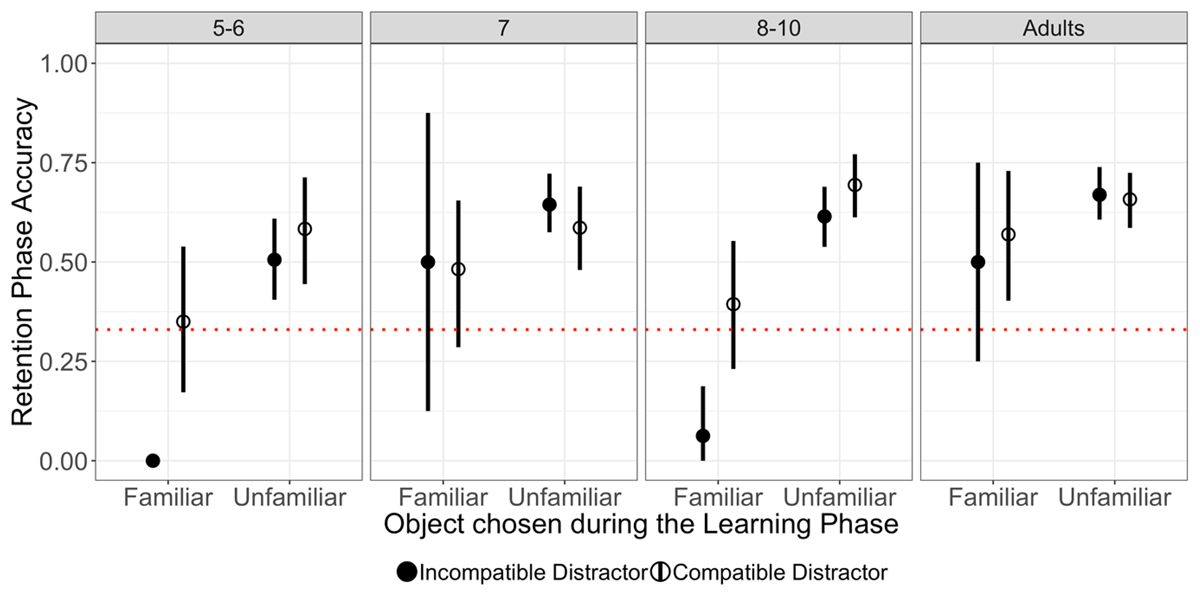
Figure 2
Retention accuracy (%) as a function of Distractor compatibility and of the referent chosen during learning (Familiar vs. Unfamiliar). Prediction error was smaller in the incompatible distractor (filled circle) than in the compatible distractor (empty circle) conditions. The error bars represent 95% bootstrap CI’s (1000 samples) over subjects. When 5-to-6 year olds chose the familiar object (i.e., the incompatible distractor) on incompatible distractor trials during learning, they never selected the correct target at retention, hence no CI is displayed for this condition with mean accuracy = 0. The error bars are generally larger for familiar object choices because these choices were much rarer and therefore these conditions are represented by fewer data points (see Table 1). The dashed horizontal lines represent chance performance (33% given on each retention trial participants chose from three objects).