
Table 1
Stimulus statistics for the Italian L1 set; we report means and standard deviations. Frequency is reported in Zipf (Brysbaert et al., 2018).
| TRANSPARENT | OPAQUE | ORTHOGRAPHIC | |
|---|---|---|---|
| Target frequency | 3.96 (0.67) | 3.63 (0.87) | 3.94 (0.84) |
| Target length | 5.16 (1.07) | 5.08 (0.84) | 4.94 (0.88) |
| Target Coltheart’s N | 18.1 (11.3) | 20.1 (11.9) | 21.5 (13.4) |
| Related prime frequency | 2.92 (0.84) | 3.15 (0.78) | 3.22 (0.69) |
| Control prime frequency | 2.91 (0.68) | 3.09 (0.85) | 3.19 (0.67) |
| Related prime length | 7.70 (1.24) | 7.96 (1.21) | 7.52 (1.18) |
| Control prime length | 7.70 (1.24) | 7.96 (1.21) | 7.52 (1.18) |
| Related prime Coltheart’s N | 3.6 (2.9) | 3.5 (2.6) | 4.2 (6.1) |
| Control prime Coltheart’s N | 3.8 (2.9) | 3.8 (2.9) | 3.5 (2.5) |
Table 2
Stimulus statistics for the English L2 set; we report means and standard deviations. Frequency is reported in Zipf (Brysbaert et al., 2018).
| TRANSPARENT | OPAQUE | ORTHOGRAPHIC | |
|---|---|---|---|
| Target frequency | 4.09 (0.72) | 3.88 (0.74) | 3.72 (0.82) |
| Target length | 4.92 (0.65) | 4.80 (0.69) | 4.62 (0.68) |
| Target Coltheart’s N | 6.66 (5.73) | 9.08 (7.78) | 11.72 (8.2) |
| Related prime frequency | 3.32 (0.93) | 3.43 (0.96) | 3.50 (0.93) |
| Control prime frequency | 3.30 (0.83) | 3.46 (1.03) | 3.47 (0.87) |
| Related prime length | 7.12 (1.15) | 7.09 (1.19) | 7.15 (1.68) |
| Control prime length | 7.12 (1.11) | 7.09 (1.16) | 7.15 (1.67) |
| Related prime Coltheart’s N | 1.98 (2.5) | 2.50 (2.9) | 2.06 (3.2) |
| Control prime Coltheart’s N | 3.4 (4.6) | 2.64 (4.7) | 3.04 (4.2) |
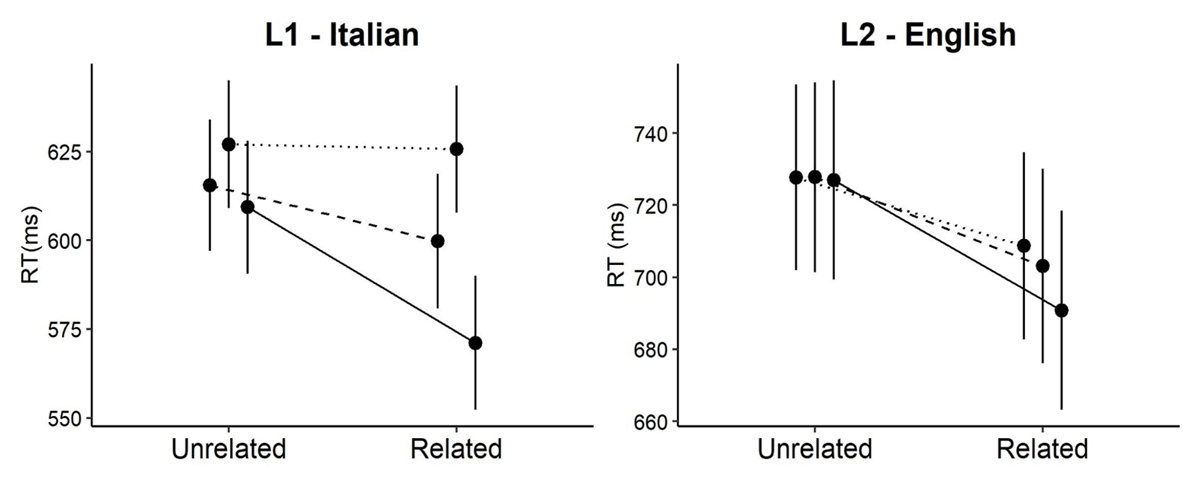
Figure 1
Model–based estimates of response times per condition, in L1 (left panel) and L2 (right panel). The solid, dashed and dotted lines represent the transparent, opaque and orthographic conditions, respectively. Error bars are 95% confidence intervals.
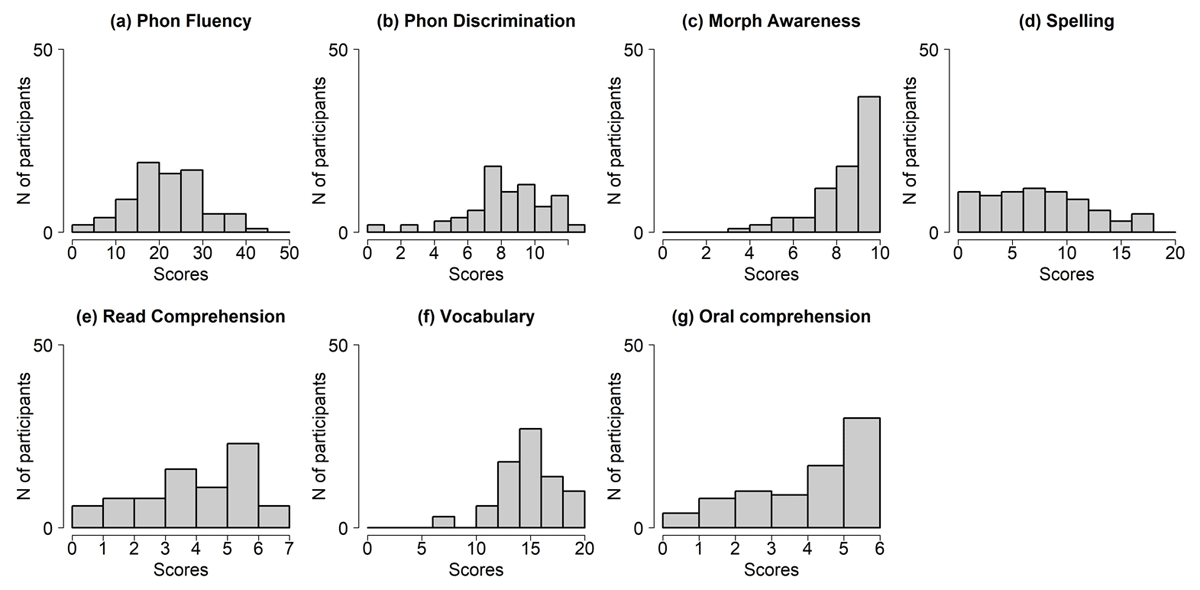
Figure 2
Participants’ score distributions for each English proficiency subtest.
Table 3
Correlation among the English proficiency subtests.
| PHON-FLUENCY | PHONDISCRIMINATION | MORPH-AWARENESS | SPELLING | |
|---|---|---|---|---|
| phonFluency | 1 | 0.25 | 0.54 | 0.61 |
| phonDiscrimination | 0.25 | 1 | 0.43 | 0.46 |
| morphAwareness | 0.54 | 0.43 | 1 | 0.64 |
| spelling | 0.61 | 0.46 | 0.64 | 1 |
| readComprehension | 0.35 | 0.44 | 0.4 | 0.49 |
| vocabulary | 0.45 | 0.44 | 0.54 | 0.65 |
| oralComprehension | 0.43 | 0.45 | 0.68 | 0.62 |
| READ-COMPREHENSION | VOCABULARY | ORAL-COMPREHENSION | ||
| phonFluency | 0.35 | 0.45 | 0.43 | |
| phonDiscrimination | 0.44 | 0.44 | 0.45 | |
| morphAwareness | 0.4 | 0.54 | 0.68 | |
| spelling | 0.49 | 0.65 | 0.62 | |
| readingComprehension | 1 | 0.37 | 0.53 | |
| vocabulary | 0.37 | 1 | 0.51 | |
| oralComprehension | 0.53 | 0.51 | 1 |
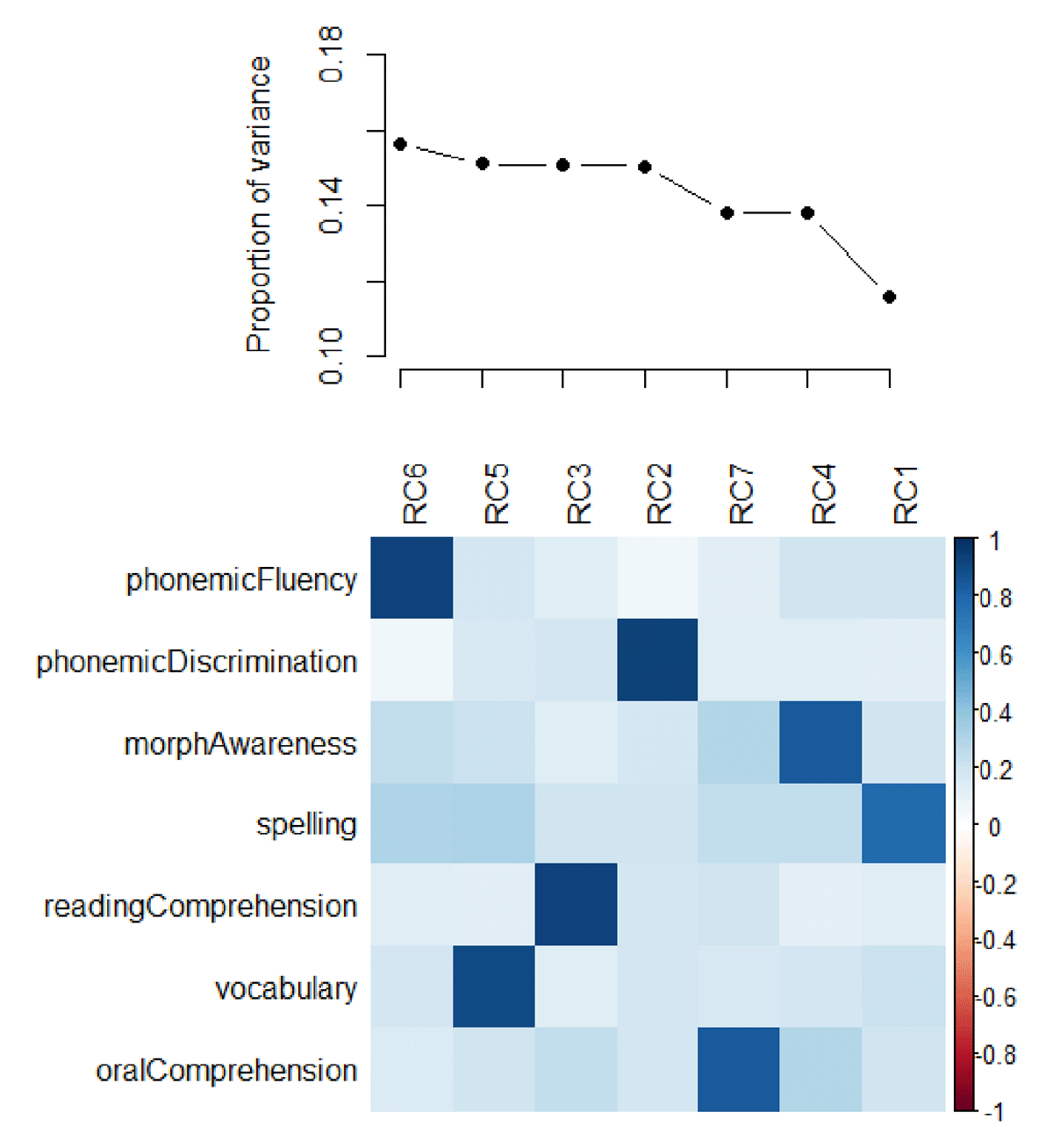
Figure 3
Illustration of the Varimax Principal Component Analysis on the seven proficiency metrics. The upper panel reports on the amount of variance accounted for by each Principal Component (RC). The lower panel describes the correlation between each Principal Component and the seven proficiency metrics; color codes for the strength of the correlation, as illustrated by the colorbar on the right.
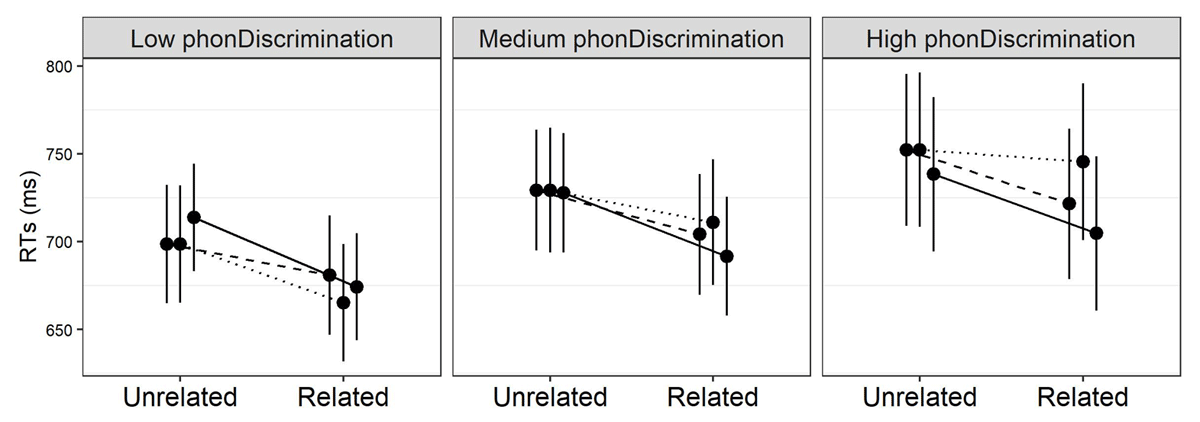
Figure 4
Model–based estimates of response times (RTs) relative to the interaction between prime relatedness, morphological type, and phonemic discrimination in L2. The solid, dashed and dotted lines represent the transparent, opaque and orthographic conditions, respectively. Effects are estimated at the 5th, 50th (median) and 95th percentile of the phonemic discrimination distribution. Error bars are 95% confidence intervals.
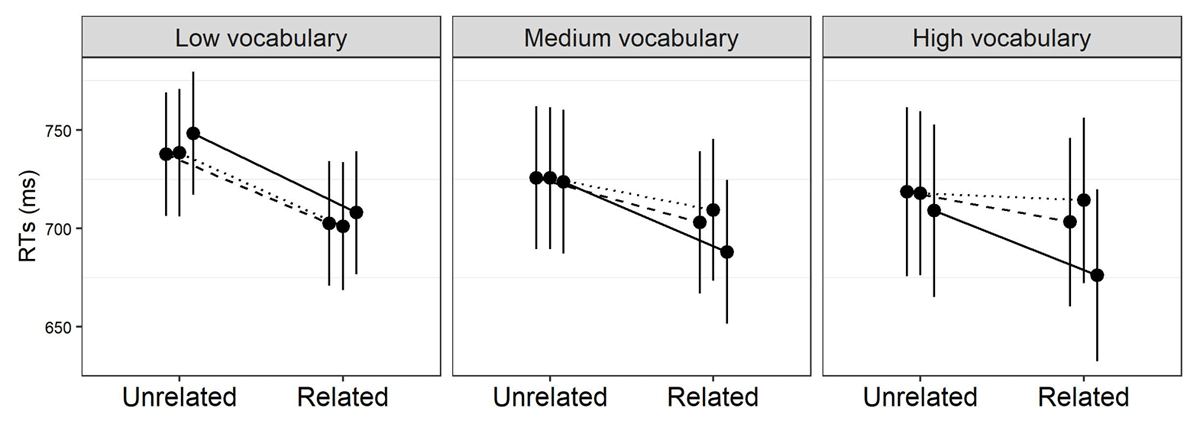
Figure 5
Model–based estimates of response times (RTs) relative to the interaction between prime relatedness, morphological type, and vocabulary in L2. The solid, dashed and dotted lines represent the transparent, opaque and orthographic conditions, respectively. Effects are estimated at the 5th, 50th (median) and 95th percentile of the vocabulary distribution. Error bars are 95% confidence intervals.
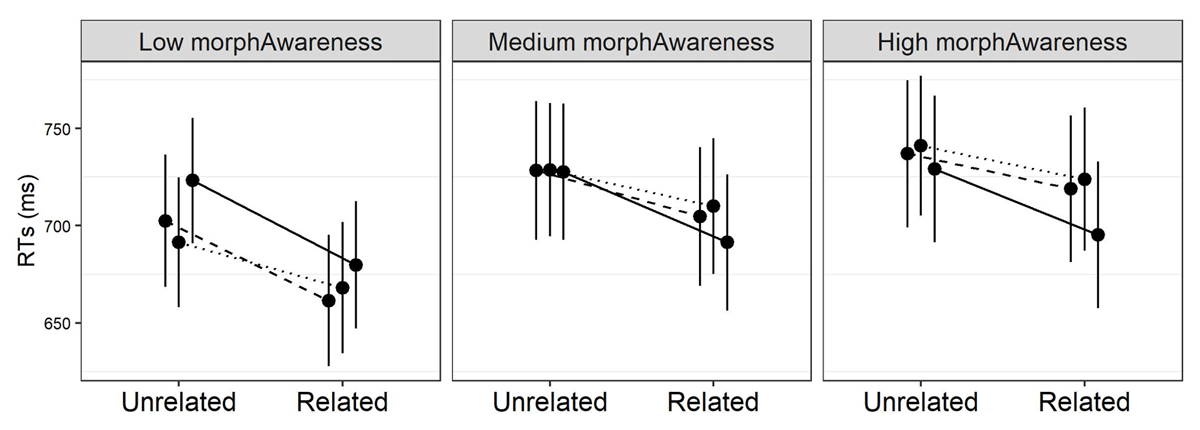
Figure 6
Model–based estimates of response times (RTs) relative to the interaction between prime relatedness, morphological type, and morphological awareness in L2. The solid, dashed and dotted lines represent the transparent, opaque and orthographic conditions, respectively. Effects are estimated at the 5th, 50th (median) and 95th percentile of the morphological awareness distribution. Error bars are 95% confidence intervals.
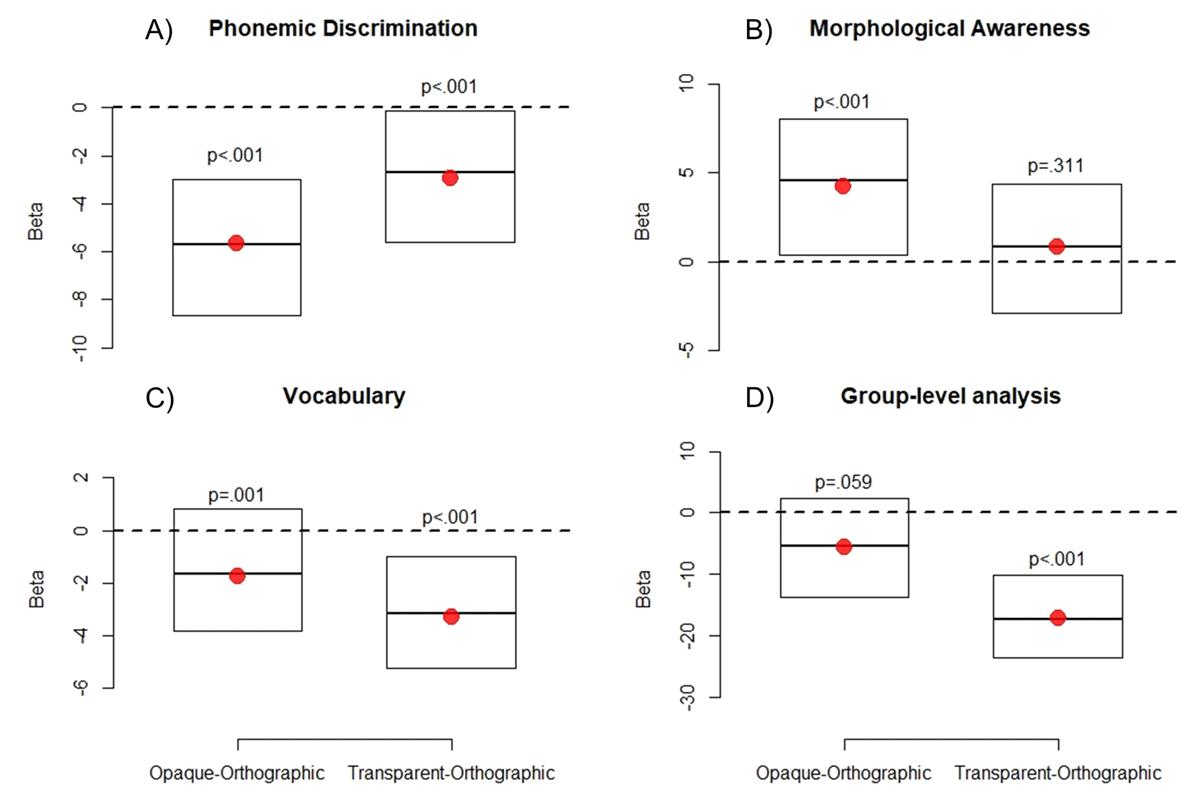
Figure 7
Jackknife results on the proficiency analysis. We used 200 replicates and, on each replicate, selected 40 out of 50 targets per condition, per participant. Each median estimate (the bold lines in the graphs) matches perfectly the full model estimates (the red dots). Also, the 5th and 95th percentiles (which define the boxes in the graphs) reflect nicely the significance of the estimated parameters in the full model (which is reported jut above the boxes as a p value). Panel (a), (b) and (c) refer to the proficiency metrics that turned out to modulate priming in L2, while panel (d) refers to the L2 group-level analysis, for comparison.
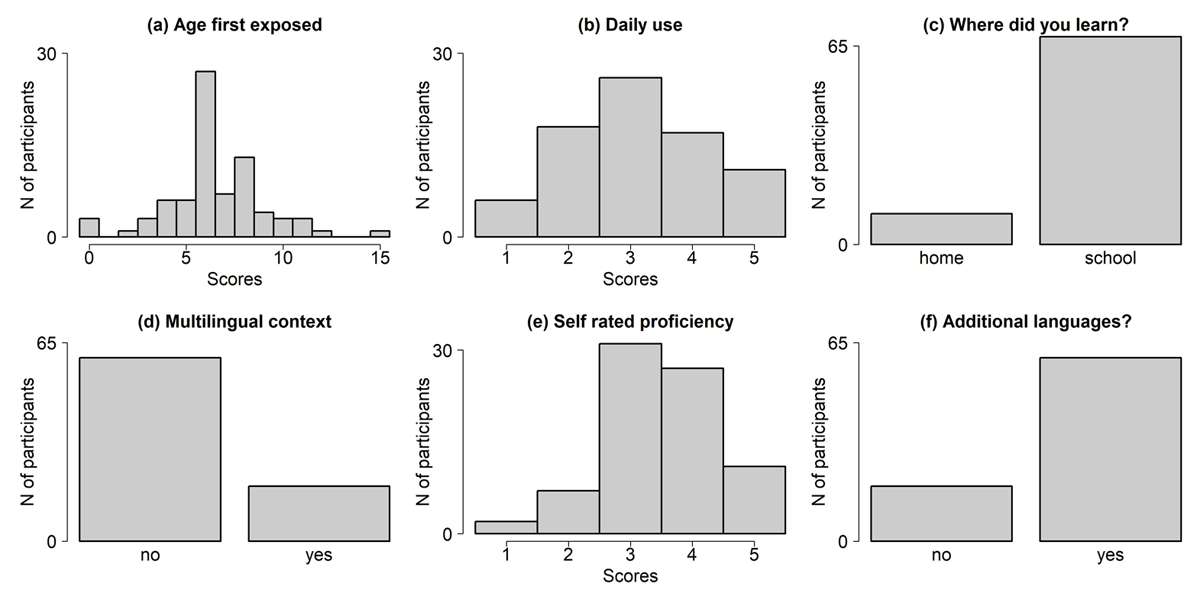
Figure 8
Scores distributions in the AoA questionnaire. All participants were Italian native speakers, the questions refer to English as a second language.
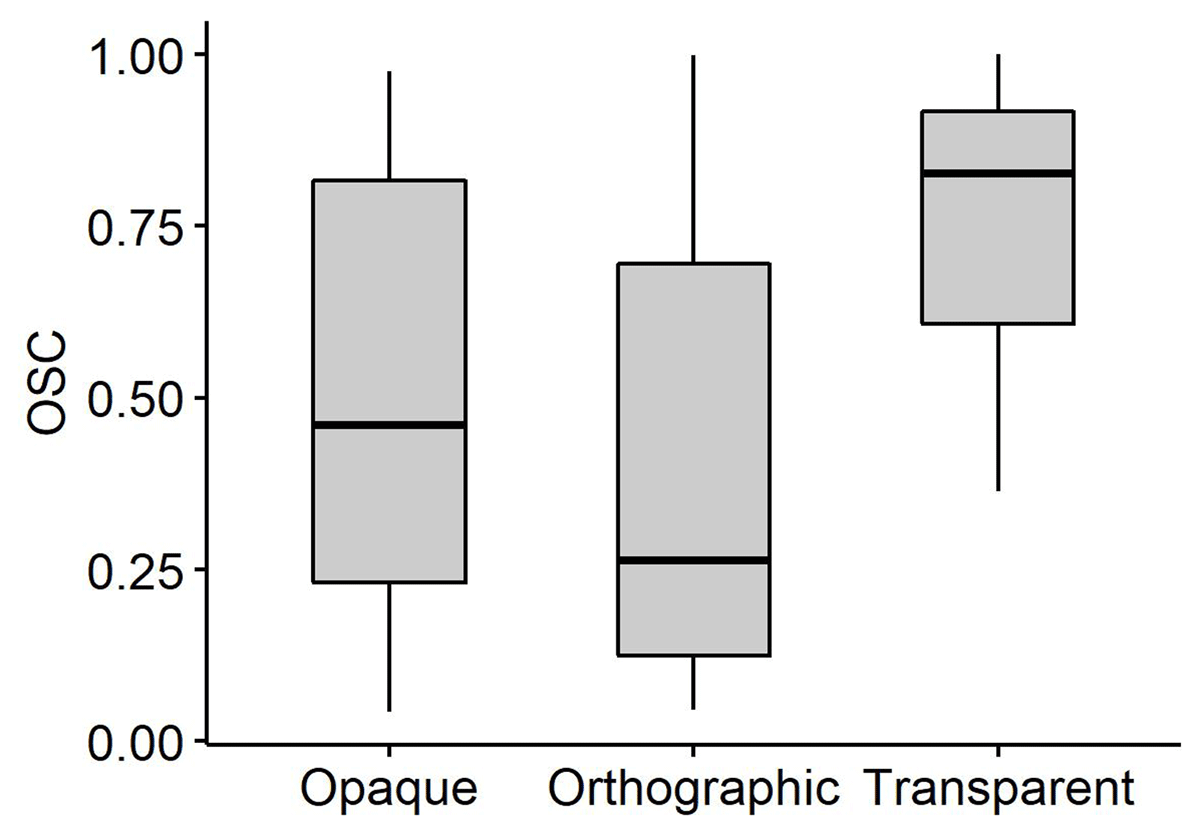
Figure 9
OSC distribution for the transparent, opaque and orthographic English target stems.
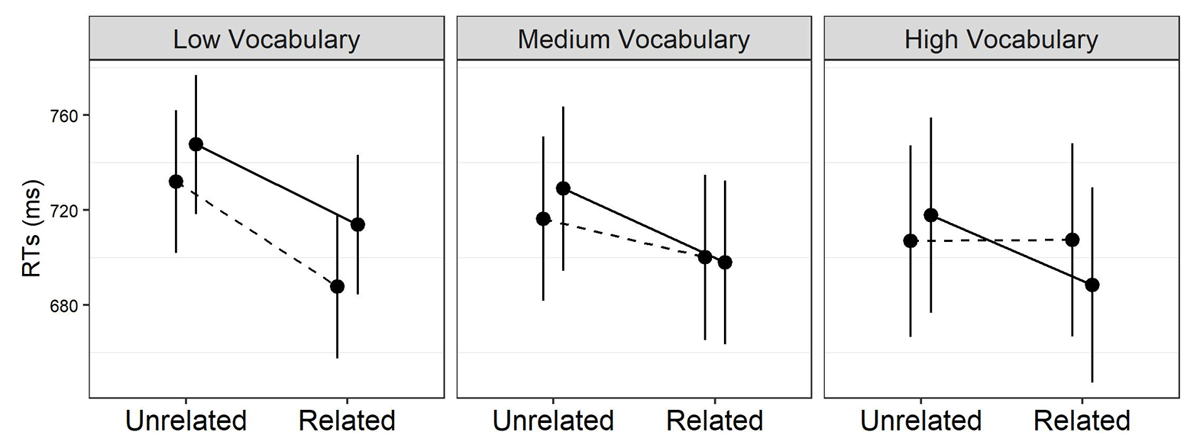
Figure 10
Model–based estimates of response times (RTs) relative to the interaction between prime relatedness, OSC, and vocabulary in L2. Effects are estimated at the 5th, 50th (median) and 95th percentile of the vocabulary distribution, and at the 20th (dashed line) and 80th percentile (solid line) of the OSC distribution. Error bars are 95% confidence intervals.
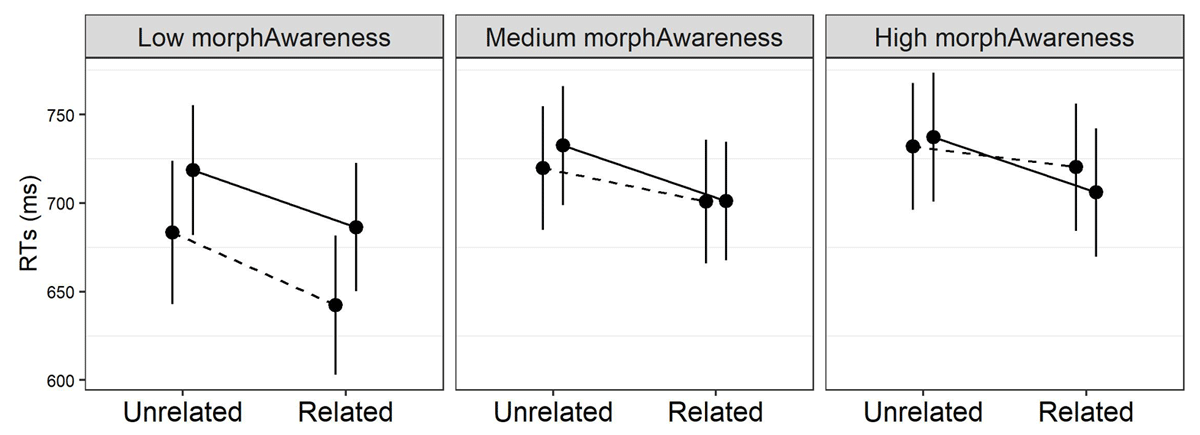
Figure 11
Model–based estimates of response times (RTs) relative to the interaction between prime relatedness, OSC, and morphological awareness in L2. Effects are estimated at the 5th, 50th (median) and 95th percentile of the morphological awareness distribution, and at the 20th (dashed line) and 80th percentile (solid line) of the OSC distribution. Error bars are 95% confidence intervals.