
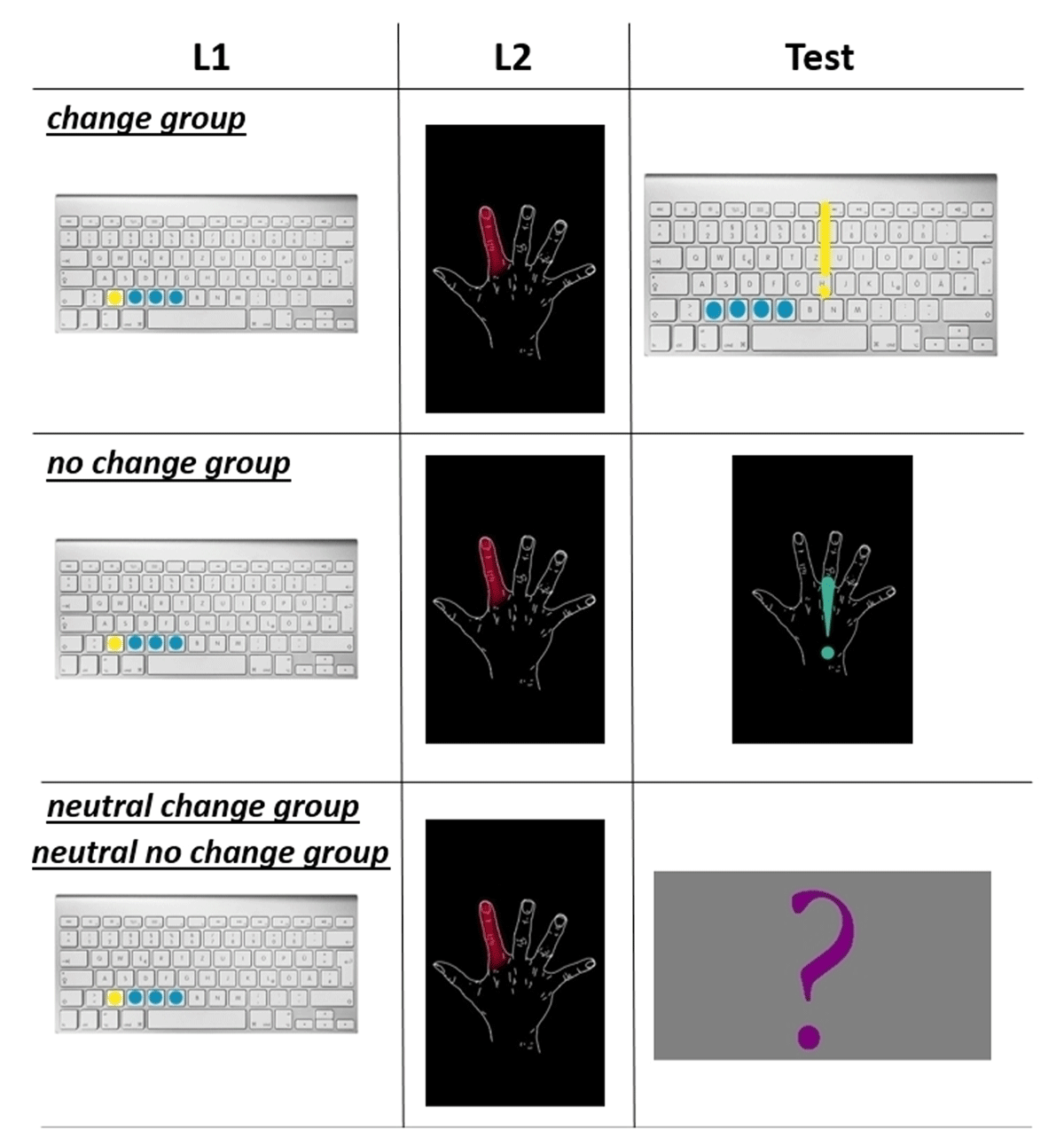
Figure 1
Diagram of the visual intentional cues in our four experimental groups at L1, L2 and at test, groups and experimental phase labeled and separated in boxes. Pictures show an example of the groups corresponding displayed intentional stimuli at encoding and test, including their display orientation (vertically vs horizontally). For the two neutral groups a question mark highlighted each input task at test, for the other two groups an exclamation mark demanded for the sequences input. Colors at test in the change and no change groups were held in the corresponding group test context, colors for the neutral groups were new ones as compared to L1 and L2 (see the Material section). The neutral groups differed with regard to used PC, display orientation, response keys and keyboard position from each other, which were the same as study of L1 (change group) or L2 (no change group).
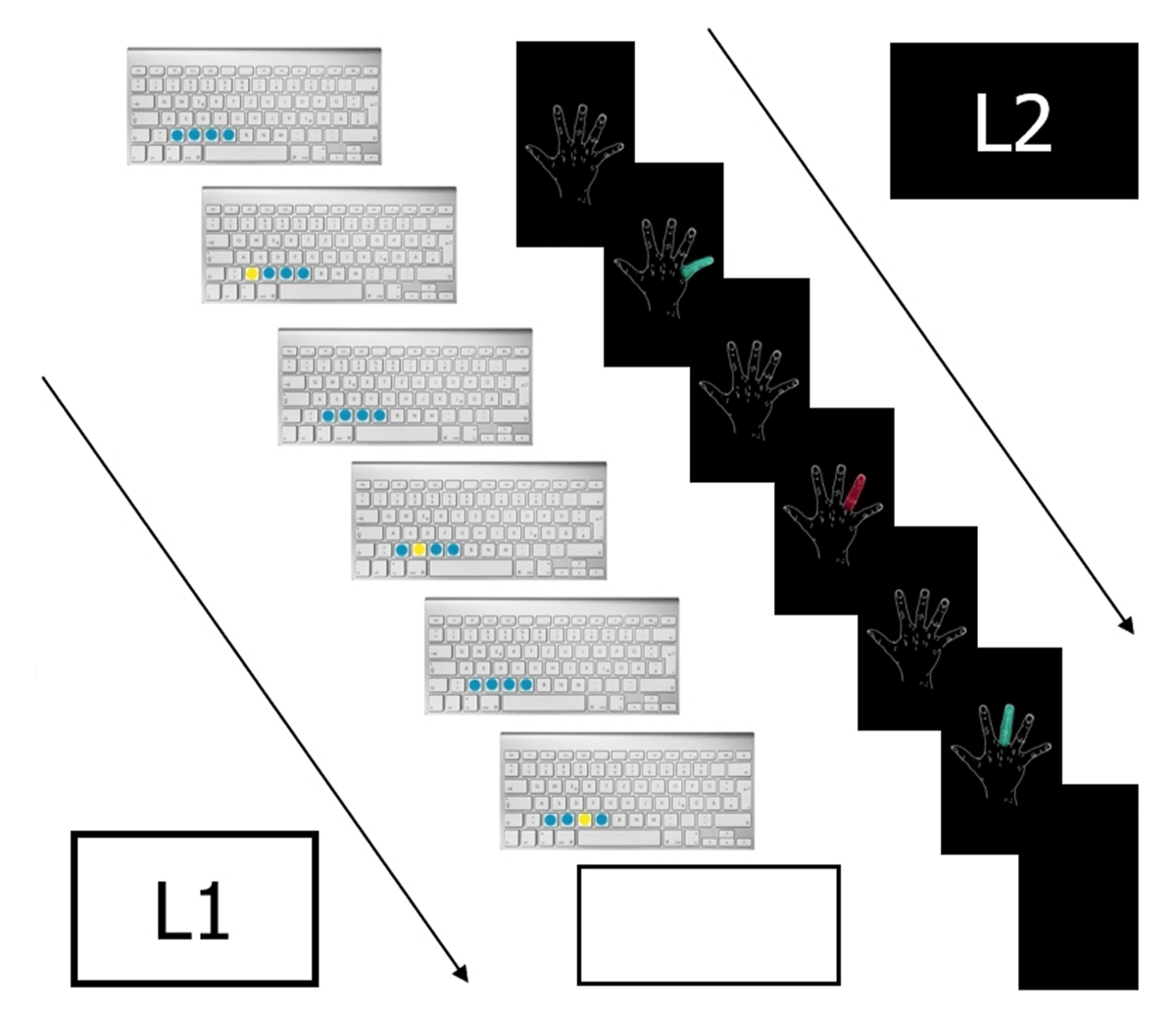
Figure 2
The Figure depicts one displayed symbolic item trial for both, L1 (left side) and L2 (right side). L1 intentional stimuli were the “moving” keys on a grey symbolic Mac-Keyboard. L2 intentional stimuli were the “moving” fingers in a drafted symbolic hand. Both items were displayed in a colored animation followed by a blank screen pause. Participants had to enter this sequence then, before the next sequence gets animated. At the beginning of the animation, a picture of the keyboard including the four not moving reaction keys marked in blue or a drawing of the corresponding hand appeared for 1500 milliseconds (ms). Then, an animation of the keys or the fingers in the hand showed three consecutively flashing keys or fingers. The index finger in L2 was highlighted in dark red, middle finger was colored in a light green, the ring finger was colored dark red again, pinkie again in light green; 200 ms per colored finger flash followed by 200ms for the uncolored hand drawing before the next moving finger. All moving keys in L1 were highlighted in yellow, the three not moving keys in between were given in blue; also 200 ms per color flash followed by 200ms for the four blue (not moving) keys before the next colored key. Once the animation disappeared, participants could perform it immediately by sequentially pressing the three corresponding keys.
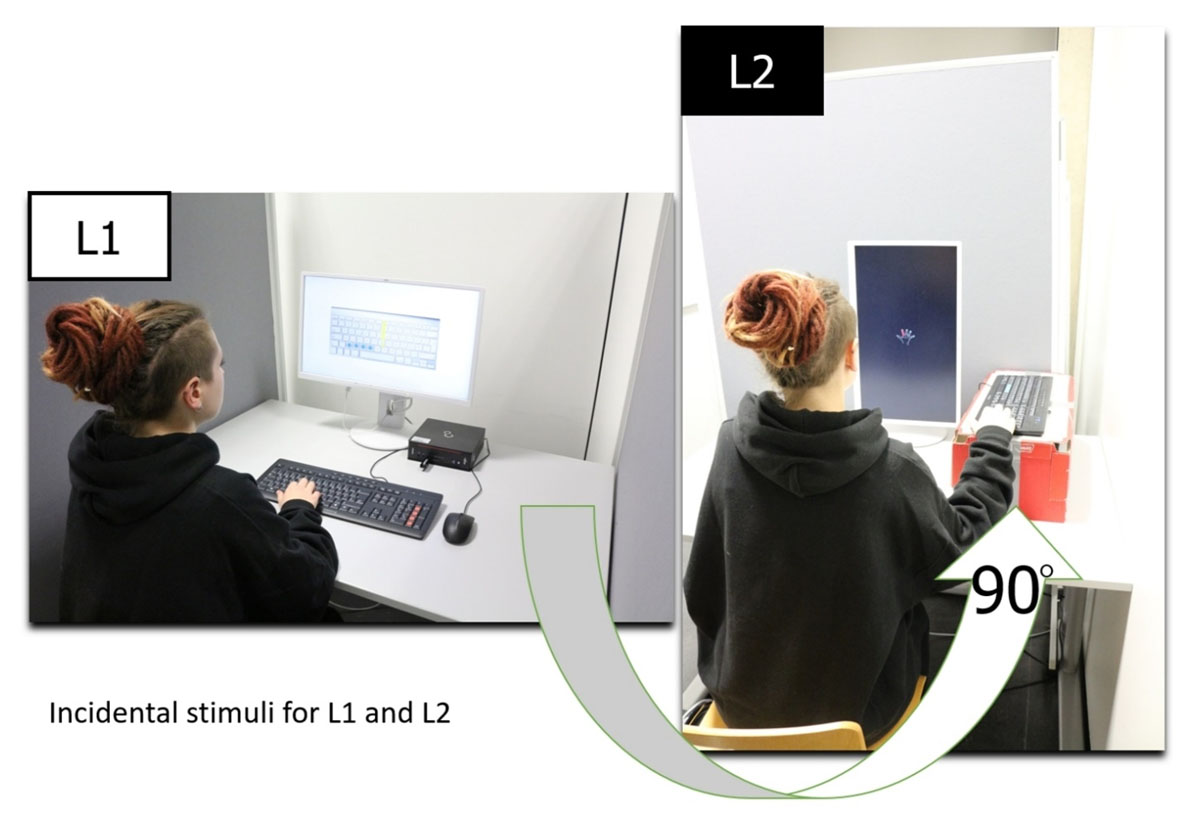
Figure 3
Photographies illustrating the different L1 and L2 incidental and intentional stimuli. L1 picture shows a change group participants’ test trial. L2 picture shows a learning trial.
Table 1
T-tests for T1 and T2 recall differences for our four experimental groups.
| CONDITION GROUP | t | df | p | SIGNIFICANCE |
|---|---|---|---|---|
| no change | 5.1 | 33 | <.001 | ** |
| neutral no change | 3.2 | 33 | .003 | ** |
| neutral change | 4.5 | 33 | <.001 | ** |
| change | .94 | 33 | .36 | n.s. |
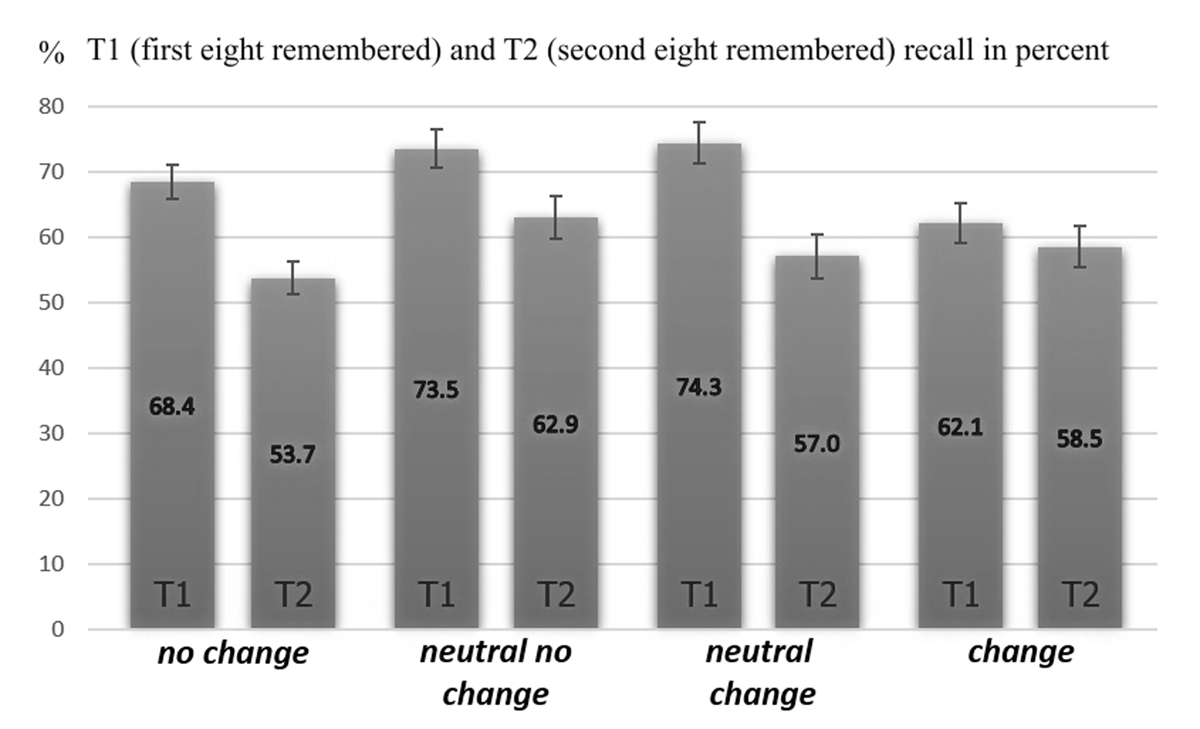
Figure 4
T1 and T2 recall rates of our four experimental condition groups in percent. Error bars represent ±1 S.E.M.
L1 – items.
| ITEM | FIRST FINGER | SECOND FINGER | THIRD FINGER |
|---|---|---|---|
| 1 | index finger | middle finger | pinkie |
| 2 | index finger | pinkie | ring finger |
| 3 | middle finger | ring finger | pinkie |
| 4 | middle finger | ring finger | index finger |
| 5 | ring finger | index finger | pinkie |
| 6 | ring finger | index finger | middle finger |
| 7 | pinkie | index finger | middle finger |
| 8 | pinkie | ring finger | index finger |
L2 – items.
| ITEM | FIRST FINGER | SECOND FINGER | THIRD FINGER |
|---|---|---|---|
| 1 | index finger | ring finger | middle finger |
| 2 | index finger | ring finger | pinkie |
| 3 | middle finger | index finger | ring finger |
| 4 | middle finger | index finger | pinkie |
| 5 | ring finger | pinkie | index finger |
| 6 | ring finger | pinkie | middle finger |
| 7 | pinkie | middle finger | index finger |
| 8 | pinkie | ring finger | middle finger |