
Introduction
The Journal of Interactive Media in Education (JIME) was launched in September 1996. 2026 marks its 30th anniversary year, and in this virtual special collection and editorial, we have sought to mark this occasion by taking a retrospective look at the collection of papers published in the journal to-date. The 15 papers which form this virtual special collection have all been published in JIME and were selected for inclusion on the basis of being the most viewed papers across the three decades. In this editorial, we provide an overview of the selected papers by way of an introduction to the collection, and also discuss where the papers sit in relation to the evolving trends in topics of papers published in JIME across the three decades.
Before moving to the analysis of keywords associated with the papers published in JIME over the past 30 years, this introductory section sets out the origins of the journal. JIME was founded in 1996, approximately three years after the World Wide Web became accessible to the public, and it was in the spirit of innovation and testing the possibilities of this new medium that JIME was created (KMI 2026). Initially, JIME began as a project within the Knowledge Media Institute (KMI) within The Open University; JIME remains supported by The Open University, but editorship has since moved to the custody of the Institute of Educational Technology (IET). The journal has been edited by several prominent academics from across IET and KMI over its lifetime, and currently has an editorial team comprising IET academics and scholars based at other institutions.
From the outset, JIME has been ambitious in asking critical questions of the social and technical implications of the fast-developing online environment at the time, and its applications and impact for education. This was reflected in both the scope of the journal, and also actively applied in how the journal was hosted and run.
In terms of scope, JIME set out to “foster a multidisciplinary and intellectually rigorous debate on the theoretical and practical aspects of interactive media in education” (KMI 2026: para.1). In the earliest version of the JIME website to be stored by the Internet Archive (logged 4th June 2004), the aims were articulated as follows:
“To foster a multidisciplinary and intellectually rigorous debate on the theoretical and practical aspects of interactive media in education.
To clarify the cognitive, social and cultural issues raised by the use of interactive media in education.
To radically improve teaching and learning through better interactive media.
To publish leading international research on the theories, practices and experiences in the field.
To link scholars and commercial practitioners.
Through its innovative use of interactive Net-based media, to be an action research project which explores the changing face of journals, and more broadly, scholarly practice in the age of digital publishing and communication.” (JIME 2004).
The aims of the journal were explicitly set out to be ambitious in scope, and help to illuminate the ‘interactive media’ part of the journal name (a query which sometimes arises today), being defined more specifically as ‘interactive Net-based media’. The scope was intentionally broad at this stage, and the acronym was further defined as:
“Interactive – refers both to interaction through the media with other people (e.g. teacher-student, student-student, researcher-teacher), and to interaction with the materials embedded in the media (e.g. control of a simulation or educational game).
Media – refers to the range of modalities which can be used to support learning. Media may represent educational materials, as well as other people relevant to that learning task. Media embraces text, sound, still and animated graphics, video, model worlds and virtual reality, as applied to the delivery of learning materials and communication between relevant communities.
Education – includes all levels and types: schools, colleges, universities, home learning, open and flexible learning, distance learning, personal development, skill learning, work-based learning, lifelong learning.” (JIME 2004).
The journal also had a broader goal, in terms of how it was run, its own practices and seeking to challenge existing publication models. JIME was intended to be a living research project in itself, to challenge existing academic publishing models and understand how these could be changed and improved by hosting a journal online – which was a vastly more radical enterprise in the previous millennium than it may seem today. Applying these principles in practice, making use of the affordances of the emerging online environment as a publishing medium itself, was thus also a key aim for the journal. Technical innovation was required to pursue this aim, and the Digital Document Discourse Environment (D3E) was developed and used as the initial solution for hosting the journal online (Sumner & Buckingham Shum 1998). The earliest version of the JIME website to be included in the Internet Archive was captured on 4th June 2004, and is shown in Figure 1 with an archive tracing back to 1996.
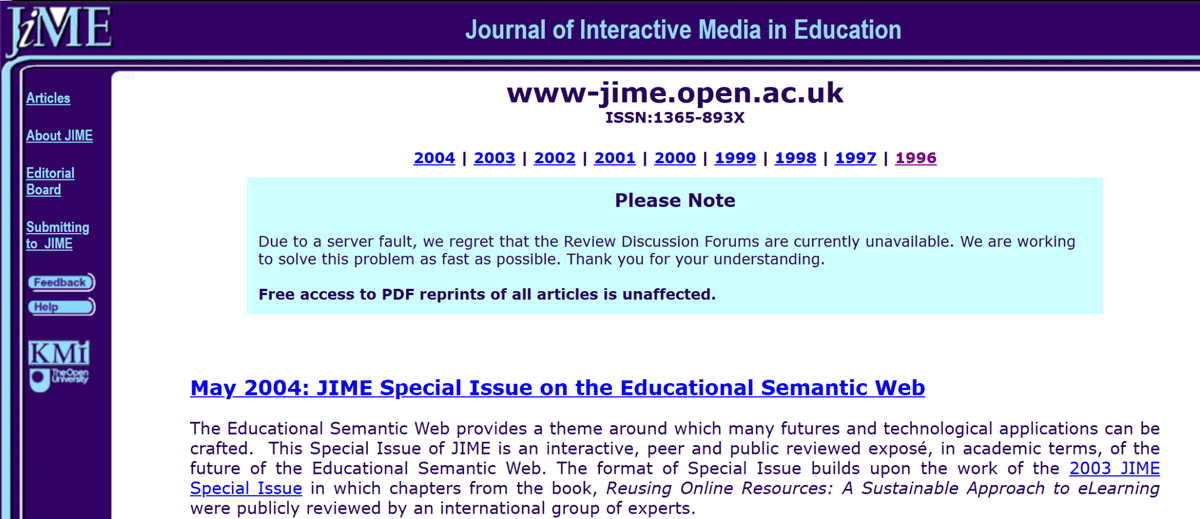
Figure 1
Screenshot of the first version of the JIME homepage to be stored within the Internet Archive, captured on 4th June 2004.
While one of the key affordances of the D3E platform facilitates open access publishing (while now widespread, JIME was an early example), the D3E platform was also intended to move beyond access to published manuscripts, and aimed to facilitate conversation and dialogue around articles (Sumner & Buckingham Shum, 1998). This included the peer review process (Sumner et al. 2000), and the platform was also an early example of open peer review. The aim was to move “from a closed process centred on evaluating scholarly work to an open process promoting constructive dialogue between participants.” (Sumner et al. 2000: 2). However, challenges were also identified, and that the role of editors needed to be re-cast to help facilitate these novel processes. As noted in the reflections from previous editors, published as a companion paper to this virtual editorial, ultimately the experiment with open peer review ended for operational reasons. Amid concerns that not having a double-blind review approach might compromise integrity and eligibility for the then-new Research Assessment Exercise (RAE), reviewers ceased to be named on JIME papers after 2003.
Another key aim designed into the D3E platform was fostering dialogue. Commentaries – shorter pieces in response to other papers and publications – were particularly encouraged as a submission format in the early days. For example, Volume 2003 Issue 1 comprises a series of commentaries in response to a particular book (Littlejohn 2003). However, platform usage showed that visitors to the JIME site tended to prefer to download papers and not engage in online dialogue (Buckingham Shum & Sumner 2001a; Buckingham Shum & Sumner 2001b).
While the D3E platform was pioneering, issues arose over time about the costs and sustainability of hosting a bespoke platform, and in 2010 JIME hosting switched to the Open Journal Systems (OJS) platform (Figure 2). OJS did not exist when JIME launched in 1996 (Academic Scientific Journals Portal 2026), and the availability of the software reflects the growth of interest in open access publishing in the wider field during this time. The aims remained unchanged at this point, and the OJS platform supported the core principle of open access publishing.
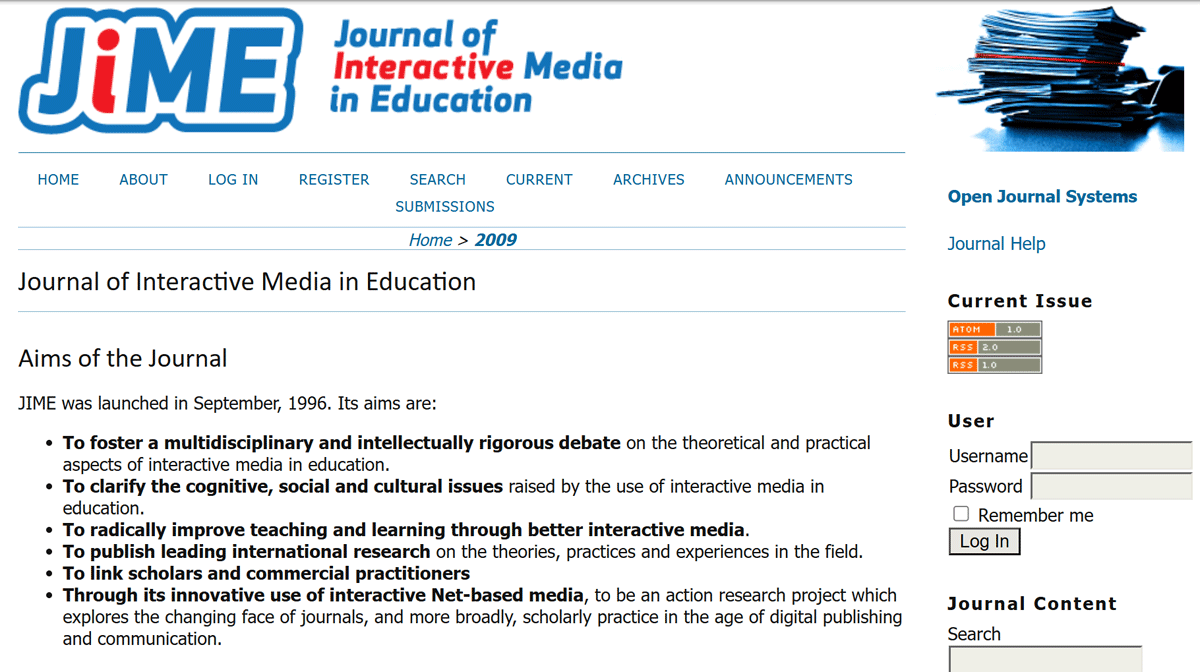
Figure 2
Screenshot of the second generation JIME homepage, earliest copy stored in the Internet Archive on 26th October 2010.
By May 2013, the aims had become more streamlined: “JIME is an open access online journal in educational technology that focuses on the implications and use of digital media in education. It aims to foster a multidisciplinary and intellectually rigorous debate on both the theory and practice of interactive media in education.” (JIME 2013). The scope of the journal subsequently moved to focus on further and higher education, and no longer includes school-level studies, for example.
The JIME website and identity shifted to its third, and current, form in Spring 2016, as hosting moved to Ubiquity Press, as an open access publisher (Ubiquity Press 2026). Similar to the shift from D3E to OJS, the move to Ubiquity and the existence of specifically open access publishers reflects how open access publishing has been normalised over the past thirty years. The first copy of this site to be indexed by the Internet Archive is shown in Figure 3.
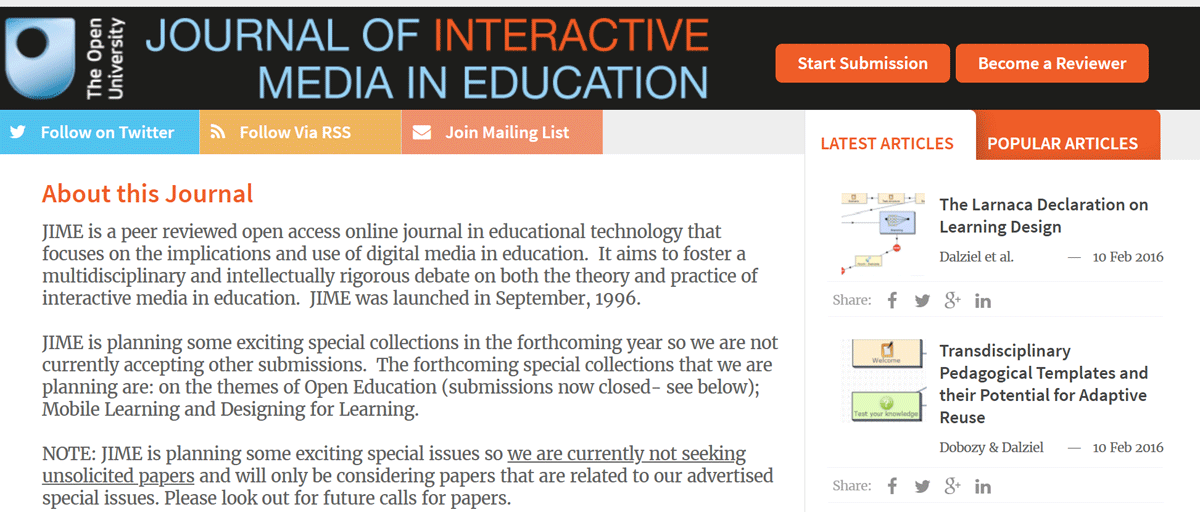
Figure 3
Screenshot of the third generation JIME homepage, 20th April 2016. Accessed via the Internet Archive.
Over the course of the past thirty years, JIME has shifted from its original vision to an extent, in terms of the technical underpinnings and affordances of the online environment for reshaping scholarly publishing, and also its scope, as technology has become more embedded into education. As open access publishing has increasingly become mainstream – and now arguably standard – in the field today, the technological side of the journal has adapted and moved to more sustainable hosting. However, this convergence into a typical form of scholarly exchange has also had implications for the extent to which a journal with JIME’s identity can continue to explore new modalities and innovate.
The relationship between technology – interactive media – and education remains at the core of the journal’s scope. While the description of the scope, as articulated on the journal website, has become more streamlined over time, the scope is of course also defined organically through the types of papers, studies and special collections that the wider community have chosen to submit and publish with us. In this virtual special collection, we explore how the scope and focus of JIME has evolved over this period of time. In this virtual editorial, we present an overview of the topics covered in each decade and bring together the most prominent articles published in JIME.
Methods
In this virtual special collection, the papers selected for inclusion in the collection were chosen based on the all-time most frequently viewed papers. However, we also wanted to mark the anniversary by looking back upon the trends in papers published in JIME over the past three decades. Similar to the approach used by Bond, Zawacki-Richter and Nichols (2019) to mark the anniversary of the British Journal of Educational Technology, we used network-based approaches to analyse and visualise patterns in keywords and topics over time.
Data collection involved importing the archive of papers published in JIME, between the first issue in 1996 and the end of 2025, into Zotero. This comprised a total of 385 papers. Once the collection of papers had been collected into a folder in Zotero, the keywords associated with the papers were checked for consistent presentation and close synonyms merged (e.g. “EdTech” changed to “educational technology”).
A two-step process was used to translate the bibliographic data into a network format. The papers were divided into decades, and exported from Zotero in RIS format. The RIS files were each in turn imported into VOSviewer (van Eck & Waltman 2010) for visualisation as a keyword co-occurrence network (at this step, some further synonyms which had been missed initially were identified and merged).
The fifteen articles within this anniversary special collection were selected on the basis of showcasing the articles which have garnered the most interest over time, as defined by the total number of views logged in the JIME website metrics. A ‘view’ is defined as an individual visit to the webpage for that paper. The top five articles per decade were selected. We recognise that this is an imperfect measure of engagement; newer publications will be at a disadvantage as articles which were published earlier will have had more time to accrue views, and the data is likely to be limited to the period since JIME moved to its current platform (see Introduction). In addition, in an increasingly crowded marketplace, there are now many more scientific journals than thirty years ago (Hanson, et al. 2024). Nonetheless, the papers span a range of dates, and topics, across the three decades, and provide a reflection and insight into the topics over time.
Decade 1: 1996 to 2005
The period covered by the first decade spans from the publication of the first paper in JIME on 2nd December 1996, to the end of 2005. During this period, 75 papers were published and the co-occurrence of associated keywords for this sample of papers is shown in Figure 4. A total of 24 issues were published in this decade, which varied in size from single paper issues (e.g. see Volume 1998, Issue 1) to more substantial collections following a model of providing invited commentary and responses around key topics or publications (e.g. see Volume 1998, Issue 2).
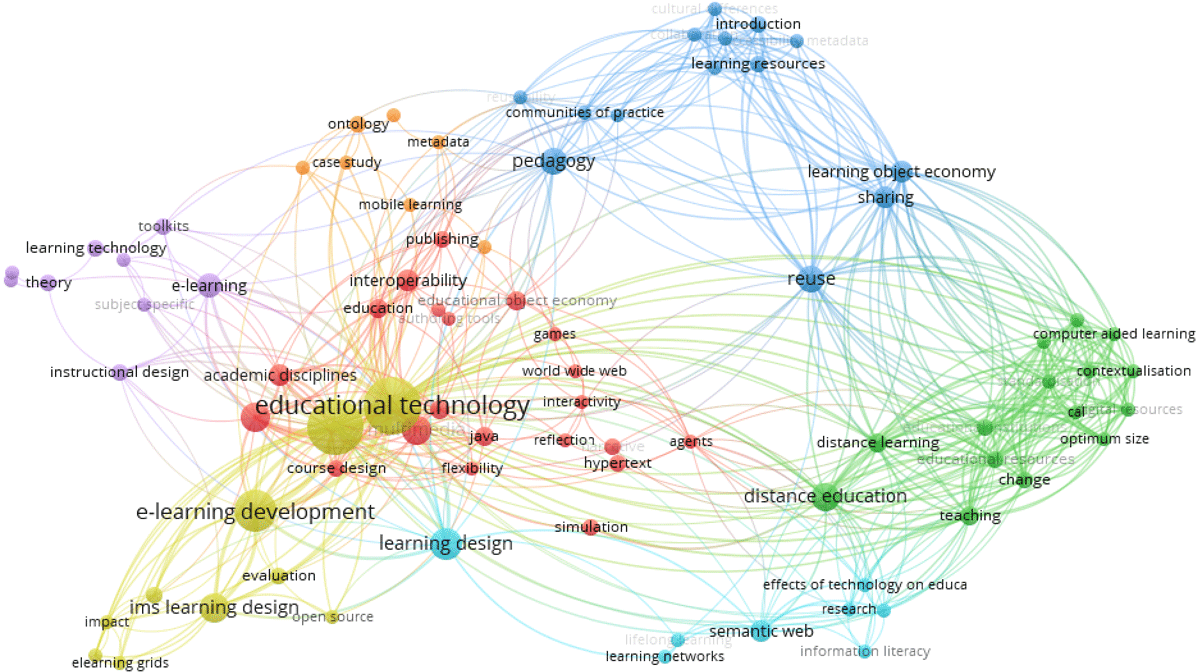
Figure 4
Network of co-occurring keywords for papers published in JIME between 1996 and 2005 inclusive. Keywords with a frequency <2 are not shown. Node size is scaled according to frequency, and colour-coded according to detected communities/clusters.
In Figure 4, each node represents a unique keyword. A total of 348 unique keywords were used by the papers in this decade, but the network only shows those with a frequency of two or more for brevity (84 keywords). A connection between two nodes denotes that a paper in the sample included both terms in the keywords specified for the article. Node size is scaled according to frequency, and nodes are colour-coded according to clusters identified by the software. Two keywords stand out as the most frequently used – ‘educational technology’ and ‘innovation’ (as the large, yellow node unlabelled in the graph), followed by ‘e-learning development’. Some of the clusters reflect the focal topics for collections which included a relatively large number of shorter, commentary pieces – such as learning design, the semantic web for education, and educational objects. Overall, the keywords convey a range of different forms of technology, and consideration of more technical aspects (such as interoperability), alongside pedagogy and learning design. There are some notable links to topics identified by Weller (2020) during this period in the volume ‘25 Years of EdTech’, including the prominence of e-learning and e-learning standards (1999 and 2001), learning objects (2000), and learning management systems (2002).
While the keywords in Figure 4 suggest a range of different technologies and a focus to some extent toward more technical issues of innovation and development, three types of technology are featured in particular in the five most viewed articles from this decade: games, the semantic web, and learning management systems.
Oblinger (2004) focuses in particular on the use of games as a form of educational technology, in ‘The next generation of educational engagement’. This article assumes that learners’ experiences are shaped by information technology and examines how game-based and simulation-rich learning environments can foster higher levels of engagement. Therefore, this research discusses the interactivity and engagement, common in games and online environments, that support deeper learning and are increasingly being explored by educational institutions. A key conclusion is that games are a familiar part of students’ cultural lives and can offer motivating and engaging approaches for experiential and social learners. However, they are a complementary tool rather than a replacement for academic guidance, direct experience and sustained effort in learning. It is notable that this paper was published relatively early, in 2004, as gamification and badges would become a major area for the field in later years (Weller 2020).
In ‘Use of the Semantic Web to solve some basic problems in education: increase flexible, distributed lifelong learning; decrease teacher’s workload’, Koper (2004) begins with questions of “Is the semantic web a tool with realistic educational application? Is it going to change future learning and teaching, and what are the possible directions of this future change?” – parallels of which can be seen in the current discourse around the use of artificial intelligence (AI) in education. He argues that Semantic Web approaches can improve education by enabling software agents to interpret educational content and processes, and reminds us that “the usefulness of any technology in any field is dependent on its capacity to address real problems and address practical needs in that field” (Mitcham 1994, in Koper 2004: 2–3). As such, Koper identifies two such areas in the field of education: flexible, distributed lifelong learning and reduced teacher workload. Both areas are still part of the mainstream discourse in the field today (e.g. AI freeing-up time from teachers). He discusses two application areas: first, software agents that interpret the semantic structure learning designs to decrease teacher workload (e.g. automate course development, coordinate complex authoring, guide learner and tutor workflows) and second, software agents that interpret the structure of distributed, self-organised, self-directed learning networks for lifelong learning to help learners perform tasks in this context (e.g. support peers and participate in assessment, while agents help them choose routes). Koper concludes that progress depends on making semantic coding cost-effective, developing user-friendly tools, clarifying overlapping standards, and managing organisational change so innovation does not simply add workload.
Writing shortly after the release of the Moodle learning management system, Berggren et al. (2005) engaged with the practical issue of its integration into educational systems, highlighting a range of practical, pedagogical, and philosophical issues. A key focus of this contribution is the attention to the role of Learning Design. It is noteworthy that Berggren et al. (2005) highlight key tensions in the workflow for Moodle (quick creation of content followed by refinement) and the process of Learning Design (where pedagogical methods are designed and described in advance, including learning activities, required resources, and roles of teachers/learners). In the intervening period since this paper was published, Learning Design has become an integral part of Moodle (Moodle n.d.). This perhaps reflects a more mature understanding of how learning management systems can support intentional, pedagogy-driven course design, although debate continues regarding the extent to which effective learning design is implemented by designers and instructors.
Papers focusing on learning design are popular in JIME across the three decades, indicating strong interest in the community. In ‘A learning design toolkit to create pedagogically effective learning activities’, Conole and Fill (2005) refer to e-learning not being a ‘peripheral’ activity in higher education or “the province of the isolated enthusiast” (2005: 2) and instead becoming pervasive to all aspects of teaching and learning. Despite the abundance of online learning environments and tools, the authors argue that e-learning is not used effectively to support student experience, because practitioners “lack the necessary e-learning skills to take full advantage of the potential affordances” (2005: 3) and make informed design choices. Discussion on educators’ lack of skills is high in the education policy and practice agenda today too in relation to AI and AI literacy. The paper focuses on the development of a learning design toolkit, seen as a practical mechanism to support practitioners. Developed through collaboration and interviews with practitioners, the toolkit embeds step-by-step guidance for designing or adapting activities, a searchable database of examples of good practice to reuse and repurpose, while remaining transparent, flexible and adaptable to local contexts in practice.
While theoretical issues are less frequently represented in the network graph overall, theory was also a focus for an issue during this period (see Oliver 2002 for the editorial), and a paper from this issue is included in the five most frequently viewed for the first decade. In ‘Educational technology: the influence of theory’, Issroff and Scanlon (2002) looked back at the previous 30 years of the history of educational technology, focusing on the role of theory with a focus on artificial intelligence and human-computer interaction. Such themes remain remarkably relevant from the viewpoint of 2026. Issroff and Scanlon (2002) argued for the ongoing relevance of theory in guiding the work of educational technologists and researchers, showing how theoretical approaches vary across sub-fields while Constructivism remains the dominant paradigm for educational technology as a whole. Deep engagement with theory is still less common than seeking an analytic framing for the presentation of research data, but, as the authors note, remains an essential anchor and justification for the work of educational technologists.
Decade 2: 2006 to 2015
The second decade spans 2006 to 2015, during which 116 papers were published, across 17 issues. 404 unique keywords were associated with the papers; as in the first decade, the co-occurrence network of keywords with a frequency of two or more (79) is shown in Figure 5. Educational technology and innovation remain two of the most prominent nodes again (shown in yellow), but e-learning, LMS learning design, and learning design, are equally frequent. However, OER (open educational resources) stands out as the most frequent keyword – an evolution from the learning objects in the first decade (Weller 2020).
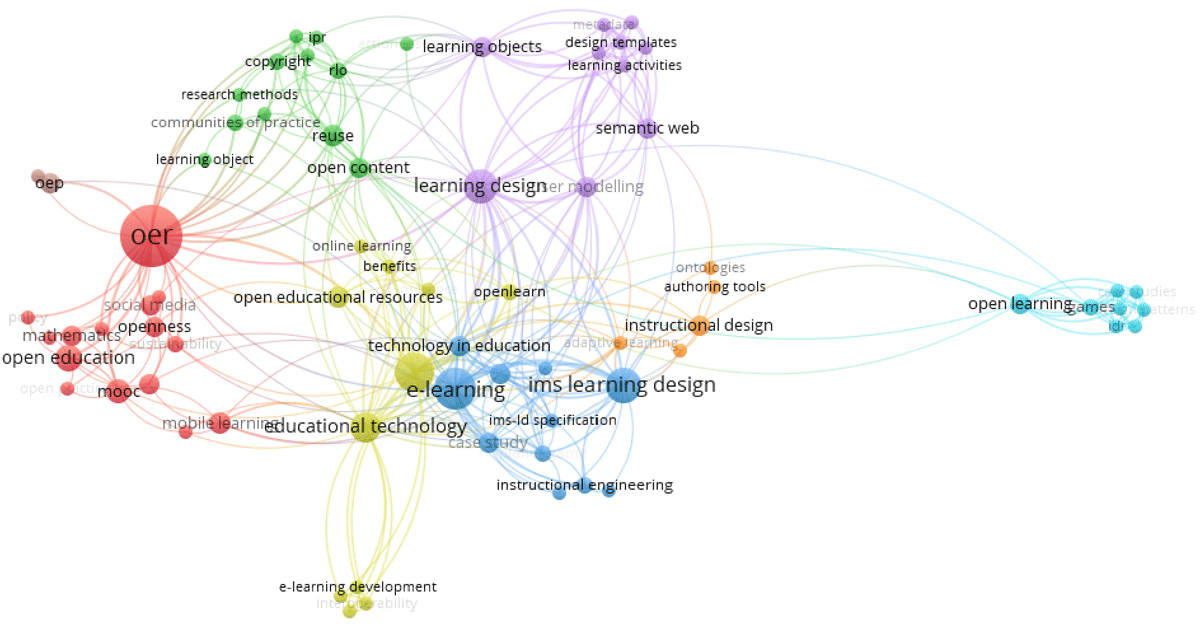
Figure 5
Network of co-occurring keywords for papers published in JIME between 2006 and 2015 inclusive. Keywords with a frequency <2 are not shown. Node size is scaled according to frequency, and colour-coded according to detected communities/clusters.
The most popular keyword – OER – is reflected in the first of the five selected papers from this decade. At a point where OER research was not yet widespread, in ‘An OER COUP: college teacher and student perceptions of open educational resources’, Bliss et al. (2013) provide an early investigation into teacher and student perceptions about OER. Positive impacts were reported and mapped to the novel COUP – cost, outcomes, use and perceptions – framework, which would then go on to be applied extensively in evaluating OER applications.
In Figure 5, the node of ‘mobile learning’ sits in a connecting position between two of the main clusters, OER (red nodes) and educational technology (yellow nodes). In this area, Farley et al. (2015) report on ‘How do students use their mobile devices to support learning? A case study from an Australian regional university’. Prompted by the increasing use of ‘bring your own device’ (BYOD) policies in higher education at the time, the study provides an in-depth, large-scale exploration of mobile device use by students. Clear practical implications for universities implementing BYOD policies are identified.
‘Exploring Curation as a core competency in digital and media literacy education’, by Mihailidis and Cohen (2013), relates to the ‘social media’ node in Figure 5, and arguably reflects the broader shift over time from particular technologies to how they are being used in practice. The study focuses on Storify as an example of a social media platform designed for content curation, making a timely contribution to the field of media literacy, which would become extremely critical in the year that followed. The study makes a significant contribution through focusing on how such a tool can be embedded within education, distilled to six points to consider when teaching, and introducing a framework for conceptualising curation as a core digital media literacy.
Massive Open Online Courses (MOOCs) arrived relatively late into this second decade (Jordan & Goshtasbpour 2022), and while there was a delay in seeing this reflected in the keyword network (see Decade 3), this would go on to become a major theme and two papers were particularly prescient and timely. In ‘Designing for educational technology to enhance the experience of learners in distance education: how open educational resources, learning design and Moocs are influencing learning’, Scanlon, McAndrew and O’Shea (2015) sit at the intersection of three of the major nodes in the network – MOOCs, OER and learning design. This analysis draws upon a substantial body of research on open, online, and distance learning across both formal and informal educational contexts to inform the then rapidly evolving discourse surrounding MOOCs. It emphasises the need for course designs that can accommodate the diverse backgrounds and needs of learners, while offering practical guidance that, although originally prompted by interest in MOOCs, remains highly relevant today.
‘Making sense of MOOCs: musings in a maze of myth, paradox and possibility’ (Daniel 2012), is notably the most viewed JIME paper of all time, and at the time of writing this editorial, the most cited in the special collection (according to Google Scholar). The high level of interest in the paper reflects the way in which it succinctly encapsulates the key issues at that particular moment in time, when MOOCs were very much a zeitgeist in the sector. Daniel (2012) sets out definitions of key terms and distinctions between connectivist cMOOCs and larger-scale platformised xMOOCs, and highlights concerns such as quality assurance, low completion rates, questions of certification, and the broader role of MOOCs within the higher-education sector, which were prominent issues at the time.
Decade 3: 2016 to 2025
The third decade of JIME began in 2016, and recently concluded at the end of 2025. This time period included 167 papers published across ten issues, reflecting a move toward annual issues, which often consisted of one or more special collections or additional open submissions. The co-occurring keywords during this third decade are shown in Figure 6. The influence of MOOCs has continued from the previous decade, from a relatively small position to being the most frequently used keyword. OER remains one of the principal keywords, but it is joined by a number of related terms such as open education, open pedagogy, open educational practices (OEP), reflecting a broad shift in the field from resources to practices (Cronin 2017). The overall structure of the network takes on a slightly different character here; compared to the first two decades, the structure of the graph is more diffuse and expansive, and the communities and clusters within the structure are not as clearly defined. This suggests increasing diversification of topics; that is, more themes emerging in parallel, and less dependence on a small number of central concepts that structure the field. Over the three decades and networks, the focus has shifted from particular technologies, to different approaches and ways of utilising technologies in practice.
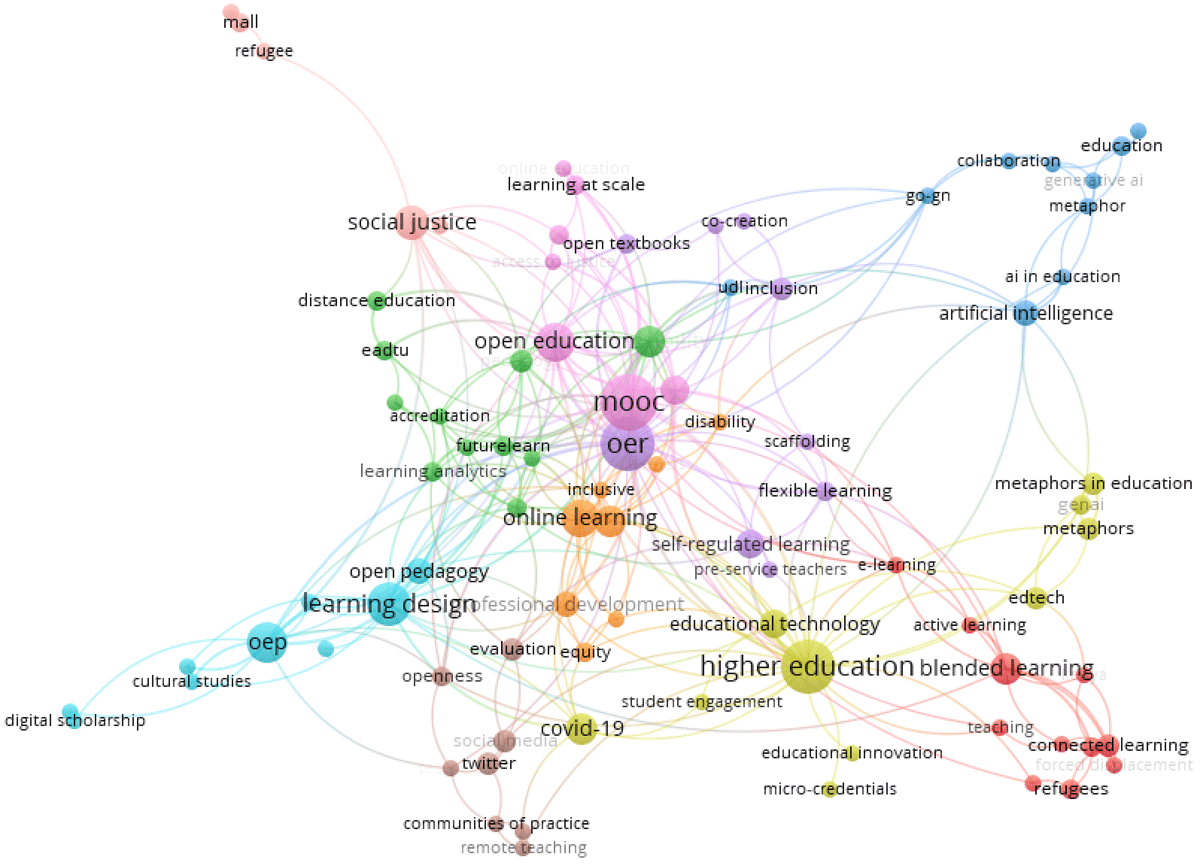
Figure 6
Network of co-occurring keywords within the empirical papers published in JIME between 2016 and 2025 inclusive. Keywords with a frequency <2 are not shown. Node size is scaled according to frequency, and colour-coded according to detected communities/clusters.
The influence of MOOCs and OER continues from the second decade, although these topics do not explicitly feature in the five most viewed papers from this decade, which may reflect these concepts becoming more integrated into practice more generally and the growing numbers of studies on these topics. As published research into the potential and impact of OER on learning and teaching increased, exploring more diffuse forms of openness such as OEP moved centre stage. Reflecting the broader shift from OER to OEP, Bali, Cronin and Jhangiani (2020) build upon foundational work (Lambert 2018) to extend the field by discussing OEP specifically from a social justice perspective. Bali, Cronin and Jhangiani present a typology of OEP which both challenges the idea of open practices as necessarily socially just whilst highlighting openness as nuanced and complex. This paper provides a critical look at different types of OEP, supporting reflection on one’s own practice whilst also highlighting potential ways to improve and centre social justice.
While not explicitly demonstrated by the network graph, it is notable that three of the papers included in the special collection from this decade foreground supporting and understanding student perspectives, particularly engagement. Paniagua and Simpson (2018) report on the EMPOWER project (2015) that places student support at the centre of ensuring student success in online and distance education. In particular, the work highlights the crucial relationship between effective student support and addressing the challenge of student drop-out and retention. Over several years, the project developed and shared a range of tools and resources to support educators and HE institutions in understanding the underlying factors influencing student engagement, motivation, and retention.
In a closely related paper, Bond and Bedenlier (2019) explore the central role of technology in student engagement in the higher education and K12 contexts in ‘Facilitating student engagement through educational technology: Towards a conceptual framework’. By building on established understandings of student engagement and development, Bond and Bedenlier develop a situated and dynamic “bioecological student engagement framework” which highlights potential barriers to engagement whilst providing practical responses to support learners effectively.
Hewson (2018) provides an earlier, more focused examination of student engagement and learning behaviours and reports the findings of two studies at Leeds Beckett University that examined the engagement and learning behaviours of online students within the broader context of their lives. The first study (2014) employed a qualitative methodology with six students, exploring their motivations, decision-making processes and the emotional aspects of learning. The study highlighted that students’ engagement was influenced not just by academic encounters but also by the broader demands of their daily lives. Addressing students’ uncertainties (e.g. course structure, assessment methods) was also highlighted as a critical factor in reducing anxiety and fostering engagement.
The 2016 follow-up study was conducted on a larger scale and used quantitative and qualitative methods over ten months to track students’ engagement, motivation and satisfaction. Although motivation levels remained constant, engagement varied notably often influenced by assessment deadlines. Students cited career progression as their primary reason for pursuing distance learning, though emotional and experiential goals such as gaining new experiences also played a role. The study reaffirmed the importance of academic support with learners valuing personalised contact with tutors and consistent study experiences across modules. Key findings from both studies also reveal that individual emotional states and varying life circumstances influence engagement. Effective interventions to improve engagement include providing tailored support at critical moments, swift feedback, clear expectations, and technical resources that minimise frustration. Ensuring consistency in tutor engagement and course delivery was also highlighted as key to maintaining student involvement and satisfaction.
The fifth paper included from this decade shows some similarities with this editorial to an extent, in that it takes a historical look back upon a time period of three decades in the field. Taking the advent of the World Wide Web being publicly available in 1993 as a starting point, in ‘Educational technology research patterns in the realm of the digital knowledge age’, Bozkurt (2020) traces the use of the term ‘educational technology’ across the scholarly literature since then. Through the analysis, five themes are identified as being progressive phases over this period, and these parallel some of the trends we have observed in Figures 4 to 6. Notably, the first theme, multimedia and instructional design, mirrors the first decade, to a prominent role for online learning environments, to learning analytics in the final theme (reflected in Figure 6).
Conclusions and looking ahead
Our investigation shows that there exist differences between popular articles from the first three decades of JIME, which are also related to the focus of special collections and trending areas of research. The first decade saw a predominance of diverse technologies in educational innovation, with game-based learning, the semantic web, and learning management systems prominent. The second decade shows great interest in OER and the growing importance of open education and its principles in educational technology, which remains a particular interest of the journal. An aspect that continues into the third decade, with the inclusion of MOOCs, is the need for OEP and for frameworks related to open practices. Over the three decades, there has been a clear shift from particular technologies, to practices, pedagogic approaches and social factors, mirroring shifts in the wider field over this period of time (Weller 2020).
One observation from this retrospective is the persistence of key challenges for educational technologists that persist over the evolution of new technologies – and that need to be attended to carefully as well as technical developments in order to effect positive changes. As Diana Laurillard, one of the founding editors of JIME, put it; “Education is on the brink of being transformed through learning technologies; however, it has been on that brink for some decades now” (Laurillard 2008: 1). New innovations tend to be privileged and draw the attention of researchers but there remain structural challenges around equity, access and the extent to which new technologies reinforce or exacerbate inequality instead of democratising learning opportunities. From the perspective of 1996 it might have seemed as if the internet was about to radically extend access to knowledge across the globe – and there is a sense in which this is what happened – but in 2026 we also find barriers to participation in education as robust as ever.
Over the last thirty years, the internet has evolved from a relatively sparse communications infrastructure into the organising substrate of contemporary social, economic, and cultural life. Early experimentation has given way to APIs, authentication standards, app stores, and platform governance mechanisms which produce increasingly uniform modes of interaction. Waves of technological innovation disrupt and then become interwoven into the fabric of everyday life, stabilising these innovations into dominant standards and infrastructures. Artificial intelligence may currently represent another such moment of proliferation. If we were to predict the characteristics of the next network graph in another ten years, it is likely that the diffuse and expansive structure of nodes seen in the third decade (Figure 6) may shift back to a more focused and less diffuse structure due to the growing focus on AI.
As noted in the Introduction, the scope of JIME set out to be purposefully broad, and while the new technologies of web-based media were the starting point, from the outset the goal was to examine their use in practical and theoretical terms too. The relationship between technology, practice and theory has not always been an easy one and remains a challenge for the field (Bligh 2020). The collection includes a foundational article in the debate around the role of theory in educational technology (Issroff & Scanlon 2002) and across the three decades, theory has provided a consistent point of engagement.
It is also notable that compared to its inception, from the initially broad stance, the scope of the journal has become narrower over time. JIME now focuses on submissions with a higher education-level focus, which may be in informal learning settings, but no longer at the school or further education level. The original scope also emphasised the relationship between academia and ‘commercial practitioners’; over the past thirty years, the ‘edtech industry’ has grown considerably and there is a pressing need for the links between commercial interests, research and educational practitioners to be strengthened (Komljenovic et al. 2026), so this remains an important concern.
This editorial began with an idea of interactive media, with the decade-by-decade network diagrams reflecting an ongoing modulation of that form, showing the permutations of what scholarly discourse might be, how it might behave, and what it might become. These networked diagrams grow more complex over time, registering the proliferation of possibilities that accompanied the rise of social media, mobile devices, learning management systems, and the many new modes of interactive experience they enabled. JIME was founded to interrogate precisely these kinds of transformations, and that purpose remains as vital as ever. The embryonic forms of JIME in the 1990s were expressions of genuinely experimental scholarly publishing; the question was always whether the journal publishing system could grow with the rich and expanding media landscape of the past thirty years. JIME’s answer has been shaped, as it must be for any modestly funded open-access title, by the realities of sustainability. Operating today as a collection of papers on OJS — as many peer-reviewed journals now do — reflects a considered commitment to continuity before innovation. The challenge facing not-for-profit academic publishing is real and ongoing, and survival itself is no small achievement. That First Monday, a peer among open-access pioneers and likewise marking its thirtieth anniversary, has now published its final issue (First Monday 2026) serves as a sober reminder of what is at stake. Over the past thirty years, open access academic publishing has moved from the fringe, to being incorporated into mainstream publishing and monetised, and momentum is building toward bringing open access publishing back to not-for-profit models (Sabel & Larhammar 2025). The next thirty years will bring pressures and possibilities we cannot yet fully anticipate; what this anniversary affirms is that journals willing to ask challenging questions about learning and media are exactly what the field needs most.
Acknowledgements
Though we can’t include by name all those who have played a role in JIME over the years, the editorial team would like to thank authors who selected JIME as their journal of preference; everyone who has contributed by acting as peer reviewers; and the wider JIME readership. Special thanks are due to The Open University, through the Knowledge Media Institute and subsequently the Institute of Educational Technology, for funding, knowledge and support. We would like to particularly acknowledge the pivotal roles played by Simon Buckingham Shum, Diana Laurillard, and Tamara Sumner, as the founding editors, and to previous editors Josie Taylor, Patrick McAndrew, Eileen Scanlon, Ann Jones and Martin Weller, several of whom were kind enough to contribute their reflections to the anniversary issue.