
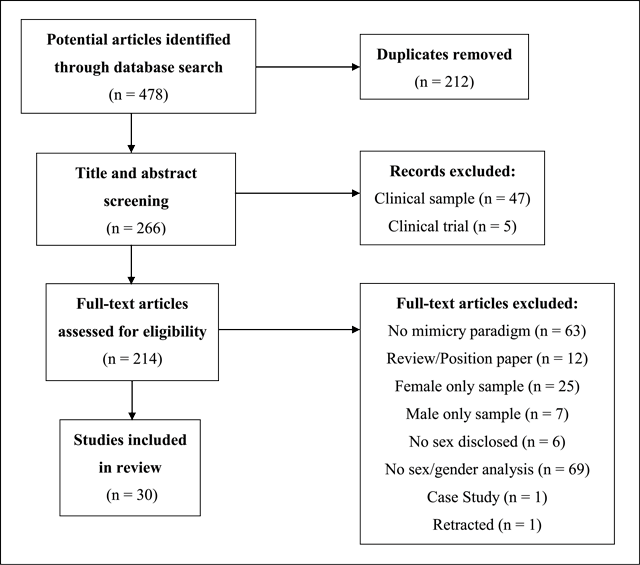
Figure 1
Article selection process.
Table 1
Articles investigating sex differences in nonconscious human mimicry.
| Authors | Aim | Stimulus | Sample | Measure | Results |
|---|---|---|---|---|---|
| Lundqvist & Dimberg (1995) | To explore the association between facial mimicry and emotional contagion. | Photographs | 28 males; 28 females | Facial EMG | A trend towards increased mimicry of happy facial expressions among females. |
| Blairy et al. (1999) | To examine whether nonconscious mimicry can facilitate empathy. | Photographs | 15 males; 15 females | Facial EMG | No significant gender differences in facial mimicry were identified. |
| Sonnby-Borgström (2002) | To investigate the association between empathy and mimicry behaviour at different levels of processing | Photographs | 21 males; 22 females | Facial EMG | Gender had a significant effect on mimicry only at the automatic processing level. |
| Sonnby-Borgström et al. (2003) | To examine how facial mimicry behaviour is related to emotional empathy at different levels of information processing. | Photographs | 36 males; 34 females | Facial EMG | Males and females did not differ on level of mimicry. |
| Vrana & Gross (2004) | To test whether the viewing of emotional facial expressions elicits facial mimicry. | Photographs | 10 males; 9 females | Facial EMG | No significant gender differences in facial mimicry were identified. |
| Sonnby-Borgström et al. (2008) | To identify whether sex differences in facial mimicry related to stimulus exposure length. | Photographs | 51 males; 51 females | Facial EMG | Females mimicked happy photographic expressions to a greater extent than males at the supraliminal level (2,500ms). |
| Hermans et al. (2009) | To examine whether autistic traits impact facial mimicry. | Photographs | 10 males; 6 females | Facial EMG | Females showed significantly higher levels of facial mimicry. |
| Rymarczyk et al. (2011) | To test whether dynamic faces would enhance facial reactions. | Photographs & Video | 12 males; 15 females | Facial EMG | No significant gender effects were identified. |
| Bush et al. (1989) | To examine the impact of facial control on reactions to comedy routines. | Video | 39 males; 34 females | Facial EMG | No gender differences in facial mimicry were identified. |
| Laird et al. (1994) | To explore the role of mimicry and self-perception processes in emotional contagion. | Video | Study 1: 18 males; 28 females. Study 2: 29 males; 28 females. | Coded observations | No gender differences in behavioural or facial mimicry were observed. |
| Estow et al. (2007) | To examine the role of self-monitoring in mimicry. | Video | 17 males; 45 females | Coded observations | No gender differences in facial or behavioural mimicry were identified. |
| Stel et al. (2010) | To investigate whether a priori liking of an individual can influence mimicry of that person. | Video | 9 males; 41 females | Coded observations | No effect of gender was identified. |
| Moody & McIntosh (2011) | To explore whether mimicry involves a motor-matching mechanism or an emotional processes. | Video | 15 males; 22 females | Facial EMG | No effect of gender was identified. |
| Niedenthal et al. (2012) | To investigate the impact of pacifier use on mimicry and emotional competence. | Video | 61 males; 45 females | Coded observations | Only boys mimicry was affected by pacifier use. |
| Stel et al. (2013) | To investigate the association between just world views and mimicry. | Video | 23 males; 26 females | Coded observations | No gender differences in behavioural or facial mimicry were identified. |
| Soussignan et al. (2013) | To examine the impact of direct and averted gaze on facial mimicry. | Video | 21 males; 21 females | Facial EMG | Men mimicked anger more than women; Women mimicked fear and sadness more than men. |
| Schneider et al. (2013) | To examine the influence of expressive suppression and mimicry on facial affect sensitivity. | Video | 39 males; 57 females | Facial EMG | No gender differences were found. |
| Joyal et al. (2014) | To assess concomitants and construct validity of a newly developed set of virtual faces. | Video | 20 males; 21 females | Facial EMG | No gender differences were identified. |
| Korb et al. (2014) | To investigate how people perceive different types of smiles and judge their authenticity. | Video | 11 males; 20 females | Facial EMG | Males showed less AU6 and more AU12 activity when mimicking smiles than females. |
| Rauchbauer et al. (2015) | To investigate whether and how mimicry is modulated by social-affective variables. | Video | 23 males; 18 females | fMRI | No gender differences were identified. |
| Cheung et al. (2015) | To investigate the interpersonal functions of facial mimicry after social exclusion. | Video | 9 males; 13 females | Coded observations | Women and men did not differ on level of mimicry. |
| Chartrand & Bargh (1999) | To test the association between mimicry, liking, and empathy. | Interaction partner | 39 male and female participants | Coded observations | No gender differences were observed. |
| van Baaren et al. (2003) | To test the prediction that self-construal orientation affects nonconscious mimicry. | Interaction partner | 18 males; 33 females | Coded observations | No effects of gender were identified. |
| Karremans & Verwijmeren (2008) | To examine the association between mimicry and participant relationship status. | Interaction partner | 31 males; 22 females | Coded observations | Women mimicked their interaction partners more so than men. |
| van Straaten et al. (2008) | To examine the role of mimicry in short-term mate preference. | Interaction partner | 60 males; 59 females | Coded observations | Men mimicked pen playing more than women. Women mimicked postural shifting more than men. |
| Hess & Bourgeois (2010) | To investigate the role of emotional and social context on mimicry. | Interaction partner | Study 1: 48 male pairs; 48 female pairs Study 2: 72 opposite sex pairs | Coded observations & facial EMG | Men showed less mimicry than females in angry versus happy conditions. |
| Kulesza et al. (2014) | To examine and define verbal mimicry, and the link between verbal mimicry and prosocial behaviours. | Interaction partner | 165 males; 165 females | Coded observations | No gender differences were identified. |
| Rueff-Lopes et al. (2015) | To explore the occurrence of vocal mimicry in a natural setting. | Interaction partner | Call centre employees (31 Female; 10 Male) Callers (754 Female; 213 Male) | Coded observations | Males showed more negative vocal mimicry while females showed more positive vocal mimicry. |
| Kurzius (2015) | To evaluate whether and how broader concepts of personality are related to mimicking behaviour. | Interaction partner | 8 males; 24 females | Coded observations | No gender differences were observed. |
| Kurzius & Borkenau (2015) | To explore the antecedents and consequences of mimicry, facial and behavioural, and the role of personality in a natural setting. | Interaction partner | 92 males: 90 females | Coded observations | No effect of gender was identified. |