
Table 1
New Zealand’s Alert Levels (New Zealand Government, 2020).
| Alert Level | Risk assessment | Rules (excerpt) |
|---|---|---|
| 1 – Prepare Disease is contained | Uncontrolled spread overseas; Isolated transmission in NZ | Schools and workplaces open; No restrictions on gatherings, record-keeping is encouraged for contact tracing |
| 2 – Reduce Disease is contained, Risk of community transmission | Household transmission could be occurring; Single or isolated cluster outbreaks | Public venues, e.g., museums, can open if they comply with public health measures and ensure 1 metre physical distancing and record keeping. Max. 100 people gatherings |
| 3 – Restrict High risk the disease is not contained | Community transmission may be happening; New clusters may emerge but controlled via testing and contact tracing | Public venues, e.g., museums, are closed; Even local travel is severely restricted; Studying and working from home |
| 4 – Lockdown The disease is not contained | Community transmission; Outbreaks and new clusters | All gatherings cancelled; All public venues closed; People must stay home |
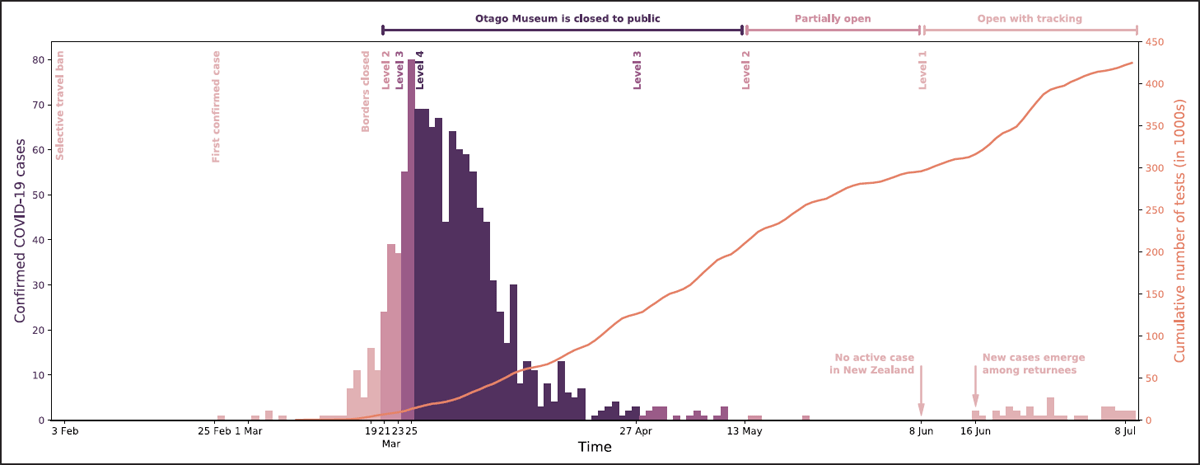
Figure 1
Confirmed cases and cumulative testing in New Zealand. (Source: Ministry of Health, NZ).
| Safety first | All government-mandated guidelines to be followed; If such advice is insufficient, seek advice from experts. |
| Instil confidence | The Museum (i) distributed ample signage; (ii) installed sanitising stations; and (iii) made cleaning regimes apparent. |
| Encourage visitation | The Museum developed programmes attracting locals and reassuring visitors of safe visitation. |
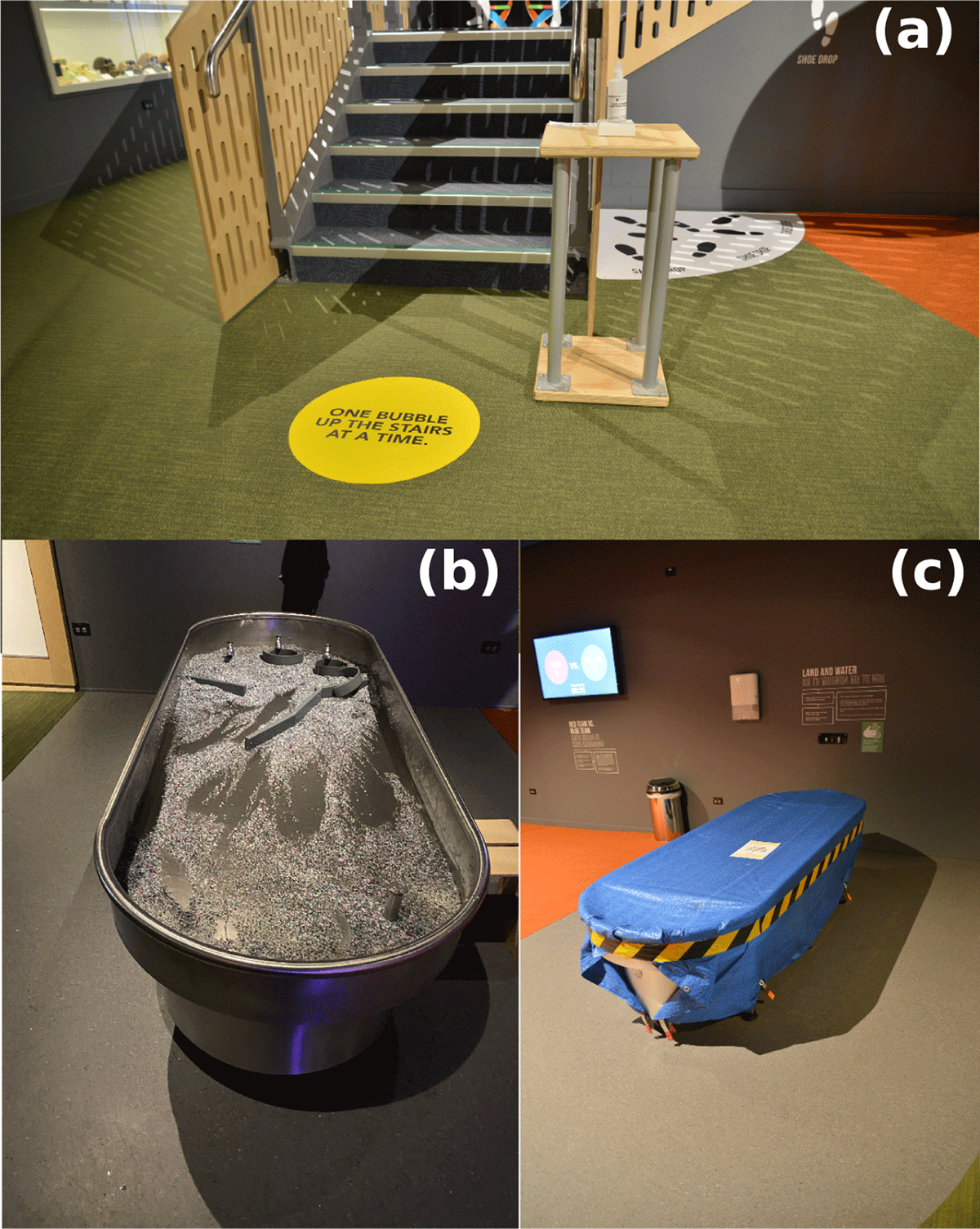
Figure 2
Figure shows three major changes due to public-health safety. (a) At the entry to areas where the number of bubbles (visitors) was strictly limited, or where people had to pass through a constricted area, a sign warned members of the bubbles and a well-lit sanitation stand was placed next to the entry point. (b) A popular item, Land & Water, in its pre-lockdown state. In this interactive item landscape is formed from aquarium gravel and flowing water from a tap mimics erosion. The efficient cleaning of this interactive item is not possible. (c) The Land & Water item has been decommissioned during lockdown. It has been wrapped in plastic whose cleaning is simple when a staff member noticed that visitors touched that surface.
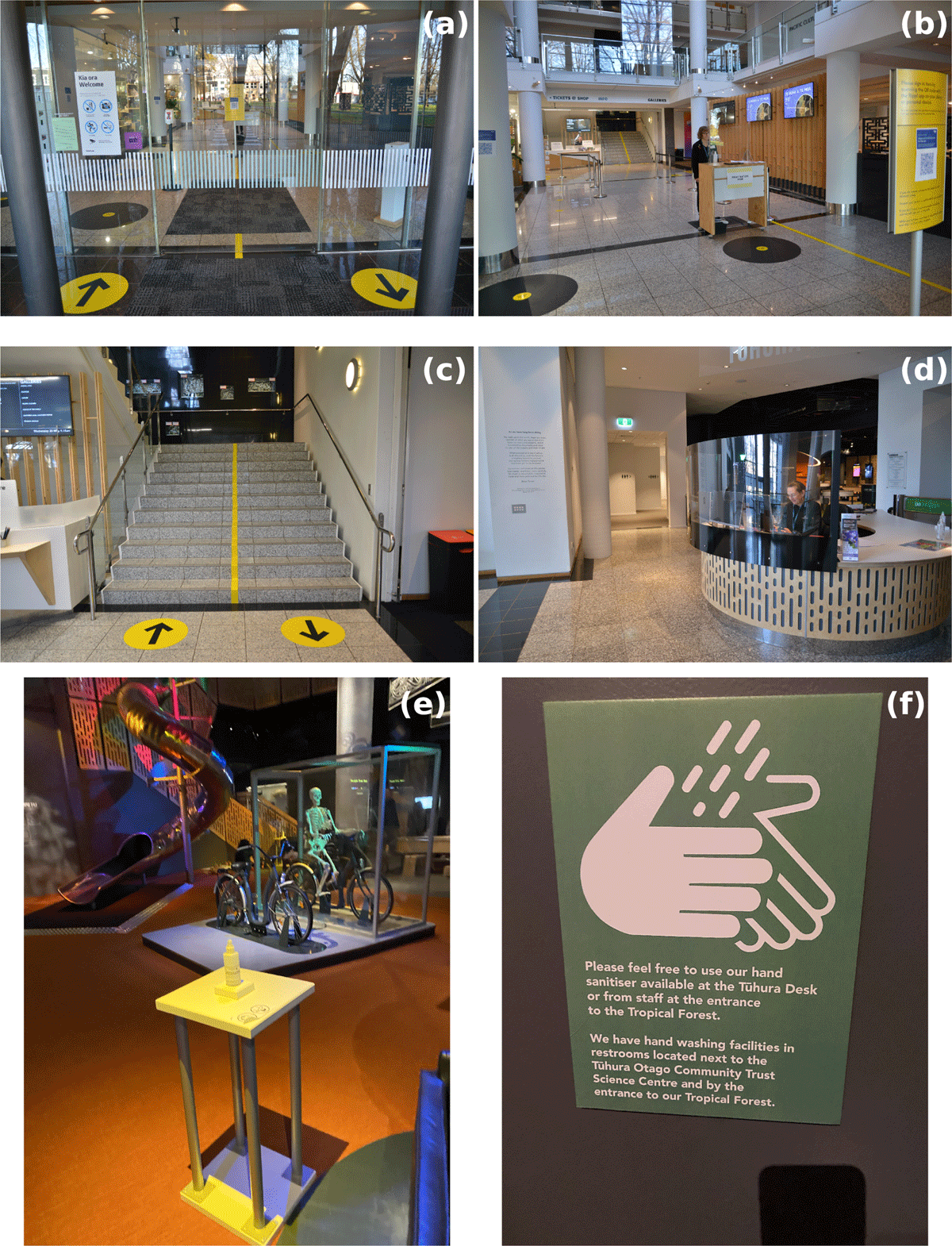
Figure 3
This collection of photos focuses on separation, visitor-flow and sanitation. (a) Outside of the main entrance arrows indicate to visitors where to enter and where to leave the building. The arrows and a separating line continue inside. (b) At the main entrance a yellow sign with the official QR code face the visitor (right side of the photo). This QR code is read by the governmental COVID mobile application. Following on, a staff member, standing behind a plastic shield and wearing a mask, greets the visitors and checks whether the visitors registered via the mobile applications. If not, then a manual registration is required. The staff member cleans the pen after each sign-in. Further on, arriving and leaving patrons are separated and their paths are indicated. (c) At the stairs, patrons are asked to keep to their left within their dedicated ‘lanes’. (d) Staff at the entry point of specific exhibition areas are protected by an acrylic shield. (e) Brightly spot-lit sanitation stand in a dark exhibition area. (f) Signs reminded visitors of the importance of hand-sanitation at different points, often close to the items on display.