
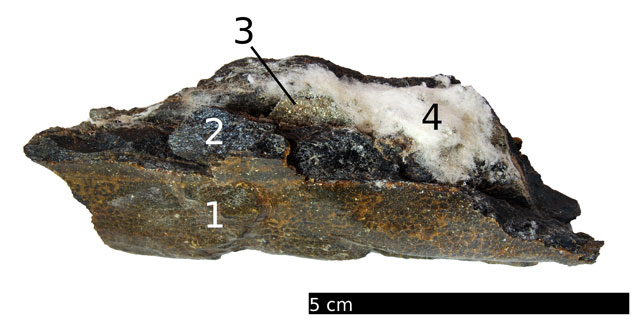
Figure 1
Fragment of the anthracothere from Chiuppano before conservation. It is possible to see different strata, from the external to the inner side of the bone: the layer of unspecified varnish (1), the cortical bone (2), stable crystals of pyrite (3), and the powdery white mineral results of oxidation (4).
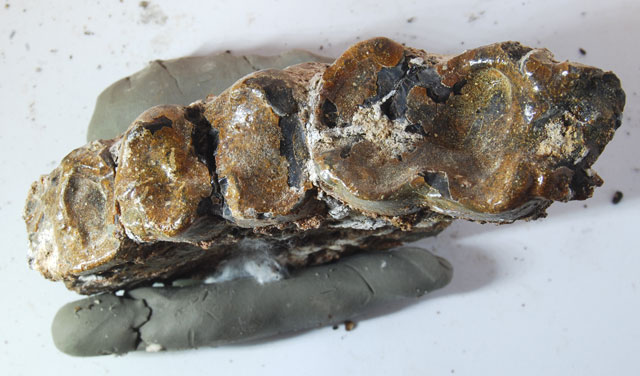
Figure 2
Dental series of mandible ISN: 18 S242-10 teeth are completely covered by unspecified varnish. It is not possible to distinguish either external enamel or dentine, and the state of tooth wear is indistinguishable.
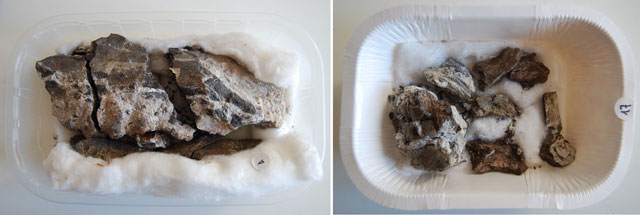
Figure 3
Fossils in their original boxes, supported by a layer of cotton. Left: mandible ISN: 18 S242-10; Right: left proximal humerus ISN: 18 S242-22.
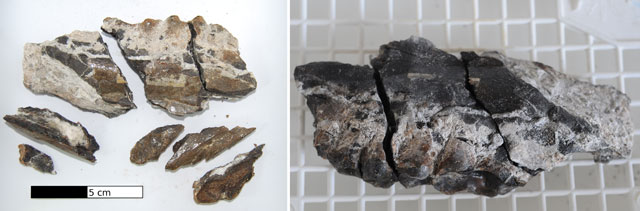
Figure 4
Mandible ISN: 18 S242-10 before the treatment (left) and prepared on the grill tray before the chemical reaction with PEG400 and ammonia (right).
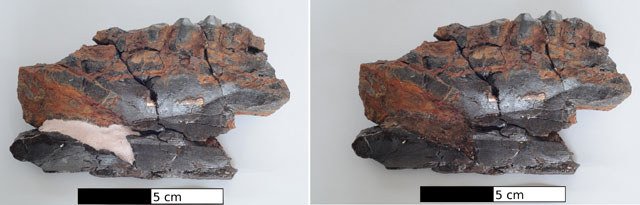
Figure 5
Mandible ISN: 18 S242-10 after the chemical reaction. a) Fragments had been joined to each other and a portion of the horizontal branch had been filled with Balsite® (pink); b) final result.
Table 1
Comparison between the determinations made by Accordi (1951) and the description of bones after the restoring activity. Several specimens have been lost since 1950, and other fossils have been taxonomically reclassified.
| Original numeration | From Accordi (1951) – 3 – List of remains of Anthracotherium | Notes (n. post-conservation) | |||||
|---|---|---|---|---|---|---|---|
| n. Repository (box) | Italian Superitendence Number (ISN) | Description | |||||
| 1 | condilus occipitalis | confirmed (n. 12) | 18 | S242 | – | 14 | reported as the astragalus in the historicai label |
| 2 | mandible with two horizons ramus with p3–m3 | confi’med (n. 3–4) | 18 | S242 | – | 10, 11a–d | p3 has been completely lost |
| 3 | fragment of a mandible with horizontal ramus and m2–m3 [rx] | confirmed (n. 2b) | 18 | S242 | – | 12, 13 | teeth are not recognisable because fragmented |
| 4 | fragmented mandible of a young lndividual, and a portion of the last decidual molar | not found | |||||
| 5 | rostrum of a mandible with the synphisis and alveolus partially preserved | not found | |||||
| 6 | mandible of a very young animal (without the vertical ramus) and decidual teeth | not found | |||||
| 7 | incomplete tooth crown of an upper right canine of a male | confirmed (n. l with other dental remains) | 18 | S242 | – | 15, 16, 17, 18 | |
| 8 | complete tooth crown of an upper right canine of a young male | ||||||
| 9 | complete tooth crown of a P3 [rx] | ||||||
| 10 | complete tooth crown of a P4 [lx] | confirmed (n. 21) | 18 | S242 | – | 19 | |
| 11 | fragment of a maxilla with complete M2–M3 [be] | not confirmed | |||||
| 12 | maxillar fragment with the last deciduous tooth (d3) and a portion of d2 [rx] | not confirmed | |||||
| 13 | epistropheus partially broken | confirmed (n. 20) | 18 | S242 | – | 25 | the epistropheus tooth has been lost after Accordi (1951) |
| 14 | a probable lumbar vertebra (corpus) | ||||||
| 15 | two joined caudal vertebra | not found | |||||
| 16 | Proximal epiphisis of a left humerus | confirmed (n. 17) | 18 | S242 | – | 22, 34, 38, 40, 41, 42 | articular head of a right humerus |
| 17 | distal epiphisis of a right humerus | confirmed (n. 11 and 10) | 18 | S242 | – | 23, 31, 32 | distal epiphisis have been rot determined as Anthracotherium. The humerus head n. 17 was of a young animal |
| 18 | Proximal epiphisis of a right radius | confirmed (n. 14) | 18 | S242 | – | 28, 33, 38 | determined as ulna and fragments |
| 19 | Proximal epiphisis of a right femur | confirmed (n. 19) | 18 | S242 | 29 | right head of a femur | |
| 20 | distal epiphisis of a right femur | confirmed (n. 6b) | 18 | S242 | – | 27 | |
| 21 | fragment of a left last astragalus | not found | (see OSN = 18 S242–14) | ||||
| 22 | distal end on a Ill (?) metacarpus | not found | |||||
| Several fragments of long bones and teeth, not determinable | n. lb, 2, 15, 18 | 18 | S242 | – | 20, 35, 36, 43, 44, 45a–b, 46a–c | ||
| n. 5 | 18 | S242 | – | 30 | distal epiphysis of a tibia | ||
| n. 6 | 18 | S242 | – | 21 | tibial dyaphisis | ||
| n. 7 | 18 | S242 | – | 24 | fragment of an ileo, previously determined as an epiphysis of left humerus in the historical labels | ||
| From the same deposit | |||||||
| 23 | fragments of a crocodile skull | not found | |||||
| 24 | Small cylindrical coprolite | not found | |||||
| Remains are hosted in the private collection of Mr. F. Rando in Chiuppano (Vicenza) | Today, they are displayed in the Palazzo Cornaggi, Thiene (Public Libiary) | ||||||
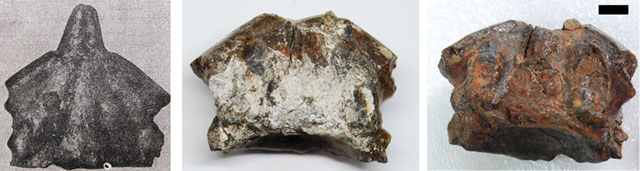
Figure 6
From left to right: the epistropheus ISN: 18 S242-25 in 1951 (Accordi 1951) and today, before and after conservation (scale bar for the recent photo = 1 cm).