
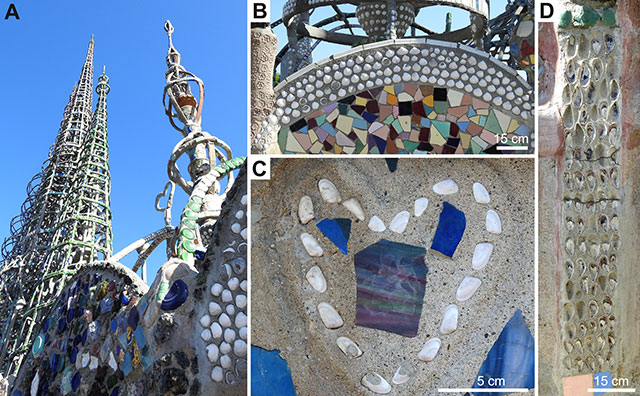
Figure 1
Mollusk shells on the Watts Towers. A. View from southeast of the exterior of the Watts Towers, showing the Center Tower (left), East Tower (middle), and one of the Ships spires (right). Mollusk shells are visible in the South Wall exterior; the two towers and the spire shown in the image also bear many mollusk shells. The Center Tower is about 30.3 m in height. B. Bivalve shells (mostly Chione and Chionista spp., with a few Argopecten ventricosus and Tivela stultorum) on the South Wall exterior panel between posts 20 and 21. C. A heart shape on the Ship formed by shells of Donax gouldi. D. Shells of Mytilus californianus embedded on South Wall interior, post 4. They are mounted with the interior of the shell facing the observer, which is unusual; most bivalve shells on the Watts Towers are mounted with the interior surface of the shell embedded in the mortar.
Table 1
Main structures of the Watts Towers examined in this study. The locations of each structure can be found in Figure 2. Note that the House was largely destroyed by fire around 1955. Its chimney, which includes numerous shells, remains mostly intact.
| Walls | Internal Structures |
|---|---|
| South Wall (exterior) | House (chimney) |
| South Wall (interior, incl. Pinnacles) | A Tower |
| North Wall (exterior) | B Tower |
| North Wall (interior, incl. Barbeque & Fountain) | Gazebo |
| West Tower Center Tower East Tower Ship |
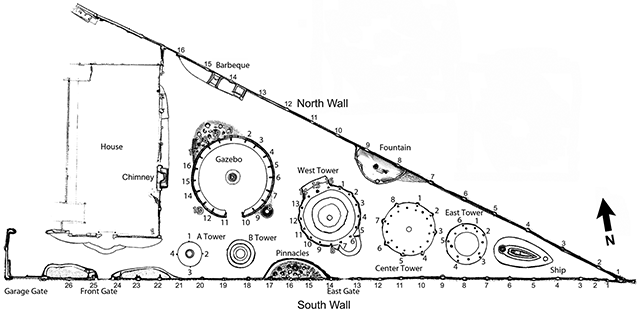
Figure 2
A map of the major features of the Watts Towers, viewed from above. Numbers on the exteriors of the South and North Walls are post numbers referred to in the text and other figure legends. Map is slightly modified from one provided by the Los Angeles County Museum of Art.
Table 2
Types of molluscan shells embedded in mortar at the Watts Towers. Most are identified to the species level, but a few could only be identified to the genus or family levels. Asterisks (*) indicated that the species is not native to southern California.
| Bivalves | Gastropods | |
|---|---|---|
| Amiantis callosa | Macoma secta | Cerithideopsis californica |
| Argopecten ventricosus | Mytilus californianus | Crossata sp. |
| Chama exogyra | Panopea generosa | Haliotis cracherodii |
| Chione californiensis | Penitella sp. | Megastraea undosa |
| Chione undatella | Psammotreta obesa | Megathura crenulata |
| Chionista fluctifraga | *Saxidomus gigantea | *Melongena corona |
| Crassadoma gigantea | Saxidomus nuttalli | Nassarius fossatus |
| *Crassostrea gigas | Semele decisa | Neverita reclusiana |
| Donax gouldi | Tagelus californianus | *Lobatus gigas |
| *Dosinia elegans | Tivela stultorum | Thylacodes squamigerus |
| Lithophaga plumula | Trachycardium quadragenarium | |
| Macoma nasuta | Tresus nuttalli |
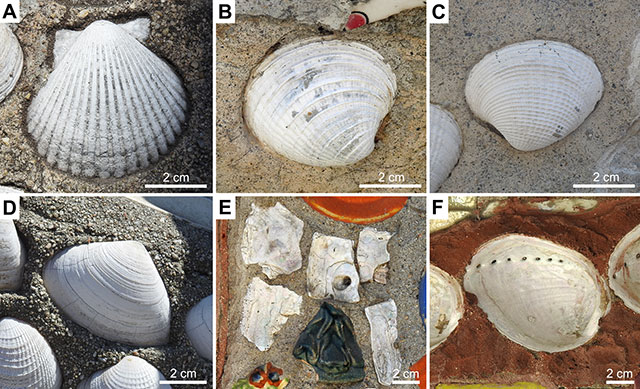
Figure 3
Exemplars of the most common mollusk shells on the Watts Towers. A. Argopecten ventricosus (Chimney). B. Chione californiensis (west side of A Tower). C. Chione undatella (west side of A Tower). D. Tivela stultorum (South Wall exterior between posts 19 and 20). E. Fragments of the shell of Haliotis sp. (Front Gate interior), with shell interior facing the observer. F. Intact shell of Haliotis cracherodii (House entrance); while fragments of the shell of Haliotis sp. are extremely common, intact shells like this one are quite rare.
Table 3
Habitat types in which the molluscan species found at the Watts Tower typically occupy in life. Species that are not native to southern California are indicated with an asterisk (*).
| Bays or estuaries | Exposed coast sand or gravel | Exposed coast rock |
|---|---|---|
| Argopecten ventricosus (Bivalvia) | Amiantis callosa (Bivalvia) | Chama exogyra (Bivalvia) |
| Chione californiensis (Bivalvia) | Donax gouldi (Bivalvia) | Crassadoma gigantea (Bivalvia) |
| Chione undatella (Bivalvia) | Psammotreta obesa (Bivalvia) | Lithophaga plumula (Bivalvia) |
| Chionista fluctifraga (Bivalvia) | Semele decisa (Bivalvia) | Mytilus californianus (Bivalvia) |
| *Crassostrea gigas (Bivalvia) | Tivela stultorum (Bivalvia) | Penitella sp. (Bivalvia) |
| *Dosinia elegans (Bivalvia) | Crossata sp. (Gastropoda) | |
| Macoma nasuta (Bivalvia) | Haliotis cracherodii (Gastropoda) | |
| Macoma secta (Bivalvia) | Megastraea undosa (Gastropoda) | |
| Panopea generosa (Bivalvia) | Megathura crenulata (Gastropoda) | |
| *Saxidomus gigantea (Bivalvia) | Thylacodes squamigerus (Gastropoda) | |
| *Saxidomus gigantea (Bivalvia) | ||
| Tagelus californianus (Bivalvia) | ||
| Trachycardium quadragenarium (Bivalvia) | ||
| Tresus nuttalli (Bivalvia) | ||
| Cerithideopsis californica (Gastropoda) | ||
| *Melongena corona (Gastropoda) | ||
| Nassarius fossatus (Gastropoda) | ||
| Neverita reclusiana (Gastropoda) | ||
| *Lobatus gigas (Gastropoda) |
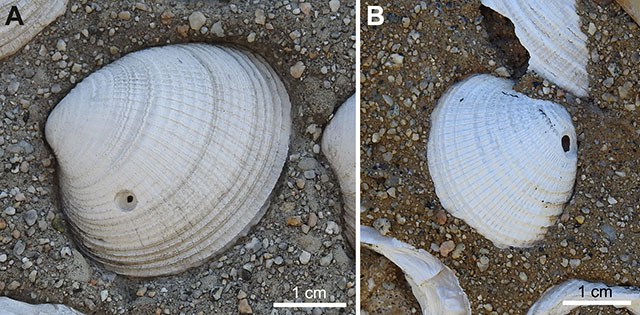
Figure 4
Examples of moon snail (naticid) drill holes in the shells of bivalves on the Watts Towers. A. Moon snail drill hole in valve of Chione undatella (South Wall exterior between posts 3 and 4). B. Moon snail drill hole in valve of Chionista fluctifraga (South Wall exterior, post 16). In both cases, drill holes are complete— that is, they completely penetrate the shell. This is strongly suggestive of successful predation, which indicates that these particular shells were collected post-mortem.