
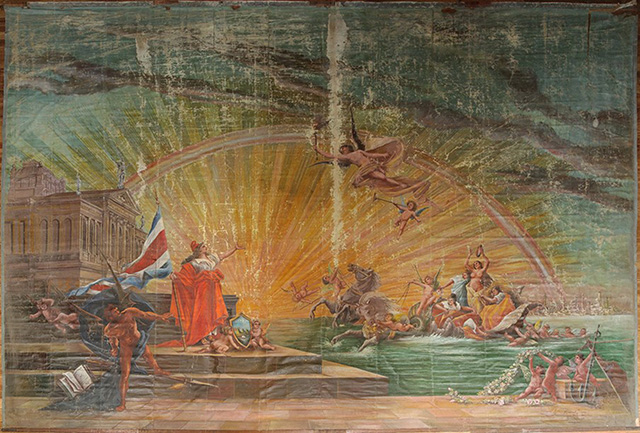
Figure 1
Original main curtain of the National Theatre of Costa Rica. Large format tempera. Painted by Carlo Orgero in 1893–1894 and intervened by Antonio Rovescalli in 1897. Photo: Juan Pérez Miralles (2016), reproduced with permission of the photographer.
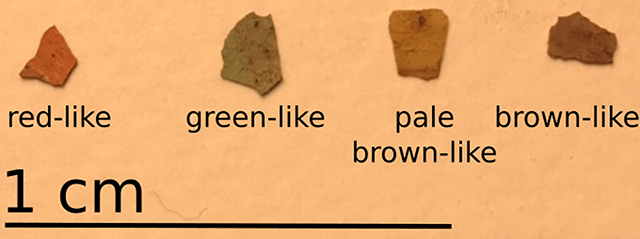
Figure 2
Examples of the fragments measured for each color shade analyzed.
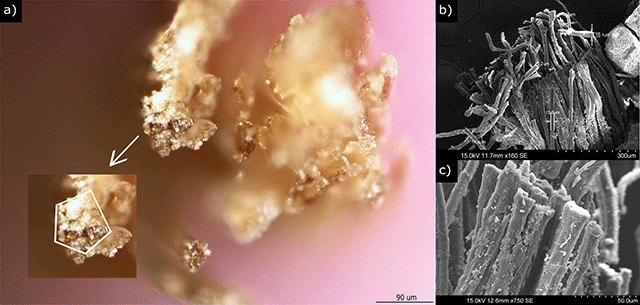
Figure 3
a) Transmitted light microscopy and b) SEM photograph acquired for the main curtain fabric sample, concluded to be Linen, and c) SEM image for the main curtain reinforcement, concluded to be cotton.
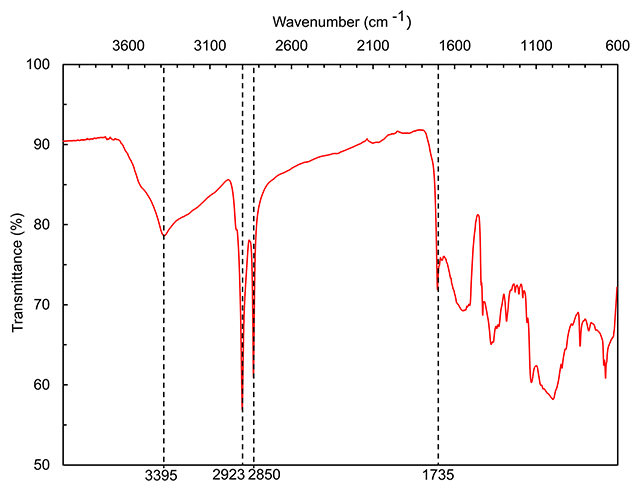
Figure 4
FTIR transmittance spectrum obtained for the studied samples. The specific bands displayed suggest the presence of egg yolk as a possible binder.
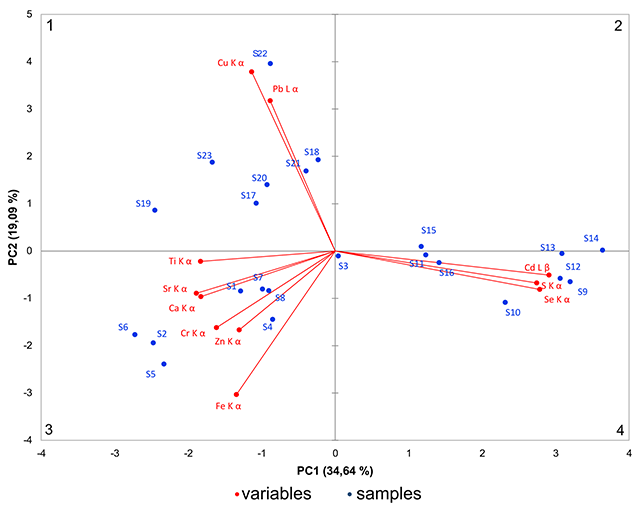
Figure 5
Clustering of samples analyzed through a PCA multivariate analysis. PC1 (principal component 1), exhibits a bigger contribution from variables S, Se and Cd, while PC2 (principal component 2) exhibits a bigger contribution from variables Cu and Pb.
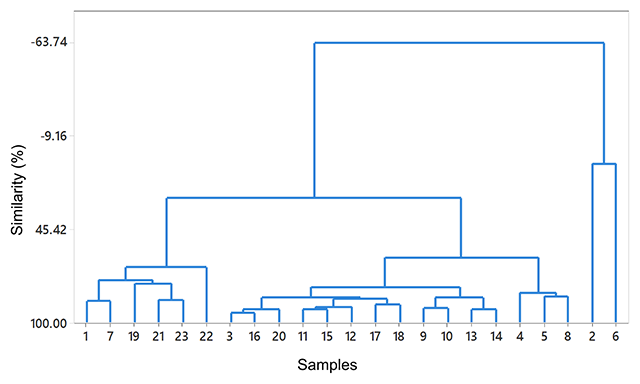
Figure 6
Cluster Analysis developed for the studied data, using a Ward linkage method and Euclidean distance measure. The identified clusters suggest the presence of a mixture of pigments.
Table 1
Suggested pictorial palette of pigments of the main curtain of the National Theatre of Costa Rica according to the results obtained.
| Elements present in the clusters of samples | Some pigments suggested |
|---|---|
| Fe, Ca, Sr, Pb, Cr, Ba | Van dyke brown, raw sienna, burnt sienna |
| Cu, Zn, Ti, Ca, Pb, Fe, Sr, Cr | Viridian, malachite, verdigris, chrome green, ultramarine green |
| Se, S, Cd, Zn, Ti, Fe, Ca, Cr, Sr | Cadmium red, red ochre, red lead, Chrome red |
| Fe, Cu, Se, S, Cd | Mixture |