
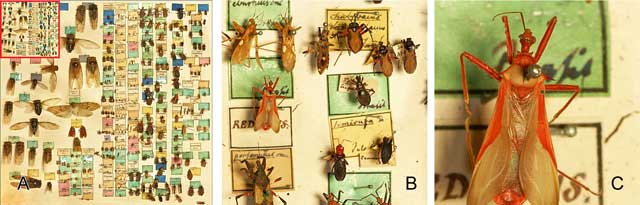
Figure 1
Increase in resolution between single-shot and multi-shot composite image of the insect drawer: A, size comparison between 16 megapixel (average resolution of currently available consumer-grade digital cameras) and 210 megapixel images; B, 100% crop from the 16 megapixel image; C, 100% crop from the same area of 210 megapixel image.
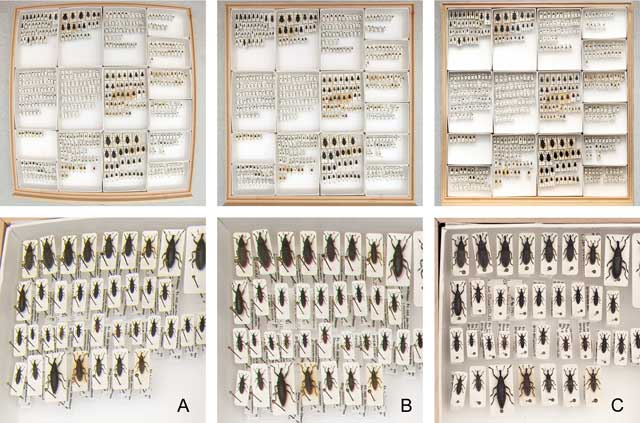
Figure 2
Different type of distortion produced by different digitizing techniques showing entire drawer (upper row) and crop from the top-left corner from the drawer (bottom row): A, barrel-shaped distortion; B, perspective distortion; C, minimal distortion/parallel projection.
Table 1
Comparison of Currently Available Whole-Drawer Imaging Systems.
| Name and authors | Optical component | Recording component | Mechanical component | Software component | Cost per unit (US$) |
|---|---|---|---|---|---|
| GigaPan (Bertone et al. 2012) | Fixed lens (non-telecentric) digital camera | GigaPan robot | Commercial | 1,500 | |
| SatScan (Blagoderov et al. 2012) | Machine vision telecentric lens | Machine vision camera | XYZ linear robot | Proprietary | Unknown |
| DScan (Schmidt et al. 2012) | Non-telecentric lens | SLR camera | XY linear robot | Proprietary and Commercial | 25,000 |
| Micro GigaPan (Longson et al. 2010) | Non-telecentric lens | SLR camera | XYZ linear robot | Proprietary and Commercial | Unknown |
| Gigapixel Micro Imager (see Micro GigaPan website) | Non-telecentric lens with telecentric attachment | SLR camera | XYZ linear robot | Proprietary and Commercial | Unknown |
| GIGAmacro Professional Photography
System (see GIGAmacro website) | Non-telecentric lens with telecentric attachment | SLR camera | XYZ linear robot | Proprietary and Commercial | 48,000 |
| Hasselblad H4D-200MS or
H5D-200MS (Thompson 2013) | Non-telecentric lens | Medium format camera | Fixed stage, Z rail | Proprietary | 50,000 |
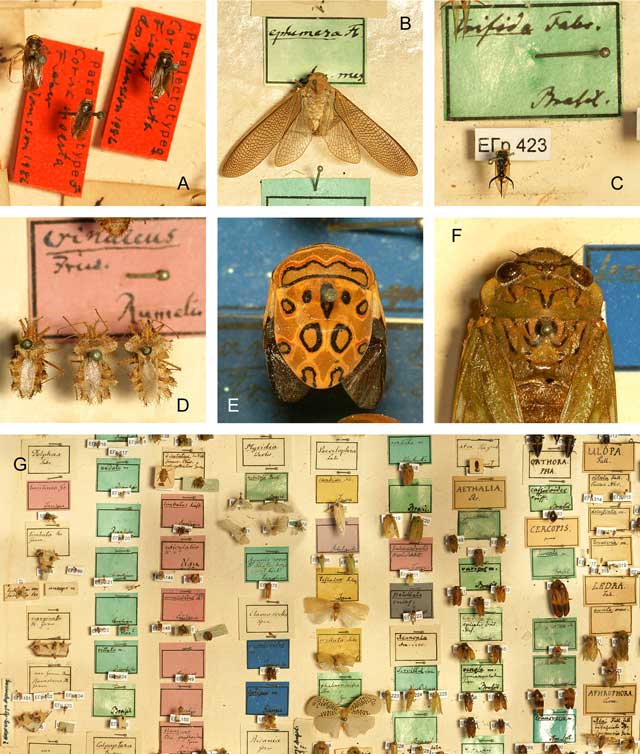
Figure 3
Examples from Germar’s collection (original names preserved): A, Corisa moesta; B, Pterodictya ephemera; C, Heteronota trifida; D, Phyllomorphus erinaceus; E, Pachycoris ocellus; F, Cicada semirlana, G, large section of the box with different genera of Homoptera. Not to scale.
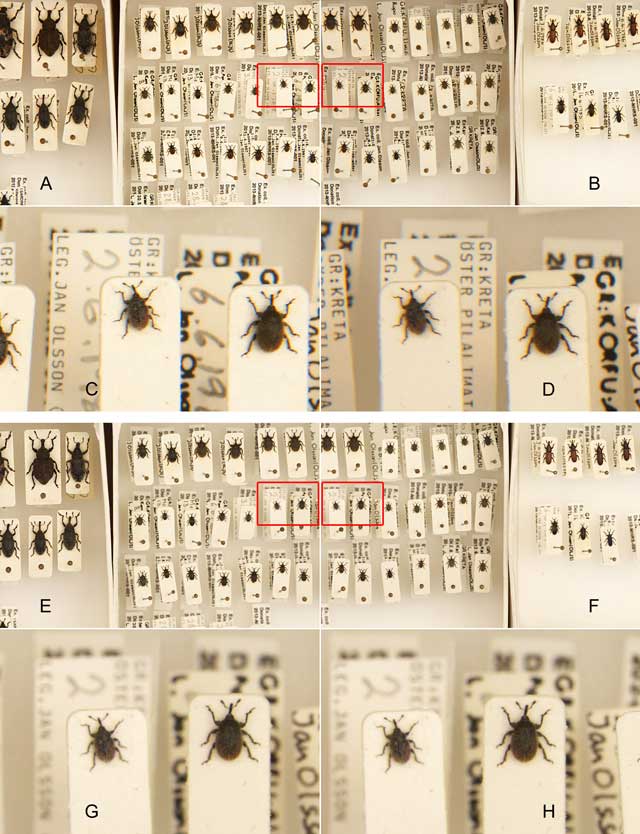
Figure 4
Differences in image rendering between conventional (A-D) and telecentric (E-H) lenses: A and B, a pair of overlapping input pictures taken with conventional lens; C and D, a pair of overlapping input pictures taken with telecentric lens; E and F, crops from overlapping portions of input pictures taken with conventional lens; G and H, crops from overlapping portions of input pictures taken with telecentric lens.
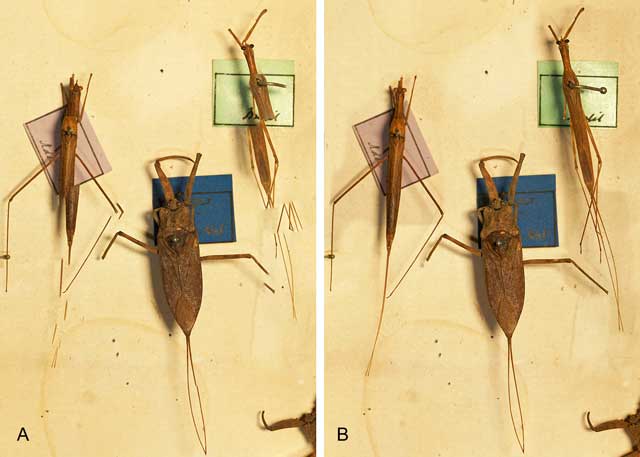
Figure 5
Examples of stitching artefacts of large insect specimens, which extend over several input images, caused by the use of conventional lenses and suboptimal software algorithms: A, unedited image; B, image after editing.
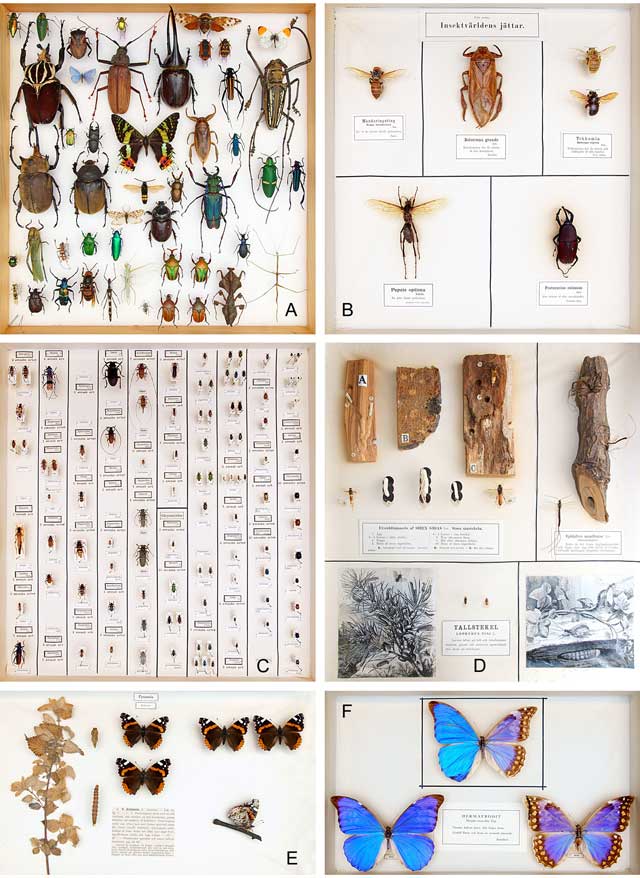
Figure 6
Examples of insect drawers with limited scientific but high aesthetic and educational potential: A, drawer with unlabelled large and colourful, mostly tropical insects showing a variety of shapes and sizes of different insect species; B, one of the drawers from the series ‘Giants of the Insect World’, showing the largest species from several different insect taxa; C, one of the drawers from the series on Swedish beetles, with each genus represented by one species, and the number of Swedish species mentioned on special labels; D, one of the drawers from the series dedicated to Hymenoptera, showing complete development cycle for one of the species; E, one of the drawers from a series on common butterflies, showing the different life stages and host plant of the Red Admiral; F, drawer showing hermaphrodite specimen alongside of normal female and male specimens of the Morpho butterfly.