
Introduction
Research Aim
This project aims to develop a workflow for creating immersive virtual museum exhibits that can be used for future projects undertaken by archaeology researchers and collaborators worldwide. The demonstrative project exhibits a collection of ten objects from a grave feature in the Necropolis of Baley in Bulgaria (Figure 1). In recent decades, interest in virtual exhibitions has been increasing, particularly with the technological developments in 3D and Virtual Reality glasses and goggles (Styliani et al. 2009; Schweibenz 2019; Carvajal et al. 2020). A virtual museum space can supplement physical museum spaces by displaying a larger quantity and diversity of objects as well as granting access worldwide. Furthermore, as research into virtual museums develops, the interest in educational aspects increases (Daniela 2020). The opportunities of these exhibitions are endless and they provide the user, or visitor, with an interactive experience that allows them to sometimes get a closer look at objects by zooming in and manipulating 3D objects that would otherwise not be possible with physical museum cases.

Figure 1
Location of the Necropolis of Baley in the North Western Region of Bulgaria.
Hundreds of important artifacts are kept in museum storage and have never been displayed. In the case of the Baley collection, artifacts are stored in different museums, which makes the logistics and documentation for a complete exhibition much more complicated. Virtual museum environments eliminate such obstacles allowing a deep and comprehensive look on the objects for users (Foo et. al. 2009). Virtual spaces can present the entire context of the research and cultural history of a collection without physical space limitations, giving the user the unique opportunity to immerse themself in the history and feel as a part of the research. Additionally, virtual museums and exhibitions are in their nature digital archives, which can be easily updated and developed as excavations and research continue (Koller et al. 2010). The digital archive of artifacts from this project serves to support the technical and historical documentation of the research projects. All the resulting data will be stored at the repository of the National Interdisciplinary Research E-Infrastructure for Bulgarian Language and Cultural Heritage Resources and Technologies integrated within European CLARIN and DARIAH infrastructures (CLaDA-BG) to be accessible for scientists in the same research area and also to the wide audience. The detailed workflow outlined in this paper will also be available to researchers through this framework.
Study Site
The archaeological site of Baley dates to the second millennium BC and includes a settlement and a necropolis. It is located in the western part of the Lower Danube region, in the modern village of Baley within the Vidin District of Bulgaria, and the site itself is situated on a dune on the right bank of the Timok River, approximately 2 kilometers south of the river’s confluence with the Danube River. The archaeological excavations of the Late Bronze Age settlement and several Early Iron Age features were undertaken over 18 seasons, from 1970 to 1989, and have since remained largely unpublished. The necropolis, on the other hand, was discovered in 2009 and archaeological investigations have continued from 2010 onwards. The necropolis is located approximately 500 meters southeast of the settlement.
The chronological division used for the site follows the periodization of the Bronze Age accepted in Bulgarian historiography (Alexandrov 2018). For the Late Bronze Age settlement, an area of 4100 square meters was excavated. The settlement had four main building levels denoted as IV, III, II, and I with some having sub-levels. The oldest levels are IVa/IVb, related to the first Late Bronze Age period, followed by levels III-Ib, related to the second Late Bronze Age period, and finally, level Ia, related to the third Late Bronze Age period and transition to Early Iron Age period. There was a hiatus between levels IV and III, which was likely caused by a flood. The Late Bronze Age archaeological material from these levels is related to what are known as encrusted pottery, Bistreţ – Işalniţa and Vârtop groups and cultures which show a gradual transition from the incised and encrusted pottery style to the so-called channeled pottery style. Stratigraphically, the Early Iron Age layers, related to the Basarabi phenomenon, cut the Late Bronze Age layers (Alexandrov et al. 2012). More than 1200 square meters were excavated in the necropolis area from its discovery up to 2022 and within the area, 164 graves and features related to mortuary practices have been investigated so far. Over the entire excavated area, archaeological evidence shows that the common burial practice was to perform an initial cremation outside the boundaries of the necropolis, followed by the collection of burnt bones from the pyre which were then cleaned and placed in one or multiple vessels used as urns and buried within the necropolis. The graves vary in size and include those with single, double, triple, and multiple burials within a single feature. According to the radiocarbon dates, four chronological groups in the necropolis can be established starting with the first half of the second millennium BC related to the Middle Bronze Age, the 15th century BC related to the first Late Bronze Age period, the 14–13th centuries BC related to the second Late Bronze Age period, and the 12–11th centuries BC related to third Late Bronze Age and transition to the Early Iron Age period (Alexandrov et al. 2016; Galabova & Atanassova-Timeva 2014). The selected feature for this project is Feature Number 123 which was discovered in 2020 in the central area of the necropolis (Figures 2 and 3).

Figure 2
Feature 123 in Situ after Excavation.

Figure 3
Technical Drawing of Feature 123.
Feature 123 is a multiple grave consisting of three urns, labeled 123A, 123B, and 123C. Urn 123A had burnt bones of a 20–50 year old female, urn 123B had burnt bones of an adult individual older than 18 years, and urn 123C had remains of both a newborn and a child aged 1 – 6 years old. Spherical amphorae covered with large bowls were used as urns in 123A and 123B. The remains of the newborn and the infant were placed in half of a so-called double vessel, likely covered with the bottom of the other half of the same vessel. The feature in discussion is considered very rich in its grave inventory compared to surrounding features. Alongside the bones in urn 123A, a clay ornithomorphic vessel and its lid as well as a bone needle were placed, and in urn 123B, two bronze hair rings. Additionally, three small kantharoi and a large bowl were found beneath and near the two large urns and a bone from a domesticated pig was also placed near urn 123A (Hristova et al. 2021). A radiocarbon date from the animal bone was obtained (SUERC-97459: 3002 ± 28 BP) that dates the grave to the 1380–1126 calBC period with 95.4% confidence. Considering the other radiocarbon dates obtained for graves from Group 3 of the necropolis, Feature 123 can most likely be dated to the 13th century BC.
All the archaeological materials from the feature were restored in the Laboratory for Analyses, Conservation, and Restoration of the National Archaeological Institute with Museum – Sofia (Penkova & Karamanova-Zlatkova 2021). The finds themselves are kept in the National Archaeological Institute with Museum – Bulgarian Academy of Sciences (NAIM-BAS) Prehistoric Depository. To date, the artifacts have not been on display to the public, and this virtual museum space is the first opportunity for dissemination of these important burial finds.
Methods
Photogrammetry & 3D Scanning
Each of the ten objects from Feature 123 were documented at the Archaeological Institute in Sofia using a combination of a handheld structured light scanner, photogrammetry, and 360° photography, using a robotic turntable. The 3D scanning was performed using a Creaform Go!SCAN scanner (Figure 4). All ten vessels were scanned on all sides, using markers for scale and the automated geometry orientation function. Two of the vessels have lids, which were scanned separately on both sides and were further processed to merge the sides together. The processing was done in the scanner’s native software package Creaform VX Elements (2022) Platform.

Figure 4
3D Scanning.
The scanner was set to a resolution of 0.5 millimeters, which provided a very detailed 3D surface. The limitation, however, of the 3D scanning was the resulting texture. The resolution of the texture was set to 100 DPI, but after the scanning was complete, the texture quality was not high enough for the research aims. To this end, the objects were also documented using photogrammetry to obtain a high-resolution texture that was later mapped onto the higher resolution 3D surface from the scanner. The photogrammetry was completed using a Nikon D500 DSLR camera with a Nikkor Micro 60 mm F2.8 lens on a Dr. Clauss Rodeon TurnTable (Figure 5).

Figure 5
Photogrammetry.
The resulting 3D models were optimized by combining the detailed mesh surface from the 3D scanner with the high-resolution photogrammetric texture (Figure 6). To do this, both the photogrammetry and 3D scan meshes were imported in Maxon ZBrush (2022), where they were oriented to overlap perfectly in the 3D space. The orientation of the models was performed manually within the software so they aligned in the 3D space. Since both the 3D scans and photogrammetric models were scaled, the overlap was seamless. The mesh from the scanner was decimated to reduce file size and loading times for online viewing while retaining the photo-realistic appearance for the viewer and fine detail on the surface from the photogrammetry (Figures 7 and 8). The final models are approximately 40 MB, compared to the original scanned models, which were up to 1 GB in size. Next, the scanned mesh was merged with the photogrammetry texture in Agisoft Metashape Pro (2022) and the final mesh was used for import in 3D Heritage Online Presenter (3DHOP) for online presentation and Autodesk 3DS Max (2021) for the virtual museum exhibit.

Figure 6
Texture mapping.

Figure 7
Object mesh in Agisoft Metashape.

Figure 8
Object texture in Agisoft Metashape.
The free open-source platform 3DHOP (ISTI-CNR Visual Computing Lab 2020) was selected to showcase the final 3D models due to its control features and capabilities to embed the links into web pages as well as the virtual exhibit (Potenziani et al. 2015). The individual OBJ files and textures as well as the raw photos and data were uploaded and stored on the Institute of Information and Communication Technologies (IICT) servers.
Designing the Virtual Museum
Although nothing can replace the real-life experience of cultural heritage in a museum or on-site, there are many benefits that a virtual museum or exhibition can provide to the user (Besoain et al. 2021). The virtual reality environment has the ability to immerse the user in the exhibit without being physically present and having the experience of being the sole observer of the display. In the digital world, users can experience heritage in a completely different way by approaching the objects, rotating them, viewing them on all sides, and exploring the traces left on them from the past and the restorations which were undertaken to preserve it for the future. Furthermore, more information can be included in the virtual space about the artifacts that would otherwise be possible with written display cards. This information can be included in such a way that depending on the interests of the user, they can have the choice to learn more about the objects they are viewing, whether it is history, conservation information, or the details of the material, size, or artistry of the artifact. At the same time, since this information can be embedded as expandable icons and hotspots, if a user simply prefers to focus solely on the artifacts themselves, the information will not be a visual distraction.
The interior of the virtual space and the narrative was designed collaboratively and rendered into its final product by an architect from IICT. The design for the Necropolis of Baley Virtual Museum desired clean lines, simple shapes, and neutral colors with discussion among multiple individuals of varying backgrounds to determine the ideal design for a comprehensive experience for diverse users. The design was presented and discussed at collaborative meetings between stakeholders with backgrounds in archaeology, museum studies, architecture, engineering, and computer science. Additionally, designs were presented to members of the public uninvolved in the project in order to obtain a diverse perspective on the most accessible and engaging design for the virtual space. In the end, compromises were made between the desired emphasis on the archaeological objects themselves while still preserving the virtual experience of being in a display room within a physical museum. A section of the produced webpage was dedicated to the objects alone for interested visitors who wish to focus only on the artifacts themselves without the virtual space.
The virtual space was designed and built completely in Autodesk 3DS Max (2021). The 360° panoramas for the virtual tour were rendered using FStormRender (Pinksoft. 2023) with minor post-processing in Adobe Photoshop (2022). Altogether, twelve panoramas were rendered for the virtual museum space, with each panorama having an 8K Ultra HD pixel resolution. Two panoramas represent each of the two rooms as well as a single panorama for each of the ten vessels on display. The resulting 360° by 180° panoramas were imported into Garden Gnome Pano2VR (2021) for the creation of the virtual tour. They were connected using hotspots for navigation. Additional info buttons and hotspots holding links were placed next to each artifact and graphic element. The 3D links lead to the 3DHOP platform for each object.
The size of the final HTML export for the tour is 71.7 MB. It was uploaded on the IICT servers and, similarly to the artifact models, the intention is to provide all of the data regarding the virtual tour and the virtual museum to the scientific e-infrastructure of ClaDa-BG. Since the virtual tour contains only images and links, no 3D data, the loading is relatively fast and it can be viewed seamlessly without long loading times getting in the way of the interactive experience.
Results
To showcase the results of this project, a website was created for the 3D and VR experience of the artifacts from the project: https://3dlab.iict.bas.bg/baley/. Within the website is the historical information of the site and the finds, the online catalog that includes the 3D models and 360° VR objects, and finally the virtual exhibition (Figure 9).

Figure 9
Example from the Online Catalog and Object Details Page.
The virtual museum is presented as a fully interactive panoramic virtual tour of the museum space. The museum can be viewed in multiple formats including desktop, mobile devices, and 3D glasses. The interactive elements of the tour allow the viewer to have the experience of walking through the exhibition space through the photorealistic rendered panoramas. The information hotspots, buttons, and signs, on the other hand, are rendered as holographic elements to preserve the interactive element that is a virtual environment without a physical space.
The virtual museum space currently consists of two rooms, the entry room and the exhibition room. This was done to place the focus entirely on the display features themselves: the texts, images, and graphics. The spaces are wide to allow a view of the entire space from the entrance, which makes the navigation in 3D much more natural. Niches are provided in the main exhibition hall to hold each vessel separately. The niches are colored in a contrasting hue to the material of the artifacts, complementing the idea of having the vessels as the main actors of the exhibition. The objects are displayed on the long parallel walls, allowing the user a complete 360° look at all of them upon entrance into the room. On the walls, graphic illustrations of the details of the incised ceramics are included to add decoration and information to the space. Finally, in the entrance room, there are short descriptions about the museum, the history of the site and necropolis, and Feature 123 specifically.
The design is simple, with dark color tones and soft lights, presenting the primary emphasis on the vessels themselves. The large space of the exhibition gallery allows the user to view all of the artifacts at once before moving closer to examine them individually. The museum narrative is presented through the historical context of the excavations of both the settlement and the necropolis. Upon entering the virtual space, the user is set in the entrance room which includes a map and information button for the history of the site on one wall (Figure 10). On the adjacent wall is a vector ground plan of the excavation area with the pits marked. On the back wall, there is a photo gallery of images from the excavation of Feature 123. Finally, on the last wall is the technical drawing and information about the feature along with the 3D button which presents the entire cremation in 3D as it was excavated in situ. Moving forward into the main gallery room all of the vessels are located on platforms along the two side walls (Figure 11). There are five objects on each wall displayed in 3D with their names below (Figure 12). Hotspots lead to each vessel for a closer examination where next to each displayed item is a set of buttons (Figure 13). The “Info” button presents the dedicated museum information about the object, such as catalog number, dimensions, materials, etc. The “3D” buttons open a link to the 3D catalog, where the user can fully manipulate the object: rotate it, relight it, remove the texture, make sections, and take measurements as desired (Figure 14). Two of the vessels have an additional button for “360”, which presents the object in 360° in two states – with and without their lid.

Figure 10
Entrance Room of the Virtual Exhibit.
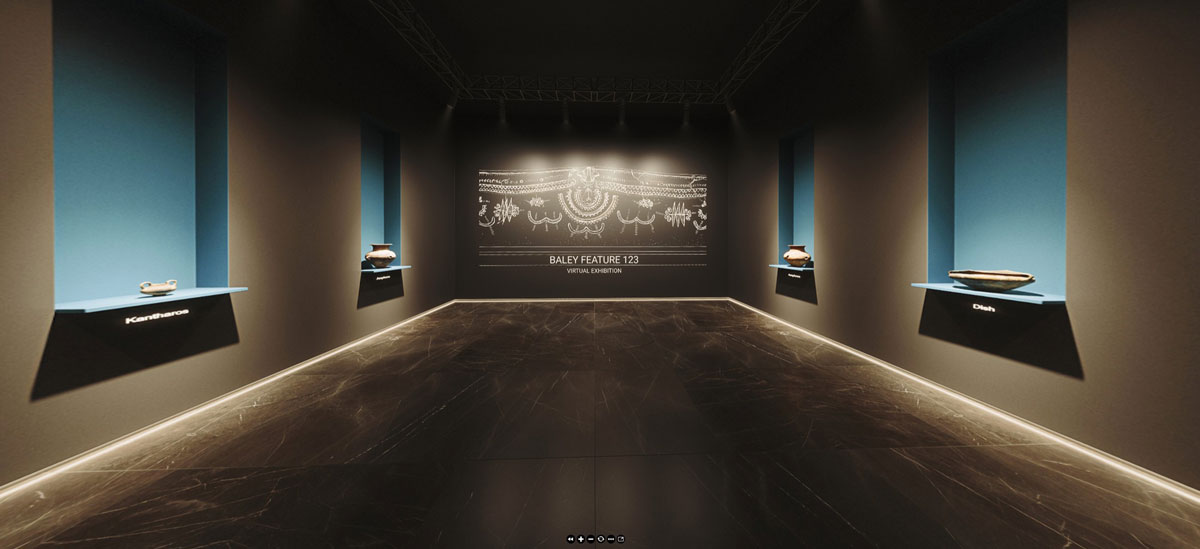
Figure 11
Display Room of the Virtual Exhibit.

Figure 12
Display Room of the Virtual Exhibit.

Figure 13
View of an Artifact in the Virtual Exhibit.

Figure 14
Manipulation Tools in 3DHOP (left: cross-section; right: measurement).
The resulting virtual museum is hosted by the Department of Scientific Computations with Laboratory on 3D Digitization and Microstructure Analysis at IICT. It is accessible through the website made specifically for this project. The complete collection of artifacts from previous excavations at this site are stored in both the National Archaeological Museum and the National History Museum in Sofia. As the digitization of the artifacts from the necropolis burial features continues, the project will be expanding the webpage and virtual museum space to “open” more exhibition rooms with the end goal of showcasing the entire collection of the Necropolis of Baley.
Discussion
Beyond the scientific, display, and educational aspects of collecting this digital data for virtual exhibits, these 3D objects also serve as a digital archive of the materials (Koller et al. 2010; Champion & Rahaman 2020). As this project continues, best practices are being developed regarding the storage of the data, the related metadata about each object, and how best to disseminate the information to scholars and the public. Currently, all of the data from the digitizations of the artifacts is stored on the servers of the 3D Laboratory at IICT. As mentioned above, all data will be additionally provided to the repository of the National Interdisciplinary Research E-Infrastructure for Bulgarian Language and Cultural Heritage Resources and Technologies integrated within European CLARIN and DARIAH infrastructures (CLaDA-BG). This includes all the raw collection data and processed files for the objects associated with the project as well as their archaeological and historical contexts and relevant metadata information. Additionally, a detailed description of the optimized computational workflow from imagery to the final virtual space as discussed will be provided so current and future researchers can use this as a base for their own virtual exhibitions. The inclusion of the raw imagery and scan data will allow for the objects to be re-processed as technology advances.
CLaDA-BG provides levels of access to cultural heritage resources for interested parties ranging from the public to academic researchers (Luchev et al. 2021). The repository provides archival digital storage, as well as tools for processing language and cultural heritage datasets. Currently, resources and technologies are being developed within the framework of CLaDA-BG for a variety of activities, such as creating descriptions and metadata for various objects from language resources, language technologies and collections related to cultural and historical heritage, transforming scanned documents and artifacts to a digitized representation, and contextualizing the data collections presented by adding temporal, spatial, and cultural-historical interpretations and facts to them (Simov, Osenova 2020; Nikolova 2022; Paneva-Marinova et. al. 2022). The services in ClaDa-BG projects are provided by complete infrastructure made by computer servers and storage. Each service is provided as an independent platform and daily incremental backup service is additionally available for ClaDa services or projects.
The methods developed during this project for the creation of the virtual museum for the artifacts from Feature 123 of the Necropolis of Baley collection provides a workflow for how to create virtual museums for other collections in the future. For the Necropolis of Baley, in particular, this virtual museum can be expanded to include the artifacts from other features within the same site without the limitations of brick and mortar museums relating to physical space. Once the infrastructure is in place at a given institution, virtual museums can be expanded with relative ease to display a larger collection of artifacts on demand which can be integrated with the historical context. The limitations associated with expanding virtual museums once the technological workflows and infrastructure are in place become access to the objects themselves and obtaining the necessary permissions to bring the objects out of storage for documentation. This process involves multiple people involved in the excavation, conservation, and preservation of the objects as well as funding for the activities involved in this process. While a virtual museum may not be able to completely replace a physical exhibition space, it serves as a support for disseminating important cultural heritage information to the public worldwide without having to travel to the country of origin. However, the accessibility that virtual museums provide differs from what is available at a brick and mortar museum. The virtual experience is as it states, virtual, and provides a very different engagement experience from real-life experiences. In this age of technological development, particularly in the realms of virtual and augmented reality, experiencing heritage both virtually and physically is subjective to the user and can vary dramatically across background, age, and interests.
Project Links
Necropolis of Baley Project Webpage: https://3dlab.iict.bas.bg/baley/.
Virtual Museum Exhibition: https://3dlab.iict.bas.bg/vrtours/BaleyVirtualExhibition/.
Acknowledgements
We acknowledge the access provided to the artifacts by the National Archaeological Institute with Museum and the access provided to the e-infrastructure of the Laboratory for 3D Digitization and Microstructural Analysis at IICT-BAS, Grant No BG05M20P001-1.001-0003. We would also like to express our graditude to Associate Professor Dr. Ivan Geogiev for his ongoing advice and support throughout this project.
Funding information
This project is funded by the Institute of Information and Communication Technologies, Bulgarian Academy of Sciences (IICT-BAS).
Competing Interests
The authors have no competing interests to declare.