
| QUESTION | HYPOTHESIS | SAMPLING PLAN | ANALYSIS PLAN | RATIONALE FOR DECIDING THE SENSITIVITY OF THE TEST FOR CONFIRMING OR DISCONFIRMING THE HYPOTHESIS | INTERPRETATION GIVEN DIFFERENT OUTCOMES | THEORY THAT COULD BE SHOWN WRONG BY THE OUTCOMES |
|---|---|---|---|---|---|---|
| How are perceived mental capabilities of animals related to their perceived edibility? | H1a: Greater perceived animal mental capabilities will be associated with lower perceived edibility. | The current study aims to recruit 1000 participants, well-powered enough to detect effects much weaker than the smallest effects in the target. See Power analysis section. | Pearson Correlation | We follow the statistical analysis of the original paper. | We examine the replicability of the findings of Bastian et al. (2012) Studies 1 and 2 based on the criteria used by LeBel et al. (2019). | The meat paradox is facilitated by the denial of food animals’ minds. |
| How are perceived mental capabilities of animals related to negative affect of eating them? | H1b: Greater perceived animal mental capabilities will be associated with greater negative affect regarding eating them. | |||||
| How are perceived mental capabilities of animals related to moral concern for animals? | H1c: Greater perceived animal mental capabilities will be associated with greater moral concern for animals. | |||||
| How does learning that an animal will be used for food affect perceptions of its mental capabilities? | H2: Learning that an animal will be used for food will lead to reduced perceptions of that animal’s mental capabilities. | Paired-Samples t-Test |
Table 1
Bastian et al. (2012) Studies 1 and 2: Summary of hypotheses.
| HYPOTHESIS | PREDICTION |
|---|---|
| 1a | Mind attribution is negatively associated with perceived edibility of animals. |
| 1b | Mind attribution is positively associated with negative affect regarding eating animals. |
| 1c | Mind attribution is positively associated with moral concern for animals. |
| 2 | Being told that animals will be raised for meat consumption (compared to being told they will live as grazing animals) leads to denial of mind for those animals. |
Table 2
Differences and similarities comparing the target article and the replication.
| BASTIAN ET AL. (2012) | REPLICATION | |
|---|---|---|
| Sample size | Study 1: 71 (after exclusion 63); Study 2: 66 | 1000 (959 after exclusion) |
| Geographic origin | Australian | Prolific (US) |
| Gender | 59 Females; 12 Males (before exclusion; not specified after exclusion) | 284 females, 264 males, 10 others, and 1 rather not disclose |
| Median age (years) | N/A | 37.00 |
| Mean age (years) | 19.13 | 40.00 |
| Standard deviation of age (years) | N/A | 14.00 |
| Age range (years) | 17–29 | 18–93 |
| Medium (location) | Australian University | Computer (online) |
| Compensation | N/A | 1.90 USD |
| Year | 2010 (estimate) | 2022 |
Table 3
Summary of study design and materials.
| Study 1 Replication | Animals 8 out of the following 32 (within-subject):
|
| DV1: Mental Capacities The degree to which each animal possessed 10 mental capacities (1 = Definitely does not possess, 7 = Definitely does possess; α = .81–.91 for different animals) 10 mental capacities: hunger, fear, pleasure, pain, rage, self-control, morality, memory, emotion recognition, planning DV2: Animal Edibility “Would you choose to eat this animal” and “Would you eat this animal if asked to?” (1 = Definitely would not, 7 = Definitely would) DV3: Negative affect “How bad would you feel if you ate this animal?” (1 = Not at all, 7 = Extremely) DV4: Moral concern “How morally wrong would it be to eat this animal” (1 = Not at all, 7 = Extremely) | |
| Study 2 Replication | IV (Within-Subjects): Animal Use Condition Food condition: Description that the animal will be taken to an abattoir and butchered as a meat product for human consumption. Nonfood condition: Description that the animal will be moved to other paddocks and will spend most of its time eating grass with other animals. |
| DV: Perceived Animal Mental Capabilities “To what extent does this animal possess the following mental capacities?” for 15 mental capacities (pleasure, fear, rage, joy, happiness, desires, wishes, planning, goals, pride, pain, hunger, tasting, seeing, hearing)(1 = Definitely does not possess; 7 = Definitely does possess; α = .88–.91 for different animals) |
Table 4
Summary of deviations between target article and current replication.
| DEVIATIONS | TARGET ARTICLE (BASTIAN ET AL., 2012) | REPLICATION | REASON FOR CHANGES |
|---|---|---|---|
| Study 1: Number of animals to rate | 32 animals. | Randomly select 8 out of 32 animals for each participant; we multiplied the required sample size by 4 in order to compensate for the modification. | Shorten survey, decrease participants’ cognitive load. |
| Study 1: List of Animals | 32 animals including “cow” and “sheep”. | Replaced “cow” and “sheep” with “Ox” and “Pig”. | Avoid repetition of animals (Studies 1 and 2 were combined). |
| Study 1: Measure Wordings | In Study 1, animal edibility item: “Would you choose to each this animal?”. | “each” was changed to “eat”. | A typo was detected in the original article. |
| Study 2: 5 min unrelated filler task | There was a 5 min unrelated task between two pictures in Study 2. | We did not implement 5 min unrelated filler task. | There was no indication of what that task was, and it was not indicated as theoretically or empirically important. Online participants have limited cognitive capacity and patience for long surveys, so we removed the unrelated filler task as a tradeoff for data quality. |
| Study 2: Manipulation Wording | In Study 2, the original manuscript was inconsistent regarding whether one of the animals was a sheep or lamb. | We used the label that was used in the actual original materials (“lamb”). | Following a helpful reviewer comment, we note that future work could determine if different labelling (sheep vs. lamb) might alter the results. |
| Study 2: Manipulation Check | No manipulation checks were included. | We included a manipulation check for each level of the IV. | It is possible that participants could miss the manipulated caption, particularly online. Thus, manipulation checks measure if participants read the scenarios carefully. |
| Studies 1 and 2: Item Randomization | Unclear if items for mental capacities in both Studies 1 and 2 were randomized. | Items for the mental capacities in both Studies 1 and 2 were randomized. | Prevent bias introduced by order and/or survey fatigue. |
| Attention Check | No attention checks were included. | Two attention checks were included. | Measures whether participants carefully read survey items, which can be an issue with online research. |
| Exclusion | Vegetarians were excluded at the end of the Study 1 survey. Exploratory analyses using exclusion criteria. | Vegetarians were excluded from participation in the survey, rather than just post-hoc. See the Exclusion Criteria section of the Supplementary Materials. | The research aims at non-vegetarians and non-vegans. Additional verification questions were added to increase data quality. We pre-registered that if we failed to find support for the hypotheses, we would also have examined the results using our exclusion criteria. |
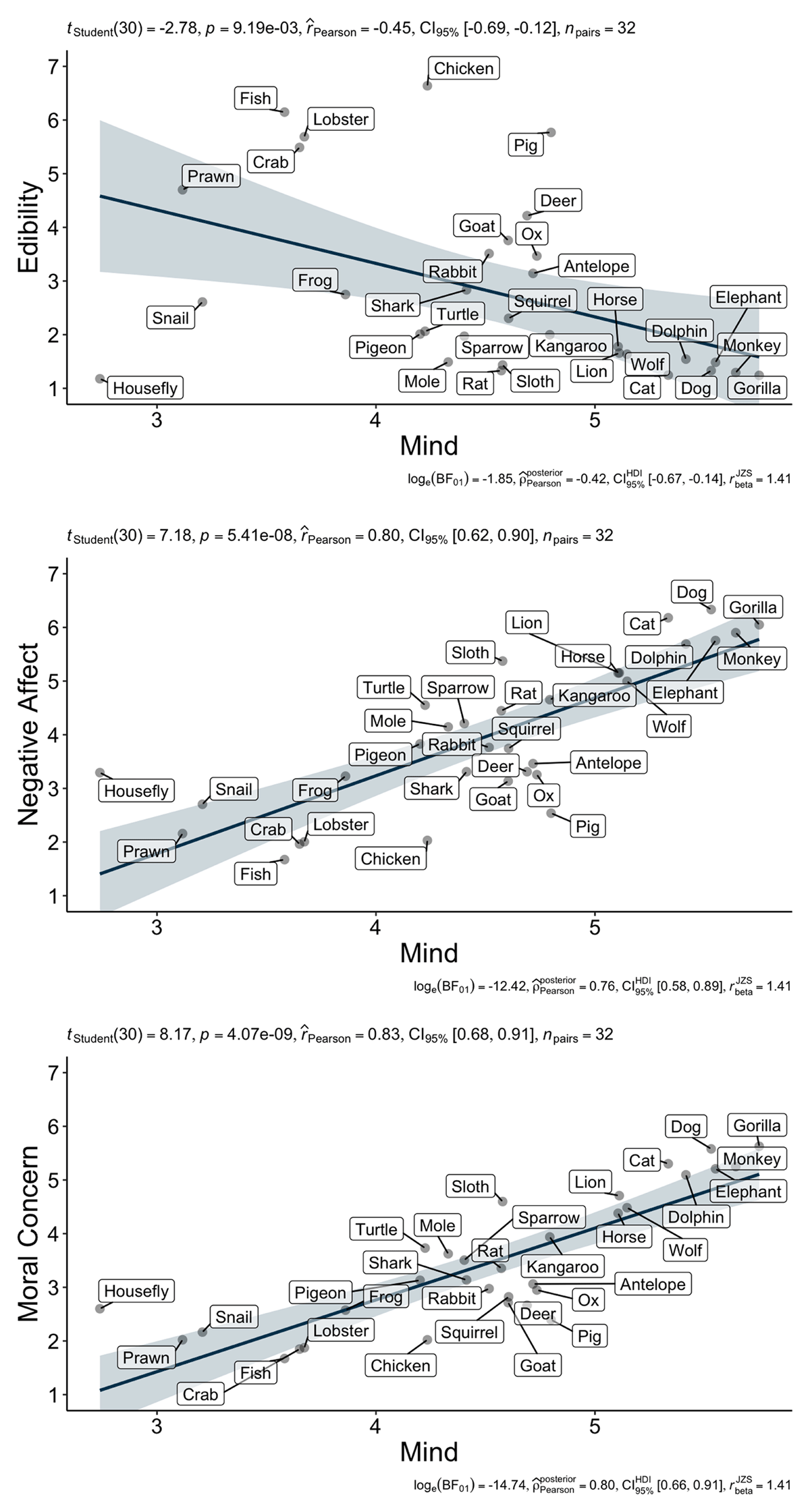
Figure 1
Study 1: Scatterplots of perceived mental capabilities’ associations with edibility, negative affect, and moral concern at the animal level.
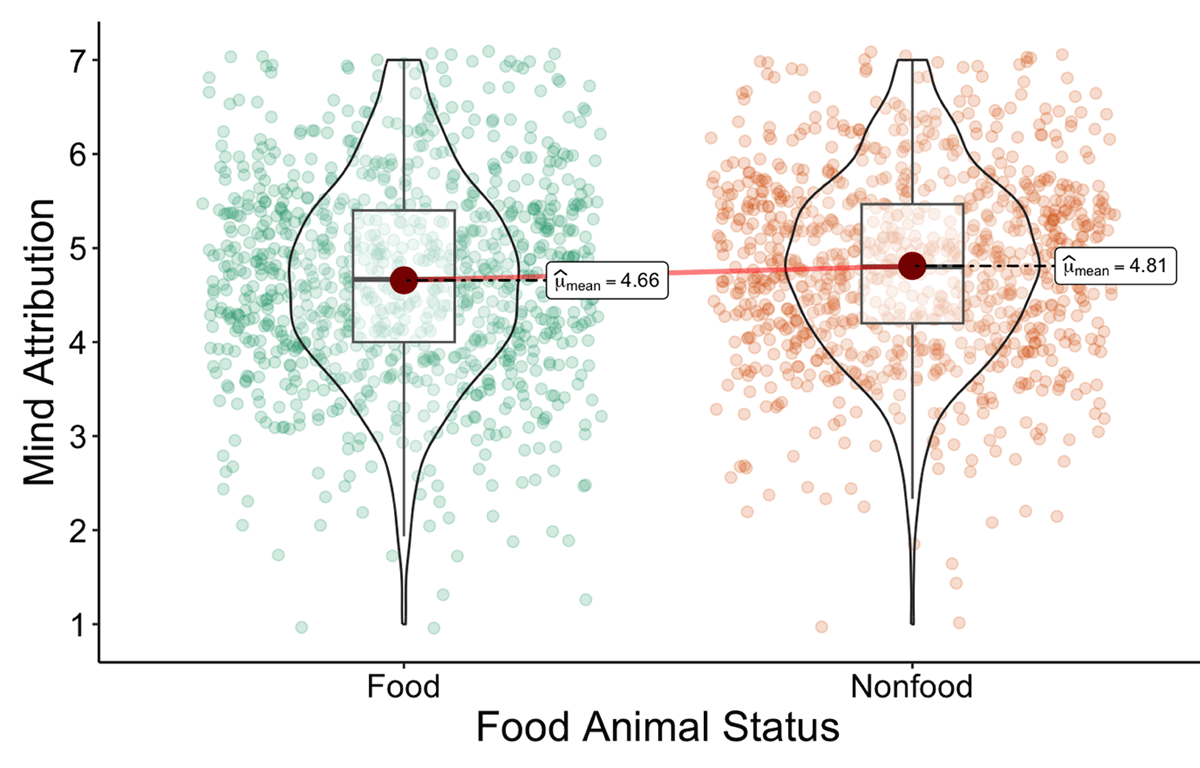
Figure 2
Study 2: Violin plot of the effect of animal food status on perceived animal mental capacities.
Table 5
Classification of the replication closeness, based on LeBel et al. (2018).
| DESIGN FACET | REPLICATION | DETAILS OF DEVIATION |
|---|---|---|
| Effect/hypothesis | Same | – |
| IV construct | Same | – |
| DV construct | Same | |
| IV operationalization | Similar | In the Study 1 replication, each participant rated 8 animals randomly selected out of 32 instead of rating all 32 animals. |
| DV operationalization | Similar | We randomized the presentation order of the mental capacity items in both Studies 1 and 2. |
| IV stimuli | Similar | In Study 1 replication, animal items “sheep” and “cow” were changed to “pig” and “ox”, given that the same animals were rated in Study 2. |
| DV stimuli | Similar | In Study 1 replication, one of the items on edibility, “Would you choose to each this animal?”, was corrected to “Would you choose to eat this animal?” |
| Procedural details | Different | 1) In the original study, participants in Studies 1 and 2 were separately recruited. Whereas in our replication, the same participants participated in both Studies. 2) The unrelated task between the cow/lamb ratings in Study 2 was eliminated. 3) Vegetarians and vegans were excluded from participation in the survey instead of at the end of the survey. 4) Manipulation and attention checks were added to the replication. |
| Physical settings | Different | In the original study, it was conducted on an Australian university campus. Whereas in our replication, the study was conducted on Qualtrics, completed by online Prolific participants. |
| Contextual variables | Different | |
| Replication classification | Very close replication | Based on the above analysis, we summarized our replications as a “very close” replication of the original studies. |
[i] Note. N = 959.
Table 6
Study 1: Summary of means, standard deviations, and correlations with animals’ perceived mental capacities at the participant level.
| VARIABLE | MEAN | SD | r | P | 95% CI Upper | 95% CI Lower |
|---|---|---|---|---|---|---|
| Mental Capacities | 4.53 | 1.00 | – | – | – | – |
| Animal Edibility | 2.79 | 1.18 | –.06 | .046 | –.001 | –.13 |
| Negative Affect | 4.00 | 1.55 | .25 | <.001 | .31 | .19 |
| Moral Concern | 3.47 | 1.61 | .24 | <.001 | .29 | .17 |
[i] Note. N = 959.
Table 7
Bastian et al. (2012) Studies 1 and 2: Summary of replication based on LeBel et al. (2019) criteria.
| H | HYPOTHESIS DESCRIPTION | METHOD | BASTIAN ET AL. (2012)’S EFFECT SIZE | REPLICATION EFFECT SIZE | REPLICATION EVALUATION |
|---|---|---|---|---|---|
| 1a | Mind attribution is negatively associated with perceived edibility of animals. | Pearson Correlation | r = –.42 | r = –.45 [–.69, –.12] | Signal-consistent |
| 1b | Mind attribution is positively associated with negative affect regarding eating animals. | Pearson Correlation | r = .77 | r = .80 [.62, .90] | Signal-consistent |
| 1c | Mind attribution is positively associated with moral concern for animals. | Pearson Correlation | r = .80 | r = .83 [.68, .91] | Signal-consistent |
| 2 | Being told that animals will be raised for meat consumption (compared to being told they will live as grazing animals) leads to denial of mind for those animals. | Paired Samples t-Test | d = 0.40 | d = 0.30 [.24, .37] | Signal-inconsistent, smaller |