
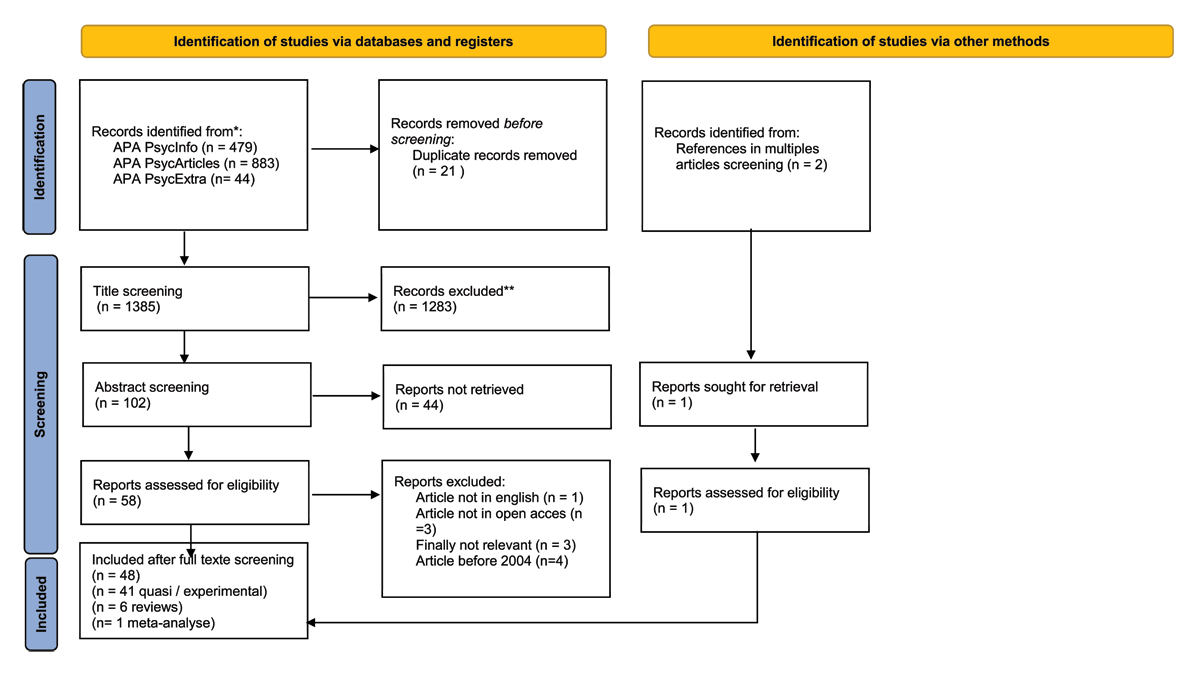
Figure 1
From: Page MJ, McKenzie JE, Bossuyt PM, Boutron I, Hoffmann TC, Mulrow CD, et al. The PRISMA 2020 statement: an updated guideline for reporting systematic reviews. BMJ 2021;372:n71. doi: 10.1136/bmj.n71. For more information, visit: http://www.prisma-statement.org/.
*Consider, if feasible to do so, reporting the number of records identified from each database or register searched (rather than the total number across all databases/registers).**If automation tools were used, indicate how many records were excluded by a human and how many were excluded by automation tools.
Table 1
Methods and main results of the 41 experimental articles included in the systematic review.
| AUTHORS | TITLE | DATE OF PUBLICATION | COUNTRY | PARTICIPANTS | METHOD | RESULTS |
|---|---|---|---|---|---|---|
| Griskevicius et al. | Going along versus going alone: When fundamental motives facilitate strategic (non)conformity | 2006 | USA | Study 1, N = 237 Study 2, N = 69 Study 3, N = 215 (students) | Judging the attractiveness of photos in an online chat room | Self protective mindset induce more conformity in both men and women. The goal to attract a mate reduces conformity in men but increases the likelihood that women will be more conforming. |
| Cress and Kimmerle | Guidelines and feedback in information exchange: The impact of behavioral anchors and descriptive norms in a social dilemma | 2007 | Germany | Study 1, N = 111 Study 2, N = 67 (students) | Online task presenting an information exchange dilemma | Participants regulate their behavior by conforming to others, becoming more or less cooperative depending on the salient norm. |
| Pronin et al. | Alone in a crowd of sheep: Asymmetric perceptions of conformity and their roots in an introspection illusion | 2007 | USA | Study 1, N = 44 Study 2, N = 40 Study 3, N = 44 Study 4, N = 64 Study 5, N = 92 (students) | Questionnaire on individual conformity perception, scenario reading on a project for university or the purchase of a fashionable item with majority opinion | Individuals perceive themselves less susceptible to influence than their peers Effect of social desirability. |
| Cinnirella and Green | Does ‘cyber-conformity’ vary cross-culturally? Exploring the effect of culture and communication medium on social conformity | 2007 | UK | N = 71 (students) | Asch paradigm in face to face or CMC (comunication-mediated by computer) | More conformity in the face to face and CMC conditions than in the control condition. More conformity in the face-to-face condition than in the other two conditions. Effect of culture in face to face condition: participants from individualist country conform less than participants from collectivist. |
| Galinsky et al. | Power reduces the press of the situation: Implications for creativity, conformity, and dissonance | 2008 | USA | Study 1, N = 52 Study 2, N = 75 Study 3, N = 45 Study 4, N = 72 (students) | Scenario-based power induction Creative task, tedious task, negotiation task | High power condition participants are more resistant to the majority. |
| Corriveau and Harris | Preschoolers (sometimes) defer to the majority in making simple perceptual judgments | 2010 | USA | Study 1, N = 40 Study 2, N = 40 (3–4-year-old preschoolers) | Asch paradigm adapted for children (video confederates) | Majority of children do not conform Negative judgment of adults’ poor video performance. |
| Pinel et al. | I-sharing and a classic conformity paradigm | 2010 | USA | N = 44 (women students) | Computer-based interaction Asch paradigm | More conformity in public responses than in private responses. More conformity in non-I-sharing condition than in I-sharing condition. |
| Mori and Arai | No need to fake it: Reproduction of the Asch experiment without confederates | 2010 | Japan | N = 26 (students) | Asch paradigm with fMori technique | Almost no conformity in men, rates similar to Asch (1956) for women. |
| Hanayama and Mori | Conformity of six-year- old children in the Asch experiment without using confederates | 2011 | Japan | N = 96 (6–7-year-old children) | Asch paradigm with fMori technique | Compared to the results of Mori and Arai (2010), boys conform more than adult males. Girls conform just as much. |
| Haun and Tomasello | Conformity to Peer Pressure in Preschool Children: Peer Pressure in Preschool Children | 2011 | Germany | Study 1, N = 96 Study 2, N = 72 (4-year-old preschooler) | Asch paradigm adapted to children (animal images) | Children conform more than a third of trials (study 1 and 2). |
| Täuber and Sassenberg | Newcomer conformity: How self-construal affects the alignment of cognition and behavior with group goals in novel groups | 2012 | Germany | N = 157 (students) | Computer-mediated workgroups with positive vs. negative feedback | Conformity is a function of self-image High levels of independent self-construction are associated with low cognitive and behavioral conformity to group goals in cooperative tasks. |
| Aramovich et al. | Opposing torture: Moral conviction and resistance to majority influence | 2012 | USA | N = 170 (students) | Online tchat (torture opinion) | More conformity in public responses than in private responses. Influence of majority present in post-test opinions. Moral conviction predicts resistance to majority opinion in public and in private. |
| Egermann et al. | The influence of social normative and informational feedback on musically induced emotions in an online music listening setting | 2013 | Germany | N = 5730 (all comers) | Online survey on music evaluations | Participants conform to the assessments of previous participants. Social feedback has more influence on participants’ conformity than informational feedback. |
| Heerdink et al. | On the social influence of emotions in groups: Interpersonal effects of anger and happiness on conformity versus deviance | 2013 | Netherlands | Study 1, N = 115 Study 2, N = 73 Study 3, N = 64 Study 4, N = 99 Study 5, N = 86 (students) | Scenario reading and questionnaire | More conformity in cooperative conditions than in competition. Emotions have a social function: anger expressed by the majority leads to a greater feeling of rejection, while joy leads to a greater feeling of acceptance. If an alternative group is possible, then the expression of the majority’s anger encourages individuals to leave the group. |
| Kundu and Cummins | Morality and conformity: The Asch paradigm applied to moral decisions | 2013 | USA | N = 33 (students) | Asch paradigm applied to moral dilemmas | Strong conformity effect on moral dilemmas. |
| Lisciandra et al. | Conformorality A study on group conditioning of normative judgment | 2013 | Germany | Pre-test, N = 68 Main Study 1, N = 97 (students) | Online questionnaire T1 and T2 (scenario evaluation) | More conformity on social norms and decency than on moral norms. More stable judgment on moral norms between T1 and T2. |
| Mori et al | Boys, be independent! Conformity development of Japanese children in the asch experiment without using confederates | 2014 | Japan | N = 20 (7th-grade junior high school pupils, 13–14 years old) | Asch paradigm with fMori technique | More errors from minority participants indicating that they conformed to the majority. Descriptive results show that girls conform more than boys (but no statistically significant results). |
| Yafai et al. | Social conformity and autism spectrum disorder: A child-friendly take on a classic study | 2014 | UK | N = 30 (15 autistic children- 15 typically developing children, 2 to 6 years-old) | Asch paradigm adapted to children (Haun & Tomasello, 2011) | Autistic children less compliant than typical children. No difference in performance between children on test trials. |
| Bos et al. | Reminders of behavioral disinhibition increase public conformity in the Asch paradigm and behavioral affiliation with ingroup members | 2015 | Netherlands | Study 1, N = 86 Study 2, N = 62 Study 3, N = 60 Study 4, N = 80 | Reminders of disinhibition or no disinhibition + Asch Paradigm | In deshinibition condition, participants conform more and have less social distance (more affiliation). |
| Tu & Fishbach | Words speak louder: Conforming to preferences more than actions | 2015 | USA | Study 1, N = 66 pairs Study 2, N = 190 pairs Study 3, N = 145 Study 4, N = 150 pairs Study 5, N = 244 Study 6, N = 220 | Choice of household products, choice of food, choice of crockery, choice of videos and questionnaire for private vs. public answers with a partner. | More conformity about preferences than about the actions of others. |
| Beckner et al. | Participants conform to humans but not to humanoid robots in an English past tense formation task | 2016 | New-Zeland | N = 78 (students native speakers of New Zealand English) | Asch experiment with visual and verbal task (condition robots, human, alone) with public and private responses. | More conformity in the presence of a human than a robot. More conformity if task is ambiguous. Visual task predicts verbal task. |
| Zhang et al. | Social anxiety, stress type, and conformity among adolescents | 2016 | China | N = 167 (10–16 year-old adolescents) | Asch paradigm modified with figures and no confederates | Strong conformity observed Interaction between social anxiety and stress type effects on conformity. |
| Kim et al. | Does children’s moral compass waver under social pressure? Using the conformity paradigm to test preschoolers’ moral and social- conventional judgments | 2016 | USA | N = 132 (4-year-old children) | Asch paradigm adapted for children | More conformity in social judgment than in moral judgment and visual judgment. No difference in conformity between moral judgment and visual judgment No ethnic difference. |
| Ng et al | Gratitude facilitates private conformity: A test of the social alignment hypothesis | 2016 | Singapore | Study 1, N = 212 Study 2, N = 331 (students) | Self-report of a memory Color discrimination questionnaire or shopping task | More conformity when reporting a grateful memory than when reporting joy and neutrality. More conformity observed in study 2 (shopping task) than in study 1 (color discrimination). |
| Kosloff et al. | Assessing relationships between conformity and meta-traits in an Asch- like paradigm | 2017 | USA | N = 205 (students) | Asch paradigm with online or face-to-face cartoon evaluation (private and public response) | More conformity in face-to-face condition than in online condition. Stability correlates positively with conformity in face-to-face condition. Positive correlation between Plasticity and Conformity in private evaluation only (no effect in other condiiton). |
| Botto and Rochat | Sensitivity to the evaluation of others emerges by 24 months | 2018 | USA | Study 1, N = 49 Study 2, N = 31 Study 3, N = 30 Study 4, N = 34 (14- to 24-month- old) | Robot task for children | Children as young as 24 months perceive public evaluation and are sensitive to information communicated by others. |
| Cordonier et al | Strong and strategic conformity understanding by 3- and 5-year-old children | 2018 | USA | Study 1, N = 39 (3 and 5-year-old children) Study 2, N = 17 (5-year-old children) Study 3, N = 31 (3 and 5-year-old children) | Third-person perspective paradigm. | Conformity is used as an affiliation strategy from the age of 5, not before (3-year-olds). |
| Hellmer et al. | Preschoolers’ conformity (and its motivation) is linked to own and parents’ personalities | 2018 | Sweden | N = 59 (3 and a half year- old children) | Personnality questionnaire (parents and children) Asch paradigm modified for children | Children of parents who self-identify as extroverts are less likely to conform. Children who were rated as more extroverted by their parents were more likely to conform due to normative reasons, while children rated at a higher level of openness tended to conform for informational reasons. |
| Ušto et al. | Replication of the ‘Asch effect’ in Bosnia and Herzegovina: Evidence for the moderating role of group similarity in conformity | 2019 | Bosnia-Herzegovina | N = 76 (political science students | Asch paradigm | Moderator effect of group similiraty (more conformity when majority in-group member (vs. out-group). Replication of Asch result (59% of participants conform at least once). |
| Kim et al | Using Remote Peers’ Influence to Promote Healthy Food Choices Among Preschoolers | 2019 | Singapore | N = 89 (3–6-year-old children) | Food choice judgment | Preschoolers conform to healthier food choices endorsed by distant peers. |
| Ivanchei et al. | Implicit learning in attractiveness evaluation: The role of conformity and analytical processing | 2019 | Russia | Study 1, N = 88 Study 2, N = 85 | Judging the attractiveness of photos | Conformity can be based on a reinforcement learning mechanism and also on unsupervised implicit learning. No difference between learning in a social context and learning without a social context. Implicit learning influences overt responses and also modifies internal criteria for assessing attractiveness. |
| Pham and Buchsbaum | Children’s use of majority information is influenced by pragmatic inferences and task domain | 2020 | Canaada | N = 250 (4 and 5 year-old children) | Langage or causal task with majority influence by videos clips | Children’s preference for majority evidence stronger for majority in the linguistic task than in the causal task. Children’s preference stronger when the majority explicitly rejects a choice (rather than in implicit, ignorance or hidden conditions). |
| Goodmon et al. | The power of the majority: Social conformity in sexual harassment punishment selection | 2020 | USA | N = 179 (art school students) | Asch paradigm applied to sexual harassment scenarios | 82.67% of participants conformed at least once with harsh or lenient punishment choices (incorrect punishment choices) in sexual harassment scenarios. |
| Kyrlitsias et al. | Social conformity in immersive virtual environments: The impact of agents’ gaze behavior | 2020 | Cyprus | N = 38 | Asch paradigm with virtual reality | Conformity has been observed in an IRV environment. 63.16% of participants conform with agents. |
| Sibilsky et al | Conformity decreases throughout middle childhood among ni- Vanuatu children: An intracultural comparison | 2021 | Vanuatu | N = 500 but exploitable 125 (5 to 11-year-old children) | Asch paradigm adapted to children (Haun & Tomasello, 2011) | The older the children, the less they follow the rules (public or private meetings). |
| Garcia et al. | Normative and informational influence in group decision making: Effects of majority opinion and anonymity on voting behavior and belief change | 2021 | USA | N = 241 (students) | Jury deliberation task with voting before and after debate | Change in vote is partially mediated by changes in the evaluation of the evidence (regardless of how participants voted in the initial survey). |
| Schreuter et al. | Trust me on this one: Conforming to conversational assistants | 2021 | Online survey | N = 163 | Online survey with general knowledge quiz | Participants conformed more with the human- voice assistant than with the robotic-voice assistant or the assistant that communicates via text. |
| Bolderdijk and Cornelissen | How do you know someone’s vegan?” They won’t always tell you. An empirical test of the do- gooder’s dilemma | 2022 | Netherlands | N = 93 (veg*an all comers) | Asch paradigm applied to food petition (vegan) | If the majority refuses to sign a petition in favour of vegan options, then vegetarian and vegan participants avoid signing. If the experimenter approved the vegan food options, participants did not conform to the majority (and signed the petition). |
| Qin et al. | Adults still can’t resist: A social robot can induce normative conformity | 2022 | China | N = 190 (undergraduate and graduate students) | Asch paradigm with 1 robot and 2 confederates | A robot in a minority position can lead to conformity, but less than if it were a human in a minority position. |
| Sah and Peng | Context-dependent Online Social Influence: Effect of Majority and Minority Comments on Posters and Lurkers | 2022 | Online survey | Pilot Study 1, N = 35 Pilot Study 2, N = 38 Main Study, N = 354 (321 exploitable) (college students) | Online survey | Participants in posters condition conformed more to the majority and participants in lurkers condition more to the minority opinion. More conformity when the majority is unanimous than when it is unbalanced (regardless of the posting or lurking condition). Moderating effect of group identification and need for cognition on conformity. |