
Table 1
Instructions for experimental conditions in Study 1.
| EXPERIMENTAL CONDITION | INSTRUCTION |
|---|---|
| Active Facebook use (N = 41) | We are interested in the way you use Facebook to post and communicate with others. So, for the next 10 minutes, we ask that you try using Facebook only for direct communication—for example, updating your status; reacting, sharing, and commenting on your friends’ posts; sending and responding to private messages; etc. In addition, we ask that you only use Facebook for direct communication and refrain from browsing, such as scrolling your news feed; looking at your friends’ profiles; looking up information; etc. While you are communicating directly on Facebook, we ask that you refrain from clicking on any links that will lead to non-Facebook sites. |
| Passive Facebook use (N = 39) | We are interested in the way you use Facebook to watch or read others’ contents. So, for the next 10 minutes, we ask that you try using Facebook only for browsing (without liking or commenting on anything)—for example, scrolling your news feed; looking at your friends’ profiles; looking up information; etc. In addition, we ask that you only use Facebook for browsing and refrain from posting or communicating with others, such as updating your status; reacting, sharing, and commenting on your friends’ posts; sending and responding to private messages; etc. While you are browsing on Facebook, we ask that you refrain from clicking on any links that will lead to non-Facebook sites. |
| Active Instagram use (N = 41) | We are interested in the way you use Instagram to post and communicate with others. So, for the next 10 minutes, we ask that you try using Instagram only for direct communication—for example, posting photos or videos; liking and commenting on your followers’ posts; sending and responding to direct messages; etc. In addition, we ask that you only use Instagram for direct communication and refrain from browsing, such as scrolling your news feed; looking at your followers’ profiles; looking up for information; etc. While you are communicating directly on Instagram, we ask that you refrain from clicking on any links that will lead to non-Instagram sites. |
| Passive Instagram use (N = 43) | We are interested in the way you use Instagram to watch or read others’ contents. So, for the next 10 minutes, we ask that you try using Instagram only for browsing (without liking or commenting on anything)—for example, scrolling your news feed; looking at your followers’ profiles; looking up for information; etc. In addition, we ask that you only use Instagram for browsing and refrain from posting or communicating with others, such as posting photos or videos; liking and commenting on your followers’ posts; sending and responding to direct messages; etc. While you are browsing on Instagram, we ask that you refrain from clicking on any links that will lead to non-Instagram sites. |
| Active Twitter use (N = 39) | We are interested in the way you use Twitter to post and communicate with others. So, for the next 10 minutes, we ask that you try using Twitter only for direct communication—for example, posting a Tweet; liking, retweeting, and/or replying to a Tweet; sending and responding to direct messages; etc. In addition, we ask that you only use Twitter for direct communication and refrain from browsing, such as scrolling your news feed; looking at your followers’ profiles; looking up for information; etc. While you are communicating directly on Twitter, we ask that you refrain from clicking on any links that will lead to non-Twitter sites. |
| Passive Twitter use (N = 41) | We are interested in the way you use Twitter to watch or read others’ contents. So, for the next 10 minutes, we ask that you try using Twitter only for browsing (without liking or commenting on anything)—for example, scrolling your news feed; looking at your followers’ profiles; looking up for information; etc. In addition, we ask that you only use Twitter for browsing and refrain from posting or communicating with others, such as posting a Tweet; liking, retweeting, and/or replying to a Tweet; sending and responding to direct messages; etc. While you are browsing on Twitter, we ask that you refrain from clicking on any links that will lead to non-Twitter sites. |
Table 2
Descriptive statistics for satisfaction with life in Study 1.
| SNS | USAGE | T1 SWLM(SD) | T2 SWLM(SD) |
|---|---|---|---|
| Active | 4.18 (1.41) | 4.20 (1.46) | |
| Passive | 4.27 (1.28) | 4.07 (1.40) | |
| Active | 4.06 (1.42) | 3.98 (1.35) | |
| Passive | 4.35 (1.20) | 4.31 (1.22) | |
| Active | 4.11 (1.37) | 4.08 (1.47) | |
| Passive | 3.77 (1.63) | 3.80 (1.64) |
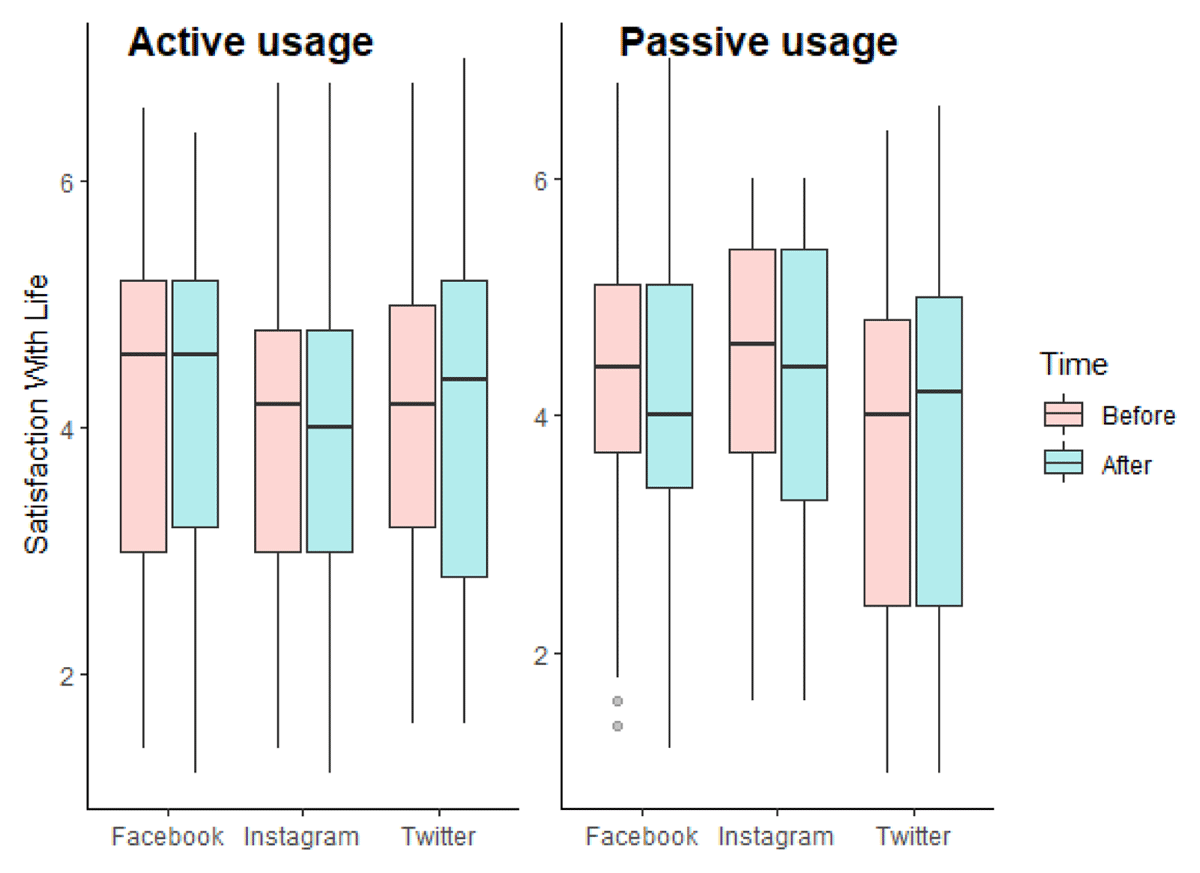
Figure 1
Boxplots of satisfaction with life according to the experimental conditions in Study 1.
Table 3
Model-averaged results for satisfaction with life in Study 1.
| EFFECTS | BFEXCL |
|---|---|
| Time | 3.18 |
| SNS | 2.17 |
| Usage | 2.33 |
| Age | 0.43 |
| Gender | 1.20 |
| Time*SNS | 13.69 |
| Time*Usage | 6.03 |
| SNS*Usage | 1.46 |
| Time*SNS*Usage | 2.31 |
Table 4
Descriptive statistics for positive affect in Study 1.
| SNS | USAGE | T1 PA M(SD) | T2 PA M(SD) |
|---|---|---|---|
| Active | 2.93 (0.76) | 2.94 (0.81) | |
| Passive | 2.88 (0.82) | 2.74 (0.91) | |
| Active | 2.95 (0.70) | 2.95 (0.86) | |
| Passive | 2.83 (0.77) | 2.77 (0.76) | |
| Active | 3.11 (0.83) | 2.97 (0.81) | |
| Passive | 2.88 (0.70) | 2.85 (0.73) |
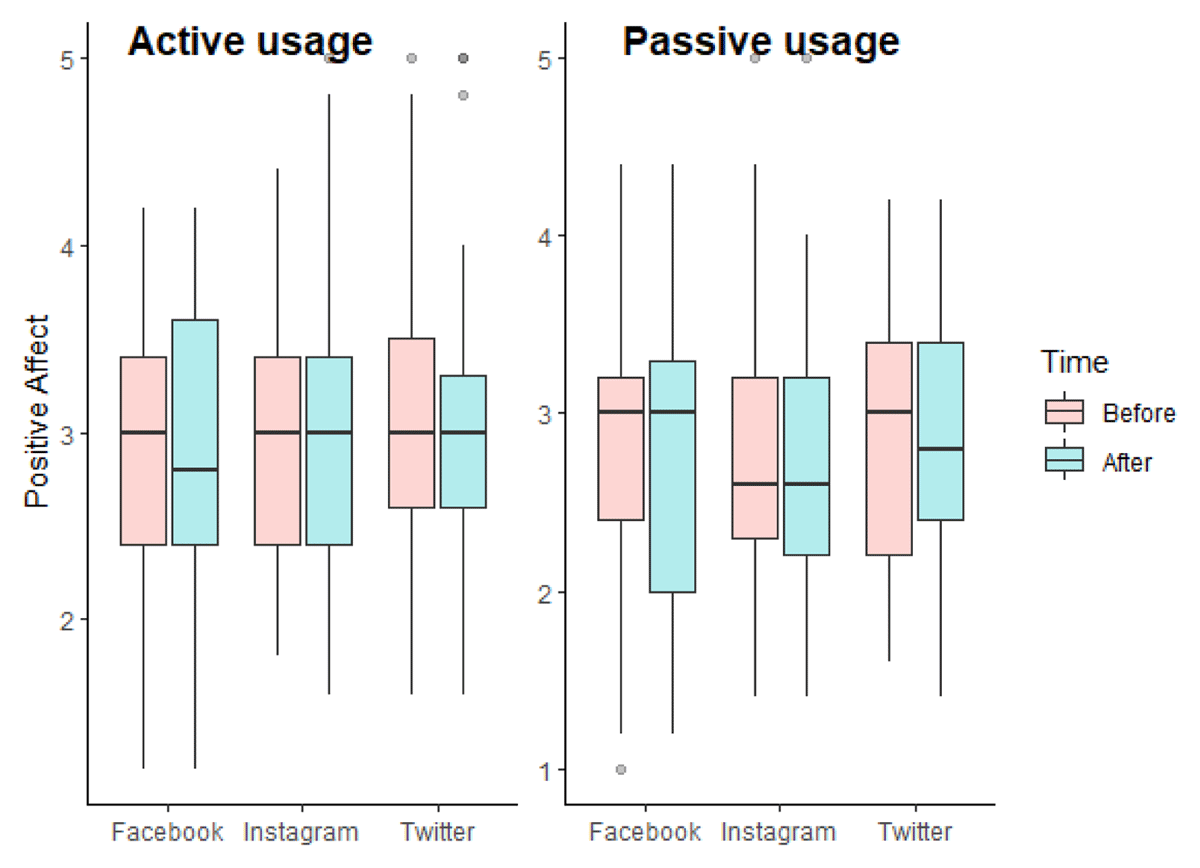
Figure 2
Boxplots of positive affect according to the experimental conditions in Study 1.
Table 5
Model-averaged results for positive affect in Study 1.
| EFFECTS | BFEXCL |
|---|---|
| Time | 2.3 |
| SNS | 6.37 |
| Usage | 1.36 |
| Age | 2.06 |
| Gender | 3.21 |
| Time*SNS | 19.32 |
| Time*Usage | 6.83 |
| SNS*Usage | 4.77 |
| Time*SNS*Usage | 5.28 |
Table 6
Descriptive statistics for negative affect in Study 1.
| SNS | USAGE | T1 NA M(SD) | T2 NA M(SD) |
|---|---|---|---|
| Active | 1.78 (0.87) | 1.73 (0.85) | |
| Passive | 1.41 (0.66) | 1.46 (0.69) | |
| Active | 1.61 (0.59) | 1.49 (0.52) | |
| Passive | 1.61 (0.77) | 1.62 (0.69) | |
| Active | 1.95 (0.76) | 1.93 (0.87) | |
| Passive | 1.80 (0.83) | 1.80 (0.78) |
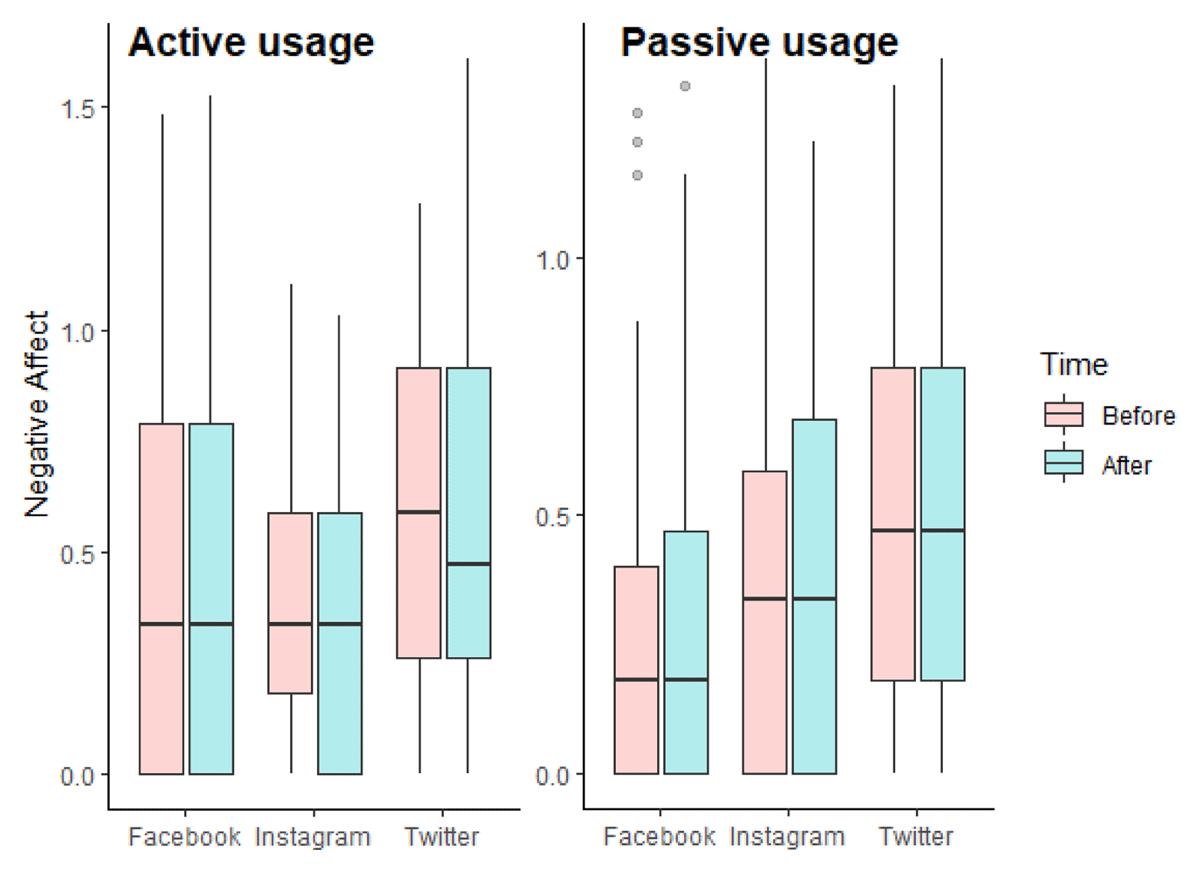
Figure 3
Boxplots of log-transformed negative affect according to the experimental conditions in Study 1.
Table 7
Model-averaged results for negative affect in Study 1.
| EFFECTS | BFEXCL |
|---|---|
| Time | 6.24 |
| SNS | 0.15 |
| Usage | 1.01 |
| Age | 0.01 |
| Gender | 0.21 |
| Time*SNS | 20.46 |
| Time*Usage | 1.01 |
| SNS*Usage | 2.69 |
| Time*SNS*Usage | 12.46 |
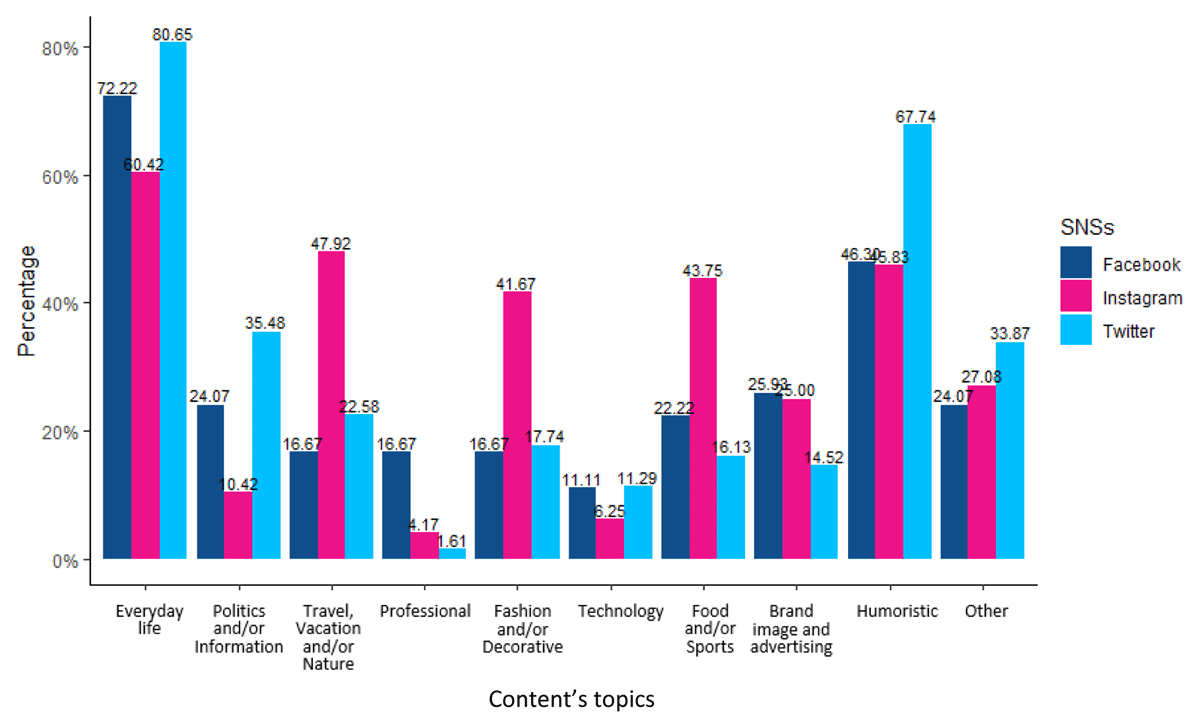
Figure 4
Content topics according to the SNS.
Table 8
Descriptive statistics for satisfaction with life in Study 2.
| SNS | USAGE | T1 SWL M(SD) | T2 SWL M(SD) |
|---|---|---|---|
| Active | 4.65 (1.39) | 4.63 (1.43) | |
| Passive | 4.66 (1.12) | 4.46 (1.24) | |
| Active | 4.53 (1.56) | 4.57 (1.58) | |
| Passive | 4.45 (1.33) | 4.30 (1.41) | |
| Active | 4.56 (1.28) | 4.50 (1.27) | |
| Passive | 4.54 (1.15) | 4.51 (1.19) |
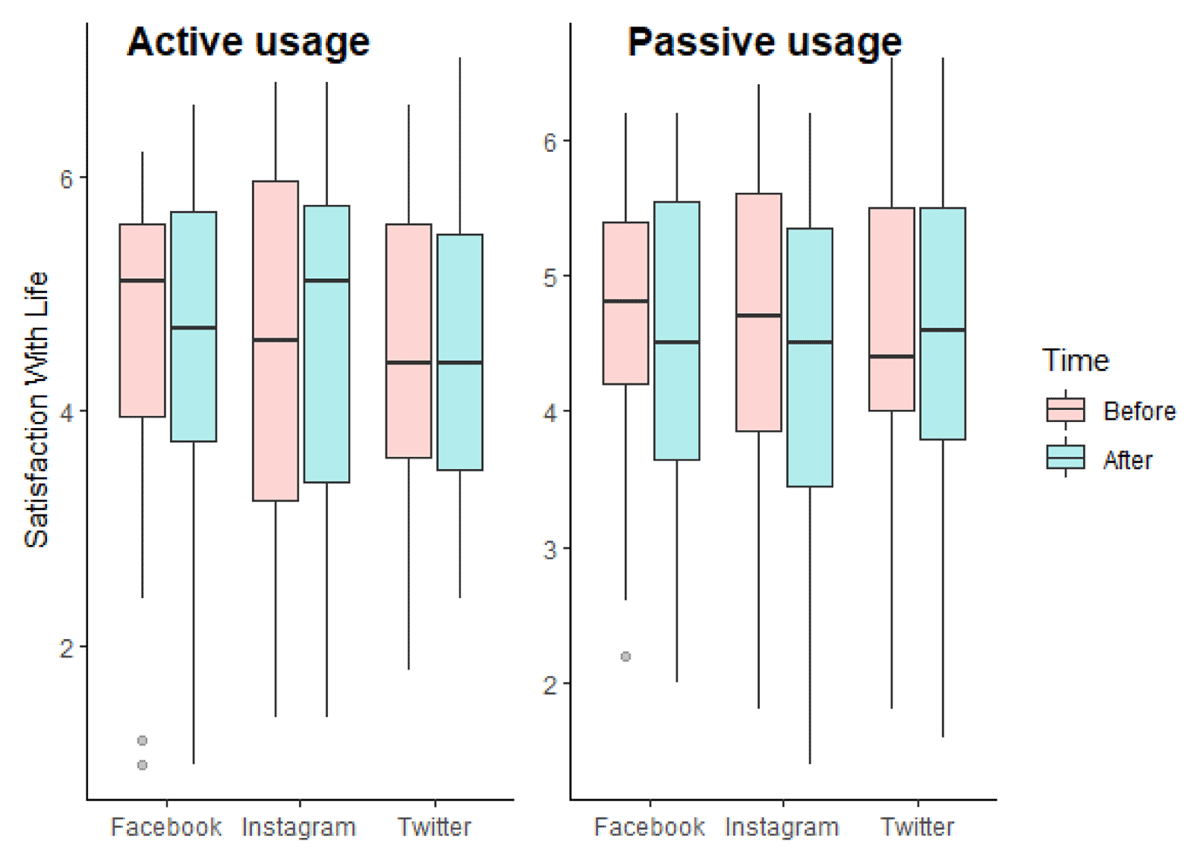
Figure 5
Boxplots of satisfaction with life according to the experimental conditions in Study 2.
Table 9
Model-averaged results for satisfaction with life in Study 2.
| EFFECTS | BFEXCL |
|---|---|
| Time | 1.74 |
| SNS | 2.34 |
| Usage | 2.24 |
| Age | 0.04 |
| Men vs. Women | 2.89 |
| Another vs. Women | 0.11 |
| Content’s valence | .005 |
| Time*SNS | 12.97 |
| Time*Usage | 2.48 |
| SNS*Usage | 1.76 |
| Time*SNS*Usage | 3.44 |
Table 10
Descriptive statistics for positive affect in Study 2.
| SNS | USAGE | T1 PA M(SD) | T2 PA M(SD) |
|---|---|---|---|
| Active | 3.66 (0.57) | 3.57 (0.69) | |
| Passive | 3.42 (0.63) | 3.24 (0.65) | |
| Active | 3.30 (0.66) | 3.19 (0.73) | |
| Passive | 3.25 (0.82) | 3.08 (0.84) | |
| Active | 3.22 (0.48) | 3.13 (0.70) | |
| Passive | 3.62 (0.55) | 3.29 (0.78) |
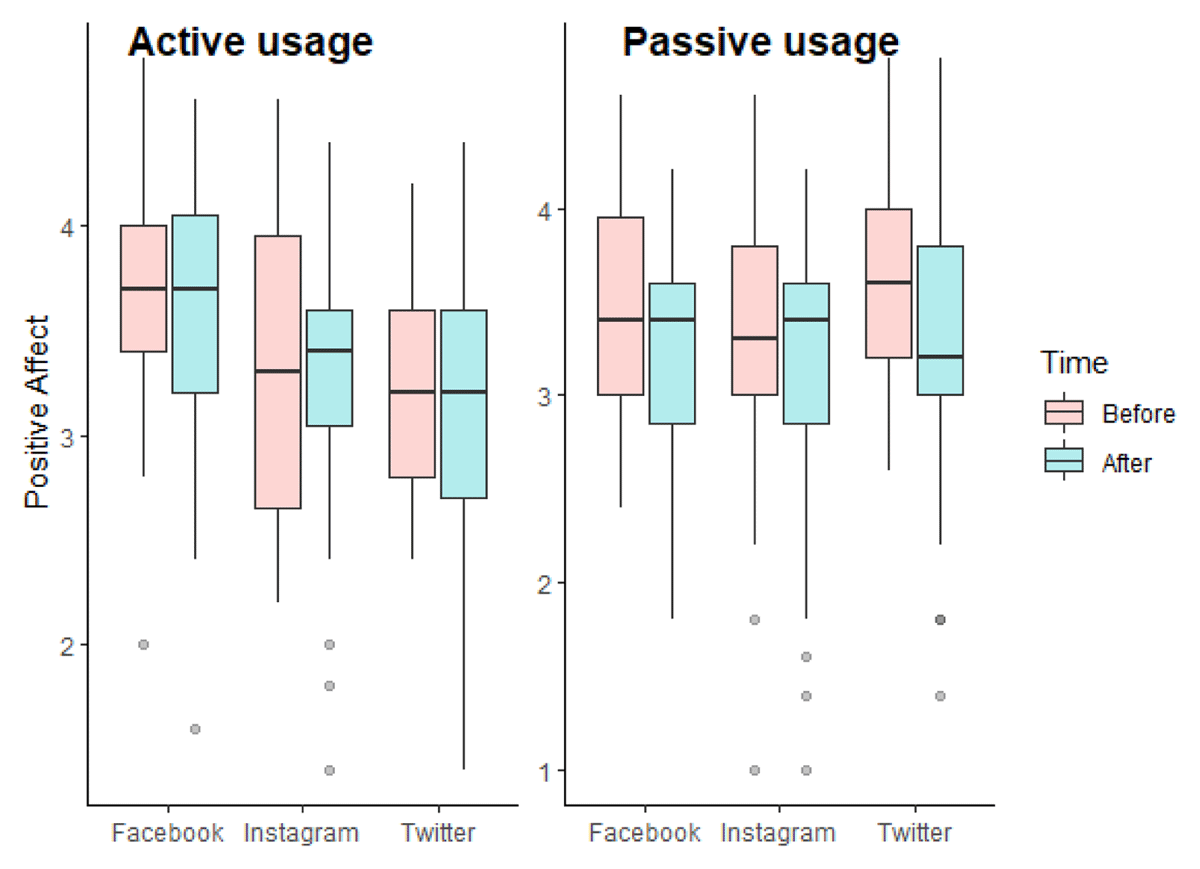
Figure 6
Boxplots of positive affect according to the experimental conditions in Study 2.
Table 11
Model-averaged results for positive affect in Study 2.
| EFFECTS | BFEXCL |
|---|---|
| Time | 0.0003 |
| SNS | 0.87 |
| Usage | 3.50 |
| Age | 1.21 |
| Men vs Women | 2.53 |
| Another vs Women | 2.38 |
| Content’s valence | 1.87 |
| Time*SNS | 10.64 |
| Time*Usage | 1.38 |
| SNS*Usage | 0.56 |
| Time*SNS*Usage | 5.31 |
Table 12
Descriptive statistics for negative affect in Study 2.
| SNS | USAGE | T1 NA M(SD) | T2 NA M(SD) |
|---|---|---|---|
| Active | 2.49 (0.79) | 2.26 (0.76) | |
| Passive | 2.37 (0.90) | 2.22 (0.76) | |
| Active | 2.58 (0.74) | 2.29 (0.87) | |
| Passive | 2.28 (0.87) | 2.27 (0.99) | |
| Active | 2.31 (0.74) | 2.21 (0.81) | |
| Passive | 2.19 (0.81) | 2.05 (0.82) |
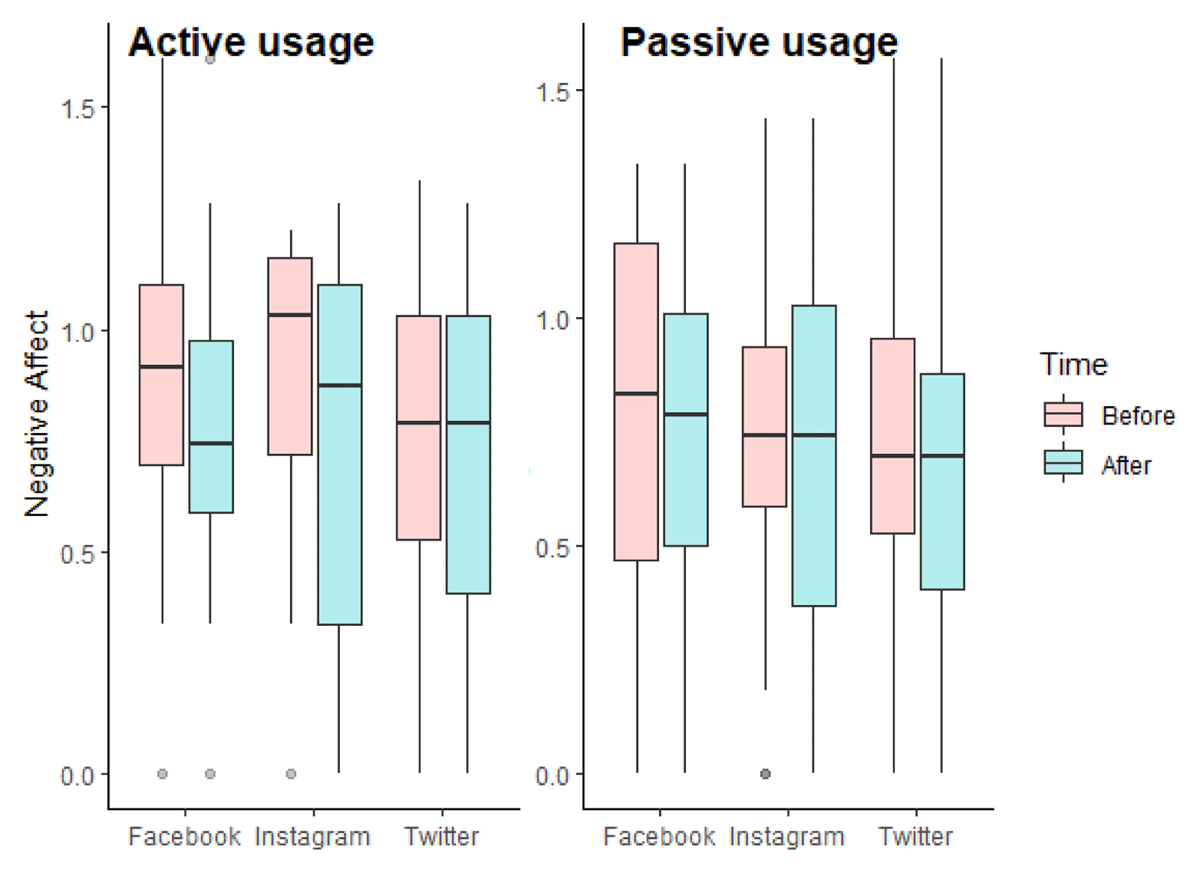
Figure 7
Boxplots of log-transformed negative affect according to the experimental conditions in Study 2.