Have a personal or library account? Click to login
Implementation process and challenges for the community-based integrated care system in Japan Cover

Implementation process and challenges for the community-based integrated care system in Japan

By: Takako Tsutsui  
Open Access
|Jan 2014

Figures & Tables

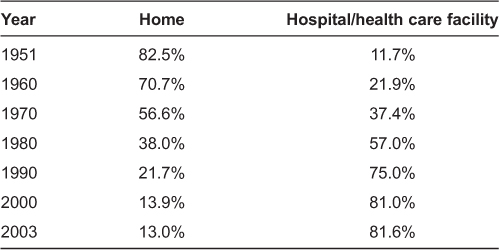
Table 1.

Evolution in terms of places where life ends, 1951–2003

figures/IJIC-14-2014002-g001.jpg
Table 2.

Evolution of benefits and project in LTCIS

figures/IJIC-14-2014002-g002.jpg

Abbreviation: LTCIS, Long-Term Care Insurance System.

*The municipalities are responsible for managing all these benefits.

**The first group of insurance premium concerns people aged 65+. The premium's amount varies depending on the municipality. The second group of insurance premium concerns people aged 40–65 years old. The premium's amount for this group is unique across the whole country.

***Preventive care benefits are provided to elderly persons requiring support, which means people in ‘support level 1’ and ‘support level 2’ categories of the LTCIS (the two lowest need categories). These two categories do not grant access to services in long-term care facilities but grant access to the same types of home care services that people with higher care needs may use (people in care levels 1–5). The category determines the maximum amount of services that is covered by the LTCIS.
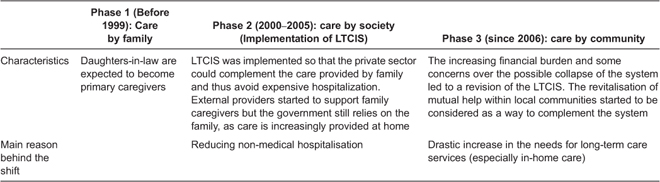
Table 3.

Evolution of care for the elderly and reasons behind the shifts

figures/IJIC-14-2014002-g003.jpg

Abbreviation: LTCIS, Long-Term Care Insurance System.

DOI: https://doi.org/10.5334/ijic.988 | Journal eISSN: 1568-4156
Language: English
Submitted on: Jul 31, 2012
Accepted on: Nov 12, 2013
Published on: Jan 20, 2014
Published by: Igitur publishing
In partnership with: Paradigm Publishing Services
Publication frequency: 4 issues per year

© 2014 Takako Tsutsui, published by Igitur publishing
This work is licensed under the Creative Commons Attribution 4.0 License.