
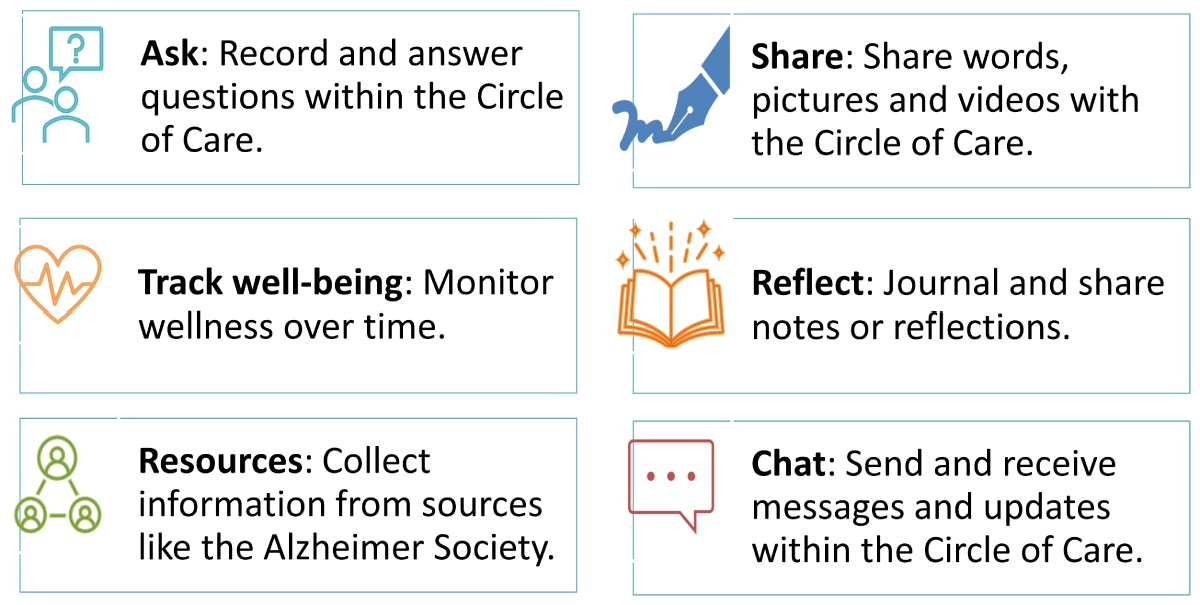
Figure 1
The six features of the ODJJ resource.
Table 1
Description of delivery sites.
| LTC COMMUNITIES | FIRST NATION COMMUNITIES | SOUTH ASIAN COMMUNITIES |
|---|---|---|
| Site 1: Calgary, Alberta. 20-bed dementia care unit. Site 2: Red Deer, Alberta. 24-bed dementia care unit. | Sites 1, 2 and 3: Robinson-Huron Treaty area on the North Shore of Lake Huron in Ontario, represented by the Mamaweswen North Shore Tribal Council. The sites have 140–1,000 Band Member residents. | Site 1: Brampton and Mississauga, Ontario. Adult Day Program. Site 2: Brampton, Ontario. Organization offering support to PLWD and their caregivers. |
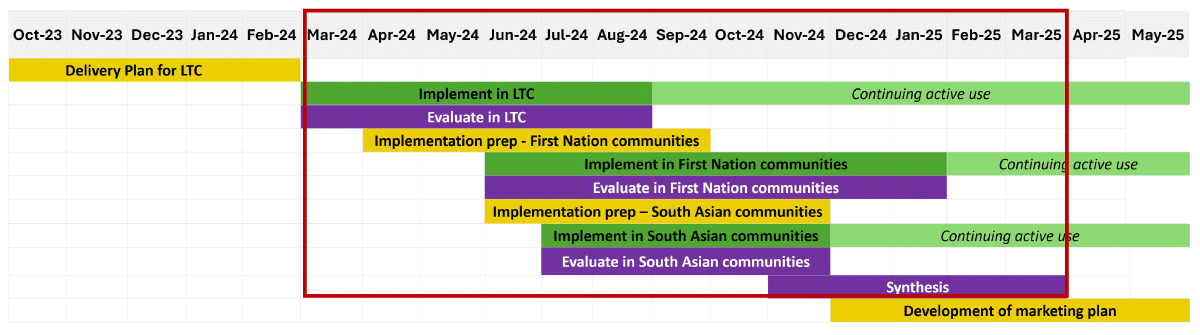
Figure 2
Project timeline.
Table 2
Alignment of Formative Evaluation Questions with CFIR Constructs and Data Sources.
| FORMATIVE EVALUATION QUESTION | CFIR CONSTRUCTS [17] | DATA SOURCE |
|---|---|---|
| What components of the implementation approach were successful, and which required adjustments? | Individual Domain
| Delivery Team debriefs Pre-post Surveys Interviews Focus Groups |
| How do people use the ODJJ resource? | — | Pre-post Surveys Interviews Focus Groups |
Table 3
Site Delivery Team members.
| SITES | SITE DELIVERY TEAM MEMBERS |
|---|---|
| LTC Site 1 | Site Director, Resident Care Manager, Clinical Educator, Director of Care, Therapeutic Recreation Manager |
| LTC Site 2 | Site Director, Clinical Educator, Wellness Manager, General Manager |
| First Nations Sites 1, 2, 3 | FNIM Program Community Engagement Liaison, Community Champions (Elders), Director of Home and Community Care |
| South Asian Site 1 | Two Health Service Managers, two Client Care Counselors, Psychogeriatric Resource Consultant |
| South Asian Site 2 | Psychogeriatric Resource Consultant (from Site 1), Senior Manager of Health Promotion and Prevention |
Table 4
Baseline implementation plan for each site.
| SITES | FACILITATORS & BARRIERS | ROLES & GOALS | TAILORING STRATEGIES | ATTRACTING & ENCOURAGING PARTICIPATION |
|---|---|---|---|---|
| LTC Sites 1 and 2 | Primary facilitators: LTC Site 1: a collaborative team. LTC Site 2: Commitment to person-centred care Anticipated barriers: staff workload, caregiver burnout, privacy concerns, and technology security. | No clear roles and responsibilities and no implementation milestones or goals were documented. | ODJJ orientation e-learning module available for staff. ODJJ was in a binder in the rooms of PLWD. | In-person ODJJ orientations with 20-minute presentation for caregivers and staff. Promotional materials included posters, newsletters, and a display board. |
| First Nations Sites 1, 2, 3 | Primary facilitator: Trust in the Site Delivery Team. Anticipated barriers: fear of talking about dementia, leadership challenges, decreased community visiting, and historical factors. | The roles included as-needed support from Community Champions, and the FNIM Liaison checking in throughout the pilot. The goal was to support even just one person. | 1:1 personalized, ODJJ orientations with relational conversation to build trust with caregivers. Caregivers provided with First Nation version in binders in their home. | Community Champions recruited potential users. ODJJ orientation was a 2-hour culturally safe “tea and talk” focused on caregiver needs. Promoting use was primarily by word-of-mouth. |
| South Asian Site 1 | Primary facilitator: Existing daily connections. Anticipated barriers: caregiver burnout, staff turnover, and dementia stigma. | Lack of clear roles and responsibilities for connecting with caregivers to support use. No milestones or goals recorded. | All resources and materials were provided in English, Hindi, and Punjabi. The ODJJ was used to communicate about activities in Adult Day Program. | A 2-hour in-person ODJJ orientation session for caregivers first. Staff were oriented through online orientation videos. Promotional materials included posters, display board, and reminders at meetings. |
| South Asian Site 2 | Primary facilitator: Commitment to being a supportive dementia community. Anticipated barriers: caregiver burnout, staff turnover, dementia stigma, and limited human resources. | No clear roles and responsibilities and no implementation milestones or goals were documented. | All resources and communication materials were provided in English, Hindi, and Punjabi. Volunteers’ involvement supported use and spread. | A 2-hour in-person ODJJ orientation session for caregivers first. Staff were oriented through online orientation videos. Promotional materials included posters and phone call reminders. |
Table 5
Descriptive Statistics for the C-DEMQOL scale.
| MEASURE | TIME 1 | TIME 2 | DIFFERENCE | COHEN’S d | ||
|---|---|---|---|---|---|---|
| N = 18 | MEAN | SD | MEAN | SD | MEAN | dz |
| C-DEMQOL Total* | 66.00 | 6.90 | 83.60 | 19.50 | 17.59 | 0.82 |
| Personal Needs* | 2.32 | 0.45 | 2.80 | 0.85 | 0.48 | 0.50 |
| Wellbeing | 2.27 | 0.43 | 2.58 | 0.87 | 0.31 | 0.35 |
| Relationship with PLWD* | 2.15 | 0.37 | 3.20 | 0.10 | 1.05 | 0.86 |
| Confidence in Future | 2.26 | 0.41 | 2.48 | 0.71 | 0.22 | 0.33 |
| Feeling Supported* | 2.07 | 0.45 | 3.04 | 0.94 | 0.97 | 0.90 |