
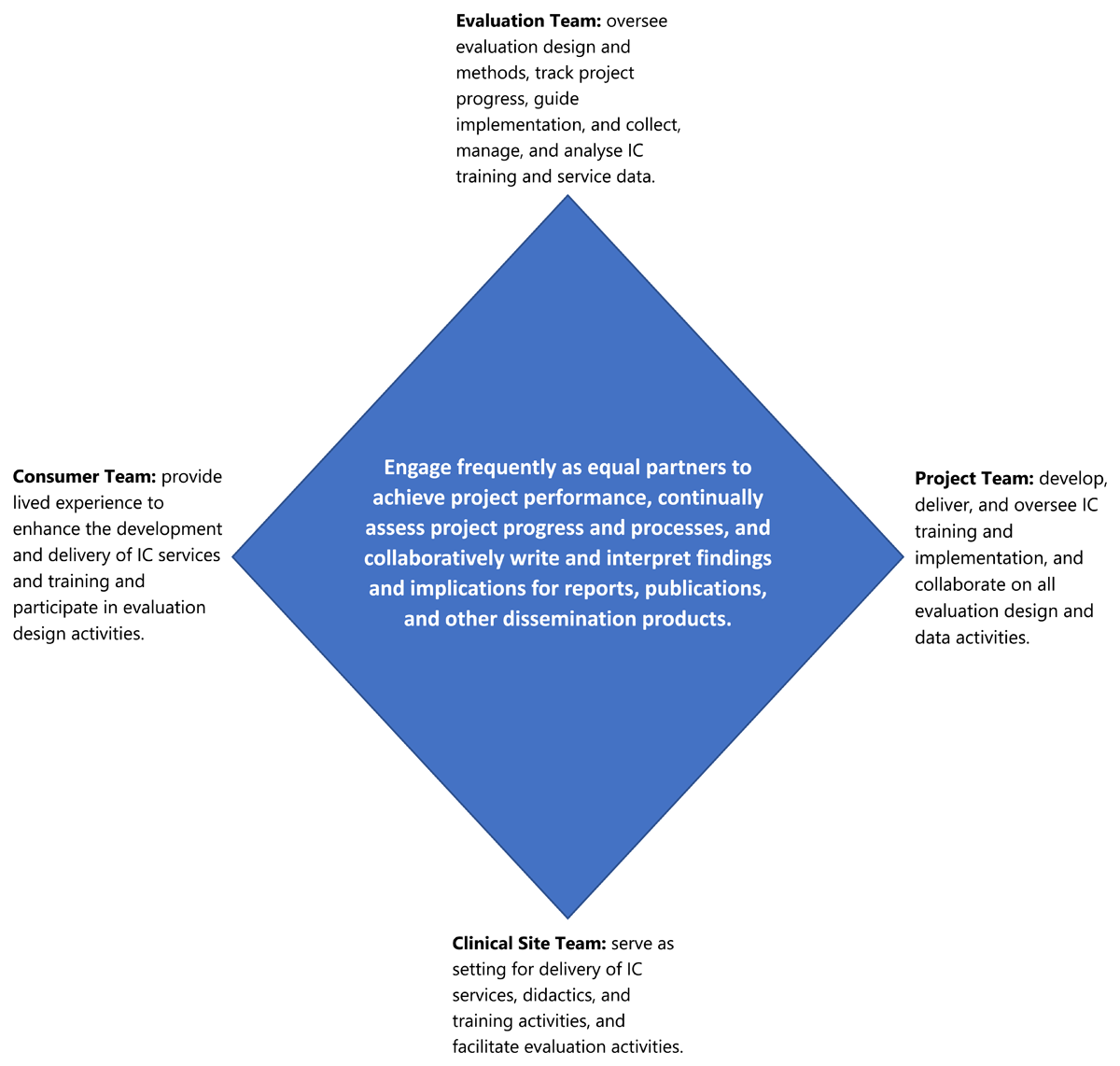
Figure 1
The RICE Research Framework: Engaging as Equal Partners Approach.
Table 1
The RICE Research Framework: Data Source Triangulation.
| SOURCE | PRIMARY DATA | SECONDARY DATA | ||||
|---|---|---|---|---|---|---|
| CLINICAL SITES | PROJECT TEAM | CLINICAL SITES | ||||
| SITE LEADER DATA | PROVIDER AND TRAINEE DATA | PATIENT AND CONSUMER DATA | PATIENT DATA | COMMUNITY DATA | ||
| Areas of Focus | Attitudes about IC, key health conditions, and patient populations | Attitudes about IC, key health conditions, and patient populations | Barriers and facilitators (individual, system) of IC program access | Implementation challenges and strategies | Behavioural health disorder rates and care patterns (using procedure codes) | Sociodemographic characteristics from public sources (e.g., US Census Bureau) |
| Barriers and facilitators (individual, system) of implementing and sustaining IC programs | Demographic and training backgrounds | Patient, family and caregiver preferences for IC and service delivery | Demographic and training backgrounds | Disparities or population-specific needs by race, gender, insurance, etc. | Medically underserved area definitions | |
| Clinical competencies and activities | Treatment and outcome data (health service databases) | |||||
| Methods | Focus groups and in-depth interviews | Focus groups and in-depth interviews | Focus groups and in-depth interviews | Real-time continuous quality improvement cycles | Extraction, transfer, and cleaning of medical records | Extraction, cleaning, and linking of public data sources |
| Surveys | Surveys | Surveys | Surveys | Pretest/posttest or time series designs to assess changes over time | Pretest/posttest or time series designs to assess changes over time | |
| Needs assessments and feasibility analyses | Pretest/posttest designs to assess changes over time | Needs assessments | ||||