Have a personal or library account? Click to login
Integrated Care in Epilepsy Management: A Scoping Review of the Models and Components of Health and Social Care Delivery Cover

Integrated Care in Epilepsy Management: A Scoping Review of the Models and Components of Health and Social Care Delivery

Open Access
|Mar 2024

Figures & Tables

Table 1

Inclusion and exclusion criteria for study selection in scoping review.

Inclusion criteria:
  • Articles reporting on epilepsy as a key focus, although may be applicable to other long-term and complex conditions

  • Articles articulating a definition or description of the concept or principles of integrated care (and related terms like coordinated care)

  • Articles describing a model of care, or components of an integrated approach to improve the organisation and delivery of care in epilepsy, that has been put into practice or is being recommended

Exclusion criteria:
  • Articles reporting on biomedical or clinical studies, or articles that are meta-analyses

  • Articles published prior to 2010

  • Editorials, commentaries, letters, conference abstracts

  • Grey literature

  • No full-text available

  • Languages other than English

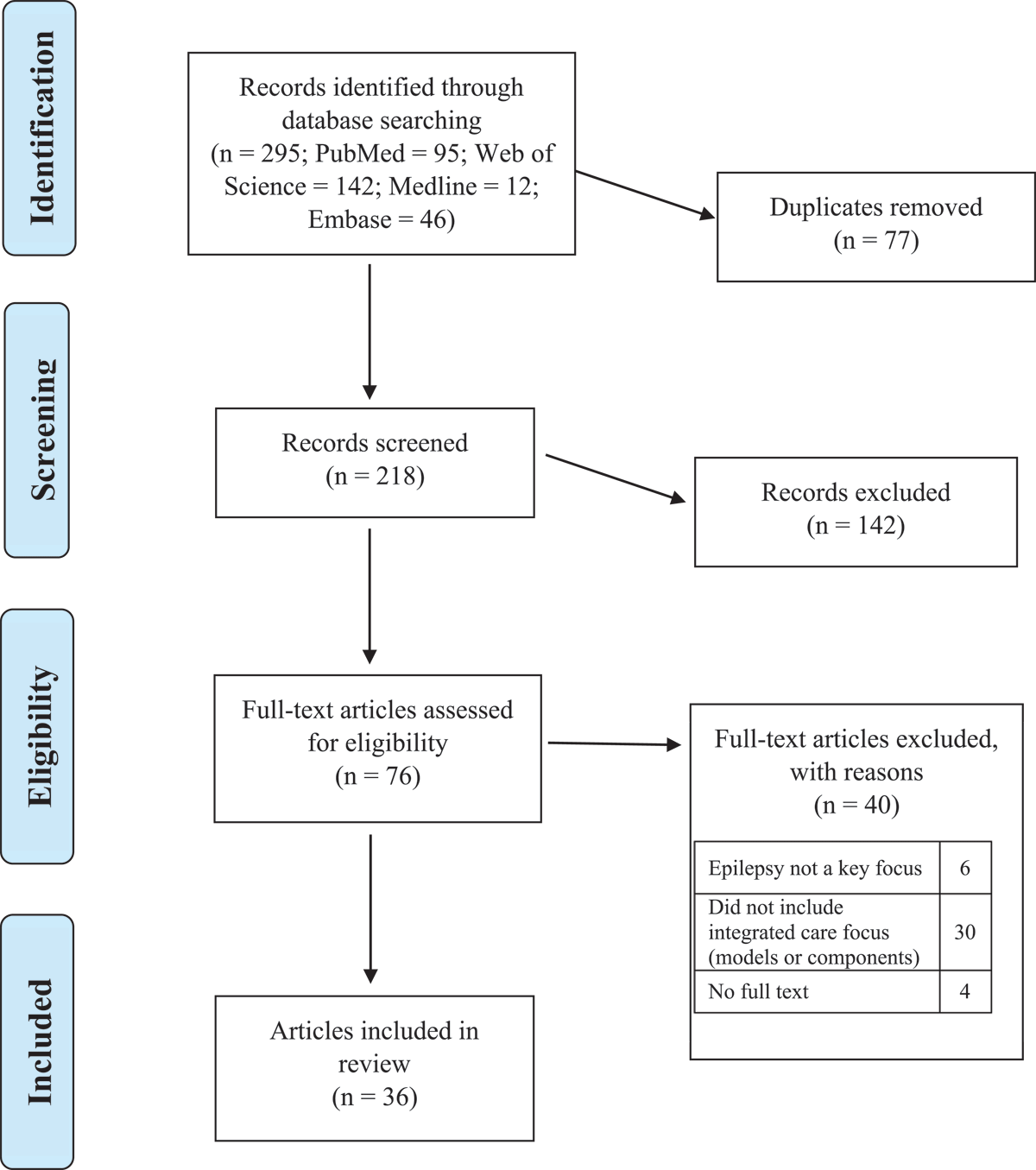
ijic-24-1-7659-g1.png
Figure 1

PRISMA flowchart displaying the process of identification and selection of included articles.

Table 2

Frequency of study characteristics included in scoping review.

STUDY CHARACTERISTICS (N = 36)n (%)
Publication year
2010–20136 (17)
2014–20175 (14)
2018–202225 (69)
Study location
Europe21 (58)
North America11 (31)
Australia3 (8)
South America1 (3)
Article type or study design*
Descriptive16 (44)
Literature review8 (22)
Retrospective cohort7 (19)
Prospective cohort2 (6)
Narrative review2 (6)
Synthesis of expert recommendations1 (3)
Delphi1 (3)
Case study1 (3)
Case series1 (3)
Implementation or recommendation focus
Refers to implemented model of care10 (28)
Refers to implemented components, but not full models, of care9 (25)
Recommends new model of care that is not implemented5 (14)
Recommends new components, but not full models, of care, that are not implemented12 (33)
Components of integrated care
Healthcare staff & pathways
Multidisciplinary teams22 (61)
Cross-sector collaboration19 (53)
CPGs or care pathways13 (36)
Epilepsy nurses7 (19)
Tasks & services
Psychosocial services19 (53)
Care coordination13 (36)
Care management plans11 (31)
Transition services5 (14)
Surgical evaluation3 (8)
Education & engagement
Shared decision making19 (53)
Education for PLWE and families15 (42)
Education for HCPs13 (36)
Technology for diagnosis & communication
Shared electronic medical records12 (33)
Telehealth8 (22)
Digital health tools5 (14)

[i] N, total number of articles included in scoping review; n, number of articles included in the frequency analysis; CPGs, clinical practice guidelines; PLWE, people living with epilepsy; HCPs, healthcare professionals.

* Three articles utilised more than one type of study design.

Table 3

Implemented models of integrated care in epilepsy management.

IMPLEMENTED MODELCOMPONENTS*
National Clinical Programme for Epilepsy
[424647484950]
  • Cross-sector collaboration: community supports, secondary care, tertiary care

  • MDTs: nursing, primary care, neurology, epileptology, emergency medicine

  • CPGs & care pathways: Integrated care pathway for emergency department seizure management

  • ENs: triage and connect PLWE with services across sectors

  • Care coordination: often performed by nurse or EN

  • CMPs: ENs play a key role in assessing care arrangements

  • Education for HCPs: education on care pathways for new and junior staff

  • Education for PLWE & families: education sessions provided by HCPs

  • SDM: facilitated by EN and through CMPs

  • Telehealth: telephone advice line virtual clinics to enhance communication between HCPs

  • Shared EMRs: shared across epilepsy services to improve care coordination

Epilepsy nurse-led model [42]
  • Cross-sector collaboration: primary, secondary, tertiary care sectors

  • MDTs: doctors, specialists, nurses, ENs

  • Care coordination: ENs coordinate care across health and social care services

  • Psychological services: ENs provide psychological and wellbeing support

  • CMPs: ENs complete comprehensive treatment assessments

  • Education for PLWE & families: ENs provide person-centred education to promote confidence to self-manage

  • SDM: ENs engage in SDM with PLWE and families to enhance care outcomes

  • Telehealth: ENs operate telephone advice lines to assist with PLWE and family concerns

  • Shared EMRs: utilised by ENs as a guide to structure healthcare information

Integrated care pathway for seizure management in emergency department [4647]
  • MDTs: inter-specialty approach; emergency department hospital staff and rapid clinic staff

  • CPGs & care pathways: embedded national guidelines into care pathway

  • Education for HCPs: provided for junior doctors and new staff

  • ENs: EN service for triage and discharge follow-up

Integrated care pathway for homeless PLWE [41]
  • Cross-sector collaboration: health, community sectors

  • MDTs: community services staff, hospital staff, epilepsy specialist

  • CPGs & care pathways: new care pathway for homeless PLWE

  • CMPs: jointly created treatment plans disseminated across providers

  • Shared EMRs: care plans and outcomes shared on hospital records, national epilepsy patient record, and community records

Urgent epilepsy clinic [43]
  • MDTs: epilepsy physicians, triage nurses, social worker

  • Psychosocial services: clinic focused on education, counselling, and addressing psychosocial risk factors

  • CMPs: seizure action plans deployed to improve knowledge around home seizure management

  • Education for HCPs: epilepsy education on seizure management

  • Education for PLWE & families: facilitated by seizure action plan development

  • Shared EMRs: used to manage the proper dosing of emergency seizure medications

Neurocare service [44]
  • Cross-sector collaboration: primary care, hospital, community sectors

  • MDTs: hospital discharge team and community neurological nurses

  • Care coordination: community neurological nurses helped PLWE navigate multiple providers

  • CMPs: community neurological nurse-led individual goal setting and action planning

  • Education for PLWE & families: community neurological nurses provided education about medications, symptom management and lifestyle changes

  • SDM: community neurological nurses worked with PLWE on their self-management planning

  • Telehealth: care delivery modes included telephone, videoconferencing, email, and text messaging

Children and Young People’s Health Partnership Evelina London Model [45]
  • Cross-sector collaboration: primary care, hospital, community sectors

  • MDTs: children’s nurses, general practitioners, paediatricians, mental health specialists

  • Care coordination: children’s nurses coordinate and deliver care across sectors

  • Psychosocial services: biopsychosocial pre-assessment to inform early intervention care

  • SDM: active family involvement in decision making processes and shared learning

  • Telehealth: nurses communicated with families via telephone, email, and text messaging

[i] *As reported within relevant articles; MDT, multidisciplinary team; PLWE, people living with epilepsy; HCP, healthcare professional; EN, epilepsy nurse; CPGs, clinical practice guidelines; CMPs, care management plans; SDM, shared decision-making; EMR, electronic medical record.

Table 4

Models of integrated care in epilepsy management that were recommended but not implemented.

RECOMMENDED MODELCOMPONENTS*
Hub-and-spoke [36]
  • Cross-sector collaboration: community, health sectors

  • MDTs: genetics, neurology, nephrology, psychology, psychiatry, paediatrics

  • Care coordination: dedicated tuberous sclerosis complex specialist coordinator

  • Psychosocial services: provision of supportive care including genetic counselling

  • Transition services: collaboration between paediatric and adult clinics

  • CMPs: tailored to support management and surveillance of symptoms

  • Education for HCPs: provide a structure to facilitate education of HCPs

  • Education for PLWE & families: individualized education plans

  • SDM: high level of involvement by PLWE and families

Integrated care for children and young people [37]
  • Cross-sector collaboration: health, education, social care, voluntary sectors

  • MDTs: nursing, primary care, paediatrics, neurology, allied health, mental health

  • CMPs: individualised and developed by MDTs

  • Education for HCPs: education and training courses for providers

  • SDM: working in partnership with children, young people, and families

  • Shared EMRs: co-produced formal tools to enhance communication; key feature is a national epilepsy registry with up-to-date data to inform care

  • Digital health tools: utilised by specialists to maximize diagnostic accuracy

Chronic disease management [38]
  • Cross-sector collaboration: health, social care sectors

  • MDTs: primary care HCPs, ENs, epilepsy specialists

  • CPGs & care pathways: embed CPGs that support clinical decisions

  • ENs: integral part of epilepsy care coordination and education provision

  • Care coordination: EN coordinates and monitors care arrangements

  • Education for HCPs: education support, incentives, and CPGs are particularly important for primary care clinicians

  • Education for PLWE & families: education and self-management are key to managing epilepsy

  • SDM: promotes continuity through shared-care partnerships

  • Shared EMRs: to standardise clinical information and educate staff

Paediatric acute seizure care pathway [39]
  • Cross sector collaboration: health, community, education sectors

  • MDTs: emergency department staff, hospital physician, neurologist, epileptologist

  • CPGs & care pathways: identifying where CPGs are not integrated into practice and providing recommendations

  • Care coordination: nurse navigator or designated care coordinator

  • Psychosocial services: psychosocial counselling for carers

  • CMPs: preventative seizure action plan in prehospitalisation settings

  • Education for HCPs: on seizure action plans and rescue medication

  • Education for PLWE & families: seizure action plans facilitate education on seizure management

  • Shared EMRs: for sharing seizure and medication data and supporting monitoring and coordination of care for PLWE

  • Digital health tools: advanced seizure detection technology (e.g., electroencephalogram)

Model of transition (paediatric to adult) [40]
  • MTDs: single combined clinic for child and adult services from paediatrics, neurology, psychology and ENs

  • CPGs & care pathways: guideline analysis to inform transition services

  • Psychosocial services: focused on psychosocial and communication needs of young people

  • Transition services: knowledge exchange and information needs during transition from children’s to adult services

  • Education for PLWE & families: age- and language-appropriate written information on safety and seizure management

  • SDM: to understand communication needs of PLWE and families

[i] *As reported within relevant articles; HCP, healthcare professional; MDT, multidisciplinary team; PLWE, people living with epilepsy; EN, epilepsy nurse; CPGs, clinical practice guidelines; CMPs, care management plans; SDM, shared decision-making; EMR, electronic medical record.

Table 5

Integrated care components across implemented and recommended models.

HEALTHCARE STAFF & PATHWAYSTASKS & SERVICESEDUCATION & ENGAGEMENTTECHNOLOGY FOR DIAGNOSIS & COMMUNICATION
MDTCROSS SECTOR COLLABORATIONCPG & CARE PATHWAYSENSPSYCHOLOGICALSERVICESCARE COORDINATIONCMPSTRANSITION SERVICESURGICAL EVALUATION & SUPPORT*SDMEDUCATION FOR HCPSEDUCATION FOR PLWE & FAMILIESSHARED EMRSTELEHEALTHDIGITAL HEALTH TOOLS
IMPLEMENTED
% models including relevant component100%71%43%29%43%57%71%0%0%57%43%57%57%57%0%
National Clinical Programme for Epilepsy [424647484950]YYYYNYYNNYYYYYN
Epilepsy nurse-led model [42]YYNNYYYNNYNYYYN
Integrated care pathway for seizure management in emergency department [4647]YNYYNNNNNNYNNNN
Integrated care pathway for homeless PLWE [41]YYYNNNYNNNNNYNN
Urgent epilepsy clinic [43]YNNNYNYNNNYYYNN
Neurocare service [44]YYNNNYYNNYNYNYN
Children and Young People’s Health Partnership Evelina London Model [45]YYNNYYNNNYNNNYN
RECOMMENDED
% models including relevant component100%80%60%20%60%60%60%40%0%80%80%80%60%0%40%
Hub and spoke [36]YYNNYYYYNYYYNNN
Integrated care for children and young people [37]YYNNNNYNNYYNYNY
Chronic disease management [38]YYYYNYNNNYYYYNN
Paediatric acute seizure care pathway [39]YYYNYYYNNNYYYNY
Model of transition (paediatric to adult) [40]YNYNYNNYNYYNNN

[i] Y = Yes, N = No, MDT = multidisciplinary team, CPG = clinical practice guidelines, ENs = Epilepsy nurses, CMPs = care management plans, SDM = shared decision making, HCPs = healthcare professionals, PLWE = people living with epilepsy, EMRs = electronic medical records.

*Recommended component of integrated care but currently a stand-alone service and not included within a specific model of care.

DOI: https://doi.org/10.5334/ijic.7659 | Journal eISSN: 1568-4156
Language: English
Submitted on: May 4, 2023
Accepted on: Feb 13, 2024
Published on: Mar 8, 2024
Published by: Ubiquity Press
In partnership with: Paradigm Publishing Services
Publication frequency: 4 issues per year

© 2024 Samantha Spanos, Karen Hutchinson, Tayhla Ryder, Frances Rapport, Nicholas Goodwin, Yvonne Zurynski, published by Ubiquity Press
This work is licensed under the Creative Commons Attribution 4.0 License.