
Table 1
Health care provider interviews-main themes.
| THEME | DESCRIPTION |
|---|---|
| Importance of Providing Care Grounded in Person and Family Centred Approaches | Health care providers mentioned that an important component of providing care for older adults is being patient and family-centred. This includes incorporating the perspectives and goals of those who are receiving care into health care discussions, as well as offering flexibility in service provision to support the diverse needs of patients and their caregivers. |
| Cross-Sectoral Communication and Coordination | While health care providers commented that collaboration is improving, gaps in communication and information sharing persisted especially between providers caring for frail older adults across different sectors/levels of care. Lack of coordinated service provision was also raised as an issue. |
| Improving Navigation Through Increased Understanding of the System | An idea that consistently arose throughout interviews with various healthcare providers was the need for improved understanding of available resources throughout the system, which would in turn allow them to provide patients and caregivers with more information regarding available services and avoid duplication of efforts. |
| Accessibility of Care | Participants identified frustrations surrounding wait times for services (i.e., specialized services, general geriatric appointments, community supports, and long-term care beds), which created a barrier to accessing care. In an effort to make health care more accessible, primary health care providers spoke about the importance of visiting patients in their homes and felt that ongoing efforts must be made to strengthen home supports. Issues around geography also impacted accessibility of care; inequity in availability of resources existed across different regions in the South West, such as inadequate transportation options. |
| Challenges with Capacity | Challenges associated with human resources was discussed by participants, which encompassed a shortage of geriatricians, health care providers with specialized geriatric training, family physicians and personal support workers. |
Table 2
Patient and caregiver interviews-main themes.
| THEME | DESCRIPTION |
|---|---|
| Importance of Providers Who Take into Consideration Unique Needs of Older Adults | Patients and caregivers described their health care experiences more positively when they felt that health care providers demonstrated compassion and listened to their needs, especially for older adults with cognitive impairment. |
| Need for Support Services and Information for Caregivers | Caregivers broadly felt that they needed additional support and education to better meet the needs of their loved ones, especially for young people in caregiver roles. Beneficial supports and services included: respite services, day programs and caregiver support groups. However, accessing information could be difficult and contributed to increased caregiver burden. |
| Patient Advocacy While Navigating the System | Participants talked about the importance of having a family member or friend who was familiar with the system and could be an advocate. At times, both caregivers and patients did not feel empowered to voice their concerns, with some caregivers finding it difficult to advocate for themselves and set boundaries in their roles. |
| Providers’ Knowledge of Community Supports and Training in Geriatrics | While some participants spoke positively about geriatric specialists in the community and primary memory care clinics, others felt that providers did not have sufficient knowledge of available geriatrics community services and adequate training in responsive behaviours. |
| Addressing Gaps in Home Care Services | Many patients and caregivers had positive experiences healthcare providers and services that were offered in the home, but a shared sentiment was there was room for improvement, especially at a policy level. High rates of staff turnover, staff changes when care transitions occur and limited services that are offered in the home were mentioned as gaps. |
| Allocation of Funding and Resources to Better Support Older People | Participants talked about the allocation of funding and resources in our health care system to create sustained improvements in the care of older adults. Some suggestions included the allocation of case managers in primary care and providing more resources for mental health and addiction. |
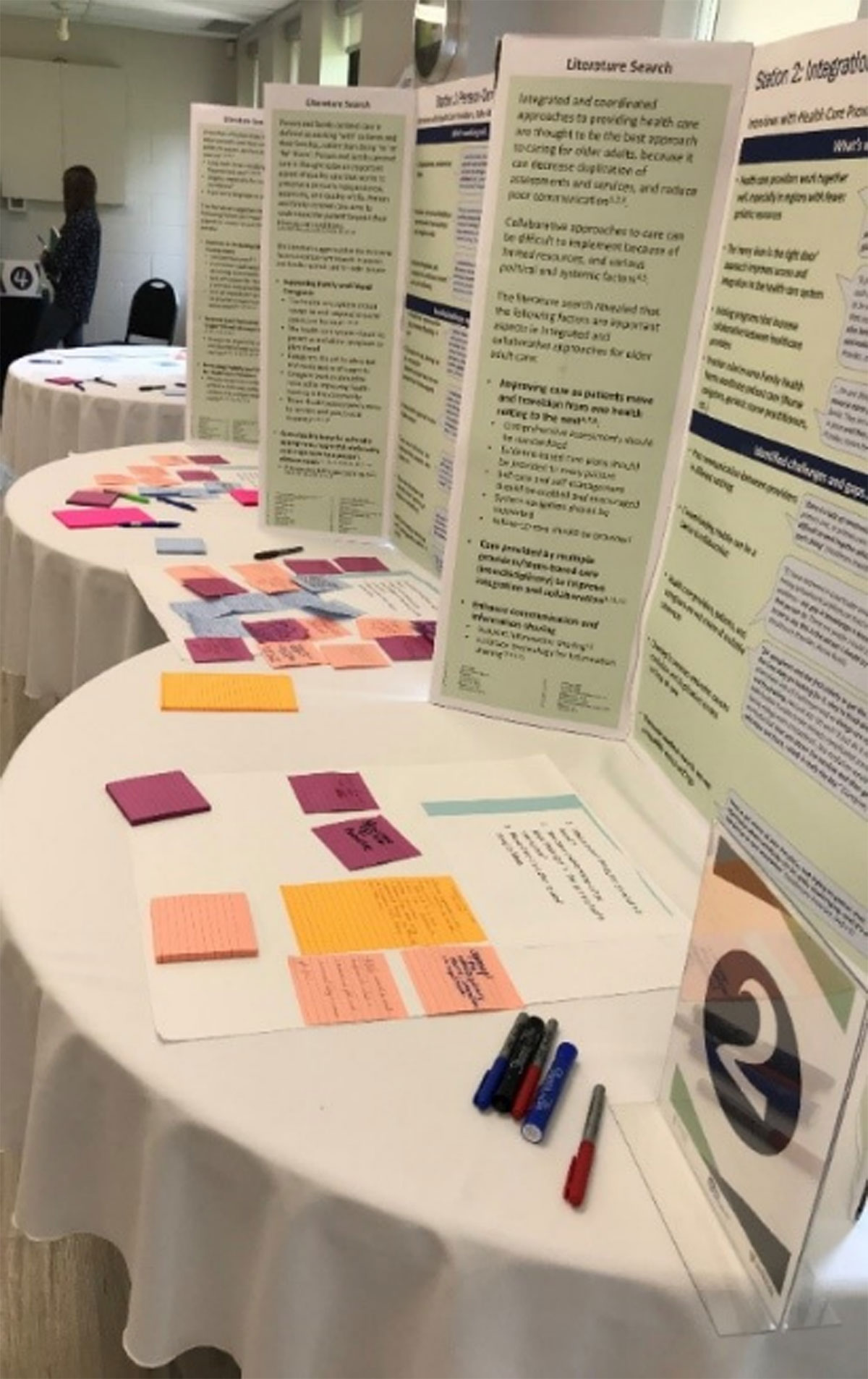
Figure 1
Community consultation feedback fair stations.
Table 3
Recommendations for the regional frailty strategy.
| RECOMMENDATION | SPECIFIC ACTIONS |
|---|---|
| Promote care that is flexible based on the patient’s individual needs | Patients’ cognitive ability, needs and preferences should be considered when providing care; especially during care transitions |
| Improve education for caregivers and patients | Provide one clear resource for caregivers and patients to access information about programs and services; ensure this highlights which services accept self-referrals |
| Increase access to primary and specialized care for older adults across the region | Expand the opportunities for geriatric specialists to work within and across the region; this may require a plan to attract and retain Consider how existing nurses and nurse practitioners can improve timely access to care |
| Continue to leverage telemedicine and telehomecare technologies | Use of telehomecare evaluated at the local level (rural/underserviced communities) and based on individual need (e.g. mobility needs), as well as during transitions home from hospital |
| Develop localized geriatric teams in each sub-region | Each team should have a system to collaborate with primary care, home and community care, mental health support services and other community support services Expand the role of geriatric resource nurses |
| Build expertise and improve quality of geriatric care across healthcare providers | Develop a regional frail senior education plan; leverage existing educational materials and advocate for upstream changes to improve training in geriatrics |
| Improve transportation services in rural regions | Ensure older adults are able to access non-profit transportation that meets their accessibility needs |
| Improve integration of services across the care continuum | Develop a coordinated intake for all services for frail older adults within each sub-region |
| Improve alignment and integration of specialist care | Work towards a model of improved alignment and integration of resources (including geriatric psychiatry, geriatric medicine, and other specialists) to provide comprehensive specialist assessments |
| Develop innovative funding models for programs and services | Consult with healthcare providers to understand how funding could effectively incentivize collaboration and shared care |
| Improve health care information sharing technologies in the region | Consider a single patient chart that is accessible to all health care providers and community support services |
| Develop and use consistent language to describe services and roles | In consultation with stakeholders, including patients and caregivers, consistent language should be agreed upon and used throughout the region |
| Develop one clear information source for providers to access information about resources | Provide one number for patients/caregivers and providers to call, for each region, to receive assistance navigating and information about supports and services. Leverage existing websites to highlight this information |
| Expand support for patients and caregivers who are navigating through the system | Consider the use of system navigators and/or peer-support services |