
Table 1
Implementation stages of the NDIS and CM job titles.
| PHASE 1 PILOT STAGE 2013–2016 | FULL IMPLEMENTATION STAGE 2017–2019 | |
|---|---|---|
| CM jobs |
| 2017 1. Planner (office based) * 2. Local Area Coordinator (LAC) 3. Support coordinator 2019 additional jobs 4. Specialist connection 5. Specialist support coordinator |
| Employer organisations |
|
|
| Support coordinator funded through participant’s plan | The Support coordinator, Specialist connection and Specialist support coordinator are funded through participant’s plan | |
| Areas | Four states (out of seven states/territories) with pilot sites In NSW (Hunter and Nepean/Blue Mountains) | All Australian states/territories |
Table 2
The two phases of content analysis and steps.
| STAGE 1: PILOT AND ROLL OUT OF NDIS (2013–2017) | |||
|---|---|---|---|
| Adapted Mayring’s Qualitative Content Analysis Procedural Model* | |||
| CONTENT ANALYSIS PHASES | TASKS | DOCUMENTS | FURTHER INFORMATION |
| Step 1 Pre-determination of order and analytical units | Definition of the material and analysis of the situation of origin | Publicly available documents relating to the CM jobs in the NDIS including the LAC positions in NSW | Documents with an adequate definition of CM and/or description of the role or actions to be performed. |
| Formal characteristics of the material | Document categories: governing legislation; operational guidelines; general (service) information; job descriptions; job advertisements | CM job: titles include local area coordinator; support coordinator; case manager; planner | |
| Differentiation of sub-components and analytical units | Document analysis: A stepped level of segmentation for analysis. | Key phrases of definitions and CM interventions/activities extracted and grouped into efficient sub-categories, thereby reducing the whole text into core contents | |
| Step 2 1st targeted document search | Search of organisational websites and screening for exclusions | Document exclusions: Duplicates, documents not in English, documents published before 2012, Early childhood early intervention CM role (ECEI) | Document sources: NDIS; Ageing Disability and Home Care; St Vincent de Paul; Uniting, Social Futures |
| Step 3 Content analysis | Intra-document search and screening for exclusions | Document exclusion: inadequate content | Example: “the company hired a case manager”. |
| First level of content analysis – text extraction and semantic differentiation of components into sub-categories. | components into the efficient sub-categories of semantically distinct phases in the text across documents. | Example: Assesses the participant or refers for assessment | |
| Second level of content analysis Mapping the sub-categories to the CMTaxonomy main actions finalised by agreement (first two authors) | The sub-categories identified in the text where mapped to the main action categories in the taxonomy | Example: Category of assesses the participant or refers for assessment – is mapped to the CMTaxonomy action of ‘holistic assessment’. | |
| STAGE 2: FULL IMPLEMENTATION OF NDIS (2018–2019) | |||
| Step 2 2nd targeted document search | Search, exclusion, and content analysis | Key organisational websites Exclusions: Documents with an adequate definition of CM and/or description of the role or actions to be performed. | Document sources: St Vincent de Paul, Uniting and Social Futures. |
| Step 3 Content analysis | Intra-document search and screening for exclusions | Compared to the 2017 documents, for new or missing phrases to be identified. Only new phrases to be analysed. | Inadequate descriptors in job advertisements and job description for support coordination positions |
| First level of content analysis – text extraction and semantic differentiation of components into sub-categories. | Only new phrases were matched to efficient sub-categories | New phrase e.g., ‘gather information, implement, build and review plans’ | |
| Second level analysis – mapping to the CMTaxonomy main actions | Not possible for support coordination (x3) jobs | ||
[i] * Mayring, P. (2014); Hsieh, H. F., & Shannon, S. E. (2005).
Table 3
CMTaxonomy actions and definitions. Lukersmith, S (2017).
| MAIN ACTION | DEFINITION | |
|---|---|---|
| 1 | Engagement | Establish, develop, and maintain a relationship with the client. |
| 2 | Holistic assessment | Evaluating the client’s health condition, functioning, environment, behaviour, situation or need for intervention; to develop a comprehensive understanding of them, their perspective, and what is important to them. Includes: their strengths, capacity, performance and needs across domains in relation to health, participation in key life areas (education, work, social, cultural and civic life), well-being and the contextual barriers and facilitators; assessment for the purpose of identifying appropriate intervention(s) and planning interventions. Excludes: monitoring |
| 3 | Planning | Supporting the person to develop their individualised plan including setting goals and priorities, actions, responsibilities to achieve the goals and identify the supports needed (services and resources). |
| 4 | Education | Providing structured information to person and stakeholders in a manner conducive to improve knowledge about matters relevant to the client’s health condition, medical, or rehabilitation treatment, functioning, situation, or strategies |
| 5 | Training and skills development | Teaching, enhancing or developing skills through context-specific practice to stakeholders. Includes: providing information or reinforcing training strategies developed by others for skill development e.g., memory or anger management strategies. |
| 6 | Emotional and motivational support | Providing the person (family and others as appropriate) with comfort, empathy or motivational support Includes: supportive communication (without using theory-based methods) to find strategies to solve or alleviate difficulties arising from their daily demands of life and situation; assisting, encouraging, and reinforcing the person (and family as appropriate) to build independence, make decisions, exercise choice and responsibilities, take actions, and support the client’s and family’s adjustment to changed circumstances |
| 7 | Advising | Recommending a course of action to be followed, to encourage a change of functioning, environment, attitude, or behaviour in relation to health, goals, or risks. Excludes: counselling and psychotherapy |
| 8 | Coordination | Navigating and facilitating the access, management, and cohesion of services and supports for the client. |
| 9 | Monitoring | Continuous acquisition of information to evaluate the client’s health condition, functioning, environment, behaviour, or situation over a defined period, to be able to determine their progress, anticipate or identify problems, additional goals or activities and modify plan and services as appropriate. |
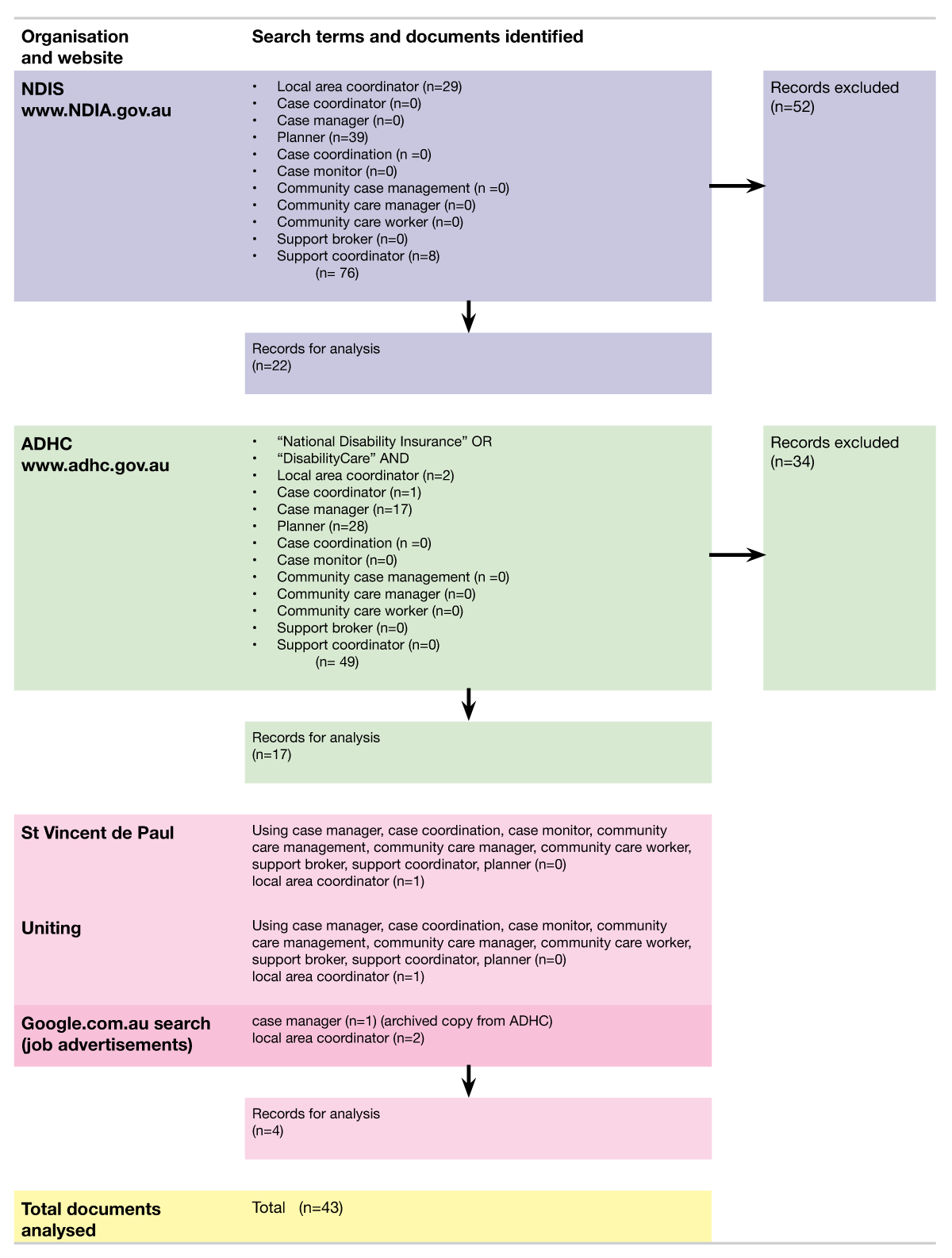
Figure 1
Search strategy and results.
Table 4
Categories of analysed documents.
| DOCUMENT CATEGORY | DOCUMENTS ANALYSED 2017 | DOCUMENTS ANALYSED 2019 |
|---|---|---|
| Governance documents | 3 | 0 |
| general (service) information | 21 | 0 |
| Operational/practice guides | 14 | 2 |
| job descriptions | 2 | 7 |
| job advertisements | 3 | 3 |
Table 5
Content extraction and analysis sub-categories.
| SUB-COMPONENT CATEGORIES (N = 24) | ||
|---|---|---|
| Provides support to implement plan | Develops goals for the next plan/reviews current plan | Assesses the participant or refers for assessment |
| Navigates, finds, connects, links with community supports | Investigates additional training/education options | Collates information to share with the team/completes compliance reporting |
| Provides technical support | Communicates any issues/barriers to stakeholders and implements solutions/strategies and problem solves | Educates external providers to enhance their ability to include individuals with disability |
| Explains how to identify options for further supports and priorities | Make decision/provides decision making support about needs and goals for completing plan | Coordinates the external services providers |
| Teaches how to enter service agreements | First point of person contact | Engages in activities to support ongoing development of the role |
| Maintains supports and has ongoing communication with participant | Discusses future long-term goals | Promotes inclusion and participation in the community |
| Monitors achievement of goals | Identifies risks and safeguards | Encourages changes in societal beliefs and disability |
| Explains the plan and provides information/answers questions | Assists with scheduling appointments and services | Advocates for human rights |
Table 6
Content analysis to CMTaxonomy categories – main actions.
| CMTAXONOMY MAIN ACTIONS | |||||||||
|---|---|---|---|---|---|---|---|---|---|
| SUB-CATEGORIES OF SEMANTICALLY DIFFERENT PHRASES (N = 24) | ENGAGEMENT | HOLISTIC ASSESSMENT | PLANNING | EDUCATION | TRAINING AND SKILLS DEVELOPMENT | EMOTIONAL AND MOTIVATIONAL SUPPORT | ADVISING | COORDINATION | MONITORING |
| Provides support to implement plan | ✓ | ✓ | ✓ | ✓ | ✓ | ||||
| Navigates, finds, connects, links with community, supports | ✓ | ||||||||
| Provides technical support | ✓ | ||||||||
| Explains how to identify options for further supports and priorities | ✓ | ✓ | ✓ | ✓ | ✓ | ||||
| Teaches how to enter service agreements | ✓ | ||||||||
| Maintains supports and has ongoing communication with participant | ✓ | ✓ | ✓ | ||||||
| Monitors achievement of goals | ✓ | ||||||||
| Explains the plan and provides information/answers questions | ✓ | ✓ | ✓ | ✓ | |||||
| Develops goals for the next plan/reviews current plan | ✓ | ||||||||
| Investigates additional training/education options | ✓ | ✓ | |||||||
| Communicates any issues/barriers to stakeholders and implements solutions, strategises and problem solves | ✓ | ✓ | ✓ | ✓ | |||||
| Make decisions/provides decision making support about needs and goals for completing plan | ✓ | ✓ | ✓ | ||||||
| First point of client contact | ✓ | ||||||||
| Discusses future long-term goals | ✓ | ✓ | |||||||
| Identifies risks and safeguards | ✓ | ✓ | |||||||
| Assists with scheduling appointments and services | ✓ | ||||||||
| Assesses the participant or refers for assessment | ✓ | ||||||||
| Collates information to share with the team/completes compliance reporting | ✓ | ||||||||
| Educates external providers to enhance their ability to include individuals with disability | ✓ | ✓ | |||||||
| Coordinates the external service providers | ✓ | ||||||||
| Engages in activities to support ongoing development of the role | |||||||||
| Promotes inclusion and participation in the community | |||||||||
| Encourages changes in societal beliefs of disability | |||||||||
| Advocates for human rights | |||||||||