
Table 1
Keywords used in the review.
| FIELD | CO-DESIGN/CO-CREATION TERM | TARGET GROUP |
|---|---|---|
| Health (care) Health and care Social (care) Care services/care pathways value in care Digital health solutions | • Co-design • Co-creation • Contribution | • Patient(s) • Health & social professionals • Health & social managers • Families • Policy makers |
| Healthcare services | Working with Involving | |
| Health care services | Accessibility | |
| Value in care | Expectation | |
| Sustainability of health- care services | Mutual understanding | |
| Value in care | Empowerment |
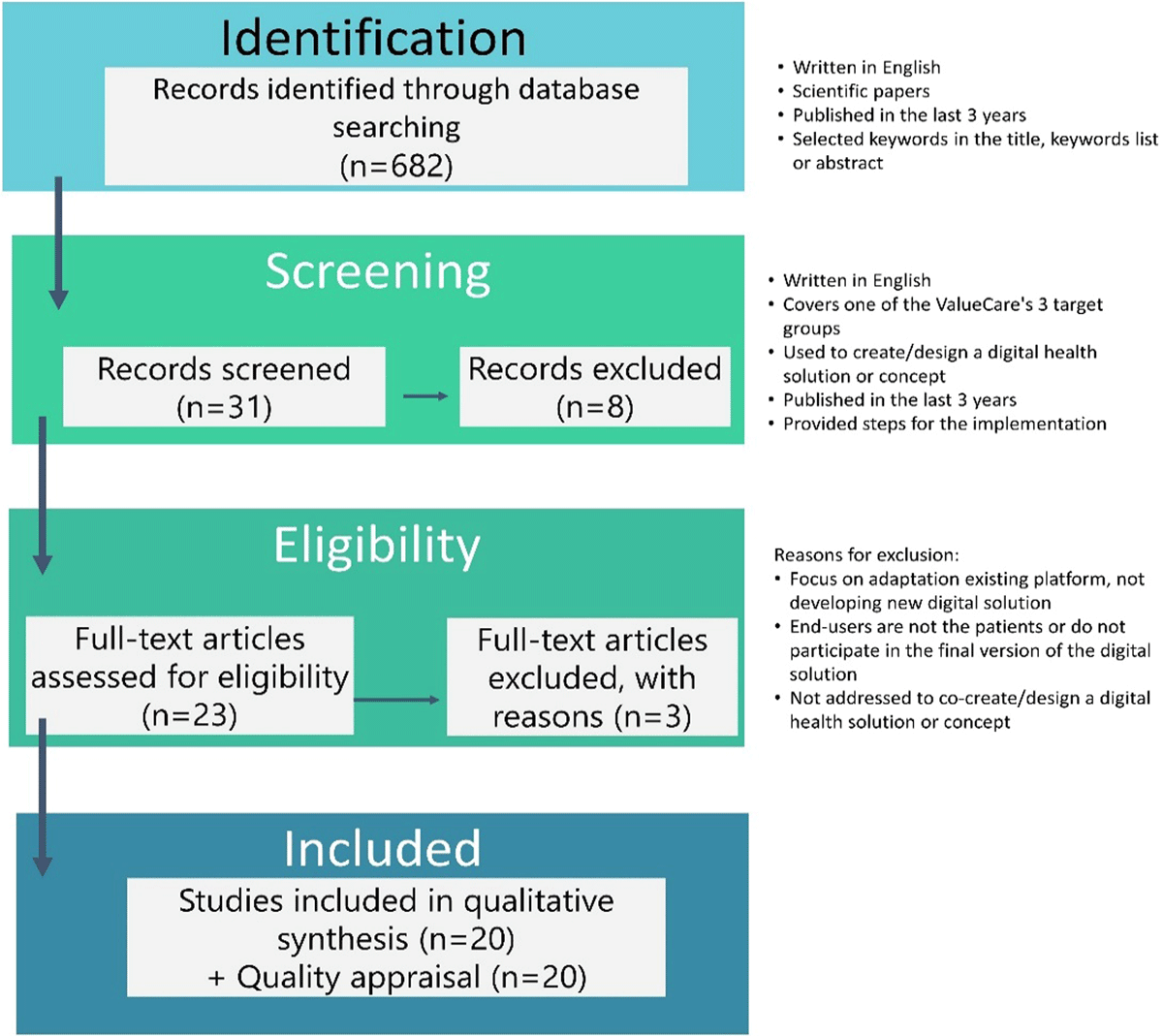
Figure 1
Literature review: adaptation from the PRISMA flow chart.
Table 2
Studies included in the review.
| PAPER TITLE | AUTHOR | YEAR | TARGET PATIENT/POPULATION GROUP | NUMBER OF PARTICIPANTS | CO-DESIGN ACTIVITY | DIGITAL SOLUTION BEING CO-DESIGNED | EVALUATION OF THE CODESIGN PROCESS |
|---|---|---|---|---|---|---|---|
| Implementing cardiovascular disease prevention guidelines to translate evidence-based medicine and shared decision making into general practice: theory-based intervention development, qualitative piloting and quantitative feasibility | Bonner et | 2019 | Health professionals | Small group meetings | Website for GP guidelines, and piloting of a new risk patient calculator/decision aid to help GPs to identify guidelines recommendations for medication and lifestyle change and communicate this to patients. | The co-design process shows how GP and patient feedback can be incorporated into intervention design, but the timeframe required for this process meant that the qualitative analysis was pragmatic rather than formally thematic. | |
| 18 | Conference | ||||||
| 98 | Feasibility study | ||||||
| Health professionals and patients with cardiovascular disease | 10 professionals and 3 patients | Semi-structured interviews | |||||
| Digital health technology: factors affecting implementation in nursing homes Digital health technology: factors affecting implementation in nursing homes | Curtis & Brooks | 2020 | Manager, nurses, resident and relative | 1 manager, 2 nurses, resident and relative | Individual interviews | Digital health technology which includes digital algorithms and digital records | Workshops enabled participating nurses to co-create a three-step process that supported the effective implementation of digital health technology innovations, which have the potential to release staff time, improve quality of care, and have positive effects on staff recruitment and retention. From residents’ point of view, it allows to analyse the level of acceptance of technology in nursing homes. |
| Health professionals (nurses) | 10 | Workshops | |||||
| Pilot implementation of co-designed software for co-production in mental health care planning: a qualitative evaluation of staff perspectives | Farr et al | 2019 | Health professionals and managers | 15 professionals and 5 managers | In-depth interviews | Software forco-production in mental health care planning with interactive touchpoints involving service users. | – |
| Design and Development of a Context-Aware Knowledge-Based Module for Identifying Relevant Information and Information Gaps in Patients with Type 1 Diabetes Self-Collected Health Data. | Giordanengo et al | 2018 | Patients with diabetes | 5 | Workshop | Prototype for extracting relevant information and documenting information gaps from self-collected health data by patients using a context-aware approach. | – |
| Health professionals | 4 | Workshop | |||||
| Patients and health professionals | 9 | 2 facilitated workshops and a co-design workshop | |||||
| Patient-Clinician Co-Design Co-Participation in Design of an App for Rheumatoid Arthritis Management viaTelehealth Yields an App with High Usability and Acceptance | Grainger et al | 2017 | Patients and health professionals | 9 patients and 11 health professionals | Semi-structured interviews | App for Rheumatoid Arthritis management via Telehealth Yields | – |
| Patients with rheumatoid Arthritis | 16 | Interviews and online survey | |||||
| The TiM system: developing a novel telehealth service to improve access to specialist care in motor neurone disease using user-centered design. | Hobson et al | 2018 | Patient with Motor Neurone Disease (MND) and public involvement group | Workshops | Telehealth service in MND | Authors strongly recommended user-centred design including all those involved in the receipt and delivery of care whenever a new intervention or service is developed to increase the chances of success. | |
| Patients with MND and families | 1 patient and 1 relative | Semi-structured interviews | |||||
| Patients with MND, families and health professionals | 3 patients, 6 carers or ex-carers, and an MND specialist nurse. | Workshops | |||||
| Health professionals | 7 | Meetings | |||||
| Patient with MND and caregiver | Semi-structured interviews | ||||||
| Patients with MND, careers, health professionals | Testing | ||||||
| Creating Gameful Design in mHealth: A Participatory Co-Design Approach. | Jessen et al | 2018 | Patients with chronic conditions | 22 | Co-design workshops | mHealth self-management app | Participants were both engaged, creative, and voiced a wide range of ideas and requirements; although much of the reported input and ideas were in line with previous research, it provided important contextualization and nuance to these design choices from the users’ perspective. |
| Design and Development of a Person-Centered Patient Portal Using Participatory Stakeholder Co-Design. | Kildea et al | 2019 | Patients with cancer | 361 | Survey | Person-Centred Patient Portal | As project matured, and more and more stakeholders were engaged, authors noticed an increase in the acceptance by clinical staff of the concept of sharing personal health information with patients |
| 3 patients | Focus groups | ||||||
| 5 members of the patient’s committee | Focus groups | ||||||
| Health professionals | 6 | Meetings | |||||
| Presentations | |||||||
| Patients with cancer and families | 10 | End-user testing | |||||
| Technology-Enabled Person-Centered Mental Health Services Reform: Strategy for Implementation Science | LaMonica et al | 2019 | Health professionals and managers | Survey, semi-structured interviews and workshops | Technology-Enabled Person-Centred Mental Health Services | ||
| Patients with mental disorders and health professionals | User-testing | ||||||
| Implementing an Antibiotic Stewardship Information System to Improve Hospital Infection Control: A Co-Design Process | Maia et al | 2018 | Health professionals | Survey and interviews | Antibiotic Stewardship Information System | The close collaboration of stakeholders under a participative approach, was the baseline for a successful implementation. | |
| Development of an mHealth platform for HIV Care: Gathering User Perspectives Through Co-Design Workshops and Interviews. | Marent et al | 2018 | Patients living with HIV and health professionals | 97 patients and 63 health professionals | Co-design workshops | mHealth platform for HIV Care | This process allowed authors to better understand how clinicians and patients were approaching, imagining, and anticipating what the platform could do for HIV care. The co-design approach enabled authors to facilitate early engagement in the mHealth platform, enabling patient and clinician feedback to become embedded in the development process at a pre-prototype phase. |
| Semi-structured interviews | |||||||
| Optimising eHealth tools for older patients: Collaborativeredesign of a hospital website. | Nguyen et al | 2018 | Multi-stakeholder related with patients with colorectal cancer | 10 | Prototype testing | Hospital website | |
| Co-designing technology with people with dementia and their carers: Exploring user perspectives when co-creating a mobile health application. | O’Connor | 2019 | Patients with dementia and families | 2 patients and 2 relatives | in-depth interviews | Mobile health application | According to the authors, more participatory methods to create health applications could help patients and carers as they are not often involved in co-producing technology that meets their needs |
| Manager and IT expert | 1 manager and 1 IT expert | in-depth interviews | |||||
| Co-Designing an eHealth Service for the Co-Care of Parkinson Disease: Explorative Study of Values and Challenges. | Revenäs et al | 2018 | Patients with Parkinson disease and health professionals | 7 patients and 9 health professionals | Co-design workshops | eHealth Service for the Co-Care of Parkinson Disease | Authors concluded that co-design is not mainly about creating new services, but it is about improving current practices to shape better care. Thus, they realised that co-design is only a phase in the cocreation and coproduction of better health care, and its potential can only be realised if the generated ideas are implemented in practice. |
| Participatory implementation of an antibiotic stewardship programme supported by an innovative surveillance and clinical decision-support system. | Simões et al | 2018 | Health professionals | Problem identification (observation) and meetings | Antibiotic stewardship programme supported by an innovative surveillance and clinical decision-support system | ||
| A Collaboration Between Game Developers and Rehabilitation Researchers to Develop a Web-Based App for Persons With Physical Disabilities: Case Study | Terrill et al | 2019 | Rehabilitation researchers, software development, people with physical disabilities andclinicians | Design box | Web-Based App for Persons with Physical Disabilities | Authors recognised that engaging stakeholders and end-users early and regularly from initial design ideas to prototype testing is critical. This foster mutual understanding that facilitates coherence within the project while supporting unique professional identities and responsibilities. In fact, it allows synergies in interdisciplinary collaborations that result in better ideas, questions, and solutions than by any one single discipline. | |
| Multi-stakeholder | User-testing | ||||||
| A web-based program to improve treatment adherence in patients with type 2 diabetes: Development and study protocol. | Vluggen | 2018 | Patients with diabetes, health professionals and IT experts | Program committee | Web-based program to improve treatment adherence | The involvement of relevant stakeholders was an essential element in the development of our computer-tailored program and the subsequent design of the trial. | |
| Conceptual Design and Iterative Development of a mHealth App by Clinicians, Patients and Their Families | Woods et al | 2018 | Health professionals | Prototype testing | mHealth App | Using participatory design processes allowed for the inclusion of diverse perspectives from different stakeholders into the product’s features and functions. According to the authors, accurate, evidence-based and validated mHealth apps, if designed with a balance of consumer and provider input, can be safely used at home. | |
| Design Thinking for mHealth Application Co-Design to Support Heart Failure Self-Management. | Woods et al | 2017 | Patients with heart failure and families | Ethnographic interviews | mHealthApplication | Authors concluded that the systematic design process provides a robust evidence-base for their speciality in health technology design for the advancement of patient-centred care. | |
| Patients with heart failure | 12 | Interviews | |||||
| Co-Design of a Mobile Health App for Heart Failure: Perspectives from the Team | Woods et al | 2019 | Health professionals, patients with heart failure and family | 11 | Interviews | Mobile Health App | Analysis of stakeholders’ accounts of the co-design process has enabled a deeper understanding of the strengths and weaknesses in operationalising co-design. As conclusions, authors stated that co-design can be achieved with a sincere partnership between staff and consumers. The findings suggested that managing stakeholders throughout the design is key to the project’s success. |
| Multi-stakeholder | 7 health professionals, 7 patients and 4 caregivers | Design workshops | |||||
| Prototype |
Table 3
Overview of the literature review results by target group.
| TARGET | CO-DESIGN ACTIVITIES | NUMBER OF PAPERS |
|---|---|---|
| Patients (and their caregivers) | Surveys, interviews, focus groups, workshops and testing sessions | 10 papers |
| Health and social practitioners | Interviews, meetings, presentations, observation, workshops, survey and user-testing sessions | 11 papers |
| Managers | Interviews | 2 papers |
| Multi-stakeholder target groups | Interviews, workshops, feedback sessions, meetings, design box session, presentations | 9 papers |
Table 4
Overview of co-design activities and target groups involved in the included studies.
| PATIENTS (AND CAREGIVERS) | PATIENTS AND HEALTH PROFESSIONALS | |||
|---|---|---|---|---|
| Interviews | In-depth interviews with people with dementia and their caregivers [18] | Meetings | 3 meetings during 18-months process of programme developed [32] | |
| Survey and interviews | Survey and semi-structured interviews with patients and health professionals [15] | |||
| Only health professionals | Interviews and workshops | Semi-structured interviews with patients, and combination of workshops with patients, health professionals and mixed [16] | ||
| Observation, meetings and interviews | Semi-structured interviews, 4-hours observation and meetings [23] | Survey, focus groups and presentations | ||
| Interviews | In-depth interviews [24] | |||
| Patients, health professionals and managers | ||||
| Interviews and workshops | Interviews with residents in nursing homes, nurses, and managers, and 2 workshops with nurses [20] | Interviews, meetings, and presentations | ||
| Patients and professionals’ stakeholders (health professionals, researchers, managers, policy makers) | ||||
| Meetings | Multidisciplinary consensus meetings [31] | |||
| Survey, semi-structured interviews, workshops, user-testing | Ongoing feedback from service staff is collected via online surveys, semi-structured interviews, and workshops to evaluate and monitor the impact of embedding the technology solution. Staff and consumers feedback about existing and newly functionalities are collected with quarterly user testing sessions. Interviews with patients, nurses, and managers of nursing homes and 2 workshops with nurses [22] | |||
| workshops | Series of workshops from the idea generation to the consensus regarding the features and functions of the wireframes plus Ethnographic interviews with patients [19] | |||
| Design box | The needs and key elements of the app were discussed. Then, the prototype was developed and later tested by users to identify errors and gather feedback on usability and accessibility [33] | |||