
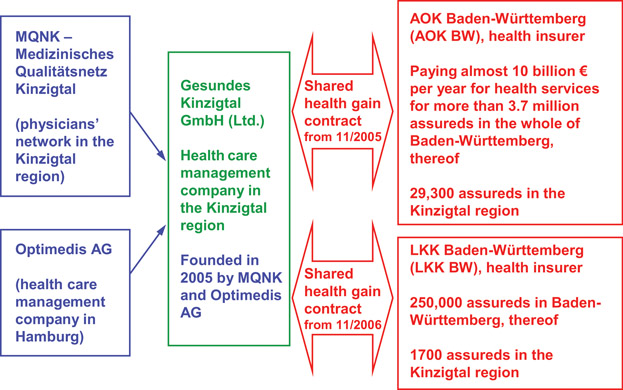
Figure 1.
Corporate structure of the Kinzigtal shared health gain contract.
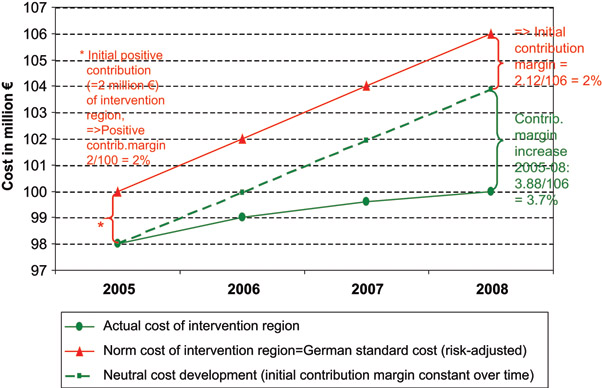
Figure 2.
Calculation model of an integrated care management company's financial results within the framework of a health insurers' contribution margin analysis—model case I: increasing contribution margin after the start of the intervention in 2006 (figures are fictitious—for demonstrational purpose only).
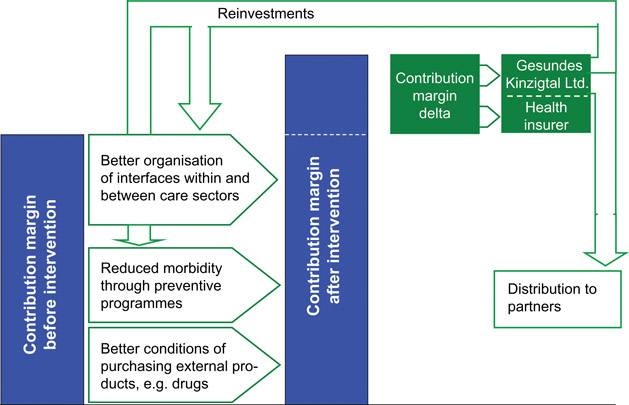
Figure 3.
Financial architecture of the Kinzigtal shared health gain contract.
Table 1.
Care management and preventive programmes in Gesundes Kinzigtal Integrative Care
| Subject/name of the programme | Year of implementation | Number of patients enrolled in the programme (as of May 2010) |
|---|---|---|
| Chronic heart failure (‘Starkes Herz’) | 2006 | 67 |
| Lifestyle intervention for patients with metabolic syndrome (‘Gesundes Gewicht’) | 2007 | 122 |
| Smoking Cessation Programme (‘Smoke-free Kinzigtal’) | 2007 | 128 |
| Active health promotion for the elderly (‘AGil’) | 2007 | 511 |
| Intervention by psychotherapists/psychiatrists in case of acute personal crises (‘Psychotherapie akut’) | 2007 | 126 |
| Prevention of osteoporosis/osteoporotic fractures (‘Starke Muskeln, feste Knochen’) | 2008 | 455 |
| Social case management (‘sozialer Dienst’) | 2008 | 78 |
| DMP diabetes mellitus type II | 2006 | 830 |
| DMP coronary heart disease | 2007 | 288 |
| DMP breast cancer | 2006 | 18 |
| DMP asthma | 2008 | 100 |
| DMP COPD | 2008 | 154 |
| Patient university | 2007 | 1.070 |
| Medical care for the elderly in nursing homes (‘ÄrztePlusPflege’) | 2009 | 124 |