Have a personal or library account? Click to login
Service Delivery Reforms for Asian Ageing Societies: A Cross-Country Study Between Japan, South Korea, China, Thailand, Indonesia, and the Philippines Cover

Service Delivery Reforms for Asian Ageing Societies: A Cross-Country Study Between Japan, South Korea, China, Thailand, Indonesia, and the Philippines

Open Access
|Apr 2021

Figures & Tables

ijic-21-2-4739-g1.png
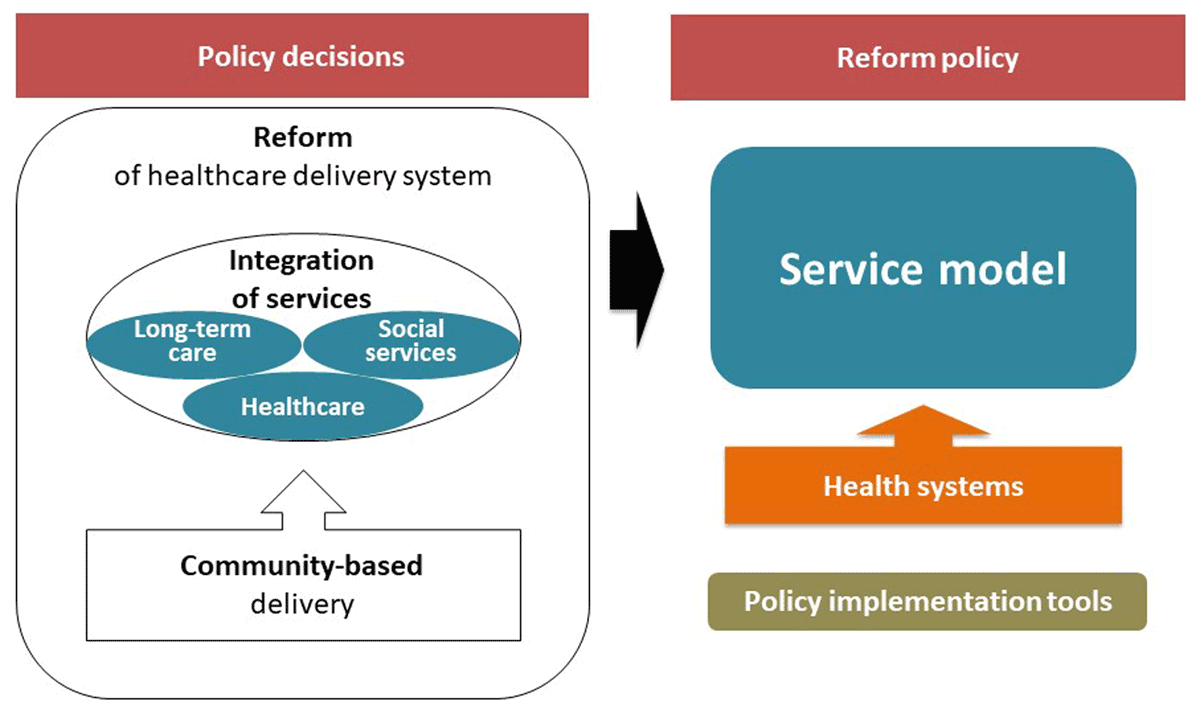
Figure 1

A conceptual framework developed to compare policies.

Table 1

Question items.

ASPECTSAREASNO.QUESTION ITEMS
Policy decisionsReformItem 1Is there any policy decision to reform current healthcare service delivery system to adapt to the ageing society?
IntegrtionItem 2Does the healthcare service reform policy aim at integration of healthcare and long-term care?
Does it aim at integration of healthcare and welfare services?
Community-basedItem 3Does it aim at more community-based care?
Reform policyService modelItem 4Name of service delively model
Item 5Services
(What kind of services are provided through the model?)
Item 6Unit of a service delivery system
(Geopgraphical area in which a delivery system of the model is established. E.g. adminisrative unit, school unit, etc)
Item 7Models referred
(Which service delivey models were used as a reference to develop the service delivery model?)
Item 8Who developed the model?
Health systemsItem 9Type of financial source for the services
Self help: individual & family, Mutual help: informal network based on locality or co-belongingness, Social solidarity: insurance, Public assistance: tax [22]
Item 10New special heatlh workforces introduced for the model
Item 11New special other workforces introduced for the model
Item 12New information system introduced for the model
Item 13New coordination mechanism introduced to facilitate collaboration between health care service providers and welfare service providers
Policy implementation toolsItem 14Name of the policy document to introduce the model
Item 15Issuing body/institution
Item 16Date of officially approved
Item 17Policy goal
Item 18Policy objective
Item 19Policy timeframe
Item 20Name of the strategies
Item 21Name of the laws or decrees
Item 22Name of the program
Item 23Source of finance for the program
Item 24Incentive to implement the policy
Item 25M&E system to check implementation status of the policy
Table 2

Policy decisions on reform of healthcare delivery.

QUESTION ITEMSJAPANKOREATHAILANDCHINAINDONESIAPHILIPPINES
Is there any policy decision to reform current healthcare service delivery system for ageing?YesYesYesYesYesNo
Does it aim at integration of healthcare and long-term care?YesNot yetYesYesYesNot applicable
Does it aim at integration of healthcare and welfare services?YesYesYesYesYesNot applicable
Does it aim at more community-based care?YesYesYesNoYesNot applicable
Table 3

Services covered by delivery models in Asian countries.

COUNTRYDELIVERY MODELSERVICES COVERED BY THE MODEL
JapanCommunity-
based integrated care systems
  1. Home healthcare system

    1. Medical care provided in collaboration with varioushealthcare cadres;

    2. palliative care

    3. family support

    4. homecare arrangement support

    5. emergency home visit

    6. hospitalisation

    7. home terminal care

    8. terminal care at long-term carefacilities

  2. Long-term in-home care

    1. Home visiting long-term care

    2. home visiting nursing care

    3. day-care centre

    4. multifunctional long-term care services in a small group home

    5. short-term in-patient care

    6. welfare equipment

    7. 24-h in-home care service

    8. combined service of home visiting nursing care and short-term in-patient care

  3. Facility-based long-term care

    1. Nursinghome

    2. health facility

    3. sanatorium-type medical care facility

    4. group home

  4. Preventive long-term care

  5. Livelihood support

KoreaReach in g-Out Community Service Centre
  1. Welfare service: integrated welfare services

    1. Identifying welfare blind spots

    2. reaching-out servicesof welfare counselling (integrated case management, connection to necessary services, application to receive subsidies/benefits)

    3. integrated case management (childbirth/parenting, poverty caring, crisis family, elderly >65 years)

    4. searchingand investigating resource (local welfare community composition)

  2. Visiting nursing service

    1. Visiting nursing (visiting health check-up, health counselling)

    2. primary prevention activities (health education, exercise education, disease prevention activities, health programmes)

    3. association with medical institutions through ‘301 Network’, introducing the client to the public hospital

ThailandHome care model
  1. Continuous medical care service fromhospitalto community

    1. Services that support long-term care

    2. nursing system

    3. treatments for significant chronic diseases (hypertension, diabetes mellitus, cardiovascular disease)

    4. community-based volunteers

    5. support to caregivers

  2. Social services forthe elderly in the community

Collaboration with the elderly club and the elderly school for prevention activities
ChinaIntegrated health and social careAtlong-term care facilities or the service area for acommunity health centre
  1. Social care

    1. Daily life care

    2. spiritual consolation, and

    3. cultural activities

  2. Healthcare

    1. Medicalconsultation

    2. preventr/e health seivice

    3. health e<amination

    4. disease diagnosis and management

    5. rehabilitative service; and

    6. hospice care

IndonesiaCommunity service centre for elderly (Posyandu lansia, Pos pelayanan terpadu, Puskesmas santun lansia)
  1. Community service centre provides comprehensivecoverage of health mobile team services for elderly resident communityin a village

    1. Posyandu lansia

    2. Posbindu

  2. Protection and activities: main rehabilitation

    1. Regular nursing home: fulfilment of basic needs of elderly people living in a care home

    2. Day care: actualisation of elderly people living alone or with family via activities at the institution

    3. Home care: fulfilment of basic needs and mentoring neglected elderly

    4. KUBE/UEP (Kelompok Usaha Bersoma/Usaha Ekonomi Produktif): A government program which empowers poor groups providing business capitaVProductive economic enterprises increase in income and elderly income that can be earned by productivity

    5. ASLUT (Asistensi Social untuk Lanjut Usia Telantar): social assistance for neglected elderly

The PhilippinesThere is no health service reform specific for elderly care; however, the following services are provided by the government
  1. Home healthcare system

    1. Medical care provided in collaboration with varioushealthcare cadres

    2. palliative care

    3. family support

    4. homecare arrangement support

    5. emergency home visit

    6. hospitalization

    7. home terminal care; and

    8. terminal care at long-termcare facilities

  2. In-home long-term care provided by thelocal government unit (i) Home visiting long-term care andhome visiting nursing care

  3. Facility-based long-term care viaresidential care facilities managed by the Ministry of Social Welfareand Development

  4. Livelihood support as provided by the Ministry ofSocial Welfare and Development via the Senior Citizen Centre

Table 4

Building blocks of the health systems that are introduced for implementation of the models.

COUNTRYTYPE OF FINANCIAL SOURCESNEW SPECIAL WORKFORCESNEW INFORMATION SYSTEMSNEW COORDINATION MECHANISMS
Japan
  1. Self-help (individual and family)

  2. mutual help(informal network based on locality orco-belongingness)

  3. social solidarity(health and long-term care insurances)

  4. public assistance

Livelihood support coordinatorThere is not a single standardised network system of patient and in-home care information, which is expected to facilitate information sharing among different care providers. However, many municipalities introduced a unique cloud-based network by themselves
  1. Technical working group for individual cases,

  2. working group to identify common problems at community level,

  3. working group for policy formulation at municipal level

Korea
  1. Public assistance (Ministryof Health and Welfare and Seoul Metropolitan Government Budget)

  2. Joint fund

  3. Private resources (religious, educational, civic qroups. etc.)

None
  1. Using the existing welfare computer network,

  2. Scheduled to integrate information system between the Ministry of Health and Welfare and the Seoul Metropolitan City

  1. Work with welfare serviceproviders (social welfare officers) and visiting nurses (working at publichealth centres)

  2. In the case of public health centres

Thailand
  1. Mainly public assistance (tax for medical and welfare services, including prevention activities),

  2. social solidarity (Health insurances)

  3. Tambon Health Fund by the National Health Security Office

  4. Self-help (Out of pocket)

Elderly caregiverNone (theThai government plans touse the individual identification number to facilitate sharing of information, including medical records and income, welfare service usage, but thisis not only introduced forth is model)The National Commissionon the Elderly underthe cabinet and new Ministry of SocialDevelopment and Human Security
China
  1. Mainly self-help (individual and family)

  2. social solidarity (insurance),

  3. public assistance (tax) Seldom mutual help (informal network based on locality or co-belongingness)

NoneThe central policies encourage local governments to establish asingle information systemto facilitate information sharing among different care providers, but it is not mandatory. Some companies establish such informationsystems by themselves
  1. collaboration contract between health and social care facilities for institutionalised persons and health and social care union;

  2. social care institutions to setup hospitals and nursing homes, which make the coordination an internal issues;

  3. community health centre to provide in-home medical, nursing and rehabilitation service

Indonesia
  1. Self-help (out of pocket),

  2. social solidarity (Indonesia National Health Insurance),

  3. Public assistance (local government resources and Ministry of Social Welfare

None
  1. Using the existing welfare computer network with improvement for electronic-based reporting (in Puskesmas, e.g., e- posyandu)

  2. There is no new information system for client-oriented welfare services

None
The Philippines
  1. Self-help

  2. mutual help

  3. social solidarity

  4. public assistance through the Philippine Health Insurance Corporation

NoneNoneNone
DOI: https://doi.org/10.5334/ijic.4739 | Journal eISSN: 1568-4156
Language: English
Submitted on: Jul 19, 2019
Accepted on: Jan 19, 2021
Published on: Apr 6, 2021
Published by: Ubiquity Press
In partnership with: Paradigm Publishing Services
Publication frequency: 4 issues per year

© 2021 Shinichiro Noda, Paul Michael R. Hernandez, Kyoko Sudo, Kenzo Takahashi, Nam Eun Woo, He Chen, Kimiko Inaoka, Emiko Tateishi, Wahyu Sulistya Affarah, Hamsu Kadriyan, Jun Kobayashi, published by Ubiquity Press
This work is licensed under the Creative Commons Attribution 4.0 License.