
Table 1
Definitions of SUSTAIN’s key domains.
| Person-centredness | Involve older people and their informal carers in decision-making and planning their care process in order to tailor the delivery of care and support as much as possible to individual needs, preferences and capabilities, taking into account socio-demographic factors, cultural backgrounds and gender [3536]. |
| Prevention orientation | Preserve and promote the health and wellbeing of older people with multiple needs by preventing deterioration in existing conditions, and providing active support to help them to maintain and regain as much autonomy, independence and resilience as possible, and to make optimal use of individual resources [37]. |
| Safety | Prevent adverse outcomes of care (e.g. drug related problems, unnecessary hospitalisations and admissions in long-term care institutions), decrease preventable decline in health status (e.g. falls) and address treatment adherence [38]. |
| Efficiency | Affordability of interventions and effective use of infrastructure, resources for sustainability (e.g. hours of service and labour allocated to recipients) and equipment and technology (e.g. IT), and the extent to which interventions may be able to shift activity from acute services to primary care services, improve alignment between the care professionals involved and reduce waste in healthcare spending (e.g. unnecessary readmissions within 30 days) [3940]. |
Table 2
Characteristics of fourteen integrated care initiatives participating in the SUSTAIN project.
| Country | Region | Integrated care initiative | Type of care services |
|---|---|---|---|
| Austria | Vienna | Gerontopsychiatric Centre | Dementia care |
| Styria | Coordinated Palliative Care | Palliative care | |
| Estonia | Ida-Viru | Alutaguse Care Centre | Home nursing and rehabilitative care |
| Tallinn | Medendi | Home nursing | |
| Germany | Uckermark | KV RegioMed Zentrum Templin | Rehabilitative care |
| Berlin Marzahn-Hellersdorf | Careworks Berlin | Home nursing and rehabilitative care | |
| Norway | Surnadal | Surnadal Holistic Patient Care at Home | Home nursing and rehabilitative care |
| Søndre Nordstrand in Oslo | Søndre Nordstrand Everyday Mastery Team | Rehabilitative care and mastery of activities of daily living | |
| Spain | Osona | Severe Chronic Patients/Advanced chronic disease/Geriatrics Osona | Proactive primary and intermediate care |
| Sabadell | Social and health care integration Sabadell | Proactive primary care | |
| The Netherlands | West-Friesland | Geriatric Care Model | Proactive primary care |
| Walcheren | Walcheren Integrated Care Model | Proactive primary care | |
| United Kingdom | Kent | Over 75 Service | Proactive primary care |
| Kent | Swale Home First | Hospital discharge planning |
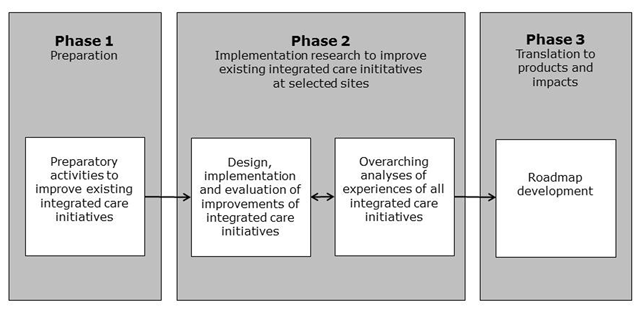
Figure 1
Three interrelated project phases of the SUSTAIN project.
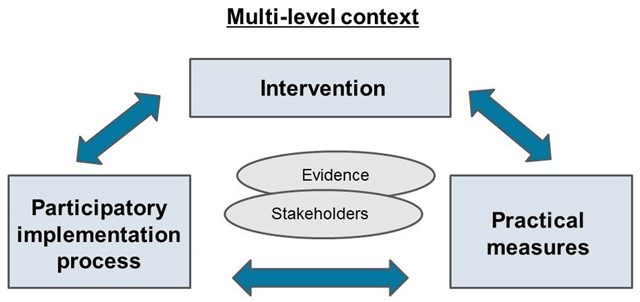
Figure 2
The Evidence Integration Triangle model (adapted) [42].
Table 3
Practical measures for monitoring outcomes and progress of the implementation of the improvement plans.
| Item | Data collection tool | Short description |
|---|---|---|
| Socio-demographics of older people (users) | Demographic data sheet – older people, administered to older people | Survey developed by SUSTAIN researchers requesting information on age, gender, education, marital status, living situation and self-reported medical conditions |
| Socio-demographics of informal carers | Demographic data sheet – carers, administered to informal carers | Survey developed by SUSTAIN researchers requesting information on age, gender, education, marital status, relationship and distance to older person (user), paid work and caregiving activities |
| Socio-demographics of professionals | Demographic data sheet – professionals, administered to professionals | Survey developed by SUSTAIN researchers requesting information on age, gender, nationality and occupation |
| Socio-demographics of managers | Demographic data sheet – managers, administered to managers | Survey developed by SUSTAIN researchers requesting information on age, gender, nationality and occupation |
| Person-centredness | ||
| Patient perceptions of quality and coordination of care and support | The Person Centred Coordinated Care Experience Questionnaire (P3CEQ) [43], administered to older people | Survey measuring older people’s experience and understanding of the care and support they have received from health and social care services |
| Proportion of older people with a needs assessment | Care plan template (in case sites do not work with care plans, information will be retrieved from clinical notes or other documentation) | Template developed by SUSTAIN researchers for predetermined content analysis of care plans of older people |
| Proportion of care plans actioned (i.e. defined activities in care plan actually implemented) | ||
| Proportion of care plans shared across different professionals and/or organisations | ||
| Proportion of informal carers with a needs assessment and/or care plan | ||
| Perception and experiences of older people, informal carers, professionals and managers with person-centredness | Semi-structured interviews and focus group interviews with older people, informal carers, professionals and managers | Interview and focus group schedules developed by SUSTAIN researchers including interview items on perception and experiences with receiving person-centred care |
| Prevention orientation | ||
| Perceived control in care and support of older people | Perceived Control in Health Care (PCHC) [37], administered to older people | Survey addressing older people’s perceived own abilities to organise professional care and to take care of themselves in their own homes, and perceived support from the social network |
| Proportion of older people receiving a medication review | Care plan template (in case sites do not work with care plans, information will be retrieved from clinical notes or other documentation) | Template developed by SUSTAIN researchers for predetermined content analysis of care plans of older people |
| Proportion of older people receiving advice on medication adherence | ||
| Proportion of older people receiving advice on self-management and maintaining independence | ||
| Perception and experiences of older people, informal carers, professionals and managers with prevention | Semi-structured interviews and focus group interviews with older people, informal carers, professionals and managers | Interview and focus group schedules developed by SUSTAIN researchers including interview items on perception and experiences with receiving prevention-oriented care |
| Safety | ||
| Proportion of older people receiving safety advice | Care plan template (in case sites do not work with care plans, information will be retrieved from clinical notes or other documentation) | Template developed by SUSTAIN researchers for predetermined content analysis of care plans of older people |
| Proportion of older people with falls recorded in the care plan | ||
| Perception of older people, informal carers, professionals and managers with safety | Semi-structured interviews and focus group interviews with older people, informal carers, professionals and managers | Interview and focus group schedules developed by SUSTAIN researchers including interview items on perception and experiences with receiving safe care, and safety consciousness |
| Efficiency | ||
| Number of emergency hospital admissions of older people | Care plan template (in case sites do not work with care plans, information will be retrieved from clinical notes or other documentation); template to register staff hours and costs | Template developed by SUSTAIN researchers for predetermined content analysis of care plans of older people; template developed by SUSTAIN researchers to collect data on costs and the number of staff hours from local services, organisations or registries |
| Length of stay per emergency admission of older people | ||
| Number of hospital readmissions of older people | ||
| Number of staff hours dedicated to improvement project | ||
| Costs related to equipment and technology for improvement project | ||
| Perception of older people, informal carers, professionals and managers with efficiency | Semi-structured interviews and focus group interviews with older people, informal carers, professionals and managers | Interview and focus group schedules developed by SUSTAIN researchers including interview items on perception and experiences with receiving efficient care, and finances |
| Team coherence of improvement team (professionals) | Team Climate Inventory – short version (TCI-14) [4445], administered to professionals | Survey measuring vision, participative safety, task orientation and experienced support for innovation of the improvement team |
| Perception and experiences of professionals | Focus group interviews with professionals and minutes from steering group meetings | Focus group schedule developed by SUSTAIN researchers including interview items on experienced factors facilitating and impeding outcomes and implementation progress |
| Minutes cover progress, issues and contextual issues impacting on outcomes and implementation progress | ||
| Perception and experiences of managers | Semi-structured interviews with managers and minutes from steering group meetings | Interview schedule developed by SUSTAIN researchers including interview items on experienced factors facilitating and impeding outcomes and implementation progress |
| Minutes cover progress, issues and contextual issues impacting on outcomes and implementation progress | ||