Have a personal or library account? Click to login
Integrated Health Care Barcelona Esquerra (Ais-Be): A Global View of Organisational Development, Re-Engineering of Processes and Improvement of the Information Systems. The Role of the Tertiary University Hospital in the Transformation Cover

Integrated Health Care Barcelona Esquerra (Ais-Be): A Global View of Organisational Development, Re-Engineering of Processes and Improvement of the Information Systems. The Role of the Tertiary University Hospital in the Transformation

Open Access
|May 2016

Figures & Tables

figures/Fig01_web.jpg
Figure 1

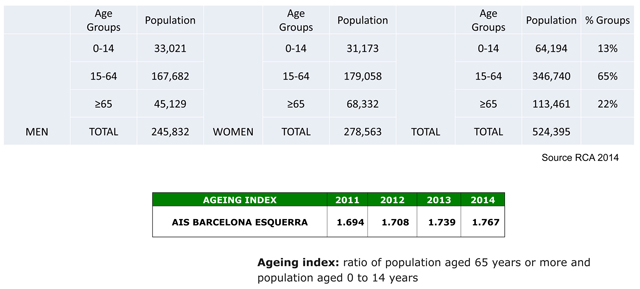
Population of the AIS Barcelona Esquerra (–).

Table 1

Main healthcare suppliers in the AIS Barcelona Esquerra.

Primary Care
  • Institut Català de la Salut: 13 teams

  • CAPSE: 3 teams

  • EAP Poble Sec: 1 team

  • EAP Sarrià-Vallplasa: 2 teams

Specialty Care
  • Hospital Clínic

  • Hospital Plató

  • Hospital Sant Joan de Déu

  • Hospital Sagrat Cor

Mental Health and Addictions
  • Hospital Clínic

  • Hospital Sant Joan de Déu SSM

  • Hospital Sant Pere Claver

  • Associació Centre Higiene Mental Les Corts

  • Agència Salut Pública de Barcelona

Social Health Care
  • Parc Sanitari Pere Virgili

  • Centre BlauClínic

  • Clínica Sant Antoni de Barcelona

  • Fundació Sociosanitària Barcelona

 
  • 33 Community Pharmacies

  • 4 Rehabilitation Centres

  • Emergency Services (Servei d’Emergències Mèdiques de Catalunya – SEM)

Table 2

Organisation of the AIS Barcelona Esquerra (AISBE).

Integrated Healthcare Committee Barcelona Esquerra (CAISBE)
  • Representation of the first management level of all suppliers involved.

  • 1–2 meetings a year

  • Monitoring the Strategic Plan and the main lines of work.

Standing Committee (SC)
  • Integrated Health Area “Barcelona Esquerra” (AIS-BE) Manager. Barcelona Health Consortium (CatSalut), Primary Care Manager of the Catalan Health Institute, CAPSE Manager, representative of each Hospital (Clínic, Plató, Sagrat Cor), Head of the Technical Office.

  • Fortnightly meetings.

  • Supervising execution of the plans and of the development of the work lines.

Technical Office (TO)
  • Staff of the Standing Committee comprising 3 professionals and support for professionals from the institutions

  • Co-ordination and methodological support for the different Committees

Operational Committees (OC)
  • Consisting basically of medical and nursing personnel of the institutions.

  • With a Co-ordinator for each Committee who reports to the TI and the SC.

  • Methodological support for the TO.

  • Proposals for improvements to organisation and processes, organising the role of each Hospital in relation with the Primary Care Teams both for the basic pathology and for tertiary care.

figures/Fig02_web.jpg
Figure 2

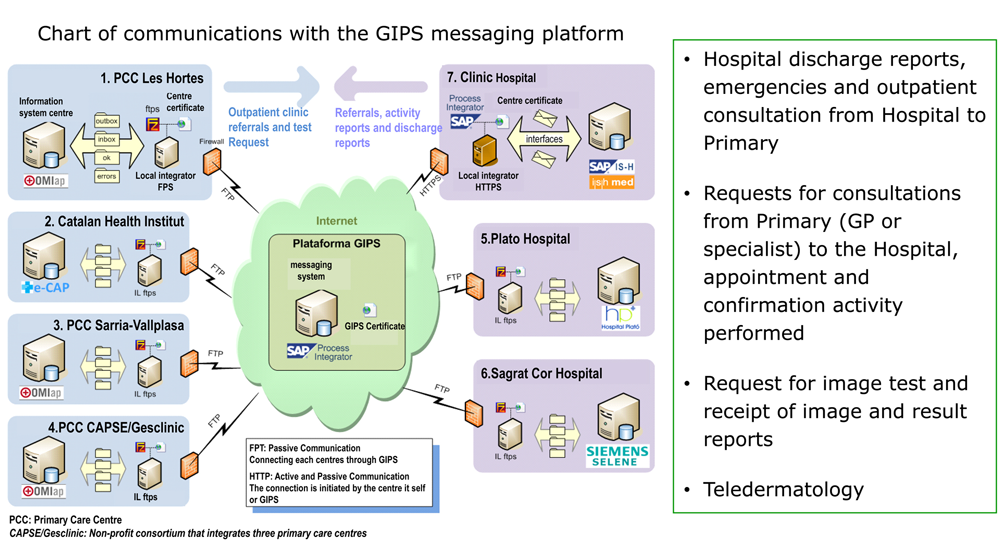
Interoperability platform and communication between the Information Systems of the suppliers of the AIS Barcelona Esquerr.

Table 3

Operational Committees of the AIS Barcelona Esquerra.

Mental Health and AddictionsLocomotor Apparatus
Chronic Patient CarePain Clínic
EmergenciesOncology and Haematology
CardiologyBreast Cancer
General SurgeryPalliative Care
Vascular SurgeryPrevention and Community Health
DermatologyEpidemiological Surveillance
DigestiveSexually Transmitted Infections
PneumologyTropical Medicinal
AllergyUlcers
NeurologyPharmacy
EndocrinologyAccessibility
OphthalmologyInformation Systems
Table 4

Main activities of the Endocrinology Operational Committee.

  • Definition of the role of primary care and the hospital by means of clinical pathways of the principal diseases.

  • Organisation of a single Day Hospital facility to deal with the endocrinological emergencies of the whole territory.

  • Implementation of case consultation sessions between GPS and endocrinologists.

  • Identification of a reference nurse in diabetes in each Primary Care Team.

  • Prioritising in drug prescription in a co-ordinated and integrated manner among the different care levels and suppliers.

  • Implementation of a diagnostic and treatment programme for type II Diabetes in onset phase prioritising the group therapeutic education of the patients.

  • Identification of uncontrolled diabetic patients in the territory and development of a co-ordinated intervention plan between the GP and the endocrinologist.

figures/Fig03_web.jpg
Figure 3

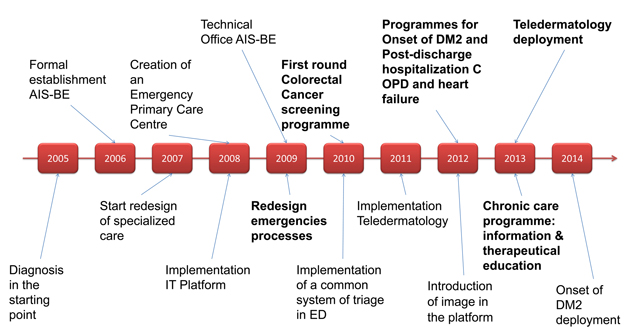
AIS-BE 2005–2016 10-year timeline key milestones.

Table 5

Evolution of Emergencies consultations in the Barcelona Esquerra AIS: Activity and complexity.

A) Activity (Number of visits)
TOTAL 2008TOTAL 2009TOTAL 2010TOTAL 2011TOTAL 2012TOTAL 2012 – 2008 Value %
Hospital Clínic145,868135,702124,721113,497103,991–41,877–28.71%
H. Sagrat Cor12,62313,74215,46116,69318,9146,29149.84%
H. Plató7,9539,2079,84712,29912,9645,01163.01%
Total Hospitals166,444158,651150,029142,489135,869–30,575–18.37%
CUAP Manso43,06759,17760,09063,63453,86710,80025.08%
Global209,511217,828210,119206,123189,726–19,785–9.44%
B) Evolution of the complexity level of the emergencies dealt with in the Hospital Clínic
200920102011
% level 4 and 5 emergencies (low complexity)54%38%32%
DOI: https://doi.org/10.5334/ijic.2476 | Journal eISSN: 1568-4156
Language: English
Published on: May 23, 2016
Published by: Ubiquity Press
In partnership with: Paradigm Publishing Services
Publication frequency: 4 issues per year

© 2016 David Font, Joan Escarrabill, Mónica Gómez, Rafael Ruiz, Belén Enfedaque, Xavier Altimiras, published by Ubiquity Press
This work is licensed under the Creative Commons Attribution 4.0 License.